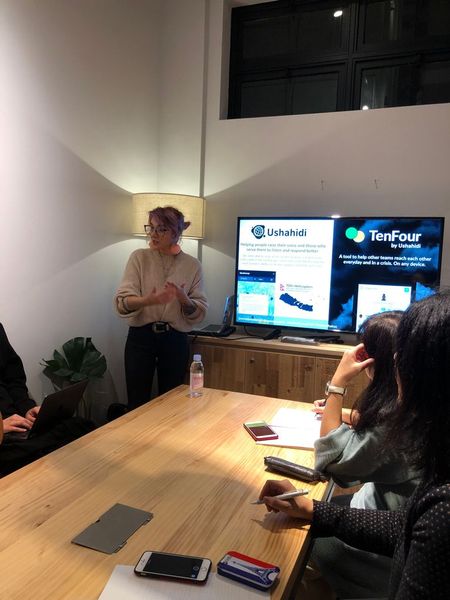
#Designers want to tackle big societal problems and contribute to #OpenSourceSoftware, but the current developer centred framework for creating #OSS makes this appear unattainable.
#MakeDesignOpen to make it better for all. https://t.co/DmCu8yFwp1
After a bit of a long first half of the 2020 year, there's an update in the Open Design repositories about the project! huzzah!
https://t.co/jgE46fVnQy
https://t.co/vd0NU6R4Wj
@ubong_mathew@figmadesign @theflaticon Also I would recommend adding this issue to the Open Source Design jobs forum for a designer interested in OSS contribution to do: https://t.co/VP5J5A4Bo1
@ubong_mathew@figmadesign @theflaticon That's a hard one for sure! It really depends on what the function of the icon is.
Sometimes more abstract icons are just as useful as a descriptive one. But abstract icon need to communicate the function.
Descriptive = A building + a figure with a tie/briefcase
@laurabalboa I would recommend joining the @opensrcdesign forum https://t.co/V18yPgLKOh
we talk about these issues and there are some folks there very deep into OSS design software and pushing this agenda forward.
Personally, I'm very excited for https://t.co/CdIfgy8H2a for version control!
@laurabalboa From within the TenFour/OSS and Open Design team we found this a healthy and encouraging view towards design in OSS so we wanted to pursue this for the first phase.
@laurabalboa There's also an aspect of Adobe XD's funding of the first phase of the project and their honest and genuine interest in how understanding how designers contribute to OSS through their products could improve design tooling + OSS + Design.
@laurabalboa We actually think that the OSS projects that need contribution should be leading the decision on how they receive their contributions and TenFour (our pilot project) used Adobe XD internally. So we used what they used.
@laurabalboa However we also understand that to include the larger design community that have no understanding of OSS we wanted to focus on the humanitarian OSS that needed contribution rather than the OSS tooling we used to contribute right then.
@laurabalboa OSS design tools/software was something we explicitly wanted to build in for future parts of the project as in our humanitarian experience, what marginalised/lower income communities use.
@laurabalboa This is a very good question and probably quite a long and potentially multi-faceted answer for a tweet but I'm gonna try!
First you can read a short written piece on Open Design and tooling here: https://t.co/vchHpwpn3z
Eriol was also at #fosdem2020 speaking about Open Design in the Open Source Design @opensrcdesign dev room!
The spotlight on how design, usability, interaction design and UX design (as well as all aspects of design!) can benefit Open Source is growing! 🌱☀️
Three of the four people that grew the Open Design project from the start were at #interaction20#ixd20@ixdconf in the 'Culture' track talking the project through with the amazing community of designers and advocating for Open Source Design contributions for good!
35+ pre-meetup, 6 outreaches, and 2-day #OpenUPSummit all happened in 2019. Over 200+ attendees came around to discuss the concept of #opensource and their practical approaches.
2019 Recap full article 👉https://t.co/5a9aZuaiyA
https://t.co/ECS0kQSS9i
Coediting is here! Now you and your team can work on the same XD document simultaneously – this means you can say goodbye to multiple documents floating around, working from the same document means your team now has a single source of truth! https://t.co/qQ1waE4uHJ
Open Design visited @ladiesthatuxTOK in December 2019 and spoke about Open Design to a community of dedicated women in design + UX in Tokyo.
https://t.co/uE641EVz28
You can find the slides on Notist here: https://t.co/3aHEq4sDKf