A cardiologist shocked me when he told me:
"You age because your body stops producing nitric oxide. Without it, blood pressure rises, erections fail, and Alzheimer's starts."
Here's the 5-step protocol to raise it naturally:
1. Quit using mouthwash.
https://t.co/4TlTc3RGHX
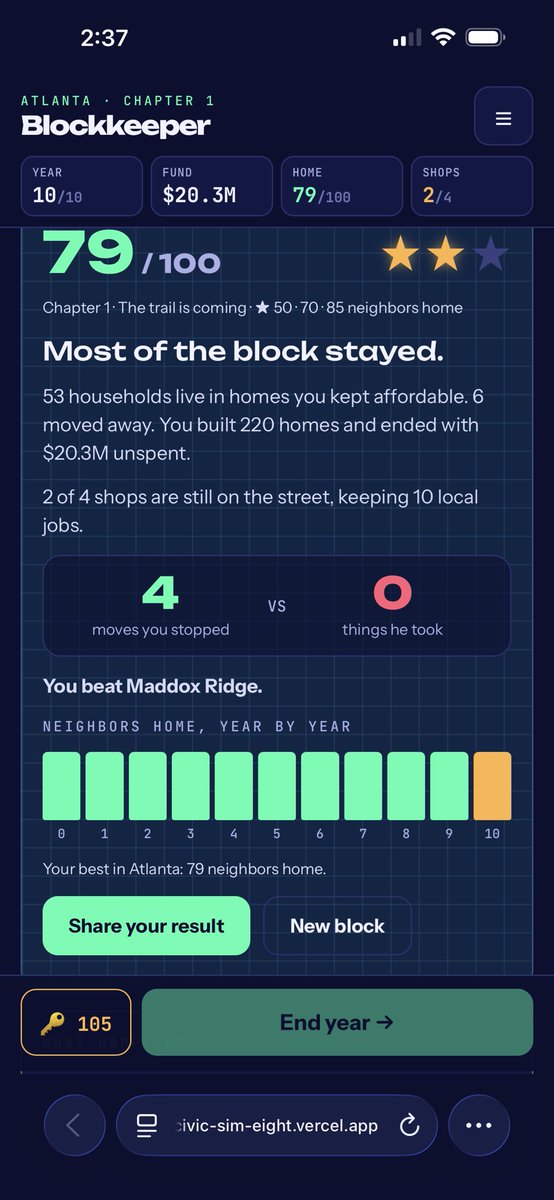
I built a game about Atlanta 🏘️
*Blockkeeper* — the Beltline is coming to your block. Can you keep your neighbors and local shops from being priced out?
*How to play (10 min, on your phone):*
1⃣ Tap a lot and choose how many homes to build and how many stay affordable
2⃣ Turn on *Land trust* to keep homes affordable for good, and *Shop space* to save a local shop
3⃣ Tap *End year* and watch who stays
4⃣ Make tough calls when a developer, a storm or a landlord shows up
💡 Tip: turn on *Legacy tax relief* first.
Play free 👉 https://t.co/4TlTc3RGHX
Send me your score — can you beat 90? 🏆
@UtdTony1 The kid has every right not to attend and if anyone is mad about it go kick rocks….i tweeted this the first day and im glad he took my advice
Guys if you are in Lagos,Ibadan,port-harcourt,Abuja or kaduna the fun it’s about to begin….OpenGame is coming to a city near you for sports pickup like football,basketball and few more..dates to be announced soon.
The History Lesson: 1966 and the Power of Protest
This isn't the first time Africa has faced this choice.
In 1966, all African nations boycotted the World Cup because they were given only one spot to share with Asia and Oceania.
It cost them a tournament appearance. But it worked.
That boycott forced FIFA to guarantee Africa a permanent place in the World Cup. It was a moment of collective action that reshaped the global game.
The question today: Does Africa still have that unity?
The Dilemma: What Should African Nations Do?
Representing the continent, the decision is brutal. Let's break it down.
Option 1: Accept the $40 Million and Support the Deal
Arguments for:
· Immediate, substantial funding for football development.
· Tangible benefits for grassroots and infrastructure.
· Pragmatic engagement rather than isolation.
The Backlash: Why This Deal Is Under Fire
The opposition is fierce and growing:
· UEFA has threatened a 2030 World Cup boycott, warning that private investors will demand more tournaments, more games, and more profit at the expense of players and the sport's integrity.
· Former UN directors have called the deal a conflict of interest, warning that member associations' consent appears to be for sale.
· Fans and players worldwide are alarmed that the World Cup the people's tournament could be controlled by private equity firms.
But for Africa, there's an additional layer: this offer comes from an institution that has repeatedly shown bias against them.
The 2026 World Cup: A Case Study in Unfairness
The recent tournament laid bare the systemic challenges African teams face:
· Visa Discrimination: African officials, referees, and even players faced fragmented and punitive visa regimes for the U.S.-hosted tournament, while other nations sailed through. Somali referee Omar Artan voted Africa's Referee of the Year was denied entry without explanation.
· Refereeing Controversies: A former Tunisian referee publicly accused FIFA of applying "double standards" against African teams. Egypt filed a formal complaint after a controversial loss to Argentina.
· Unequal Treatment: Time and again, African teams have felt that the rules, logistics, and officiating work against them in ways that don't affect European or South American powers.
Africa's Moment of Truth: Take the $40 Million or Fight for Respect?
Why the FIFA private equity vote is a defining test for African football
The 2026 World Cup was supposed to be a celebration. Instead, it became a painful reminder for African teams of a persistent truth: they are treated as second-class participants in a game they help make great.
Now, FIFA is offering a choice: take the money or take a stand.
The Offer: $40 Million for Your Vote
FIFA President Gianni Infantino has proposed selling a minority stake in a new commercial subsidiary to private investors. The deal would inject billions into FIFA's coffers, but it comes with conditions.
For each of the 211 member associations, the promise is up to $40 million in development funding over the coming years.
The catch? Your vote in favor of the deal is expected in return.
For many African nations, $40 million is transformative. It could build stadiums, fund youth academies, and develop grassroots football across the continent.
But at what cost?
The $4 Billion Question: Will Private Equity Break Football?
Why FIFA's plan to sell a stake to investors could tear the World Cup apart.
Football is the world's game. But right now, the people in charge of it are playing a high-stakes game of poker and the chips are the very soul of the sport.
Here's what's happening, why it matters, and how close we are to the unthinkable: a breakaway World Cup.
The Proposal: A Private Stake in Football's Crown Jewel
FIFA President Gianni Infantino has proposed selling a minority stake in a new commercial subsidiary called FIFA Forward Enterprise (FFE) to a group of private investors led by Joshua Kushner's Thrive Eternal.
The price tag? A staggering $4.2 billion.
FIFA's pitch: This money will fund grassroots development, with each of the 211 member associations receiving up to $20 million a life-changing sum for smaller federations.
The catch? Those investors will want a return on their money. And that means more tournaments, more games, and more commercial control.
The Opposition: UEFA Draws a Line in the Sand
The European governing body (UEFA) and its 55 member nations are furious. Their argument is simple:
The World Cup is not FIFA's to sell.
UEFA warns that private investors could demand:
· More frequent World Cups
· Expanded tournaments that overburden players
· Commercial decisions that prioritize profit over the sport's integrity
The threat? A boycott of the 2030 World Cup. If Europe pulls out, the tournament loses its biggest stars, half its commercial value, and any investor's interest.
The Vote: Who Decides?
The decision rests with 211 member associations one vote each. That means the United States has the same voting power as Samoa.
The vote is expected at the FIFA Congress in March 2027.
Here's the tension:
· For the "Yes" vote: $20 million per federation is hard to turn down, especially for developing nations.
· For the "No" vote: A European boycott could fracture world football permanently.
Can Nations Break Away and Start Their Own World Cup?
Legally? Yes. Practically? It's a mutual hostage situation.
· If nations leave, FIFA bans their players from all official tournaments—including the World Cup and Olympics. That threat alone keeps most federations in line.
· If FIFA pushes the sale, UEFA has enough financial muscle to organize its own rival competition (think of it like the tennis Grand Slams). They wouldn't go broke.
Neither side wants to pull the trigger. But both are willing to point the gun.
The $64,000 Question: Will It Pass?
It's too close to call. The battle is between greed (the allure of $20 million per federation) and fear (the catastrophic consequences of a European boycott).
The most likely outcome? A compromise. UEFA will demand a formal veto over major commercial decisions, or the reduction of extra games the investors want. FIFA needs the money; UEFA needs FIFA's global structure.
But if compromise fails? We could be looking at the biggest split in football history since 1888.
What's at Stake
This isn't just about money. It's about:
· Player welfare: More games mean more injuries and burnout.
· National pride: The World Cup is the pinnacle for billions of fans. A watered-down version without top nations would lose its magic.
· Democratic governance: FIFA is a non-profit governed by its members, not private equity. This deal could permanently shift control from nations to investors.
The Bottom Line
Football is at a crossroads. The decision made in March 2027 will shape the sport for generations.
Will the beautiful game be sold to the highest bidder? Or will it remain in the hands of the people who love it?
One thing is certain: this isn't over yet.
What do you think? Should FIFA go private, or is this a step too far? Drop your thoughts in the comments.