He Won India's First Gold. The Country Lost His Records.
In 1965, Murlikant Petkar was the Indian Army's national boxing champion. He asked his commanding officer for a reward: a holiday to Kashmir, a place he'd never seen.
He was sleeping in his bunker when Pakistani aircraft struck. Seven bullets hit him. An army vehicle ran over his legs in the chaos. Six bullets were surgically removed. The seventh remained in his spine. He was paralyzed from the waist down, confined to a wheelchair at INHS Aswini naval hospital in Bombay.
His physiotherapist put him in the water as part of rehabilitation. Petkar kept going. He competed at the 1968 Paralympics in Tel Aviv in table tennis. He changed disciplines to swimming, training every day. At the 1972 Paralympics in Heidelberg, Germany, he climbed out of lane three having set a world record in the heats, and then won the final. Time: 37.33 seconds in the 50-metre freestyle. No Indian had ever won an individual gold at the Olympics or the Paralympics. Now one had.
When Petkar flew home, not a single government official was at the airport. No reception. No acknowledgment. When India's Paralympic Committee was formally established, it began keeping records from 1984 onward. Petkar's gold, the one that came before any of them, simply was not entered. "We don't have any record of his medal," a committee official told the Hindustan Times in 2012. Four decades after Heidelberg, he was living on a Rs 4,000 monthly pension from the Maharashtra state government.
He swam the fastest 50 metres in the world with a bullet still lodged in his spine. His country's official records described him as if he had never entered the water.
An Incredible Story!
A ₹3,480 crore IPO of Physics Wallah has hit the market. While reading about this issue, I came across information about a village called Patwa Toli in Bihar.
This year, 45 students from this village cleared JEE, and 38 of them cleared JEE Advanced, meaning 38 students from a single village secured admission to IITs.
Patwa Toli is a village of traditional weavers. There is not a single coaching institute here. Instead, it has a community-driven education system run by current and former students of the village.
The Patwas are traditional weavers, originally from Rajasthan. They were brought to Bihar by Raja Man Singh during Emperor Akbar’s reign to produce a specific type of cloth used in Hindu funeral rituals. Over time, their weaving industry flourished so much that the village earned the title Manchester of Bihar. Today, however, it is better known as the Village of IITians.
The spark of educational transformation was ignited in 1991 when Jitendra Patwa became the first student from the village to gain admission to IIT. His success inspired an entire generation. Although he now lives abroad, he has never forgotten his roots. Through the NGO Vriksha Foundation, he and other IIT alumni continue to support educational initiatives in the village.
The educational model followed here is truly unique. Students from earlier batches mentor the next generation. Whenever a junior student faces difficulty, they seek help from their seniors. Over time, this has created a continuous support network where everyone helps one another move forward.
The foundation has established a digital classroom and a well-equipped library. Expert teachers from cities such as Delhi and Mumbai conduct online classes. A dedicated team continuously monitors students’ progress to ensure that no one is left behind. This is a remarkable blend of modern technology and community participation.
This is more than an educational program—it is a movement that is transforming lives. For many students, attending expensive coaching classes in big cities was once an impossible dream. Today, they can pursue those aspirations from their own village. Most importantly, the doors of opportunity have also opened for girls, enabling them to dream of a brighter future.
Patwa Toli teaches us an important lesson: when an entire community decides to invest in its children, extraordinary things can happen. A united community is the real need of the hour. If schools improve, villages will progress. #Bihar #education #IIT
@omarali50@12number_ai@HasnainWizard That was never feasible. But since muslims of subcontinent pushed for that idea that ripped apart Bharat, they demonstrated the thought process that drives them.
Majority still display it opportunity. So Hindus are convinced that even to get anything done they need Hindu unity.
@sabizak@HasnainWizard@omarali50 "He brought Indian muslims to a turn..."
Why did Indian muslims follow him? Could have rejected him and supported Undivided Bharat?
Whatever thought process led Indian muslims to follow jinnah still is the dominant thought among muslims.
Reason Hindus need to unite to SURVIVE.
I've no words to describe some of the legends of early 20th cen India
People like Mysore Hiriyanna (philosophy), Ramanujan (math), Alladi Krishnaswamy (law), Rajaji / Patel et al (politics), CV Raman (science)
Such high achievement despite in many cases being the first generation with modern English education in their lineage.
Hiriyanna for instance was born in 1871! Thats a super-early date. For him to become a legend of modern academia is remarkable (hailing from practically the old world)
Goes to show how high the cultural capital must have been for these guys to excel in modern world with no background or money or familial backing
India's population is about that of all the Americas (North and South) together combined with Western Europe. Almost five dozen odd countries together have say 1.4-1.5 billion people, same as just India.
Now imagine if you wake up and read about all the terrible news in the entire Western Hemisphere (ex-Africa, but also adding some regions). Murders, rapes, accidents, scandals etc. And you form a view basis that.
This is what is happening to people who are consuming too much news off social media where virality needs are pushing algorithms (no Indian oversight here, only American - and for TikTok, Chinese) to accentuate the bad.
Please get a perspective. An accurate one, not a ugly one or rose-tinted one. Just a balanced and contextualised one. And please take care of your mental health.
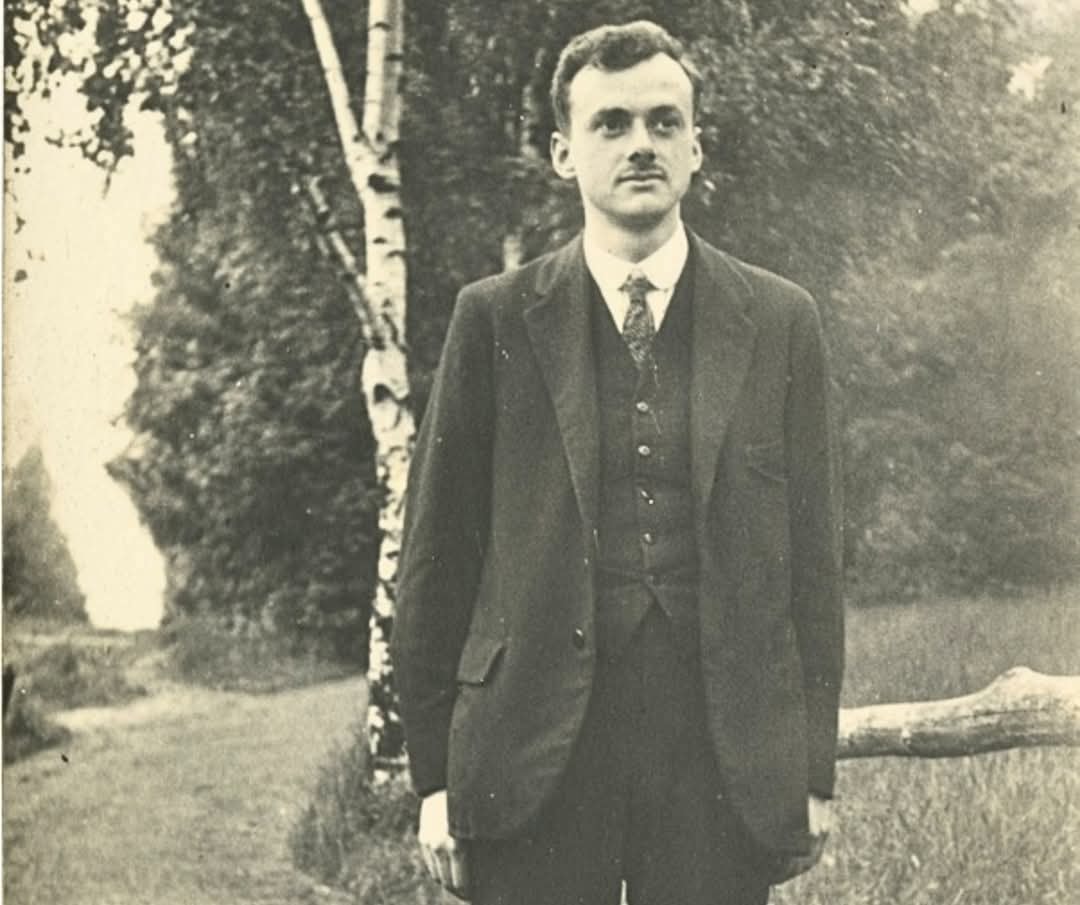
"In the winter of 1926... I was so desperate that I was ready to give up physics altogether. I felt that I was a completely untalented person who had chosen the wrong profession."
- Paul Dirac, reflecting on his early struggles with quantum mechanics
What's this guy talking about?
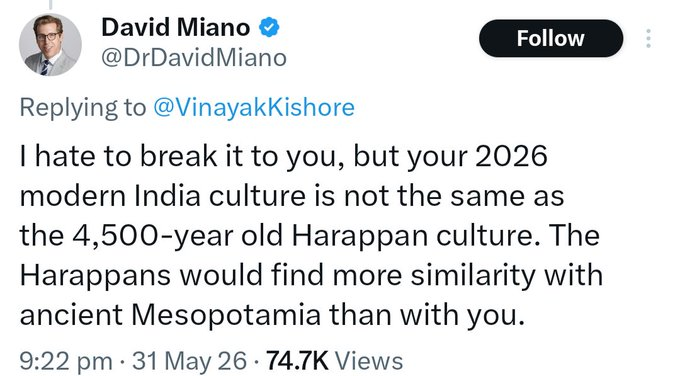
The wells we see in backyard of Indian homes, the brick houses, the bullock carts, the rangoli, the co-existence with wild animals, the bangles, the pottery, the toys, the ditches on the side of roads, the use of millet, the textiles - so much hasn't changed in India since Harappan times.
Perhaps no other civilization has such an unchanged continuous history for some 7000+ years preserving itself and its dangerous wild animals as well. If a Harappan time travels to present day India, he will instantly feel at home. Albeit scoff at the bad sanitation and cleanliness of our modern towns, I am sure.
‘In one tweet, Truschke referred to Rama as a “misogynist” and used a slur after the word. When asked to justify this claim, she cited a translation of the Ramayana by Robert Goldman. When Prof. Goldman was contacted, he said: “I find it extremely disturbing but perhaps not unexpected to learn that AT (Audrey Trushcke) has used such inappropriate language and passed it off as coming from Valmiki.
Neither the great poet nor we used such a vulgar diction and certainly Sita would never have used such language to her husband even in the midst of emotional distress. Nowhere in our translation of the passage do we use words you mention AT as using… she is in no way quoting our translation but giving her own reading of the passage in her own highly inappropriate language.”’
This video is an exceptional compilation capturing the sublime performances of the "Radetzky March" by the Vienna Philharmonic across five decades of New Year's Concerts, taking viewers on a timeless musical journey alongside legendary conductors.
Rakhigarhi was discovered in 1963 & excavated to be the largest by the 1990s.
Even 2014 is a decade old already. What kind of history expert doesn't upgrade their knowledge for a decade?
And what kind of scholarship still considers these laziness scholarship?
There are three phases of Indian Islamic architecture
First phase when they desecrated all the temples and converted them into mosques.
When no temples were left to destroy they moved to second phase. They forced local artisans to make mosques for them. This phases shows strong Indian imprint and same regional diversity that we see in temple architecture
Third phase when Mughal destroyed all the regional traditions and any Indian touch with it and imposed their architecture everywhere
This mosque looks like the temple because it was part of second phase.
@DrDavidMiano@VinayakKishore In someways it is and in someways it isn't.
Whats the point you are trying to make anyway? Are you suggesting Hindus of 21st century cannot claim Harappan heritage unless they live like Harappans?
Do brits of 21st century live like brits of 17th century?
Dumb take!