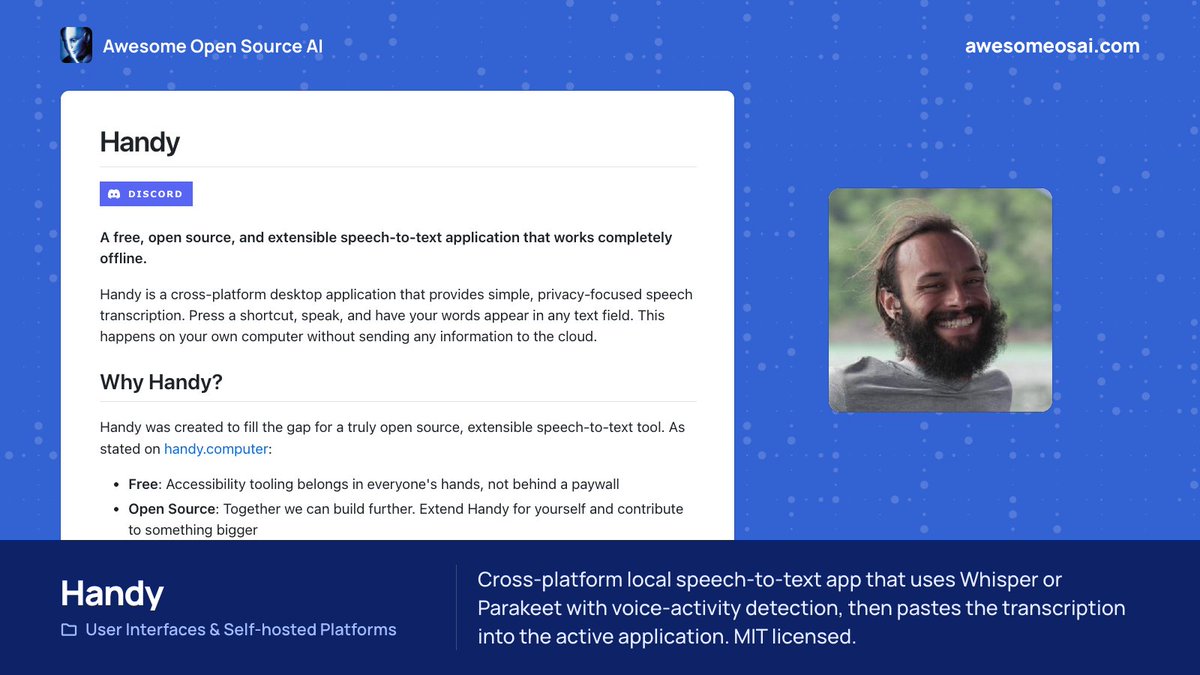
Handy is a free speech-to-text desktop app that runs fully offline. Press a shortcut, speak, and the transcription is pasted into whatever app you're in.
It uses Whisper or Parakeet V3, with Silero VAD to filter silence. MIT licensed.
ncnn is an inference framework for running neural networks on phones, embedded boards and desktops.
No third-party runtime dependencies. CPU and Vulkan GPU backends. The pnnx tool converts PyTorch and ONNX models to ncnn.
TruLens traces and evaluates LLM apps and agents.
Add a decorator, then score every step with LLM judges that explain themselves.
Traces are OpenTelemetry-native, so they port to any OTLP backend.
Tools that extend what a coding agent can see and do from your terminal.
1. Codex CLI
2. Context7
3. CLI-Anything
4. Repomix
5. REA
All five are permissively licensed: MIT or Apache-2.0.
transcribe.cpp is a C/C++ speech-to-text library that runs GGUF models on the ggml runtime.
It covers 16 model families and 60+ variants, streaming and batch, with Metal, Vulkan and CUDA backends plus a CPU path. MIT licensed.
AI-Toolkit is an all-in-one training suite for finetuning diffusion models. It runs as a GUI or a CLI.
It targets consumer-grade hardware and supports FLUX.1, FLUX.2, Qwen-Image, SDXL, SD 1.5 and video models. MIT licensed.
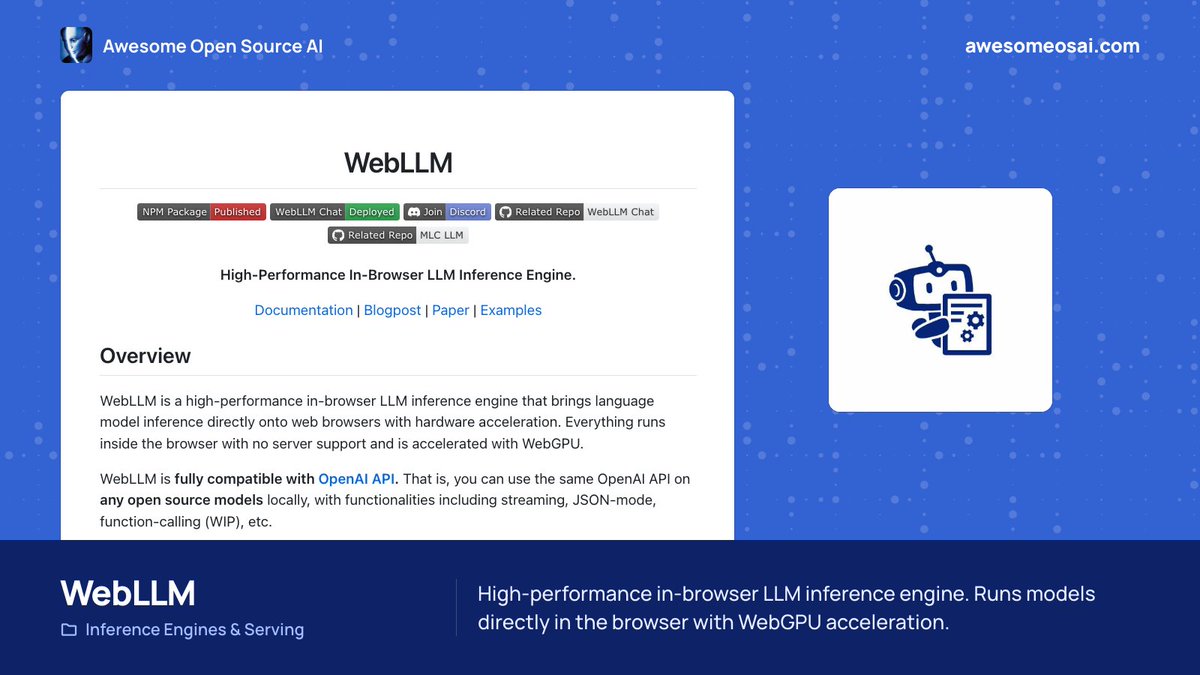
WebLLM runs LLM inference inside the browser, accelerated with WebGPU. No server support needed.
It is compatible with the OpenAI API, including streaming and JSON mode, and installs as an npm package.
OpenSpec is a spec-driven development framework for AI coding assistants.
You propose a change, and it generates proposal.md, specs, design.md and tasks.md as plain Markdown. You review the plan before code is written, then archive it.
Getting messy PDFs, Office files and web pages into a form an LLM can actually use:
1. MarkItDown (Microsoft)
2. Firecrawl
3. PaddleOCR
4. Crawl4AI
5. Scrapling
Four of the five are Python; Firecrawl is the TypeScript one, and the only AGPL-3.0 in the set.
Fairlearn is a Python package for assessing and improving the fairness of machine learning models.
It ships metrics to compare model behavior across groups, plus mitigation algorithms with scikit-learn integration.