The Street Recap | Week of Oct 13
Monday we said: strong retail sales plus hot CPI is the Fed's nightmare.
That's exactly what printed. But the retail sales number wasn't what it looked like.
TUE (10/13) | Existing home sales
3.99M, up 1.5% and slightly ahead of expectations. On the surface, housing stabilizing.
Underneath: sales fell year over year in all four regions, and NAR's own economist flagged that recent mortgage rate increases mean fewer buyers can qualify. Inventory is building. That's a market finding a floor on volume, not on demand.
WED (10/14) | CPI, the main event
We said a soft core print keeps the Fed cutting, a hot one cracks the "temporary" story. It cracked.
Core came in at 0.3% MoM vs 0.2% expected, and core YoY accelerated to 2.6% from 2.4%. Headline hit 3.7%, up from 3.4%.
Gasoline jumped 9.1%. But core excludes energy, and core still accelerated. That's the tell: fuel is no longer contained to the fuel line.
THU (10/15) | PPI
This was the ugliest print of the week and got the least attention.
Wholesale prices rose 1.3% MoM against a 0.5% forecast. Annual PPI hit 6.3%, the biggest gain since 2022. Core PPI rose 0.7% on the month.
PPI leads CPI. Pipeline pressure this strong means next month's inflation print has a hard floor under it.
THU (10/15) | Retail sales, and the number everyone misread
Headline: +0.8% vs 0.3% expected. Looks like a resilient consumer.
Strip out gas stations: +0.2%.
Consumers didn't buy more. They paid more for the same gallon. Ex-autos and gas, spending slowed to roughly 0.25% from about 1.1% the prior month.
That's not strength. That's fuel costs crowding out everything else.
The Read: The Fed is Now Fully Boxed In.
Core accelerating and PPI at 6.3% argue it can't cut. A consumer whose spending growth is almost entirely gasoline argues it can't tighten much either.
This is the same thread running through earnings season. $DAL cut full-year guidance 24% on fuel. $STZ shipped more beer than people drank. Now the macro data shows the same squeeze at the household level.
The temporary vs. structural question didn't get answered this week. It got harder.
Gross margin.
TSMC reported $46.7B in revenue, nearly a billion above the high end of its own guidance. EPS $4.60 vs $4.42 expected. Operating margin 58.7%, above guidance. Full-year growth raised to ~44%. Q4 guided to $52.3-54.3B, implying ~58% YoY growth. CEO Wei called AI demand "extremely robust."
Sixth straight quarter of record profit. The beat was clean across the board.
But gross margin fell from 67.7% to 66.4%, and that's the number that moved the stock. The cause is the 2nm ramp. TSMC is spending $60-64B in capex this year to build capacity for AI demand that management says still outpaces supply. New nodes compress margins before volume economics kick in. The more the world wants AI chips, the more it costs TSMC to build the fabs to make them.
This is the tension at the heart of every AI infrastructure name right now. Demand is real. Revenue is growing 40-50%+. But the cost of serving that demand is growing too, and the market is starting to ask whether the margin profile investors priced in at the top can survive the buildout required to get there.
HPC, which includes AI accelerators, was 68% of revenue this quarter, up from 66% last quarter. TSMC is becoming more AI-dependent by the quarter, not less. That's a tailwind while demand holds. It's concentration risk if it ever doesn't.
Same pattern we flagged on $MU: when perfect is already priced in, a perfect quarter gets you flat. Or in this case, down 4.4%, because a 100bp margin compression matters more than a billion-dollar revenue beat when the stock trades at these levels.
Watch whether 2nm yields improve fast enough to stabilize margins by mid-2027. That's the real tell for the next leg.
$TSM beat on every line this morning
Revenue, EPS, operating margin, and guidance raised
The stock is still down ~5% this morning. Here’s the number the market cared about more than all of them 👇
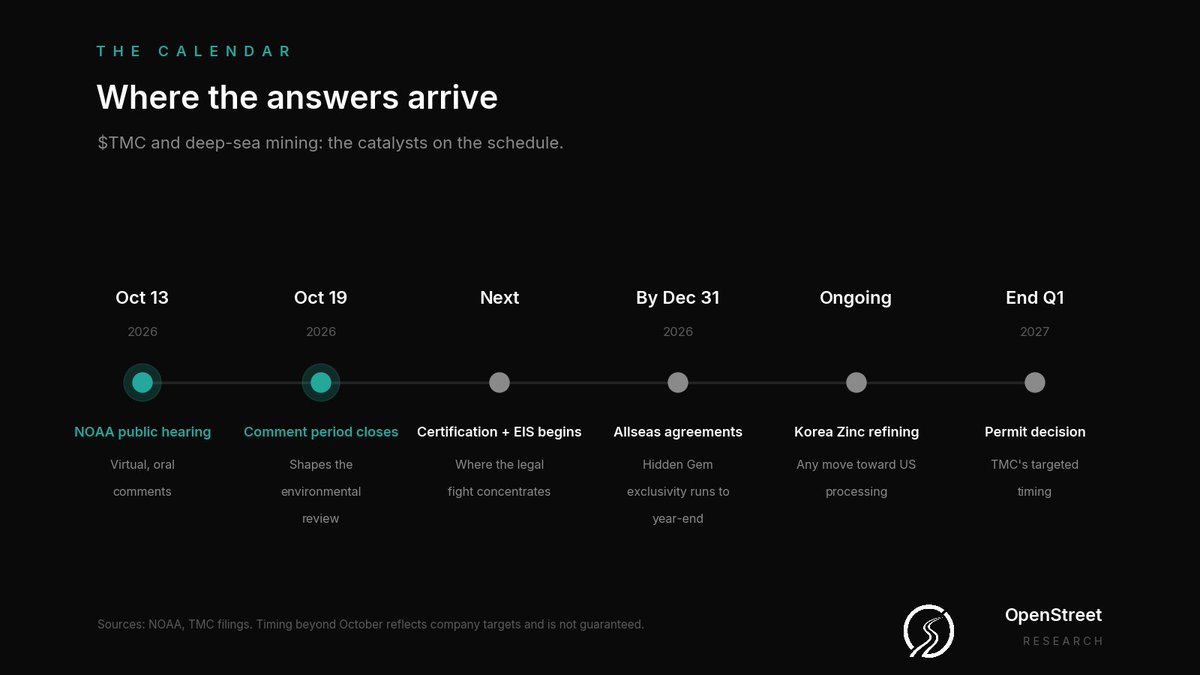
NOAA is taking comment on the first commercial recovery application ever filed under US seabed law, from $TMC. Comments close October 19.
This matters beyond one company. The US isn't part of the UN's seabed authority, so it's building its own path, while China holds the most UN exploration contracts and is the body's largest funder. Two rulebooks, two strategies.
What comes next is on a schedule: NOAA certification and an environmental review, where the legal fight will concentrate. Allseas agreements and the Hidden Gem vessel deadline by year-end. Refining progress with Korea Zinc. Then the permit decision TMC is targeting by the end of Q1 2027.
Each step answers a real question about whether this industry works. First movers don't just build companies in new regulatory systems. They set the precedent everyone else follows.
https://t.co/9DGE2sJV13
Today the US holds its first-ever public hearing on commercially mining the deep seafloor.
One company stands a lot to gain and most investors aren't watching. Here's why they should be $TMC 👇
The read
This is a week where the Fed gets boxed in by its own data. Cooling CPI and soft retail sales clear the runway to keep cutting. A hot core print alongside a resilient consumer argues the opposite.
The thread tying it together is the same one running through earnings season: how much of today's cost pressure, fuel and tariffs, is temporary versus structural. Wednesday starts to answer it.
The Street Setup | Week of Oct 13
Quiet week by volume. Not by consequence.
Wednesday's inflation print lands right as the Fed is deciding whether it can keep cutting. One hot number reshapes the path.
Here's what we're watching👇
THU | PPI, Retail Sales, Fed Chair speech
PPI is wholesale cost pressure, one step upstream from CPI, so it previews next month's inflation. Hot PPI means more CPI pressure coming.
Retail Sales is the real-time consumer. The same question Delta and Constellation raised this earnings season: are people still spending, and on what. Soft sales plus cooling CPI is the Fed's green light. Strong sales plus hot CPI is its nightmare.
Then the Fed Chair speaks into whatever the data just said. Markets will parse it for how the week shifted the odds of another cut.
The cut was entirely fuel.
Delta missed on EPS ($1.72 vs ~$1.76) and slashed full-year guidance to $5.10-$5.60 from $6.50-$7.50. First EPS miss in about two years. On paper, ugly.
But look at what drove it. Fuel expense jumped ~62% to ~$4.1B, adding over $6B in cost for the year. Strip fuel out and the business is strong: revenue +16%, loyalty +18%, cargo +29%, premium demand solid, and Q4 revenue guided +20%. Bastian says fares are still climbing.
So the market made a distinction. The guidance cut came from a cost Delta doesn't control: jet fuel, spiking since the Iran war began. That's the key point. This is a geopolitical shock working through a cost line, not a crack in the business. The part Delta does control (demand, pricing, mix) is as healthy as ever. A flat close on a 24% cut is the market saying "this is a fuel problem, not a Delta problem."
That's the real debate for 2027, and it comes down to a geopolitical question as much as an airline one. If the conflict eases and fuel normalizes, this quarter is the trough and the stock is cheap at ~14x forward earnings. If $4+ jet fuel is the new normal, the margins airlines guided to for years were built on a fuel cost that no longer exists, and every carrier reprices lower.
Delta is the tell for the whole group. It's the most profitable of the Big Four and up ~19% YTD while American is down 17%. If the best operator can't fully pass through fuel, the weaker ones are in real trouble.
Watch two things: the pace of fuel recapture, and whether the Middle East situation escalates or cools. One is in Delta's hands. The other isn't.
Everyone saw Delta ($DAL) CUT guidance by 24% on Friday and moved on.
A lot missed the actual signal, and it's a fairly important read on airline stocks heading into 2027👇
The concerns are real. The deep sea is among the least studied places on earth, and nobody fully knows what large-scale nodule collection does to it. Forty countries have called for a moratorium.
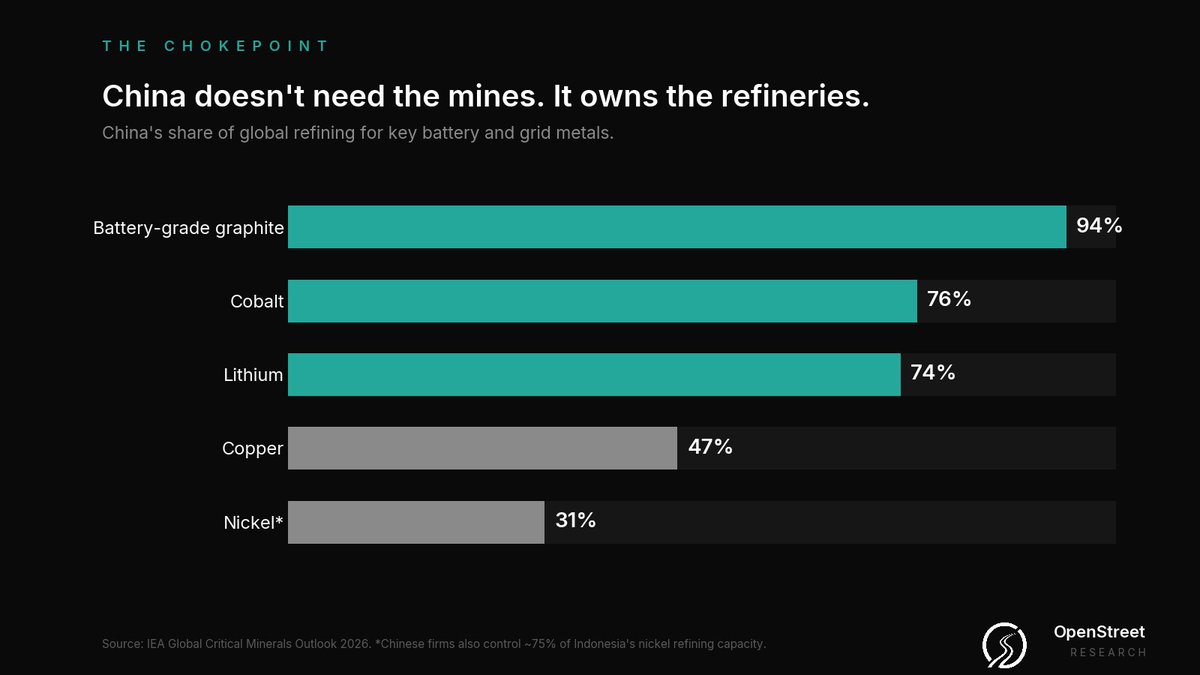
But the metals don't stop being needed if the seafloor stays untouched. They come from somewhere else, and today that's mostly land.
Indonesia, the world's dominant nickel producer, has lost an estimated 76,000 to 153,000 hectares of forest inside nickel concessions since 2000. It leads the world in mining-driven deforestation. Many of its smelters run on captive coal, and one Chinese-run industrial park is building enough coal capacity to burn more than Spain or Brazil does in a year.
None of that makes deep-sea mining clean. But it changes the honest framing.
The choice isn't mining vs. not mining. It's a known land footprint vs. an unknown ocean one. Reasonable people land on different sides of that trade.
Where do you land? @themetalsco
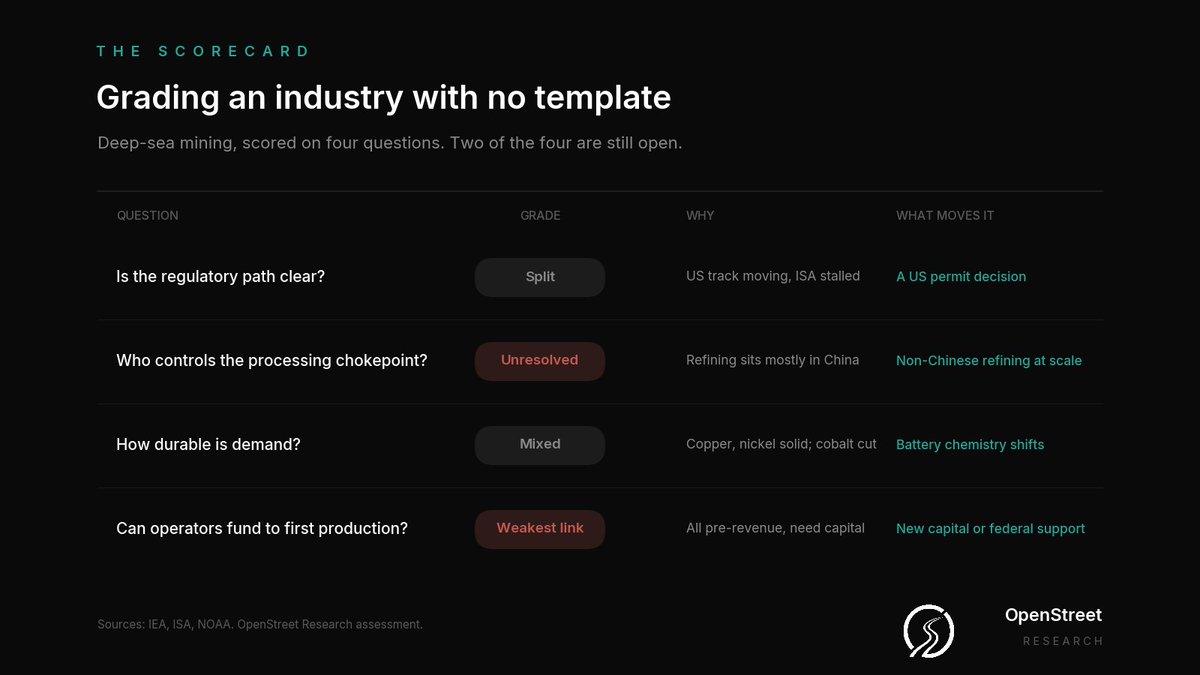
Deep-sea mining is a good test case. No company has ever produced commercially, so comparing multiples to an industry average doesn't work. The market prices headlines instead.
So we grade four questions instead:
Is the regulatory path clear? Split. The US track is moving. The UN track has no mining code.
Who controls processing? Unresolved. Refining still runs through China.
How durable is demand? Mixed. Copper and nickel are solid. Cobalt demand is being cut as cheaper battery chemistries spread.
Can operators fund themselves to production? The weakest link. Norway's own industry champion went bankrupt first.
Two of four are still open. That's why $TMC and the sector swing on regulatory news, not fundamentals.
The useful move isn't predicting the outcome. It's tracking which answer changes first. This works for any frontier industry, not just the seafloor.
Had time this morning to read article from @OpenStreetRS’s piece and the research quality is very underrated. Highly recommend :)
https://t.co/tR2nVy86Wg
(Not paid post, just really liked the article)
Thanks for reaching out. In short, OpenStreet was created as a reaction to the growing trend of pay to play sell side research, shaped by banking relationships, M&A fees, and other incentives that have nothing to do with actual analysis. We wanted to build something independent, conflict free, and focused on undercovered opportunities/narratives that receive little coverage.
We’re still early as a brand. The near term focus is on building a public track record primarily on Substack, with individual equity research, price targets, and ratings coming soon. We will also continue to provide shorter pieces and breakdowns on X. We come from finance, banking, and research backgrounds so fully understand the research process and why independence is important.
Feel free to DM. Always good to connect with others in the space!