@jakemintz I totally get it! I get asked, from time to time, if I would be interested in taking it private. I don't think pain avoidance is a good reason to do it. I like the cards we have and if you had told me 9 months ago we'd be here, I would have taken the job faster!
After all the Silicon Valley CEOs who wanted no responsibilities or accountability and could just stay private and cash out phantom equity when they needed another house, Kaz’s attitude is refreshing and more importantly correct! Let’s go OPEN
I’m surprised $OPEN hasn’t gone private. I wouldn’t want to be rebuilding the company in public with short pressure and a $3.5B market cap. (Investor, bullish, but it’s hard)
@jakemintz Amazon went all the way down to $2B in market cap and had massive debt load. AMD, just a decade ago, was at $1.3B in market cap and an even bigger debt load.
Public turn arounds are not for the faint of heart. They are hard but they are also valuable and fun.
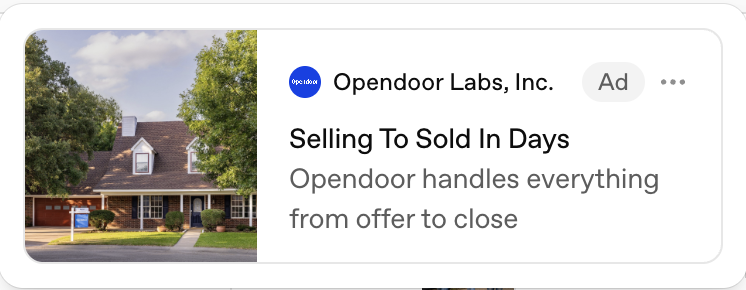
Opendoor is now running ads in ChatGPT.
We launched a test this week putting Opendoor in front of sellers directly inside ChatGPT via OpenAI's new ad product.
Excited to see how this new channel does.
CHANGE THE DEFAULTS VIOLENTLY
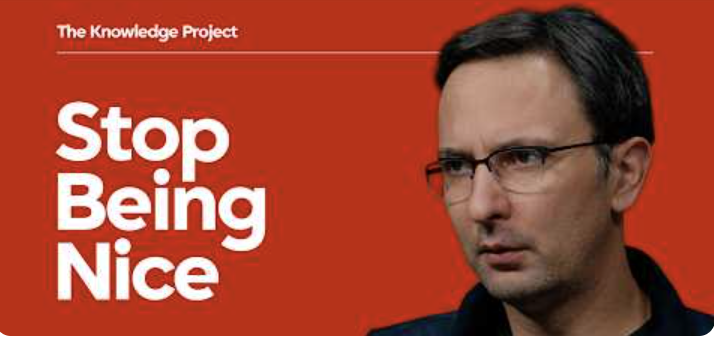
@nejatian, CEO of @Opendoor (previously COO of Shopify), interviewed by @shaneparrish (@TKPPodcast)
Summary: Nejatian took over Opendoor months from bankruptcy and found a company that had drifted, one comfortable lie at a time, into being run by consultants and process. His fix was to change the defaults violently, hire an almost entirely new company, and commit to truth over feelings at every level. Opendoor now buys 6 to 7 times more homes per week than it did a year ago, and the last time it bought at this volume its OpEx was more than twice as high.
1. All Failures Rhyme. Every company that dies, dies the same way. Good people leave, control of innovation slips, G&A climbs, and the company starts picking fights with its customers and partners. Successes are each unique, so they teach you little you can reuse. Failure patterns repeat, which means you can diagnose a sick company much faster than you can copy a healthy one.
2. The Professional Leech. Opendoor's largest external vendor expense went to a big consulting firm, ahead of its cloud provider. That firm had advised offshoring every job, loading up G&A, and cutting engineering, which Nejatian calls exactly what you do if you have zero desire to create alpha. When the founders are gone and no large shareholder cares, a company becomes a host for professional leeches whose job is to drain it while making management look good. Pull the full 12-month vendor list on day one and the diagnosis is obvious.
3. Violent Defaults. Opendoor had run many 7-step, 8-month plans to bring people back to the office, and none of them worked. At 9am on his first Monday, Nejatian told the whole company everyone was in the office the following Monday or no longer employed. Change management defeats the purpose, because you want the change to feel jarring. He rewrote the careers page the same week, replacing "a happy place to work where we all care about each other" with "this will be hard," so the hiring funnel would repel anyone looking for the old company.
4. Competent But Unaligned. The most dangerous people in any company are competent and not mission-aligned. Competent people tilt the org toward themselves, and everyone has worked with the internal politician who keeps getting promoted because the boss cannot see what they are doing. Nejatian's first job was to widen that rift on purpose so those people would leave quickly. Rebuilding Opendoor meant hiring an almost entirely new company, and he says plainly that it was painful.
5. Room Size And Truth. The larger the room, the less space there is for truth. That one dynamic is why big companies are usually average, and it is the real reason two-pizza teams work. A new CEO's most urgent task is finding the speakers of truth and getting them in a room alone. Without that, Nejatian says, you die.
6. Say The Thing. Nejatian's rule, written at Shopify and carried into Opendoor: say it now, say it about the thing and not the person, and say it over and over until you have been heard. People do not have to agree with you, but they have to hear you, and staying quiet gets treated as rude. Meetings at Opendoor are louder and more ornery than average, and walking out of one you cannot contribute to is expected behavior. Meetings are a bug in the system anyway, evidence that people could not get the information they needed to decide before the meeting existed.
7. The Map Is Not The Train. Most executives run their company on dashboards, which are a first derivative of the facts. Build models on models and you drift further from reality every quarter, until you go bankrupt with nobody asking how far they are from the ground truth. Nejatian talks to customers weekly, visits homes constantly, reads the raw database, and builds his own dashboards. Watch Undercover Boss and the CEO is always surprised by their own company, which is the tell.
8. Friction Is Underestimated. Everyone has seen the supply and demand curve, and almost everyone underestimates how much friction moves where the two lines cross. The market size for Walmart, Amazon, and Google all looked far smaller before those companies existed, because friction was hiding the demand. At Opendoor, 11 people sat between a customer typing their address and getting an offer. Removing them raised demand every time, and Opendoor now buys 6 to 7 times more homes per week than it did a year ago.
9. Do Things, Tell People. Toby Lütke put "do things, tell people" on the walls at Shopify, and most companies run that order backwards. When an Opendoor home had no power, the fix ran through a Salesforce form, an email, a manager's approval, and 3 or 4 people. Nejatian gave everyone corporate cards and a Slack lookup that returns the utility phone number, the account number, and the card number for any address. The chain of command exists to reduce risk, so the fix is reducing the number of people who can say no.
10. AI Collapses Management. AI lowers the need for human management by dropping the communication barrier, which collapses the long tails of managers managing managers before anyone does real work. It also decides who wins and who loses, and there will be more winners. Opendoor has more engineers today than when Nejatian joined, because the company uses AI well. He describes it as an AI exoskeleton around every person at Opendoor, making them 3 to 4 times more efficient than the competition.
11. The First Derivative. Opendoor takes thin margins on each home and makes its real money on mortgage, insurance, title, and escrow. Shopify sells software for $1 because credit cards will not process less, and earns from merchants succeeding on it. Google makes its money showing you ads while you search. There is a word for businesses that take all your money upfront and never speak to you again, and Nejatian calls them carnies.
12. Excellence Is The Capacity To Take Pain. The person who holds their hand over the fire longest tends to win. The gap between doing something extremely well and doing it poorly is small, and people mostly give up too soon. Nejatian traces his own tolerance to fleeing Iran as a teenager and getting into no clubs, then playing rugby in North America where nobody watches, so you bleed for teammates instead of an audience. The sugar rush of easy satisfaction in modern life has under-prepared people for how much pain they can actually absorb.
It's funny... calling out all the bots who'd been born in a server farm in November (to avoid detection) and were then mobilized against me and EMJX caused 500 followers to disappear overnight. Idiots.
"On the way out the door, I told my wife @CandiceMalcolm, 'hey sweetheart, I'll be back on Thursday.' And she said 'Don't come back until you have a plan to breakeven."
Just in case he thought she was joking, she sent a mattress to the office.
OPEN just made a new low since Kaz took the job. My mentions are full of the same 2 messages: "tweet something" and "Kaz needs to buy more stock."
I bought at 73 cents and stamped $82 by 2028 on my public scoreboard, where it stays graded win or lose. So instead of a tweet, I recorded 6 minutes: the chart that actually explains this week's low (it's not the OPEN chart), the honest math if you bought between $5 and $10, why the "Kaz buy stock" ask is aimed at the wrong scoreboard, and the 3 things that would change my mind.
A tweet cannot move the 10-year. The full take is in the subscriber video. Subscribe in my bio.