It's true! Use our free tier to host your own VPN server.
You can even save the money on a VPS if you have a Raspberry Pi or something that can run Linux lying around. Host it all yourself.
NordVPN charges $13/month.
ExpressVPN charges $15/month.
Surfshark charges $11/month.
Someone open sourced the VPN daemon that powers all of them for $0. And it's been running in production for 20+ years.
It's called OpenVPN.
Here's what most people don't know:
Every commercial VPN you've ever paid for is just a pretty interface on top of open source software anyone can run.
OpenVPN is the actual engine.
Military-grade AES-256 encryption. The same tunneling protocol enterprise networks and governments use to move sensitive data.
You don't rent it. You own it.
→ Run it on any $5/month VPS and you have a private VPN server nobody controls but you
→ Works on Linux, Windows, macOS, iOS, Android, and routers
→ No logs. No company collecting your browsing data. No trust required.
→ Configure it in 15 minutes with one script
→ Zero third parties between you and the internet
The commercial VPN business model is simple. Take open source software. Wrap it in an app. Charge you $13/month forever.
OpenVPN is what they're charging you for.
13.2K stars. GPL-2.0. 100% Opensource.
https://t.co/4cjG5r0rDO
Self hosted: https://t.co/G6zOw9NE0K
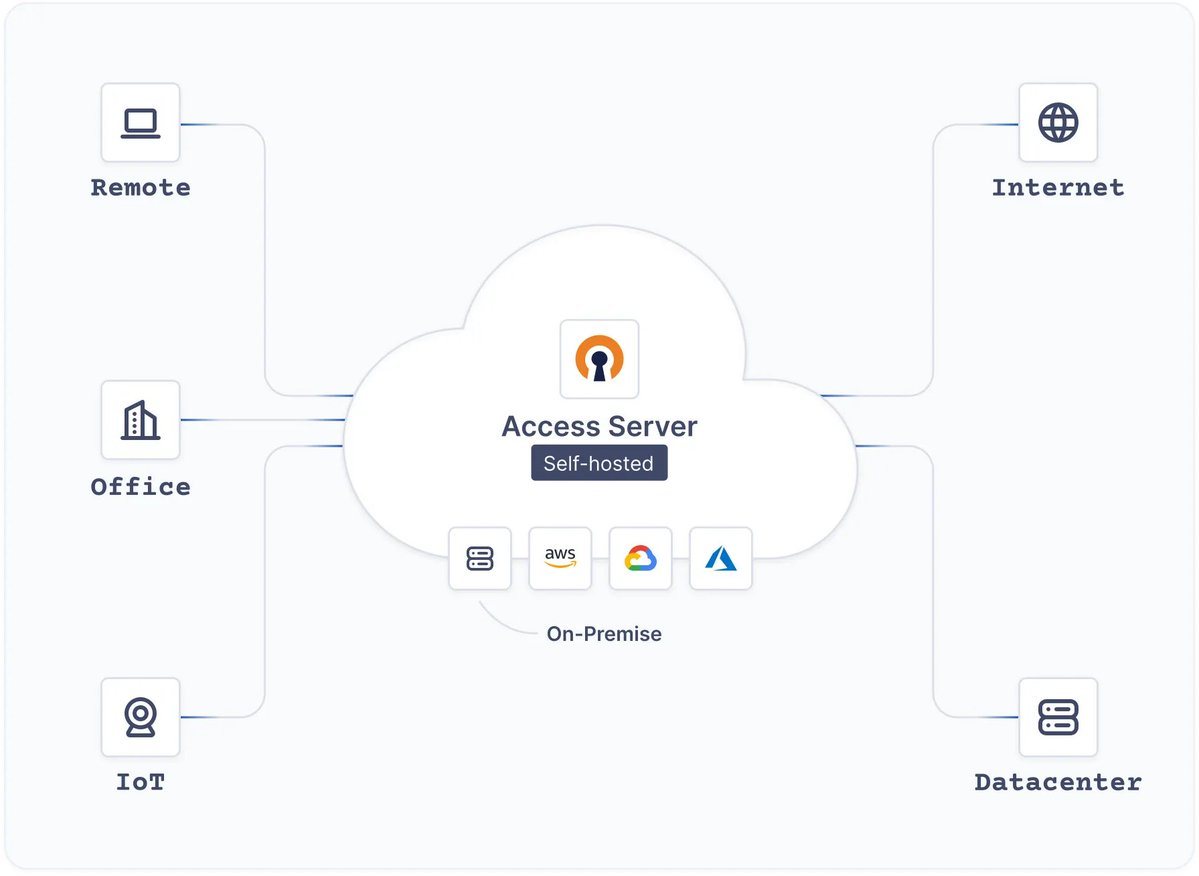
Self-hosted VPN on AWS, Azure, or GCP. No SSH. No manual DNS. No certificate warnings.
Introducing Access Server Link — deploy OpenVPN Access Server from your browser in minutes, keep full control of your data plane.
→ https://t.co/hS6S8kEw2D
#OpenVPN#SelfHostedVPN#AWS #Azure #GCP #BusinessVPN
BREAKING: Tata Electronics confirms breach. World Leaks claims 630 GB published — Apple circuit board specs, Tesla "TRADE SECRET" Model 3 and Model Y blueprints, employee passports.
This week in cybersecurity: https://t.co/qvLBWV3nao
#DataBreach#Ransomware
One security policy for every business trip? That’s not a framework — that’s a coin flip.
Tier your risk. Tier your controls. Complimentary Gartner® report inside ↓
https://t.co/lnXeqBOdKp
73,000+ working Fortinet FortiGate VPN credentials. Cracked. Circulating. Right now.
The FortiBleed campaign didn't require a new vulnerability. A Russian-speaking threat group ran 1.16 billion authentication attempts against internet-facing FortiGate appliances, intercepted SSL VPN authentication hashes, and cracked them with a 45-GPU cluster. The resulting database — covering AT&T, Chevron, Siemens, Samsung, and government agencies across 194 countries — is now in criminal hands.
If you're running a FortiGate SSL VPN and haven't reset credentials and terminated active sessions, this week's post explains exactly why you need to do so today.
https://t.co/0zKQ7iMAXI
#FortiNet #VPNSecurity #Cybersecurity #InfoSec #OpenVPN
45% of AI-generated code introduces OWASP Top 10 vulnerabilities. CVEs from AI code jumped from 6 in January to 35 in March.
Build-time review isn't enough anymore. Our CEO @FrancisDinha, new in @Forbes: https://t.co/uVgZT060Gb
#AISecurity#RuntimeSecurity#Cybersecurity
North Korea poisoned 144 @mastra AI npm packages in 88 minutes — via one forgotten contributor account. Payload: credentials, API keys, 166 crypto wallet extensions. Microsoft + Socket confirmed it.
Full breakdown: https://t.co/68OeidQKMl
#Cybersecurity#SupplyChain
Full route mode. True site-to-site. This is how it's done. 🔁
Bobby from @LinuxhintTeam breaks down the Access Server route mode switch on AWS.
#OpenVPN#SiteToSiteVPN#AWS
🎬 https://t.co/IymbYCUHPc
📖 https://t.co/JiZHLTRAxQ
Is OpenVPN slow? Not with DCO. Home Network Guy’s test: ~2x download, ~4x upload, upload parity with WireGuard®, and far lower CPU usage.
His verdict: https://t.co/QADZj5NkYD
#OpenVPN#DCO
"We'll lock it down later" is how AWS misconfigurations become headlines.
IAM hygiene, MFA on root, roles over keys — none of it is complicated. It's just the stuff that gets skipped.
Here's the checklist: https://t.co/wbOVWgClw4
Secure access shouldn’t slow you down.
Access Server helps teams connect quickly and work efficiently.
👉 https://t.co/G1TaozHVkt
#SecureConnectivity#VPN#Productivity
400+ Arch Linux AUR packages were hijacked to deliver a Rust credential stealer targeting SSH keys, GitHub tokens, Slack sessions, Docker creds, and cloud keys. If you built an AUR package after June 11, check it now.
https://t.co/31uQwoSdVJ
#SupplyChain#ArchLinux
It's true! Use our free tier to host your own VPN server.
You can even save the money on a VPS if you have a Raspberry Pi or something that can run Linux lying around. Host it all yourself.
NordVPN charges $13/month.
ExpressVPN charges $15/month.
Surfshark charges $11/month.
Someone open sourced the VPN daemon that powers all of them for $0. And it's been running in production for 20+ years.
It's called OpenVPN.
Here's what most people don't know:
Every commercial VPN you've ever paid for is just a pretty interface on top of open source software anyone can run.
OpenVPN is the actual engine.
Military-grade AES-256 encryption. The same tunneling protocol enterprise networks and governments use to move sensitive data.
You don't rent it. You own it.
→ Run it on any $5/month VPS and you have a private VPN server nobody controls but you
→ Works on Linux, Windows, macOS, iOS, Android, and routers
→ No logs. No company collecting your browsing data. No trust required.
→ Configure it in 15 minutes with one script
→ Zero third parties between you and the internet
The commercial VPN business model is simple. Take open source software. Wrap it in an app. Charge you $13/month forever.
OpenVPN is what they're charging you for.
13.2K stars. GPL-2.0. 100% Opensource.
https://t.co/4cjG5r0rDO
Self hosted: https://t.co/G6zOw9NE0K
Your server. Your data. Your rules. Rich from @2GuysTek on why complete control is the case for self-hosting your VPN with Access Server.
Full review: https://t.co/uwkyJ00Ei6
#SelfHosted#VPN
A China-nexus group called Velvet Ant hid in an air-gapped network for 10 years by backdooring PAM modules and OpenSSH — not the perimeter, the authentication stack. Sygnia found 9 distinct pam_unix.so variants.
https://t.co/HqfjL2iWdv
#CyberEspionage#Linux
CloudConnexa assigns different split tunneling policies per User Group — default-secure for finance, performance-first for engineering, and restricted access for contractors. No one-size-fits-all compromise.
https://t.co/N3IzUYyYGm
#OpenVPN#CloudConnexa
Microsoft's record Patch Tuesday (200+ CVEs) patched six zero-days — then an unpatched Defender PoC called RoguePlanet (CVE-2026-47281) dropped the same afternoon. SYSTEM access on fully patched Win10/11.
https://t.co/DWCakBfTmm
#PatchTuesday#Windows
Zero Trust ≠ complicated. 🔐
Sean walks through SSO group mapping + Zero Trust controls in CloudConnexa. Clean setup. Strong access control.
#OpenVPN#ZeroTrust#CloudConnexa#SSO
Watch: https://t.co/ZqmCpRcHF0
Cisco SD-WAN zero-day (CVE-2026-20245) under active attack — no patch available. Mandiant flagged it from a live incident. It's the 7th SD-WAN zero-day exploited in 2026.
https://t.co/g0LP4GENqG
#Cisco#ZeroDay#Cybersecurity
“Is OpenVPN slow?” Home Network Guy decided to find out — testing OpenVPN without DCO, with DCO enabled, and WireGuard® head-to-head.
Full test: https://t.co/w6Riu6BXv5 #OpenVPN#DCO