Grace removed the barrier. It did not remove the altar.
The veil was torn, not so that men would stop coming, but so that men could finally come boldly.
Grace did not abolish prayer. Grace abolished the distance.
Grace did not abolish fasting. Grace abolished the idea that fasting purchases what Christ has already paid for.
Grace did not abolish consecration. Grace changed its motivation. We are not consecrated to become accepted. We consecrate because we have been accepted.
And here is the scandal of our generation: we have more access and sometimes less appetite.
Men who believed they had to climb mountains climbed them. Men who thought they had to tarry all night tarried.
Now we preach that the veil is torn, the blood has spoken, the throne is accessible, and yet we barely enter.
Something is wrong when superior revelation produces inferior devotion
The congregation doesn't need your coffee joke.
They buried someone this week.
They're sitting in pews with divorce papers in their glovebox.
Kids who won't speak to them.
Test results they haven't opened.
They drove past three churches to hear you say something that costs you something.
So open the Book.
Forget the illustration you found on Google.
Skip the movie clip.
Kill the countdown timer on your outline.
Preach like a man possessed.
Preach like you'll answer for every wasted syllable.
Preach like their blood is on your hands.
Because it is.
The pulpit isn't a stage.
@freddy_0x Great app. Already using it. I would love that you add a file explorer with the ability to add multiple .md files for easy click, view and read
@elonmusk@XFreeze You are going beyond your boundary @elonmusk
Jesus heals and he heals completely, he doesn't manage sicknesses or diseases.
And this is the ultimate one - you may perform miracles but you cannot give eternal life.
As you grow older, you'll realise a lot of things are absolutely unnecessary. All those fights... They're not worth your peace. Malice is violence to self. Hatred is a murderous cooking pot.
That viral palm reading trend going around? Do not do it.
You're uploading a high-resolution biometric map of your hand to a third-party server.
Unlike a password, you can't change your palm lines or fingerprints if they get leaked.
That data can be used to bypass lock screens, approve fraudulent payments, or spoof hand-geometry scanners.
It's a fun party trick until someone uses your hand to empty your bank account.
Source: @T3chFalcon
When a loved one dies, they don't come back as a bluejay, butterfly, dog, or ghost to visit you.
They are either present with the Lord, or absent from the Lord (2 Cor. 5:8-10, Luke 16:19 - 31).
Knowing Jesus or not knowing Him here on earth is what determines your eternity.
There is a dimension of worship that goes beyond songs, beyond tears, beyond even fasting and sacrifice — and that dimension is called obedience.
In Zechariah 7, God confronted His people. They had mastered the act of fasting, yet their hearts were far from Him. They were doing spiritual activities, but neglecting divine instructions. And God made it clear — He is not impressed by rituals without alignment.
In 1 Samuel 15:22, the prophet Samuel spoke to King Saul and said:
“Has the Lord as great delight in burnt offerings and sacrifices, as in obeying the voice of the Lord? Behold, to obey is better than sacrifice.”
This means you can give, you can fast, you can pray all night — but if you are resisting what God has told you to do, heaven does not call that worship.
True worship is not convenient.
True worship is not emotional.
True worship is obedience.
Look at Genesis 22:5 — when Abraham was going to offer Isaac, he said, “I and the lad will go yonder and worship.”
What was the worship there?
Not a song.
Not a prayer meeting.
It was obedience to a difficult instruction.
Worship is when God tells you:
“Forgive,” but everything in you wants to hold the pain — and you still forgive.
Worship is when God says:
“Let go,” but your comfort is tied to it — and you still release it.
Worship is when God instructs:
“Wait,” but your flesh is screaming for speed — and you still stay still.
Worship is when God tells you:
“Walk away,” “Start again,” “Speak up,” “Be quiet,” “Trust me” — and even when it doesn’t make sense, you obey.
That moment — right there — is where incense rises from your life.
Because obedience costs you something.
It costs your pride.
It costs your emotions.
It costs your logic.
It costs your comfort.
But that is exactly why it is powerful.
Anyone can sing when it feels good.
Anyone can fast when it is convenient.
Anyone can give when it is surplus.
But it takes a surrendered heart to obey when it is uncomfortable.
Let this sink deep into your spirit:
Your obedience is your worship.
Not just what you say in church,
But what you do in private.
Not just how loud you sing,
But how well you follow.
May God find in us a people who don’t just love His presence,
But honor His voice.
Because at the end of the day,
He is not just looking for singers…
He is looking for sons and daughters who will obey.
A startup spent 18 months building a product for Nigeria
launched it, got press, investors were happy, the team was proud
then something happened that nobody in that office saw coming...
The Third Temple and the Return of Sacrifices
Many Christians have become fascinated with the idea that a third temple will be rebuilt in Jerusalem and that animal sacrifices will begin again as part of God’s prophetic plan. This belief has spread widely through modern prophecy industry. Conferences, books and videos treat it as though it were a central part of God’s plan. But when we examine the Bible carefully, this expectation reveals a serious misunderstanding of what Christ accomplished on the cross.
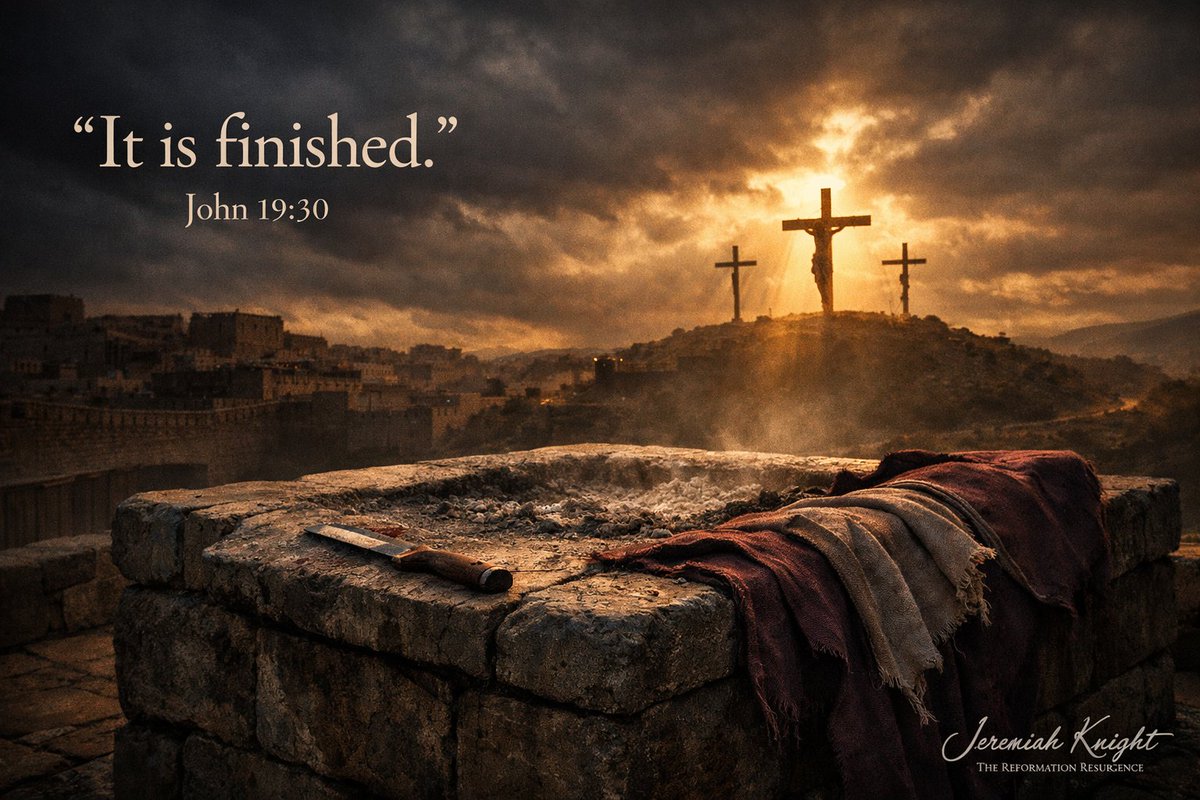
Scripture does not treat the temple as the centre of God’s plan. The New Testament consistently teaches that the entire temple system reached its fulfilment in Jesus Christ. When Jesus died, He cried out, “It is finished” (John 19:30). That statement was a declaration that the sacrificial system had REACHED ITS COMPLETION. The work that the temple sacrifices pointed toward had finally been accomplished.
The book of Hebrews explains this with unmistakable clarity. The writer says that the priests under the old covenant “stand daily ministering and offering time after time the same sacrifices, which can never take away sins; but He, having offered one sacrifice for sins for all time, sat down at the right hand of God” (Hebrews 10:11–12). Christ did not offer another temporary sacrifice. HE OFFERED THE FINAL ONE. That is why the chapter continues by declaring, “Where there is forgiveness of these things, there is no longer any offering for sin” (Hebrews 10:18).
This means the sacrificial system has reached its end. To return to animal sacrifices would not be a step forward in God’s redemptive plan. It would be a step backward toward shadows that have already been fulfilled in Christ. Hebrews warns about this very danger when it says that if the old system were still effective, the sacrifices would have continued without interruption (Hebrews 10:2). The reason they stopped is because Christ accomplished what they could never accomplish.
Many Christians overlook another crucial event recorded in the Gospels. At the moment Jesus died, “the veil of the temple was torn in two from top to bottom” (Matthew 27:51). That was not an accident of history. It was a divine declaration that the barrier between God and man had been removed through the sacrifice of Christ. The temple no longer functioned as the meeting place between God and humanity because Christ Himself had become the true mediator.
The New Testament goes even further by redefining the temple itself. Believers are now described as the temple of God. Paul writes, “Do you not know that you are a temple of God and that the Spirit of God dwells in you?” (1 Corinthians 3:16). The church is built together as a spiritual house where God dwells by His Spirit (Ephesians 2:19–22). The focus of God’s dwelling place is no longer a physical building in Jerusalem but the people redeemed by Christ.
This is why the expectation of a future temple with renewed sacrifices is not merely an interpretive mistake. It strikes at the heart of the gospel itself. If sacrifices were to resume as a legitimate act of worship, it would imply that the sacrifice of Christ was insufficient. The entire message of Hebrews exists to prevent that kind of thinking.
Some argue that future sacrifices would only serve as memorials of Christ’s death. But the Bible never describes animal sacrifices as memorial rituals. In the Old Testament they were offerings for sin. To reintroduce them in that form would contradict the clear teaching that Christ’s sacrifice was offered once for all.
History also teaches us something important here. The temple in Jerusalem was destroyed by the Romans in AD 70 just as Jesus predicted (Matthew 24:2). That destruction marked the visible end of the old covenant system. Since that day the worship of God has not been tied to a temple structure. Jesus Himself had already said that the hour was coming when true worship would not be confined to a place but would occur “in spirit and truth” (John 4:21–24).
If a third temple were ever built in Jerusalem, it would not restore biblical worship. It would represent a tragic rejection of the finished work of Christ. The reintroduction of sacrifices would not honour the cross. It would deny its sufficiency. Hebrews is explicit that Christ offered one sacrifice for sins for all time and that where forgiveness has been secured there is no longer any offering for sin (Hebrews 10:12, 18). Any system that returns to animal offerings after the death of the Son of God would be proclaiming, whether intentionally or not, that the cross was not enough.
IT MUST ALSO BE SAID PLAINLY THAT MUCH OF THE MODERN ENTHUSIASM FOR A REBUILT TEMPLE IS NOT DRIVEN BY THE GOSPEL BUT BY POLITICAL ZIONISM AND NATIONALIST AGENDAS THAT ATTEMPT TO MERGE BIBLICAL LANGUAGE WITH GEOPOLITICAL AMBITIONS.
When Christians uncritically adopt those narratives, they end up supporting a project that shifts attention away from Christ and back to shadows that the New Testament declares fulfilled. The gospel moves forward from the altar to the cross, not backward from the cross to the altar.
That is why the church must approach this subject with theological clarity rather than prophetic excitement. The gospel does not move backward to the shadows of the old covenant. It moves forward in the reality that Christ has accomplished redemption once for all.
The true temple has already come.
The final sacrifice has already been offered.
And the last word spoken from the cross still stands.
“IT IS FINISHED.” (John 19:30)
Listen to this pastor’s message regarding the U.S., Israel, and Iran war.
It’s deeper than what these social media influencers would like you to think. Ignore the noise and ignorance.