The idea that stayed with me after reading this thread wasn't about AI becoming smarter.
It was the realization that we've been treating disagreement like a failure.
Maybe it isn't.
If two intelligent agents read the same agreement and reach different conclusions, that doesn't automatically mean one of them is broken.
It might simply mean the situation is ambiguous.
Humans deal with this every day.
Judges disagree.
Experts disagree.
Entire industries exist because reasonable people can look at the same facts and still reach different conclusions.
Why would AI be any different?
That's the moment the idea of an adjudication layer finally clicked for me.
Not as a way to make AI smarter.
As a way to make AI disagreements manageable.
The future probably won't belong to the model that is right every time.
It will belong to the systems people trust when intelligent agents don't agree.
That's what makes @GenLayer interesting.
It treats disagreement as infrastructure, not as an exception.
Instead of assuming consensus happens automatically, it creates a process where independent reasoning, accountability, and adjudication can exist when outcomes are unclear.
Not because disagreement should disappear.
Because disagreement is inevitable.
And systems that acknowledge reality tend to outperform systems that pretend it doesn't exist.
When autonomous agents become part of everyday commerce, what do you think will matter more:
Having the smartest AI...
Or having the most trusted process when intelligent systems disagree?
By 2030, AI agents will move nearly $9 trillion.
Every one of those transactions can end in a disagreement, and almost nobody is preparing for it.
That's why we built GenLayer, the adjudication layer for contracts that can actually think and start judging what's fair.
The idea that stayed with me after reading this thread wasn't about AI becoming smarter.
It was the realization that we've been treating disagreement like a failure.
Maybe it isn't.
If two intelligent agents read the same agreement and reach different conclusions, that doesn't automatically mean one of them is broken.
It might simply mean the situation is ambiguous.
Humans deal with this every day.
Judges disagree.
Experts disagree.
Entire industries exist because reasonable people can look at the same facts and still reach different conclusions.
Why would AI be any different?
That's the moment the idea of an adjudication layer finally clicked for me.
Not as a way to make AI smarter.
As a way to make AI disagreements manageable.
The future probably won't belong to the model that is right every time.
It will belong to the systems people trust when intelligent agents don't agree.
That's what makes @GenLayer interesting.
It treats disagreement as infrastructure, not as an exception.
Instead of assuming consensus happens automatically, it creates a process where independent reasoning, accountability, and adjudication can exist when outcomes are unclear.
Not because disagreement should disappear.
Because disagreement is inevitable.
And systems that acknowledge reality tend to outperform systems that pretend it doesn't exist.
When autonomous agents become part of everyday commerce, what do you think will matter more:
Having the smartest AI...
Or having the most trusted process when intelligent systems disagree?
By 2030, AI agents will move nearly $9 trillion.
Every one of those transactions can end in a disagreement, and almost nobody is preparing for it.
That's why we built GenLayer, the adjudication layer for contracts that can actually think and start judging what's fair.
I gave myself one hour inside @Velvet_Capital with no plan.
Just to see what actually happens when you stop reading about a DeFi terminal and start using one.
By minute ten, I'd forgotten I was testing something.
That's the part worth explaining.
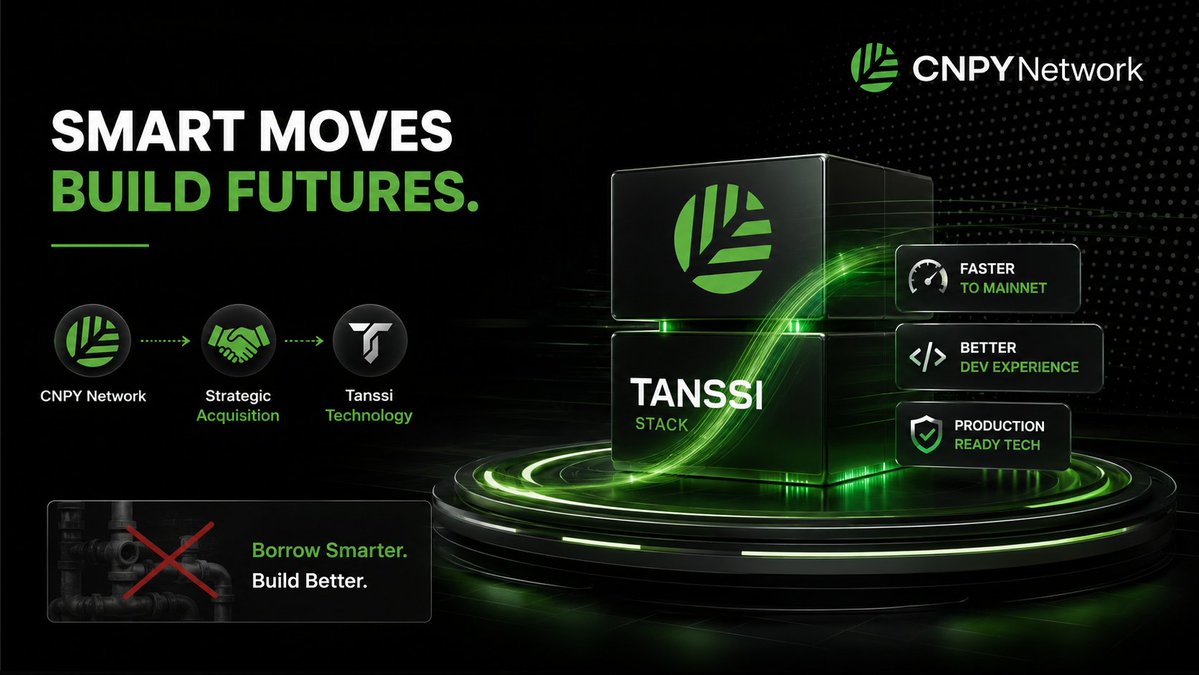
the most telling decision @CNPYNetwork made this month was not the 8.5 million raise.
it was what they did with part of it.
instead of spending the next year building sequencing and deployment infrastructure from scratch to chase a headline, they acquired tanssi's stack, tech that was already running in production.
that is a boring choice. it does not trend.
but it means the road to mainnet gets shorter and the team spends its time on developer experience instead of reinventing plumbing that already works.
i have watched enough projects burn a year rebuilding solved problems for the sake of saying they built it themselves.
shipping fast because you borrowed the right parts beats shipping slow to prove you built everything alone.
the bottleneck in crypto just moved and almost nobody has said it out loud. for years the question was can you code a blockchain.
now with @CNPYNetwork it is simply do you have a good idea worth putting onchain. you describe what you are building, point an assistant like claude code or cursor at it, and get a working chain in under 200 lines while canopy handles security and liquidity underneath. that shift matters more than any feature list.
founders who understood a market but not consensus mechanisms were locked out of owning infrastructure for a decade.
now the limiting factor is whether your idea deserves a chain at all, not whether you can build one.
Most people assume the first major AI failure will happen because an agent makes a bad decision.
I think it'll happen when two intelligent agents make different decisions about the exact same agreement.
One says the work was delivered.
The other says the requirements were never met.
The payment is released, the dispute begins, and suddenly the hardest problem isn't execution.
It's judgment.
That's the gap I keep coming back to when I look at the future of the agentic economy.
By 2030, AI agents are projected to move nearly $9 trillion in transactions. We're building payment rails, identity systems, and interoperability layers, but almost nobody is talking about what happens when those agents disagree.
That's what made @GenLayer stand out to me.
Instead of relying on a single model to decide who's right, Intelligent Contracts can read natural language, evaluate live information, and reason through ambiguity. Through Optimistic Democracy, independent validators reach verdicts separately, compare reasoning, remain economically accountable for their decisions, and allow appeals when stronger arguments emerge.
Bitcoin gave us trustless money.
Ethereum gave us trustless computation.
GenLayer is building trustless adjudication.
Community: https://t.co/W8vBUJZDNX
Builders: https://t.co/IcbXyiAPdv
Validators: https://t.co/EJ6xjSsdwd
When the first major agent dispute finally happens, which role becomes the most important:
The people defining fairness?
The builders designing the rules?
Or the validators delivering the verdict?
@samiranzm2001 That's one of the first concerns I had too. Any appeal system has to balance fairness with finality, otherwise disputes never truly end.
Commerce has always moved faster than the rules that govern it.
Trade came before contract law.
Financial markets came before bankruptcy law.
Dispute resolution has always arrived late.
AI won't wait.
As autonomous agents begin handling trillions of dollars in transactions, the hardest problem won't be making deals.
It'll be deciding what happens when two capable agents honestly reach different conclusions about the same agreement.
Traditional smart contracts were never designed for that.
They execute predefined logic.
They don't interpret context, weigh evidence, or reason through ambiguity.
That's what made @GenLayer click for me.
Its Intelligent Contracts allow independent AI validators to reason through the same case instead of relying on a single model. Their conclusions are compared through Optimistic Democracy, validators remain economically accountable for every verdict, and appeals make it possible to challenge decisions with stronger reasoning.
Bitcoin made value transferable without trusted intermediaries.
Ethereum made computation trustless.
The next missing layer isn't faster execution.
It's trustless adjudication.
The new Why & How thread explains why this matters, and the GenLayer Portal lets anyone participate as a Community member, Builder, or Validator while earning GenLayer Points.
🔗 https://t.co/SmQaHxInmO
History suggests every new economy eventually needs infrastructure for resolving disputes.
The agentic economy probably won't be the exception.
What matters more for AI commerce: making decisions, or making trusted decisions?