Samsung C&T(028260) increasingly looks like the Samsung Group version of SK Square.
The market has started rewarding holding companies with meaningful stakes in strategic assets, and SK Square’s recent re-rating is a clear example.
Yet Samsung C&T still trades at a significant discount despite owning one of the most valuable portfolios in Korea: a large stake in Samsung Electronics and a controlling interest in Samsung Life, which itself holds a substantial stake in Samsung Electronics.
As Samsung Electronics continues to strengthen its position in AI semiconductors, HBM, advanced packaging and foundry, the embedded value inside Samsung C&T becomes increasingly difficult to ignore.
Investors are effectively gaining exposure to Samsung Electronics through multiple layers while also benefiting from Samsung C&T’s construction, trading, renewable energy and biotech businesses.
What makes the setup particularly interesting is that the market is beginning to focus on asset value realization across Korean holding companies.
SK Square's sharp re-rating demonstrated how quickly discounts can narrow once investors start looking beyond reported earnings and focus on underlying asset value.
Samsung C&T owns one of the strongest collections of strategic assets in Korea, yet its valuation still fails to fully reflect the value of its Samsung Electronics and Samsung Life holdings.
If the market continues rewarding asset-rich holding companies, Samsung C&T may be one of the most compelling catch-up opportunities in the space.
https://t.co/QxNbSW2uDL
If Intel’s U.S. manufacturing ramp accelerates as suggested by recent headlines, the biggest beneficiary may not be semiconductor equipment vendors but materials and consumables suppliers.
For Comico, one of Intel’s key partners, higher fab utilization directly translates into increased demand for precision cleaning, coating services, and ESC-related products—making utilization recovery a far more powerful earnings driver than new fab construction alone.
https://t.co/Ho0zj5kkXB
Comico(183300) continues to emerge as one of the most direct beneficiaries of the accelerating AI semiconductor cycle.
As wafer starts recover across both memory and foundry, demand for its mission-critical precision cleaning and coating services is rising, while subsidiary Mico Ceramics is benefiting from surging demand for electrostatic chucks (ESCs), a key consumable used in advanced semiconductor equipment.
Major memory customers are ramping next-generation HBM production, leading-edge foundries are expanding advanced-node capacity, and Comico is investing aggressively to capture that demand.
The company is expanding annual ESC capacity from roughly KRW 350 billion to KRW 500 billion while accelerating investments in the U.S., including facility expansions in Austin, Hillsboro, and Phoenix.
The recent $100 million financing package from Citi and Korea Eximbank underscores confidence in Comico’s growing role within the global semiconductor supply chain.
Unlike many semiconductor suppliers that remain dependent on a single region, Comico is steadily building a localized manufacturing footprint in the United States, positioning itself closer to leading customers as semiconductor production increasingly shifts toward North America.
With semiconductor utilization rates recovering, ESC demand entering a multi-year upcycle, and U.S. expansion adding another layer of strategic value, Comico is evolving from a cleaning and coating supplier into a critical infrastructure provider for the next generation of semiconductor manufacturing.
https://t.co/pExXdk6eiu
LG Innotek(011070) is increasingly being viewed as an AI infrastructure story rather than a traditional smartphone supplier—and the latest analyst commentary suggests that transition is accelerating faster than the market expected.
KB Securities now expects a meaningful 2Q26 earnings surprise, forecasting operating profit of KRW 203 billion, roughly 39% above consensus despite what is typically a seasonal low quarter.
This would mark one of the strongest second-quarter performances in the company's history and reinforce the view that the earnings recovery is structural rather than cyclical.
The key driver is no longer just cameras.
Across the package solutions business, LG Innotek is emerging as a direct beneficiary of multiple AI hardware trends simultaneously.
The company is gaining exposure to SOCAMM2 substrates, GDDR7 substrates, and server FC-BGA substrates—three areas that are rapidly becoming critical bottlenecks within the AI ecosystem.
According to industry commentary, major U.S. customers are not only signing long-term agreements but are also providing investment support to secure future capacity, a strong indication that demand visibility extends well beyond the current cycle.
What makes the story particularly interesting is that the market may still be underestimating the scale of the substrate opportunity.
SOCAMM2 represents one of the most important memory architecture changes in AI servers, while GDDR7 demand continues to accelerate across next-generation AI accelerators and graphics platforms.
At the same time, hyperscalers and semiconductor companies are aggressively securing FC-BGA supply, turning the market into a seller's market where capacity, not demand, is the limiting factor.
The recent industry discussion around AI substrates further strengthens the thesis.
While investors remain focused on GPUs and HBM, substrate suppliers are increasingly becoming strategic assets because advanced AI chips simply cannot ship without them.
LG Innotek has already highlighted embedded-chip FC-BGA technology and is actively pursuing global AI semiconductor customers as it expands its package solutions business.
Meanwhile, the optical solutions business remains stronger than many investors appreciate.
Apple's AI ecosystem expansion, higher-end iPhone mix, and increasing optical content per device continue to support earnings, creating a rare situation where both of LG Innotek's core businesses—optics and substrates—are benefiting from AI at the same time.
The market historically valued LG Innotek as an Apple supplier.
The more relevant framework today may be that LG Innotek is becoming one of the few Korean companies with meaningful exposure to both sides of the AI hardware stack: AI-enabled edge devices through optical solutions and AI datacenter infrastructure through advanced semiconductor substrates.
If AI substrate shortages remain as tight as many industry participants expect, the company's re-rating may still have further room to run.
https://t.co/g6OvuEI3kq
The market is increasingly recognizing that Techwing(089030) has crossed one of the most important milestones: gaining access to SK hynix's HBM production line with its Cube Prober platform.
Techwing has been known as the global leader in memory test handlers, supplying all three major memory manufacturers.
The challenge was proving that its next-generation HBM inspection technology could become an industry standard rather than a niche product.
After successfully supplying Cube Prober systems to Samsung Electronics, Techwing has also passed SK hynix's final qualification process for HBM applications, clearing a critical hurdle toward volume deployment.
This is particularly significant because SK hynix currently sits at the center of the AI memory ecosystem as the dominant HBM supplier to leading AI accelerator programs.
The importance of the SK hynix win goes well beyond adding another customer.
Cube Prober is designed to inspect individual HBM dies and base dies at a stage where defect detection becomes increasingly critical as HBM complexity rises.
As the industry transitions toward HBM4 and beyond, inspection requirements are becoming more stringent, making yield management a strategic bottleneck rather than a simple manufacturing task.
Techwing's management has stated that Cube Prober could evolve from an optional process tool into a required step in future HBM production flows.
Samsung Electronics has already adopted the platform, SK hynix qualification has been completed, and Micron continues its evaluation process.
Techwing is steadily moving toward the rare position of having exposure to all three global HBM leaders.
The more important question today is whether Cube Prober can emerge as a de facto inspection standard for the HBM era.
If that happens, the SK hynix qualification may ultimately be remembered not as another customer win, but as the inflection point that transformed Techwing from a memory equipment supplier into one of the most direct beneficiaries of the global HBM expansion cycle.
https://t.co/HKy4WmOd6k
Samsung Electro-Mechanics' recent KRW 1.5 trillion silicon capacitor contract has understandably captured most of the market's attention.
What may be getting overlooked, however, is the company sitting one step further down the value chain: Nepes(033640).
Industry reports indicate that Nepes is responsible for the backend packaging process of Samsung Electro-Mechanics' silicon capacitors.
As silicon capacitor adoption accelerates across AI GPUs, HBM packages and next-generation AI servers, Nepes effectively gains exposure to one of the fastest-growing segments within advanced semiconductor packaging.
The opportunity extends beyond simple volume growth.
Samsung Electro-Mechanics is reportedly pursuing a package-deal strategy that combines silicon capacitors with FC-BGA solutions, reflecting the industry's push toward higher-performance packaging architectures.
Every increase in silicon capacitor penetration ultimately translates into additional packaging demand, placing Nepes in a strategically favorable position.
This also fits neatly with Nepes' broader long-term thesis.
The company remains one of the few OSAT players with meaningful commercial experience in FO-PLP (Fan-Out Panel Level Packaging), a technology widely regarded as a potential next-generation packaging platform capable of improving cost efficiency and scalability versus conventional wafer-level approaches.
According to recent analyst commentary, AI-related revenue currently accounts for roughly 10% of sales but could approach 40% by 2030 as silicon capacitors, AI server PMICs and advanced packaging applications continue to expand. Capacity investments are already underway to support that transition.
The market still tends to value Nepes as a traditional OSAT company.
The more interesting possibility is that Nepes is gradually evolving into a leveraged AI packaging beneficiary with exposure to two structural themes simultaneously: silicon capacitor adoption and next-generation advanced packaging.
The market is focused on Samsung Electro-Mechanics as the direct silicon capacitor winner.
The overlooked question is who benefits every time a silicon capacitor gets packaged—and the answer increasingly points to Nepes.
https://t.co/9LwekU06w9
One of the more interesting developments in the memory market is the growing recognition that LPDDR is no longer just a smartphone component—it is rapidly becoming a critical enabler of edge AI.
Recent industry reports suggest that AI adoption is driving a structural increase in high-performance, low-power memory content across smartphones, AI PCs, industrial devices, robotics platforms, and connected edge systems.
As AI workloads migrate closer to the device, memory solutions must deliver both higher bandwidth and superior power efficiency, making LPDDR one of the key beneficiaries of this transition.
That is precisely where Jeju Semiconductor(080220) stands out.
Unlike many memory-related names that are tied primarily to commodity DRAM cycles, Jeju Semiconductor has built its business around specialty memory solutions with LPDDR as a core product offering.
The company is already deeply embedded in mobile and IoT ecosystems where power efficiency and reliability are essential.
While investors remain heavily focused on HBM and AI server infrastructure, the next wave of AI growth is increasingly shifting toward edge devices.
Every AI smartphone, AI-enabled IoT device, smart industrial system, and autonomous robot requires more local memory, and LPDDR is emerging as the preferred architecture for many of these applications.
Jeju Semiconductor offers a differentiated way to participate in the AI memory cycle.
Rather than betting solely on datacenter spending, investors gain exposure to the memory platform powering AI adoption at the device level.
The market has spent the last two years talking about HBM as the memory of AI servers.
The next conversation may be about LPDDR as the memory of edge AI—and Jeju Semiconductor is one of the few Korean-listed companies with direct leverage to that theme.
https://t.co/u3KCEbuSF1
Cosmo Advanced Materials(005070) has quietly become one of the more interesting recovery stories in Korea’s materials sector.
While investor sentiment toward EV supply-chain names remains subdued, the company appears to be moving past its earnings trough just as several growth drivers begin to reaccelerate.
Temporary disruptions from weak North American EV demand and production adjustments at key customers weighed heavily on results over the past year, but the picture is now improving.
IBK Securities expects shipments to resume meaningfully from 2Q onward, with Samsung SDI EV-related volumes recovering and additional capacity ramping through the second half of the year.
Cathode capacity is expected to expand from roughly 30kt at the end of 2025 to 100kt by 2026, supporting a sharp acceleration in revenue and earnings growth over the next several years.
What makes the story more compelling, however, is that the market may be overlooking a second growth vector entirely.
Recent enthusiasm surrounding Samsung Electro-Mechanics, Murata, and other MLCC-related names has focused on rising demand for AI servers, networking equipment, and automotive electronics.
Yet one area that has received little attention is the upstream materials ecosystem supporting MLCC production itself.
According to recent industry reports, demand for MLCC release films is tightening as manufacturers expand output to meet growing AI infrastructure demand.
Cosmo Advanced Materials is one of the few domestic companies with meaningful exposure to this niche specialty-film segment.
Release films may not attract the same headlines as MLCCs themselves, but they are essential consumables in the manufacturing process.
As capacitor production scales higher, demand for these materials naturally follows.
While the market is currently rewarding the obvious beneficiaries of the MLCC cycle, it may not yet be fully appreciating the suppliers positioned further upstream.
The release-film opportunity is still largely absent from most investment discussions despite sharing the same end-market exposure to AI servers, optical networking equipment, and high-performance computing infrastructure.
Investors are getting a company whose primary earnings recovery is tied to a rebound in high-nickel cathode materials and Samsung SDI shipments, while also retaining underappreciated exposure to a potentially strengthening MLCC materials cycle.
With cathode shipments expected to recover, operating leverage beginning to return, and a hidden MLCC materials angle that the market has only started to recognize, Cosmo Advanced Materials increasingly looks like more than just another EV materials stock.
https://t.co/gpBh4OybbJ
TechWing(089030) has been one of the strongest names in the Korean semiconductor equipment space over the past two trading sessions, and the resilience is particularly notable given today's broad-based weakness across both KOSPI and KOSDAQ.
Investors are increasingly recognizing that TechWing is no longer just a memory handler company—it is becoming a critical enabler of the HBM inspection ecosystem.
According to recent reports, Samsung Electronics has already adopted TechWing's Cube Prober in its HBM4 production flow, while SK hynix has completed qualification and Micron is also evaluating the platform.
That puts TechWing in the rare position of potentially supplying all three global memory leaders with the same next-generation inspection solution.
What makes the Cube Prober particularly important is its role in testing the base die, the "brain" of future HBM architectures.
As HBM evolves beyond HBM4, the base die takes on increasingly complex logic and power-management functions, making comprehensive inspection a necessity rather than an option.
TechWing's management has gone as far as suggesting that Cube Prober could become a mandatory process step in future HBM generations, with expectations of more than 200 systems being shipped next year alone.
The company is simultaneously benefiting from a recovery in its core memory handler business while expanding into higher-value inspection equipment such as Cube Prober and next-generation probe stations.
A new manufacturing facility in Cheonan is already being prepared to support future demand growth.
Perhaps the most important takeaway is that HBM scaling is increasingly becoming a yield-management challenge rather than simply a capacity-expansion story.
In that environment, companies controlling critical inspection points tend to capture disproportionate value.
With Samsung, SK hynix, and Micron all either adopting, qualifying, or evaluating its technology, TechWing is emerging as one of the most strategically positioned beneficiaries of the next phase of HBM adoption.
https://t.co/dbbYzMSt91
Pemtron(168360) has built a unique portfolio spanning SMT inspection and semiconductor inspection equipment, serving customers across memory IDMs, foundries, OSATs, EMS providers, and PCB manufacturers.
While its core SMT inspection business continues to provide a solid foundation, the company's next phase of growth is increasingly being driven by advanced semiconductor inspection applications.
What makes Pemtron particularly interesting is its ability to address virtually every major stacked-memory architecture currently attracting industry attention, including HBM, HBF, and SOCAMM.
The company possesses one of the broadest 3D inspection portfolios capable of measuring stacking gaps and detecting defects throughout the stacking process, positioning it to benefit as memory architectures become more complex and inspection intensity increases.
Samsung Electronics is reportedly accelerating commercialization of next-generation memory solutions such as SOCAMM to support AI servers, creating additional demand for advanced inspection and metrology technologies.
As memory moves from 12-layer designs toward 16-layer, 20-layer, and even higher-stack configurations, inspection requirements expand not linearly but exponentially due to tighter yield management requirements.
HBM inspection systems command significantly higher ASPs than traditional SMT equipment, often several times higher and in some cases more than an order of magnitude higher.
As stacked-memory inspection becomes a larger portion of the revenue mix, Pemtron's business model gradually shifts toward higher-value semiconductor inspection solutions.
Beyond wafer and package inspection, Pemtron has developed solutions covering wire bonding, FC-BGA substrates, memory modules, and advanced packaging applications.
While many view Pemtron as a traditional machine-vision company, the bigger picture may be that it is evolving into a comprehensive semiconductor inspection platform leveraged to the growth of HBM, HBF, SOCAMM, and next-generation AI memory.
As the industry moves toward higher stacking, more complex packaging, and stricter yield requirements, inspection intensity is likely to increase faster than wafer output itself—a dynamic that could make inspection equipment one of the most attractive picks-and-shovels segments within the AI memory value chain.
https://t.co/hYv35OwQP3
KoYoung Technology(098460) has been mainly viewed as a traditional SMT inspection company.
That perception has evolved toward an AI infrastructure beneficiary through optical module inspection, CPO-related opportunities, and advanced packaging metrology.
Now, the company is beginning to gain exposure to another long-duration secular theme: the commercialization of space.
According to Shinhan Securities, the rapid increase in global satellite launches is creating a meaningful new demand source for high-precision inspection systems.
SpaceX alone launched 165 Falcon rockets in 2025, while global launch activity has risen for three consecutive years.
Unlike commercial electronics, many aerospace components require exceptionally high reliability standards, making inspection and quality control a mission-critical step rather than an optional one.
Modern satellites and launch systems contain complex PCB and FPCB architectures, power management systems, communication modules, sensors, and AI-enabled control units.
As system complexity increases, the need for advanced AOI and 3D inspection rises accordingly, and every reduction in defect rates translates directly into improved mission reliability.
The common thread across AI servers, optical interconnects, humanoid robots, and satellites is straightforward: all require increasingly complex electronics, tighter manufacturing tolerances, and higher inspection standards.
Each new growth market ultimately expands demand for KoYoung's core competency.
AI servers continue to drive optical module and packaging inspection demand, humanoid robotics is emerging as another meaningful growth avenue given the large number of PCBs and control systems embedded in each robot, and the accelerating space economy could create an additional layer of demand over the coming years.
The market has largely focused on AI so far, but the combination of AI infrastructure, humanoid robotics, medical robots, and now space electronics suggests that the company's TAM may be expanding faster than investors currently appreciate.
The latest order of KoYoung Technology(098460) may be more important than it initially appears.
Following its recently disclosed optical module inspection business, the company has now secured an additional SOCAMM2 inspection equipment order, further expanding its footprint across some of the most critical hardware layers of next-generation AI infrastructure.
Most inspection equipment vendors participate in a single niche, but KoYoung is steadily building a comprehensive advanced packaging inspection platform spanning CPO and optical modules, wafer-level inspection, substrate-level inspection, and now SOCAMM-related applications.
Few companies globally can claim exposure across so many AI-driven packaging and interconnect technologies simultaneously.
The optical module opportunity is particularly compelling.
As AI clusters transition from 400G to 800G and eventually 1.6T networking, the complexity of silicon photonics, DSP integration, laser packaging, and bump inspection rises dramatically. Industry discussions increasingly point to optical interconnects and CPO as the next major bottleneck in AI infrastructure, creating a structural rather than cyclical demand driver for advanced inspection solutions.
SOCAMM adds another layer to the story.
As memory architectures evolve to support AI workloads more efficiently, new packaging and module formats require increasingly sophisticated quality control and metrology capabilities.
The addition of SOCAMM-related inspection further strengthens KoYoung's position within the broader AI packaging ecosystem.
Perhaps most importantly, these orders continue to validate the thesis highlighted by recent analyst reports: KoYoung is no longer simply an SMT inspection company.
The company is becoming a direct beneficiary of AI infrastructure spending through advanced packaging and optical interconnect inspection, where meaningful competition remains limited.
Investors have spent years focusing on compute and the bottlenecks are shifting toward packaging, interconnects, and yield management.
With growing exposure to both optical networking and SOCAMM inspection, KoYoung appears to be positioning itself at the center of that transition.
https://t.co/e2nyZBZvyL
The Bloomberg report suggesting that Google could source more than 3 million AI chips through Intel's manufacturing ecosystem reinforces a trend that many investors are still underestimating: hyperscaler AI spending is increasingly shifting from merchant GPUs toward custom ASICs.
If that transition continues, few Korean companies are better positioned than Isu Petasys(007660).
Unlike many AI hardware names whose exposure depends on a single customer or product cycle, Isu Petasys sits at the heart of the infrastructure layer that enables large-scale ASIC deployment.
Every generation of Google TPU requires increasingly sophisticated high-layer MLB boards to support higher bandwidth, denser routing, improved signal integrity, and massive power delivery requirements.
As Google scales TPU clusters and AI networking architectures become more demanding, the value content of advanced multilayer boards increases as well.
Investors do not need to predict the winning AI chip; they simply need to recognize that more TPUs, more AI switches, and more custom silicon ultimately require more advanced MLB capacity.
The market has spent years focusing on NVIDIA's compute leadership and the next phase of AI infrastructure investment may be defined by hyperscaler-owned silicon, and Google appears to be leading that transition.
If so, Isu Petasys could emerge as one of the most direct beneficiaries of the TPU buildout cycle anywhere in Korea.
Despite that positioning, the company still trades at a meaningful discount to global PCB peers such as TTM Technologies and Gold Circuit Electronics.
For investors looking for ASIC exposure rather than GPU exposure, Isu Petasys is one of the cleanest ways to participate.
https://t.co/GaAJF3afng
The reported purchase order from Elon Musk’s TerraPeta project is noteworthy not because of its size, but because it reinforces where HPSP(403870) sits within the semiconductor equipment landscape.
While many equipment vendors are still discussing future opportunities with next-generation AI and advanced computing projects, HPSP appears to be converting those conversations into actual orders.
That is a direct reflection of its technological moat.
HPSP remains the world's first and only commercial supplier of high-pressure hydrogen annealing (HPHA) systems, a process that has become increasingly critical as semiconductor scaling advances toward ever more complex transistor architectures.
High-pressure hydrogen annealing directly improves device performance and reliability while enabling lower-temperature processing, making it particularly valuable for advanced logic, memory, FinFET, GAA, and future device architectures.
HPSP itself describes HPHA as an essential process for advanced-node manufacturing, and the company continues to expand joint development efforts with imec and leading semiconductor manufacturers.
The implication is straightforward: if a frontier AI infrastructure project such as TerraPeta is already issuing purchase orders, it suggests that HPSP's technology is increasingly viewed as part of the enabling layer for next-generation semiconductor manufacturing rather than a discretionary process step.
In an industry where many equipment suppliers compete on execution, HPSP's advantage comes from owning a process capability that few others can replicate.
As advanced-node adoption broadens and AI-driven semiconductor demand accelerates, the company's monopoly-like position in high-pressure hydrogen annealing may prove even more valuable than investors currently appreciate.
https://t.co/UpkSEnRXZo
Hanmi Pharmaceutical(128940) is evolving from a traditional Korean pharma company into a global obesity and metabolic disease platform, with its valuation now being driven as much by pipeline optionality as by its core business.
Mirae Asset recently raised its target price to KRW 700,000, citing both improving earnings visibility and a significant increase in pipeline value.
The key driver is efinopegdutide, Hanmi’s GLP-1–based obesity asset licensed to Eli Lilly, which alone is now estimated to be worth more than KRW 1.9 trillion following encouraging Phase 1 data.
The drug demonstrated a long half-life of 108–167 hours, strong weight-loss efficacy, favorable safety results, and pharmacokinetic characteristics that support once-monthly dosing.
If these advantages continue to hold up in later-stage studies, the commercial opportunity could extend well beyond the current obesity market.
Additional pipeline catalysts remain on the horizon, including MASH programs, next-generation obesity candidates, and multiple clinical readouts expected over the coming quarters.
Lilly's involvement substantially de-risks development while increasing the probability of future milestone payments and commercialization success.
In Hanmi's case, investors are gaining exposure to a profitable pharmaceutical franchise while retaining significant upside from one of the most promising Korean-developed obesity pipelines currently in global development.
Hyundai Mobis(012330) is no longer just an automotive supplier story.
In a report that stands out even within the recent Korean robotics rerating cycle, KB Securities raised its target price to KRW 1.2 million and outlined a valuation framework implying more than KRW 100 trillion in equity value, driven by the convergence of automotive technology, robotics, and high-value actuators.
The centerpiece of the thesis is surprisingly simple: actuators.
KB argues that as humanoid robots move toward mass adoption, actuators could become one of the highest-value components in the entire robotics stack, and Hyundai Mobis is uniquely positioned to emerge as a key supplier through its relationship with Boston Dynamics and the broader Hyundai Motor Group ecosystem.
The report estimates that the actuator business alone could eventually generate operating profit comparable to that of major industrial companies today.
The analyst values Hyundai Mobis using three pillars: its existing automotive business, its indirect exposure to Boston Dynamics, and the future actuator opportunity.
The robotics upside is increasingly being layered on top of an already profitable and globally competitive automotive franchise rather than replacing it.
Following Jensen Huang’s recent comments expressing interest in expanding investment in Korean robotics and AI-related industries, the possibility of deeper collaboration between NVIDIA and Hyundai Motor Group has become a recurring topic among investors.
While no formal partnership has been announced, the strategic logic is easy to understand: NVIDIA provides the AI brain, Boston Dynamics provides the robotics platform, and Hyundai Mobis could become a critical hardware enabler through sensors, control systems, and actuators.
For years, the market viewed Hyundai Mobis primarily as a parts supplier.
The emerging investment case looks very different.
If humanoid robotics becomes one of the defining industrial trends of the next decade, Hyundai Mobis may ultimately be remembered not as an auto component company with a robotics option, but as one of the key hardware suppliers powering the commercialization of intelligent robots at scale.
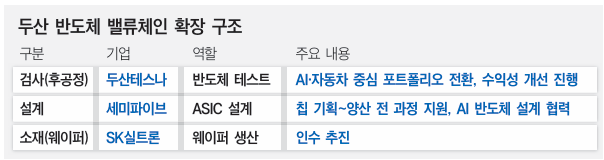
Doosan(000150) rallied on renewed AI optimism surrounding Jensen Huang’s Korea visit, but the market may still be underappreciating one of its most interesting hidden assets: its strategic exposure to the custom ASIC ecosystem through its stake in SemiFive(490470).
While most investors focus on Doosan’s direct AI infrastructure businesses, SemiFive has emerged as one of Korea’s most important ASIC design platforms, helping customers develop custom AI accelerators and specialized semiconductors at a time when hyperscalers are increasingly shifting beyond off-the-shelf GPUs.
As the AI industry moves toward a world of custom silicon, advanced packaging, and vertically optimized infrastructure, Doosan is exposed not only to the physical AI supply chain but also to the design layer through SemiFive.
This creates a rare combination of hardware, infrastructure, and semiconductor design optionality under a single umbrella.
The market is increasingly rewarding companies tied to the ASIC value chain, and SemiFive's growing relevance suggests that Doosan's stake could become more strategically important than many investors currently assume.
Jensen Huang's visit may be less about a short-term headline and more about highlighting where the next phase of AI investment is headed: custom silicon, advanced packaging, and the broader ASIC ecosystem.
https://t.co/HtIzJeY0vM
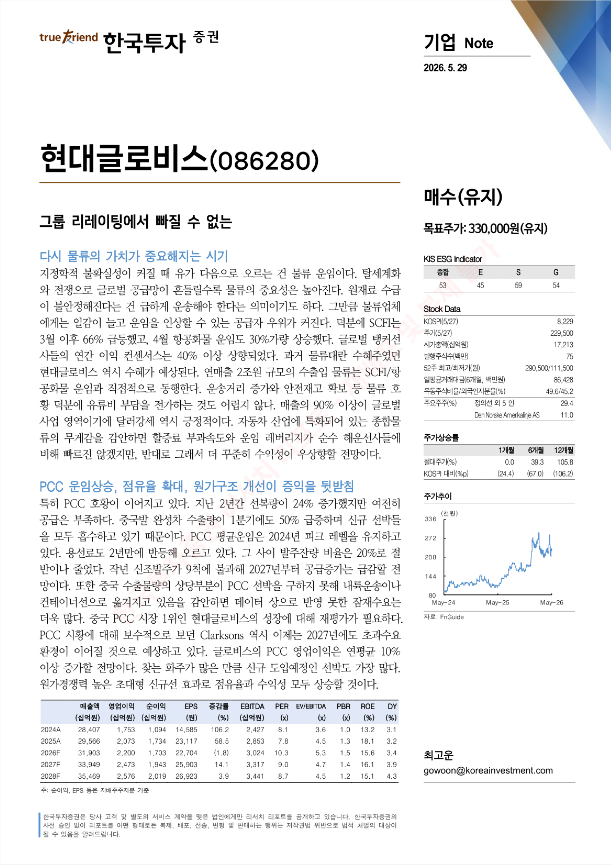
Hyundai Glovis(086280) may be one of the most misunderstood stocks in Korea today.
Despite being a direct beneficiary of the ongoing Middle East logistics disruption and enjoying one of the strongest earnings outlooks within the transportation sector, the stock has materially underperformed while investors chased robotics-related rerating stories elsewhere in the Hyundai Motor Group ecosystem.
The irony is that Hyundai Glovis arguably offers the greatest listed exposure to robotics within the entire group when measured against its market capitalization.
The company owns an 11.25% stake in Boston Dynamics, and with market discussions increasingly assigning a potential long-term value of KRW 100 trillion or more to Boston Dynamics, the implied value of Glovis’ stake alone becomes extraordinarily significant.
Even after applying a substantial holding-company discount, investors are effectively buying a global logistics franchise with leading PCC economics, improving shareholder returns, and structural shipping tailwinds at what appears to be only 5–6x 2026 earnings.
That valuation looks increasingly difficult to justify given the company’s strategic assets and earnings visibility.
What makes the story particularly compelling is that the market continues to treat logistics and robotics as unrelated themes.
Yet if Hyundai Motor Group’s robotics ambitions ultimately scale as expected, Hyundai Glovis is unlikely to remain a passive shareholder.
As the group's logistics backbone and one of the largest owners of Boston Dynamics equity, the company sits much closer to Hyundai's future mobility and robotics roadmap than many investors currently appreciate.
PCC shipping rates continue to benefit from tight vessel supply, improving utilization, and favorable industry fundamentals, while Middle East-related logistics disruptions provide an additional tailwind.
Unlike many thematic stories that depend on future expectations, Hyundai Glovis combines visible earnings growth today with significant hidden asset value tomorrow.
They are gaining exposure to one of the strongest automotive logistics franchises globally while also acquiring one of the largest Boston Dynamics-linked equity positions available anywhere in the Hyundai ecosystem — at a valuation that still reflects neither.