Nejlepším lékem na deprese je uvědomit si fakt, že lidstvo jako celek, i přes své chyby a nedostatky, s nejvyšším nasazením a bez ohledu na oběti pracuje na splnění své úlohy ve vesmíru: obohatit složení Země o plasty, vyvinout inteligentní bojové roboty a vyhubit se.
Nie mogę przestać tego oglądać 😅
Koreański influencer przyleciał do Francji, aby zrobić strima i zadać kłam prawackim mitom, że niby francuskie miasta są niebezpieczne z powodu obecności w nich afrykańskich imigrantów.
Ledwo co wysiadł z taryfy i od razu został zaatakowany przez grupę murzynów. Przeszedł dosłownie kilkaset metrów. Dostał lepe na ryj, stracił buta i ukradli mu statyw.
"Nie, proszę, proszę, nie róbcie tego! Proszę, nie!"
I to wszystko w środku dnia na otwartej ulicy.
“I’m 23 years old… and my clitoris is completely numb, like the back of my elbow. I can’t orgasm. I can’t feel love for my own mother. I can’t even enjoy music anymore.”
That was Laureen Friedman’s raw testimony at a recent Safety Advocates on Mental Health Care panel.
She lives with PSSD — Post-SSRI Sexual Dysfunction. After taking Zoloft, she woke up one day with total genital numbness, zero libido, permanent inability to orgasm, and a sudden emotional numbness she describes as “chemical castration” and an “emotional lobotomy.” What used to be a deeply emotional, empathetic, songwriting young woman now feels disconnected from the core human experiences of love and pleasure.
She says she was never warned this could happen even after stopping the drug.
Millions are prescribed SSRIs every year, often without being told about rare but potentially permanent side effects like PSSD. People deserve full informed consent about what they’re risking.
Have you or anyone you know experienced lasting sexual or emotional side effects from antidepressants?
Bangladéš…
Druhá nejvíc znečištěná země na naší planetě.
Jedním z důvodů je, že je to druhý největší exportér oblečení na světě.
Přes 4000 fabrik většinou nemá kanalizaci ani nějaký systém zpracování odpadů.
As a Muslim it's not bad. There are so many here now people are begrudgingly acclimated to them. There's resistance to Islam to some degree but if things keep up. Germany will become a new Bosnia seeing how many Germans are becoming Muslim. It's not a flood, but surprisingly many.
Halal food can be found in regular stores now, not just the ones run by foreign Muslims, which used to be the case in the past. Masjids are many in every major city.
I don't advise living here if you're a productive person. The government doesn't view you as human, you are a resource that must have its value extracted from at any and all cost. If you're a scrounger then this place is great, a LOT of benefits that makes low income people consider the idea that working makes no sense since you can not work and come out with the same money as a jobless person. Because most people on benefits are foreign, it causes tension between locals and refugees, immigrants tend to work.
Nice place to visit, don't live here.
🚨تضارب في تحديد موعد انتهاء الهدنة...
- باكستان تقول: الهدنة تنتهي الأربعاء 4:50 فجرًا بتوقيت باكستان.
(الأربعاء الساعة 2:50 فجرًا بتوقيت السعودية).
- الولايات المتحدة تقول: الهدنة تنتهي 8:30 مساء الغد بتوقيت شرق أمريكا.
(الخميس الساعة 3:30 فجراً بتوقيت السعودية).
- إيران تقول: الهدنة تنتهي يوم الأربعاء.
(لم يتم تحديد ساعة معينة).
Vegans: "Drinking cow's milk is unnatural!"
Great point.
So instead of pulling on some teats for thirty seconds, we've developed a twelve-step industrial alternative.
Step one: grow almonds in California, a drought-afflicted state currently depleting an aquifer that took twenty thousand years to fill.
Step two: ship them to a processing facility.
Step three: soak them in water. California water, specifically, because almonds need 15 gallons per ounce and California is already rationing.
Step four: pulverise them into a slurry.
Step five: filter the slurry through fine mesh, discarding most of the actual almond in the process. That was the bit with the nutrition in it. Gone now.
Step six: add more water, because the resulting liquid isn't watery enough.
Step seven: add sweeteners, because it tastes of nothing.
Step eight: add emulsifiers, because it separates in six minutes otherwise.
Step nine: add synthetic vitamins, because all the natural ones left in step five.
Step ten: add seed oils, because we apparently learned nothing.
Step eleven: homogenise, degas, pasteurise, and sterilise the mixture until it resembles no food that has ever existed in nature.
Step twelve: put it in a carton with a picture of a field on it.
The cow: stands in a field. Makes milk. Has done this for ten thousand years. No factory. No steps. No aquifer.
Unnatural, though. Very unnatural.
Too many people have a mouth, and speak without saying anything at all.
They weaponize language like a blunt instrument, endless streams of filler, slogans, hot takes, and performative virtue that echo loudly but land hollow.
Their words tumble out in pursuit of validation, applause, or dominance, yet they rarely carry weight, rarely pierce the surface, rarely reveal anything true or beautiful or courageous. They speak to fill the silence, to signal belonging, to win imaginary arguments. In the end, the noise reveals more about their emptiness than any idea worth sharing.
Too many people have ears to hear, and refuse to listen.
They possess the machinery of hearing but reject its purpose. Conversations become battles where the goal is never understanding, only victory. They nod politely on the outside while inside they’re already drafting their rebuttal.
Uncomfortable truths are labeled “harmful,” dissenting voices are canceled or caricatured, and nuance is treated like a threat. Real listening demands vulnerability—the willingness to be wrong, to be moved, to let another person’s reality reshape your own. Most would rather remain sealed inside their fortified opinions than risk the humility of genuine dialogue.
Too many people have eyes to see, yet keep themselves in the dark even when the harsh reality of truth confronts them head on.
They look, but they do not behold. Evidence stares them in the face—clear, undeniable, sometimes brutal—and still they squint, deflect, or scroll past in search of something more comforting. They curate their vision like a carefully edited feed: blocking what challenges them, amplifying what flatters them. Cognitive dissonance becomes a lifestyle.
They’d rather cling to comforting illusions, convenient narratives, or tribal loyalties than face the raw, unflinching light of reality. Closing their eyes to truth doesn’t make the truth disappear—it only leaves them stumbling through life, blind by choice, wondering why the world feels so confusing.
We live in an age of equipped human beings who refuse to use what they’ve been given.
Mouths that produce sound but no substance.
Ears that register noise but not meaning.
Eyes that register light but reject sight.
The tragedy isn’t the lack of tools—it’s the deliberate refusal to wield them with honesty and courage.
The rarest souls among us are those who speak with purpose, listen with openness, and look truth dead in the eye without flinching. They don’t just exist in the world.
A Soviet psychologist walked into a café in 1927 and watched a waiter do something impossible.
He remembered every open order at every table. Perfectly. Without notes. Without effort.
Then a table paid their bill. She asked him to repeat the order.
He couldn't remember a single item.
She spent the next two years figuring out why. What she found is now the operating system underneath every platform fighting for your attention.
Her name was Bluma Zeigarnik, and she was a graduate student at the time, sitting with her professor Kurt Lewin, watching the waiters work the room. What caught her attention was something so ordinary that it had been happening in restaurants for centuries without anyone asking why.
The waiters could remember every open order with perfect accuracy. Table four wanted the schnitzel with no sauce. Table seven had changed their wine twice. Table twelve owed for three coffees and a dessert. Every detail, held without effort, without notes, without any visible system at all.
But the moment a table paid their bill, the information vanished. Completely. Lewin tested it on the spot. He called a waiter back minutes after a table had settled up and asked him to recite the order. The waiter could not do it. Not partially. Not approximately. The information was simply gone.
Zeigarnik went back to her lab and spent the next two years turning that observation into one of the most replicated findings in the history of psychology.
Here is what she proved, and why it changes how you think about attention, memory, and almost every piece of media you have ever consumed.
She gave participants a series of tasks. Some tasks they were allowed to finish. Others were interrupted before completion. Then she tested recall across both groups.
The unfinished tasks were remembered at nearly twice the rate of the completed ones.
Not slightly better. Nearly twice. The brain was holding the incomplete work in a state of active tension, returning to it, keeping it warm, refusing to file it away. The finished tasks were closed, archived, released. The unfinished ones were still running.
She called it the resumption goal. When the brain commits to a task and cannot complete it, it opens a file that stays open until resolution arrives. That open file consumes a portion of your cognitive bandwidth whether you are thinking about it consciously or not. It surfaces in idle moments. It pulls at the edge of your attention during other work. It is the thing you find yourself thinking about in the shower when you were not trying to think about anything at all.
This is not a flaw in human cognition. It is a feature. The brain evolved to finish things. An open loop is a signal that something important is unresolved. Keeping that signal active increases the probability that you will return to it and complete it. In an environment where most tasks had real survival stakes, this was an extraordinarily useful mechanism.
In the modern world, it is the most exploited vulnerability in human attention.
Netflix did not invent the cliffhanger. But it industrialized it in a way no medium before it ever had. When a show ends on an unresolved question, it does not just create curiosity. It opens a file in your brain that stays active until the next episode closes it. The autoplay countdown that begins at 15 seconds is not a convenience feature. It is a precise calculation about how long the average person can tolerate an open loop before the discomfort of not knowing overrides every other intention they had for the evening. One more episode is not a choice. It is your brain doing exactly what it was designed to do: return to what is unfinished.
The writers who built Lost, Breaking Bad, and Succession understood this intuitively without ever reading a psychology paper. Every episode ended on an open question. Every season finale answered three things and opened five more. The entire architecture of prestige television is a Zeigarnik machine running at industrial scale.
But television is not where this gets dangerous.
Every notification on your phone is an open loop. Every unread email is an open loop. Every task you wrote on a list and have not yet crossed off is an open loop. Each one is consuming a small but real portion of your available attention, pulling fractionally at your focus, degrading your capacity to be fully present in whatever you are actually doing right now. TikTok's algorithm does not just serve you content you like. It serves you content that ends one loop and immediately opens another, keeping the resumption system permanently activated so the cost of stopping always feels higher than the cost of continuing.
The research on this accumulation effect is striking. Psychologists studying cognitive load have found that unfinished tasks do not sit passively in memory. They actively interrupt. They surface at the wrong moments. They are the reason you are reading something and suddenly remember an email you forgot to send. The brain is not malfunctioning. It is running its resumption system exactly as designed. It is just running it across forty open loops simultaneously, in an environment that generates new ones faster than any human nervous system was built to process.
The most important practical implication Zeigarnik's research produced is one that most people use backwards.
David Allen built his entire Getting Things Done system on the insight that the only way to close a cognitive open loop is to either complete the task or make a trusted commitment to complete it later. Writing something down in a system you actually trust has the same effect on the brain as finishing it. The file closes. The bandwidth is released. This is why writing a task down feels like relief even before you have done anything about it. You have not solved the problem. You have simply told your brain that the loop is registered and will be returned to, which is enough for the resumption system to stand down.
The inverse is equally true and far more destructive. Every task that lives only in your head, unwritten and unscheduled, is an open loop burning cognitive resources around the clock. The mental cost is not proportional to the size of the task. A tiny nagging obligation consumes the same active tension as a major project. Your brain does not discriminate by importance. It discriminates by completion.
Zeigarnik published her findings in 1927. The paper sat in academic literature for decades before anyone outside psychology paid attention to it.
Then television got good. Then the smartphone arrived. Then the entire attention economy was engineered, largely by people who understood intuitively what she had proven scientifically: an open loop is the most powerful hook available to anyone who wants to hold human attention.
Netflix knew it. Instagram knew it. Every designer who ever made a notification badge red instead of grey knew it.
The café in Vienna is long gone.
The mechanism she discovered there is now the operating system underneath every platform fighting for your time.
Every "to be continued."
Every unread notification.
Every thread that ends with "part 2 tomorrow."
All of it is the same waiter, the same unpaid bill, the same brain refusing to let go of what it has not yet finished.
Zeigarnik noticed it over coffee in 1927.
A century later, it is the most valuable insight in the history of media.
And nobody taught it to you in school.
Every election in developed countries for the last ten years:
Voters: we want less immigration
Politicians: we’re going to stifle housing through regulation
V: we want less immigration
P: we’re going to give more money to seniors
V: we want less immigration
P: we’re going to do green energy that will raise energy prices
V: we want less immigration
P: we’re going to give more military aid to Ukraine and Israel
V: we want less immigration
P: we’re going to do mass immigration because the economy absolutely needs it
V: …
P: we need censorship, democracy is under assault from populists
Finland tracked every gender-referred adolescent in the country for up to 25 years.
Their psychiatric needs didn't improve after 'gender reassignment'. They surged.
A landmark peer-reviewed study just dropped. Here's what it found. 🧵
טראמפ מנסה למכור לעולם שחסימת מצר הורמוז על ידי איראן היא "בעיה של העולם, לא של ארה"ב". הוא טוען שאמריקה היא מעצמת נפט אז היא חסינה. המציאות? זה פשוט לא נכון. הנה המציאות ב-3 נקודות פשוטות:
1. מחיר הנפט הוא גלובלי.
זה נכון שארה"ב היא מעצמת נפט, אבל נפט הוא מוצר גלובלי. ברגע ש-20% מאספקת הנפט העולמית שעוברת בהורמוז נתקעת, מחיר החבית מזנק לכל העולם. מה זה אומר? שגם אם הנפט מופק בטקסס - היצרן הטקסני ימכור אותו במחיר השוק העולמי לתחנת הדלק בארה"ב.
2. המיתוס של "עצמאות אנרגטית".
ארה"ב אולי מייצאת המון נפט אבל היא מייבאת לא פחות. על מנת שהתעשייה שלה תתפקד היא חייבת לייבא כ-6 מיליון חביות ביום. למה? כי חלק מבתי הזיקוק שלה בנויים לנפט "כבד" שמגיע מהעולם - בזמן שהיא מפיקה בעיקר נפט "קל".
3. מכה לחקלאות האמריקאית.
מצר הורמוז הוא לא רק נתיב לנפט, הוא עורק ראשי לדשנים חקלאיים (אמוניה ואוריאה). נכון ל-2025 כ-13% מכלל יבוא הדשנים של ארה"ב מגיע ישירות ממדינות המפרץ ועובר במצר. במוצרים ספציפיים זה אפילו יותר גרוע: 28% מיבוא האוריאה (דשן חנקני קריטי) של ארה"ב מגיע מהמפרץ. חסימה של המצר מקפיצה מיד את עלויות הייצור של החקלאים באמריקה.
הבעיה האמיתית היא שטראמפ ונתניהו ניהלו אסטרטגיה של "מקסימום לחץ" בלי לבנות "מקסימום הגנה" על נתיבי הסחר. הם הניחו שהחיסול של חמינאי ומכת הפתיחה תהמם את האיראנים והם לא יעזו לחסום את המצר. אבל בפועל מה שזה עשה הוא רק לדחוק את האיראנים לפינה, וכשצד אחד מרגיש שאין לו מה להפסיד הוא שובר את הכלים.
Your Tesla has a 60 GHz RADAR pointed at your face.
Not for driving or autopilot.
For "cabin monitoring"
Texas Instruments IWR6843AOP chip.
60-64 GHz millimeter wave. mounted above the rearview mirror. beaming down into the cabin.
Detecting your breathing, your heart rate, whether a child is in the back seat.
Sounds helpful until you understand what 60 GHz millimeter waves actually do to biology.
60 GHz penetrates roughly 0.4 mm into skin.
shallow enough for the industry to call "safe"
But your skin is the largest organ in your body. packed with Nerve endings, Merkel cells, melanocytes.
Soviet-era research documented non-thermal biological effects of mmWaves at low power densities.. effects the FCC has never evaluated.
and nobody has studied what happens when this signal runs continuously for 10-hour drives, week after week, year after year.
This cabin RADAR was installed in late 2021 but never activated.
Left dormant for over 3 years.
February 2025, software update 2025.2.6 quietly turned it on.
no opt-out or announcement.
just switched on.
and it doesn't turn off.
it runs while you drive. while you're parked. while you're charging. while your kids sit in the back seat on a 10-hour road trip. continuous millimeter wave exposure at close range.. 0.4 to 2 meters from your body.
That's not a cell tower 200 meters away. that's a RADAR transmitter inside a sealed metal box with you.
a Faraday cage works both ways. the metal body of the car that blocks outside signals also TRAPS the ones generated inside. every RF source in that cabin bounces off the roof, the doors, the floor.. back into you.
and the cabin RADAR is just one layer.
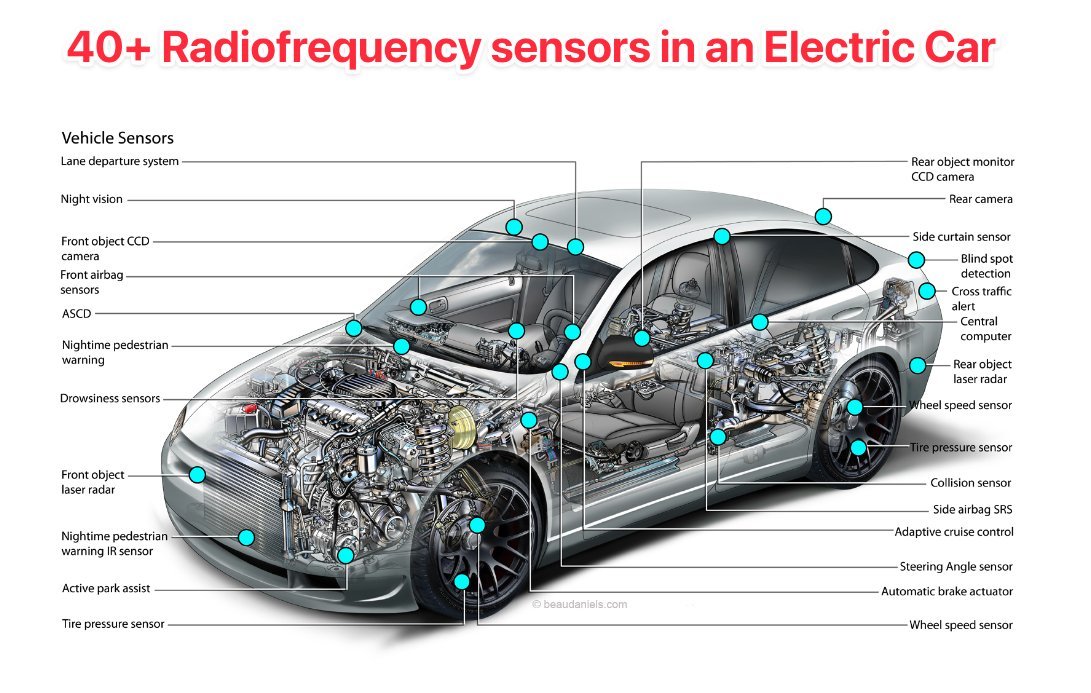
a Tesla Model S Plaid has 46 antennas.
— LTE cellular: 700-2600 MHz, 2x2 MIMO, always on
— WiFi: 2.4 + 5 GHz, dual band
— Bluetooth: 2.4 GHz, always scanning for your phone key
— UWB ultra-wideband: 6-8 GHz, phone-as-key
— GPS: 1.2-1.6 GHz
— Satellite radio: 2.3 GHz
— Cabin RADAR: 60-64 GHz
LTE, Bluetooth and cabin RADAR are essentially ALWAYS transmitting.
A 2025 study on the Tesla Model Y took 952 EMF measurements across SuperCharging, standard charging, high-speed driving, urban and idle states.
They found:
1/ Peak ELF emissions during SuperCharging, especially near center console and rear seats
2/RF hotspots from LTE, WiFi, Bluetooth in the sub-6 GHz range
3/ Body voltage INCREASED during SuperCharging and high-speed driving
4/ EMF varied dramatically depending on where you sit in the cabin
FCC safety limits are from 1996.
Based on animal studies measuring only THERMAL effects for less than 1 hour. no non-thermal biological effects considered. no study has EVER examined chronic simultaneous exposure to ELF + LTE + WiFi + Bluetooth + 60 GHz mmWave + UWB in a sealed metal cabin.
NOT ONCE.
In 2021, a U.S. Court of Appeals ruled the FCC's refusal to update these limits was "arbitrary and capricious." they still haven't changed them.
Martin Pall's model calculates that VGCCs amplify EMF forces by 7.2 million times at the cellular level. that calcium flooding triggers peroxynitrite formation, PARP activation, NAD+ depletion.. your repair machinery eating itself.
You're sitting in a metal box with 40+ antennas, a millimeter-wave RADAR pointed at your chest and AC magnetic fields from a battery pack under your seat pulling hundreds of kilowatts during charging.
and the safety standard says it's fine because your skin didn't get warm.
Diabolical.