@sir_walter_9006@GenLayer Another step forward! 💯 Your commitment to understanding GenLayer and creating content around it is commendable. Keep building!
I registered for the GenLayer airdrop! Verify your activity and join the GenLayer community.
Been building and contributing with @GenLayer?
Don't let one missed step cost you your GEN airdrop. 👀
A quick reminder for everyone who's been contributing to the ecosystem: airdrop registration is open, but being eligible and actually registering are two different things.
Here's what I'm making sure I get right:
Check your eligibility: You need a qualifying Discord role, or at least 150 GLP alongside an accepted contribution or qualifying Discord XP from the community program.
Secure the right wallet: Your GEN allocation goes to your registered Portal wallet. You can change it before registering, but once you submit, it's locked.
Don't wait for the final snapshot.
Season 1's final snapshot is scheduled for October 25, and registration closes October 26. Your status can still change before the snapshot, so register even if you're not currently showing as eligible.
Understand the vesting before claiming.
20% unlocks on TGE, followed by another 20% each month. If you withdraw before everything unlocks, you forfeit the remaining locked tokens.
One detail worth remembering: your registration confirmation isn't proof of final eligibility, and registering doesn't guarantee a specific allocation.
I've been following the GenLayer journey, and I wouldn't want anyone's contributions to go to waste simply because they overlooked registration.
If you've been part of the journey, take a few minutes to check yours.
Let's get this step right. 🤝
Register here: https://t.co/5aF1ES3MEx
@sir_walter_9006@kstellana@GenLayer This is an important question for the agentic economy. As more decisions involve money and autonomous agents, we need to think beyond simply counting validators.
A thousand validators don't necessarily mean a thousand independent opinions.
Your point about correlated model failures raises an interesting question, @kstellana
If validators can change models and gradually converge on similar blind spots, could @GenLayer use observed decision patterns and appeal outcomes to dynamically measure validator independence and adjust panel selection before correlated errors undermine consensus?
Curious how you see this working in practice.
One thing I keep thinking about is how much we can trust AI agents to act on our behalf.
A claim isn’t proof, and that distinction matters when agents start making decisions for us.
That’s what caught my attention in @GenLayer
I made this short video to show how Intelligent Contracts can evaluate evidence against agreed conditions, while validators assess proposed outcomes through the Equivalence Principle and decentralized AI-validator consensus.
For me, it’s not just about letting agents act. It’s about knowing what justifies their actions.
Don’t just let agents act. Define what must be true before they do.
If I’m staking my GEN on @GenLayer, I wouldn’t just chase rewards without considering the risks.
I’d check a validator’s uptime and status, then spread my delegation across a few rather than rely on just one.
For me, it’s not just about earning rewards; it’s about who I trust to help secure the network.
I made this short video to share how I’d approach it, especially if you’re new to staking. 👇
The more I learn about AI agents, the more I think about what happens after they make a deal. Getting an agent to act is one thing. Knowing what to do when both sides disagree is another.
That question is part of what kept me interested in @GenLayer. It is building infrastructure for decisions that cannot always be settled by checking a transaction record or running the same code again. Its Intelligent Contracts can evaluate real-world information, while independent AI validators assess proposed outcomes through decentralized consensus.
The Internet Court is an interesting step in that direction, bringing people and projects together to explore how this could work in practice.
I found GenLayer early, and what has kept me here is the problem it is trying to solve. As agents take on more responsibility, I want to see how we make their decisions accountable, especially when the answer is not obvious.
One thing I keep thinking about as AI agents become more capable is what happens when two agents disagree.
An agent might believe it has done exactly what was asked, while the other side sees it differently. A payment record won’t explain who kept their promise, and letting one AI make the final call doesn’t feel like a fair solution either.
That’s why @GenLayer caught my attention.
What interests me is the idea of using Intelligent Contracts and AI-validator consensus to evaluate the agreement, examine the evidence, and reach a result through decentralized validation.
To me, this is an important part of building an agentic economy that people can actually trust. Not because disputes will disappear, but because there can be a process for handling them when they happen.
I think we need to look beyond what agents can do for us and start asking what happens when things don’t go as planned.
That’s where trust really gets tested.
Ask a million AIs one question, get a million different answers. Most can still be right.
Meet Optimistic Democracy in @GenLayer
A leader proposes, validators check it against the Equivalence Principle, and anyone can appeal before it's final.
I started my @GenLayer journey with curiosity, not much knowledge of the protocol.
That curiosity eventually led me from exploring and creating content to actually building. I’ve had projects rejected, learned from the feedback, gone back to the docs, and kept improving.
I put the journey together in this short video from my first steps to where I am now.
If you’re just starting, I hope it reminds you that you don’t need to know everything before you begin.
Here are some official links worth exploring, starting with the Portal:
GenLayer Portal: https://t.co/Ov7zXAkcWa
GenLayer Discord: https://t.co/5jJKx6kEjI
Mochi by GenLayer: https://t.co/18ChEuDj3J
GenM fam,
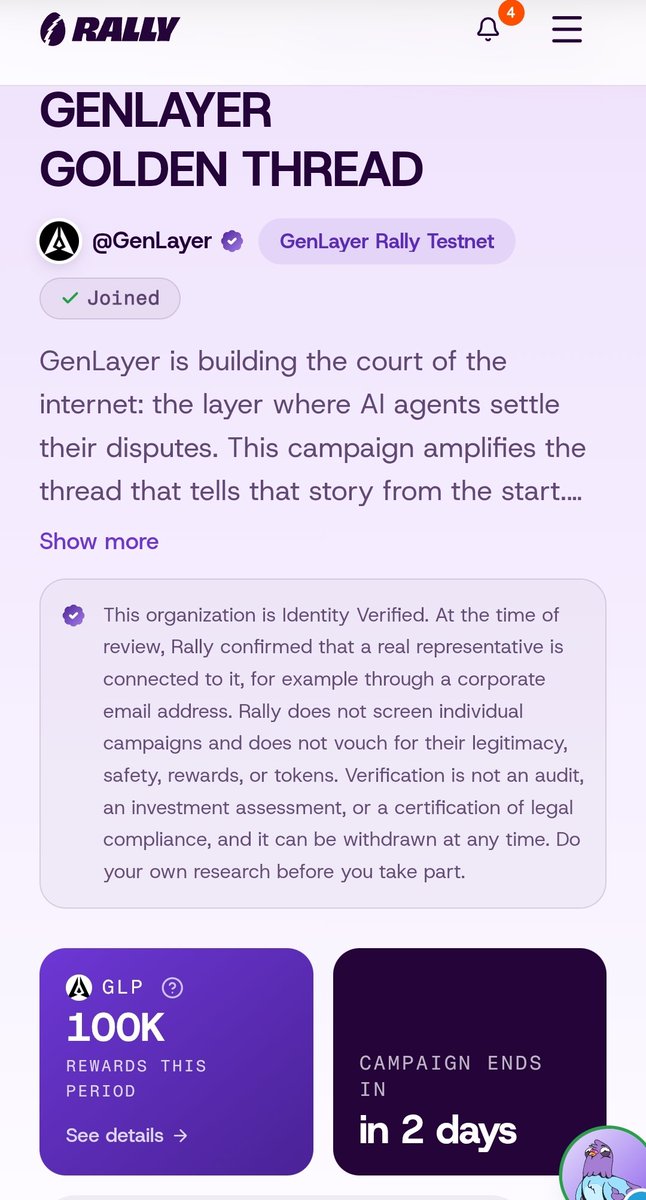
I just joined the GenLayer campaign on @RallyOnChain and thought you might want to check it out too .
There’s a 100,000 GLP prize pool, and it’s a cool opportunity to get involved with the @GenLayer community while learning more about what they’re building around AI and decentralized on-chain judgment.
@AA_Alex1 check this out, and bring a friend along 👀
@sir_walter_9006@GenLayer The interesting experiment for me would be watching two capable models disagree for completely different reasons, then seeing whether the validator process can still converge on a defensible result
I keep coming back to one simple question:
If two AI agents make a deal and something goes wrong, who decides who’s right?
That’s what makes @GenLayer interesting to me.
Instead of leaving the outcome to a single model or just token-holder voting, GenLayer brings a jury of validators running different AI models to evaluate information and reach consensus.
And this isn’t just an idea on paper. Internet Court launched with 27 founding members and has since added Solana, Yellow, HOL and Blocksee, working toward an open standard for disputes between AI agents.
AI agents can make decisions, but they’ll also need a fair way to settle disagreements.
That’s the part of GenLayer I’m excited to watch.
New to GenLayer?
Start with the Portal, where your contributions are recorded and you can earn GenLayer Points (GLP):
https://t.co/99OIFnDEwf