Gambling industry entrepreneur, investor, advisor. GP at Acies Investments, Operating Advisor at Arctos Sports Partners, Partner Emeritus at Eilers & Krejcik.
Many of the eCommerce product showcase videos you now see on Instagram and TikTok are AI-generated. It's generally fairly easy to tell because the hands may be mangled, the faces don't retain consistency throughout, and/or the person in the video interacts in odd ways with the product (hand passing through it, etc.). This is because diffusion transformers (DiT) are trained primarily on RGB representations, meaning they infer human-object boundaries from appearance alone.
A new paper from Alibaba introduces CoInteract, which trains a DiT on two parallel representations of the same scene: a standard RGB video stream and an auxiliary Human-Object Interaction (HOI) stream that strips away texture from the human representation while preserving body structure and interaction geometry. The two streams are trained jointly through a shared backbone with co-attention, allowing the model to learn physical interaction priors during training. The HOI stream is discarded at inference, so most of the quality gains come with almost no additional generation cost.
The framework also introduces face- and hand-specific experts in an MoE architecture that routes tokens via a "spatially supervised router." The training pipeline relies heavily on off-the-shelf tools for object segmentation, human mesh recovery, and hand/face detection to create human- and object-masked streams and to encode them both into a shared latent representation. The model was trained on 12k clips with "RGB–HOI representations, hand/face bounding boxes, and silhouette masks." CoInteract outperformed other SOTA models on nearly every benchmark.
Paper linked below.
Introducing The Run by Called It.
We make a prediction market call. We back it. And we carry it — position by position — until we hit our target.
$250 to $1 Million
Every call is logged. Every result is public. Nothing gets deleted.
Editorial only. Not financial advice.
Kalshi has filed to offer contracts related to fantasy football for the first time, having self-certified contracts on players’ average draft position.
The contracts use Sleeper’s single-QB point-per-reception redraft leagues as the sole source agency to determine ADP. In February, Sleeper started offering Kalshi’s sports event contracts.
This is true from a category perspective, but any given competitor in the retail casino category can certainly be outcompeted by companies that better leverage technology.
Good news is that bar is fairly low in the retail casino industry due to its ~hermetic nature.
Barry Diller, whose company already owns a 26% share of casino giant, has said he sees it as a business that is less at risk of being disintermediated by technology. https://t.co/ec4mUcvFVE
On The Record is live today 11am EST.
@dannyburke5 will be joined by @AdamMKaufman and @CormacYanited to discuss the following prediction markets:
⚾️CI. Daily Call of Texas Rangers to Win
⚽️The World Cup Golden Boot Winner
👽Will Aliens be Confirmed to Exist?
Watch here on X or at https://t.co/0CjDb76cZr
Starting today, licensed Massachusetts sports betting operators must send out notifications to customers if their sports betting activity is limited in any way.
Several operators have confirmed with @SBD notifications are going out.
https://t.co/ug0Ar892Zw
Gonna do an unsolicited plug here: If you are in gaming and enjoy just learning about the business, there really is no better conference than the @UNLVigi#GamblingConf. Regulators, academics, industry execs all find so much to take from this event.
If you’ve been anywhere near gambling Twitter the last few weeks, you’ve seen it: Kalish vs Kalshi.
DraftKings co-founder @mattkalish, freshly retired from the company, lighting up the timeline with one critique after another of Kalshi.
The Business of Betting podcast got Kalish on to find out what set him off — and why he continues to beat the drum.
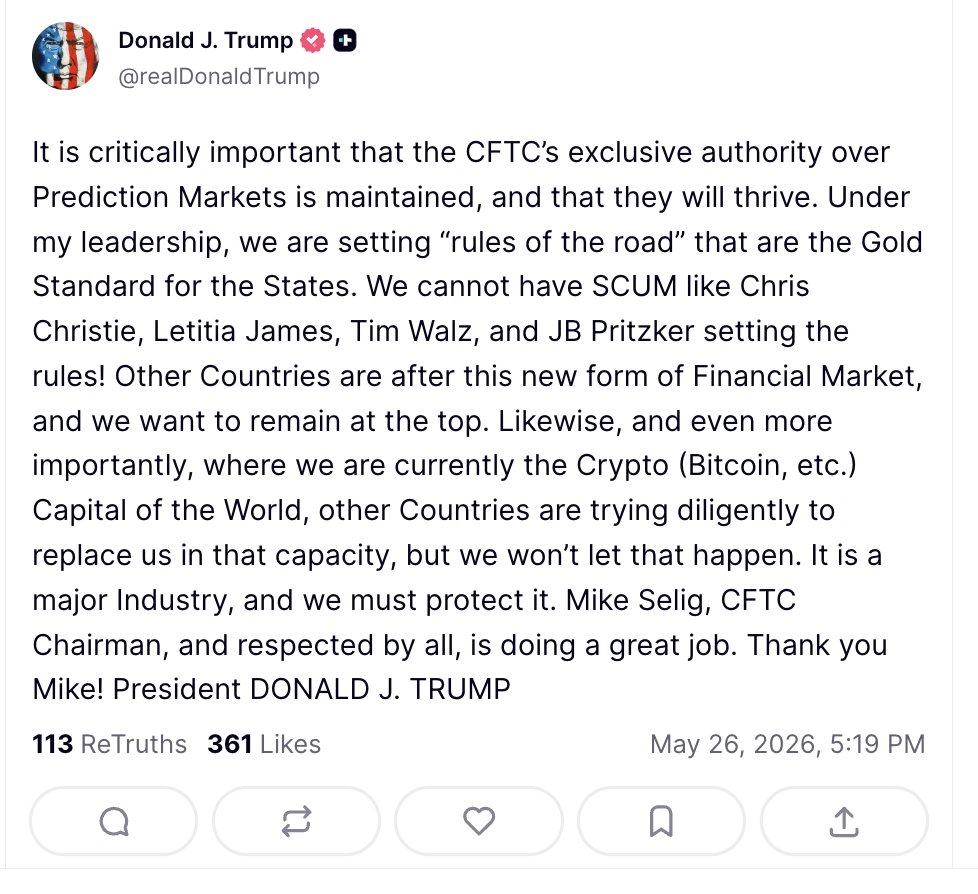
Breaking down President Trump’s most comprehensive comments yet about PREDICTION MARKETS:
—Full-throated endorsement of the view that prediction platforms are “financial markets” (not gambling) and therefore can only be regulated by the @CFTC , not the states. (This is already the Trump administration view. It’s being litigated in the courts.)
—Strong praise for the CFTC chair he appointed, @MichaelSelig. (Who also strongly backs the industry.)
—Attacks Democratic-run states like MN, NY, IL, that are trying to regulate prediction markets. (MN just became the first state to ban prediction markets. CFTC immediately sued to block the law.)
—Also slams @ChrisChristie, a lobbyist for the casino industry, who regularly bashes prediction sites.
(Notably not mentioned: Trump's social media company is getting involved in prediction markets. And Don Jr. is an investor in Polymarket and an adviser to Kalshi.)
Totalis (@totalistrading) lets users parlay on anything.
Combine multiple event markets into one trade across politics, crypto, stocks, sports, weather, and macro. Starting with parlays, expanding into structured products.
Congrats on the launch, @ImTheBigP & @ericliujt!
https://t.co/1rSLysBXA2
Year over year single month (or quarterly, or even annual) comps for OSB can easily be misleading. Lot of variables factor into total handle, and not all of them reflect underlying steady state demand
Citizens Bank analysts say online sports betting handle in the US actually increased slightly in April (1%) compared to a year earlier, “the first month of positive same-store growth since November.”
Big bumps for Fanatics and bet365, the latter of which launched in MI in April.
Wednesday’s highly anticipated congressional hearing on sports betting integrity netted little new for the gambling industry.
It was more of an educational moment for the Senate Committee on Commerce, Science, and Transportation’s Subcommittee on Consumer Protection, Technology, and Data Privacy.
Five witnesses testified and fielded questions from the committee, which for the most part was transparent about where it stood on prediction markets and federal oversight of sports betting.
DraftKings, Andreessen Horowitz and Meta are spending millions to influence state elections, which have become frontlines for regulation https://t.co/V38mo3DDx9