⬛️ https://t.co/kxpDC1Py0f
Early users of Optima Beta who also sign up for the waitlist for compute supply stand to receive future rewards.
To ensure eligibility for these rewards, users must use the same wallet address for both experiencing Optima Beta and filling out the waitlist form.
#Base #AI #LLM
Since joining BNB Chain(@BNBCHAIN), MiL.k has secured a Binance Alpha listing, launched the USD1 Loyalty Hub with 60K+ participants, and recorded $110M+ in MLK trading volume.
Next, we’re teaming up with BNB chain for a special event at KBW.
👉 https://t.co/DmXAxS5c8r
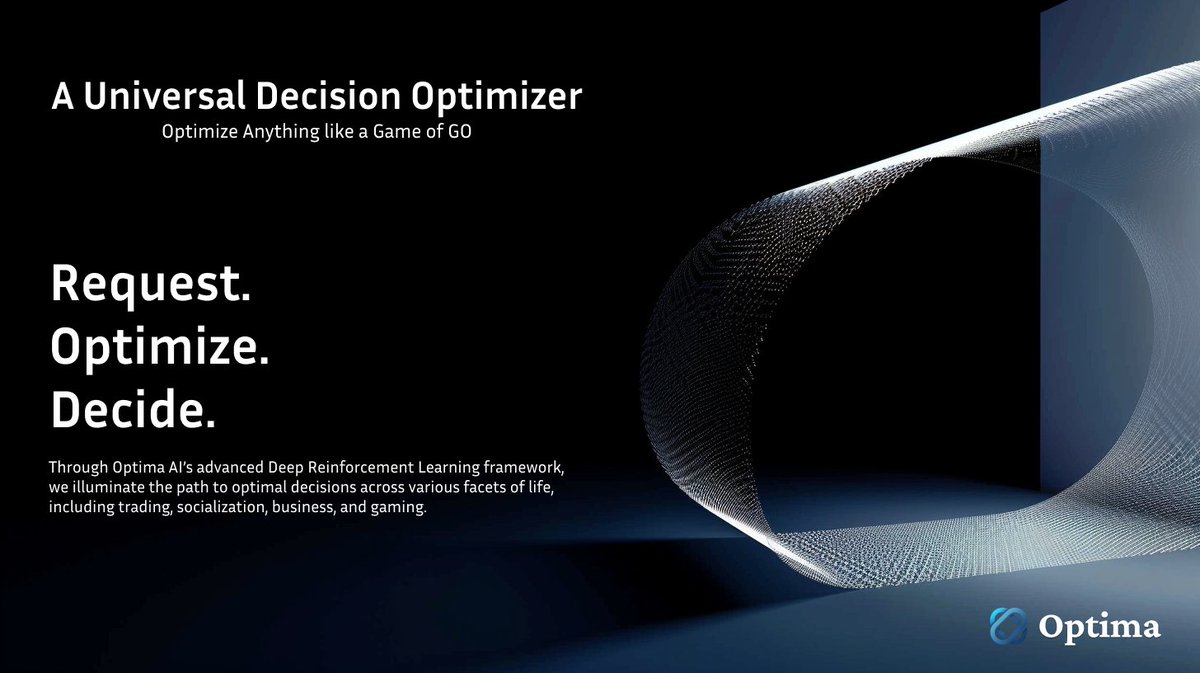
Experience Optima AI: the universal decision optimizer for gaming, trading, business, and interpersonal relations, powered by deep reinforcement learning.
Embrace a future free from information gaps in decision-making.
#AI#DRL#BaseChain
2024.04.01: Network Stress Test Complete
To boost-start the Optima Network, 83.49PFLOPS of computing power has been confirmed as the initial compute supply from our partner mining farms.
#BASEChain#AI#Compute#Optimizer
Supply. Earn. Use.
Waitlist for compute supply is now open. Be among the first to supply to the network and join our move to democratise information seeking, data ownership, and privacy computing.
#AI#LLM#DeInfra#DDL#base
Excited to announce that https://t.co/Q5cVZBQ33h is now live!
We share one goal to eliminate information gap, centralized digital control, and misguided decision-making.
Experience Optima AI Beta and join the waitlist for compute supply to the network!
#AI#DePIN#DRL#LLM
Optima envisions a world where decision-making and planning are as strategic and profound as a game of GO, empowering humans to navigate life's complex board with confidence and precision.
#Ethereum#ArtificialIntelligence
Through gathering all of the world's compute into a global supercluster, including computers, phones, tablets, and FPGA, Optima seeks equal right and democracy over the advancement of AI technology.
#artificalintelligence
At Optima, the power of advanced Deep Reinforcement Learing(DRL) framework aims to demonstrate how to make optimal decisions in diverse realms of life, including trading, interpersonal communication, business, and gaming.
#AGI
Anyone who tried to read any scientific article at least once knows that English cannot be used to clearly convey ideas. Most people, including the brightest of scientists, have a hard time writing clearly. I'm sure Nvidia CEO knows that too. What he is doing here is he is selling the snake oil that fuels the multi-trillion valuation of his company's business. Keep listening and buy more GPUs.
Logistic Regression is the most important foundational algorithm in Classification Modeling. In 2 minutes, I'll teach you what took me 2 months to learn. Let's dive in:
1. Logistic regression is a statistical method used for analyzing a dataset in which there are one or more independent variables that determine a binary outcome (in which there are only two possible outcomes). This is commonly called a binary classification problem.
2. The Logit (Log-Odds): The formula estimates the log-odds or logit. The right-hand side is the same as the form for linear regression. But the left-hand side is the logit function, which is the natural log of the odds ratio. The logit function is what distinguishes logistic regression from other types of regression.
3. The S-Curve: Logistic regression uses a sigmoid (or logistic) function to model the data. This function maps any real-valued number into a value between 0 and 1, making it suitable for a probability estimation. This is where the S-curve shape comes in.
4. Why not Linear Regression? The shape of the S-curve often fits the binary outcome better than a linear regression. Linear regression assumes the relationship is linear, which often does not hold for binary outcomes, where the relationship between the independent variables and the probability of the outcome is typically not linear but sigmoidal (S-shaped).
5. Coefficient Estimation: Like linear regression, logistic regression calculates coefficients for each independent variable. However, these coefficients are in the log-odds scale.
6. Coefficient Interpretation (Log-Odds to Odds): Exponentiating a coefficient converts it from log odds to odds. For example, if a coefficient is 0.5, the odds ratio is exp(0.5), which is approximately 1.65. This means that with a one-unit increase in the predictor, the odds of the outcome increase by a factor of 1.65.
7. Model evaluation: The evaluation metrics for linear regression (like R-squared) are not suitable for assessing the performance of a model in a classification context. For Logistic regression, I normally use classification-specific evaluation metrics like AUC, precision, recall, F1 score, ROC curve, etc.
===
Want help improving your data science skills?
👉Free 10 Skills Webinar: I put together a free on-demand workshop that covers the 10 skills that helped me make the transition to Data Scientist: https://t.co/LR39RJ5XKB
👉ChatGPT for 10X Faster DS Projects: I have a live workshop where I'll share how to use ChatGPT for Data Science (so you can complete projects 10X faster): https://t.co/EaMpKrJiqX
If you like this post, please reshare ♻️ it so others can get value.
🚀 𝐀𝐜𝐭𝐢𝐯𝐞𝐑𝐀𝐆: 𝐑𝐞𝐯𝐞𝐚𝐥𝐢𝐧𝐠 𝐭𝐡𝐞 𝐓𝐫𝐞𝐚𝐬𝐮𝐫𝐞𝐬 𝐨𝐟 𝐊𝐧𝐨𝐰𝐥𝐞𝐝𝐠𝐞 𝐯𝐢𝐚 𝐀𝐜𝐭𝐢𝐯𝐞 𝐋𝐞𝐚𝐫𝐧𝐢𝐧𝐠 🌟
Retrieval-augmented generation (RAG) combines LLMs with external knowledge to create more accurate and relevant answers. However, RAG's effectiveness seems affected by noise from retrieved knowledge, leading to potential inaccuracies.
The usual RAG method's passive approach to external information contradicts Constructivism's active knowledge construction, making LLMs mere holders of external data without deeper refinement.
🔍 𝐀𝐩𝐩𝐫𝐨𝐚𝐜𝐡:
To address these issues, 𝐀𝐜𝐭𝐢𝐯𝐞𝐑𝐀𝐆 introduces a three-step pipeline—Retrieval, Knowledge Construction, and Cognition Nexus—to improve answer accuracy and comprehension:
1️⃣ 𝐑𝐞𝐭𝐫𝐢𝐞𝐯𝐚𝐥: retrieves relevant passages/chunks for the queries.
2️⃣ 𝐊𝐧𝐨𝐰𝐥𝐞𝐝𝐠𝐞 𝐂𝐨𝐧𝐬𝐭𝐫𝐮𝐜𝐭𝐢𝐨𝐧: Deepens understanding by connecting new with existing knowledge, expanding cognitive boundaries through Semantic Association, Epistemic Anchoring, Logical Reasoning, and Cognitive Alignment.
▶ 𝐒𝐞𝐦𝐚𝐧𝐭𝐢𝐜 𝐀𝐬𝐬𝐨𝐜𝐢𝐚𝐭𝐢𝐨𝐧: Connects new knowledge with existing.
▶ 𝐄𝐩𝐢𝐬𝐭𝐞𝐦𝐢𝐜 𝐀𝐧𝐜𝐡𝐨𝐫𝐢𝐧𝐠: Establishes new knowledge bases.
▶ 𝐋𝐨𝐠𝐢𝐜𝐚𝐥 𝐑𝐞𝐚𝐬𝐨𝐧𝐢𝐧𝐠: Constructs knowledge to solve problems.
▶ 𝐂𝐨𝐠𝐧𝐢𝐭𝐢𝐯𝐞 𝐀𝐥𝐢𝐠𝐧𝐦𝐞𝐧𝐭: Refines understanding with new or conflicting information.
3️⃣ 𝐂𝐨𝐠𝐧𝐢𝐭𝐢𝐨𝐧 𝐍𝐞𝐱𝐮𝐬: Finally, it integrates the outcomes of knowledge construction with the LLM's intrinsic cognitive processes. This includes generating an initial chain of thought for the given query and refining it with the newly constructed knowledge to produce more precise answers.
📈 𝐑𝐞����𝐮𝐥𝐭:
𝐀𝐜𝐭𝐢𝐯𝐞𝐑𝐀𝐆 achieves a 5% improvement over baseline approaches.
⚠️ 𝐋𝐢𝐦𝐢𝐭𝐚𝐭𝐢𝐨𝐧:
The process requires three LLM calls—increasing latency and costs.
📄 𝐏𝐚𝐩𝐞𝐫: https://t.co/kUMLdcuXyi
💻 𝐂𝐨𝐝𝐞: https://t.co/eOoKwF8L07
Thanks, @_akhaliq for sharing our work. 🙏
🌍Palo is the first open-source Large Multimodal Model (LMM) offering ten key languages covering 2/3rd of the world’s population.
Paper: https://t.co/fIJUZgdc8d
Code: https://t.co/uKkij9Dyna
Demo: https://t.co/We8erqgzWv
#LLM@mbzuai
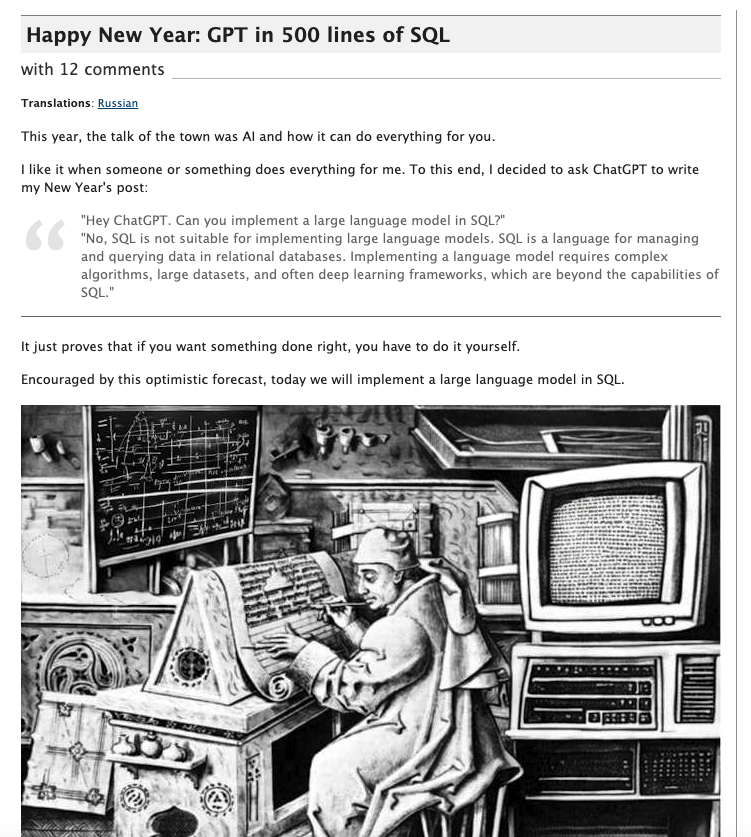
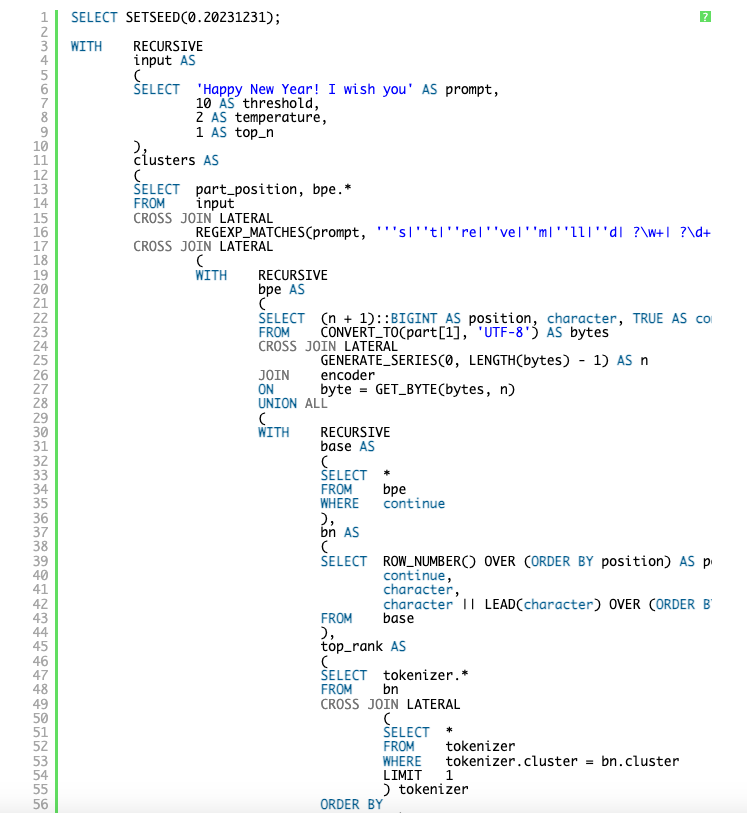
GPT in 500 lines of SQL
Attempts to implement an LLM with SQL in just 500 lines.
If you are interested in diving deep into the inner workings of GPT this is a fun weekend read.
By the way, this approach of breaking things down in a form you better understand I find to be an exceptional approach to learning. I didn't use SQL, but I have done something similar with GPT using detailed pseudocode.
https://t.co/u4hb45cmO1