@JonahLupton I bought downside puts, sold upside calls, and bought stock delta neutral. This benefits from a small bounce or major correction on Monday.
The AI bubble is primarily an earnings bubble rather than a valuation bubble. My report this week discusses the metrics investors should monitor to know when this bubble is about to burst.
Clients can read it here:
https://t.co/nPpZ5E1mas
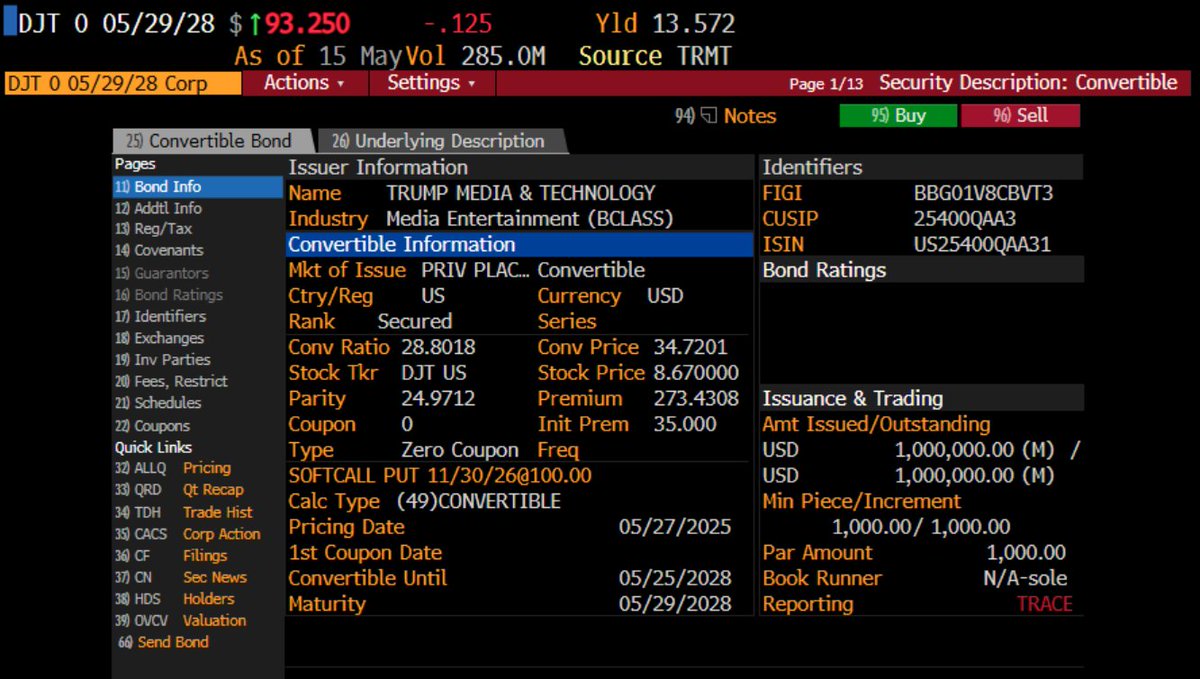
Here’s a weird bond:
$DJT busted SECURED converts due ’28 trading @ 93.
Basically the only debt in the cap stack. Cash and crypto exceed debt. Putable at par later this year. ~13.5% yield-to-put.
Largest shareholder is the sitting president of the United States.
Not exactly a screen you see every day.
Why I’m adding OBDC (Blue Owl Capital Corporation) and VBF (Invesco Bond Fund) to my fixed-income portfolio.With rates still elevated and markets uncertain, I want steady income plus some capital protection. These two deliver cash flow through debt investments, but in very different ways:
What each does
VBF: Owns debt (bonds) on mostly public companies — investment-grade corporate bonds from large listed firms.
OBDC: Owns debt (senior loans) on private companies backed by private equity sponsors.
Key differences (in plain English)
Leverage:
VBF uses zero leverage.
OBDC uses moderate leverage at ~1.2x debt-to-equity. Think of it as owning a portfolio that’s about 200% invested — your equity plus borrowed funds to control a larger pool of loans. It boosts income but adds risk if markets turn.
Private equity backing vs. public companies:
OBDC lends to upper middle-market private companies where ~89% have strong private equity sponsors providing operational and financial support (an extra cushion).
VBF holds bonds from public companies without that dedicated sponsor backing.
Diversification:
OBDC: Spread across ~30 industries with a defensive tilt (e.g., software/services, healthcare, asset-based lending, manufacturing, food & beverage).
VBF: Focused on public corporate bonds, diversified across financial services, industrials, and other broad sectors.
Average term & rate sensitivity (vs. Treasuries):
OBDC: Weighted average maturity on new loans 5.5–6.3 years, with very low effective duration (0.5–2 years) thanks to floating rates that reset with interest rates.
VBF: Average maturity ~14.7–15.4 years (fixed-rate), with higher effective duration (likely 6–9 years).
Current Treasuries (mid-April 2026): 2-yr ≈3.82%, 5-yr ≈3.95%, 10-yr ≈4.31%. OBDC offers floating income with minimal rate risk; VBF provides a yield pickup but more price sensitivity to rate moves.
Management fees:
VBF: Low at 0.42% (total expenses ~0.62%).
OBDC: 1.5% base on gross assets (steps down on leveraged portion) plus incentive fee — typical for BDCs.
Discount to NAV (recent data):
OBDC: ~24–25% discount.
VBF: ~7.7% discount.
Yields (approximate current):
OBDC: ~13.4–13.9% dividend yield (floating-rate).
VBF: ~5.3–5.6% distribution yield (monthly).
Why both in my fixed-income allocationI’m diversifying instead of going all-in on one style.
VBF delivers stable, unlevered public credit exposure bought at a discount.
OBDC adds higher income from private direct lending, floating rates that adjust automatically, private equity sponsor comfort, shorter terms, and a deeper discount.
Together they balance yield, risk, and exposure (public fixed-rate bonds vs. private equity-backed floating-rate loans) without excessive leverage.This mix strengthens my fixed-income sleeve for reliable income https://t.co/UGW3aFEDzb move fast — always do your own research or consult your advisor.
Portfolio Update: Increasing Merger Arbitrage to 35% with a Large GTLS Allocation + Defensive Rebalance
Corigliano Arbitrage LLC
In the current environment, where concerns around capital expenditure spending failing to materialize are keeping me cautious on broad equity exposure, I am maintaining a sizable 50% allocation to Fixed Income. This sleeve continues to deliver an attractive ~8% yield through a diversified mix of T-bills, preferred securities, and BDCs, providing stability and income ballast while I wait for clearer signals on corporate capex trends.
I am redeploying capital to increase the Merger Arbitrage sleeve to 35%, where high-probability, well-structured deals continue to offer compelling risk-adjusted returns with limited correlation to macro swings.
Within this bucket, I am building a large allocation to Chart Industries (GTLS) as one of the most attractive setups currently available. GTLS is trading near $207, delivering a tight but clean ~1.5–2% gross spread to the $210 per share all-cash acquisition by Baker Hughes (BKR). With shareholder approval already secured (overwhelmingly passed in October 2025), committed financing (including Baker Hughes’ recent multi-billion bond raises), and strong strategic fit in energy transition, LNG, hydrogen, and industrial tech, this remains a low-risk spread trade with very limited downside.
Even in the remote event the deal were to break, Chart’s robust backlog, diversified end markets, and secular tailwinds provide a solid fundamental floor — making GTLS an ideal core holding for the enlarged arb sleeve. I view the probability of closing by mid-2026 (Q2 target) as 95%+, with the narrow spread reflecting high market confidence while still offering attractive annualized compensation for patient capital.
Warner Bros. Discovery (WBD) continues to build gradually toward its target weighting as the Paramount Skydance process advances, and Electronic Arts (EA) remains a core position from my prior discussion.
Volatility Update
• 90-day realized volatility in SPY is tightly clustered around 16.0% – 16.6% annualized.
• 3-month implied volatility is running around ~18%.
This leaves a modest positive volatility risk premium. I am reducing the dedicated Equity Volatility Strategies allocation to 15% of the portfolio, reflecting a smaller overall book in the current regime while keeping flexibility for selective opportunities.
Updated Portfolio Allocation
• 50% Fixed Income (~8% yield via T-bills, prefs, and BDCs) — Defensive positioning amid capex uncertainty.
• 35% Merger Arbitrage — Large GTLS weighting as the anchor, alongside WBD build and EA core.
• 15% Equity Volatility Strategies — Smaller allocation to the overall strategy.
This rebalance tilts the portfolio toward disciplined event-driven compounding while maintaining a conservative risk posture given macro nervousness on spending
Bill Gurley just identified the only career advantage that AI cannot commoditize.
It isn’t talent. It isn’t your degree. It isn’t your network.
Gurley: “The thing that will differentiate you more in your career than anything else is to be the most hyper curious person that’s trying to do this thing.”
For centuries, knowledge was gatekept. Elite institutions. Expensive mentors. Geographic luck.
The information existed but access to it was the moat.
That moat is gone.
Gurley: “You have no excuse not to be the most knowledgeable person, because the information’s all out there.”
Every question you can formulate now has an answer available instantly.
Every industry. Every domain. Every skill you want to acquire.
The playing field didn’t just level. It inverted.
The people who used to win by controlling access to information now compete against anyone willing to ask better questions.
Gurley: “I can’t make you the most talented person in your company or your field.”
Talent is genetic. It’s luck. It’s the variable you cannot control.
But knowledge is a choice. And curiosity is a compounding asset.
Gurley: “If you are the most curious person that’s constantly learning in your field, you will do extremely well.”
This was always true. What changed is the multiplier.
Gurley: “That advantage is put on steroids with these AI tools.”
A relentlessly curious person with access to all human knowledge and the ability to interrogate it in real time doesn’t just outlearn their peers.
They outlearn entire institutions.
The gap between the curious and the incurious was always there.
AI just made it insurmountable.
Failing to Protect Americans - Terrifying report on FTC's collapse under its activist Chair Lina Khan
From the @JudiciaryGOP Committee's report:
Leadership Neglect and Ideological Pursuits
Leadership Neglect:
Chair Lina Khan is accused of neglecting the Federal Trade Commission's (FTC) core responsibilities in favor of pursuing personal political and ideological goals. This has allegedly led to undermining the FTC's mission by centralizing power and micromanaging investigations, diverting from consumer protection to pursue a radical agenda.
Unconventional Appointment:
The manner of Khan's appointment as Chair by President Biden, bypassing Senate consultation, raised concerns about the lack of assessment of her leadership capabilities.
Consolidation of Power and Pursuit of a Radical Agenda
Centralization of Authority:
Chair Khan centralized power within her office, undermining the collaborative nature of the FTC and limiting the effectiveness of career staff.
Micromanagement:
Despite centralizing power, Khan failed to delegate effectively, leading to micromanagement without providing clear direction.
Neglect of Legal Mandates:
Khan's focus on a personal political and ideological agenda came at the expense of the FTC's core mission to protect consumers, leading to negligence in enforcing antitrust laws.
Mismanagement and Governmental Waste
Inaction and Indecision:
Khan's indecisiveness caused delays in investigations and enforcement actions, wasting resources and limiting the FTC's ability to act effectively.
Failure to Prioritize:
Despite an increase in funding, Khan's refusal to make necessary trade-offs in resource allocation hampered the FTC's ability to address significant anticompetitive conduct.
Marginal Theories of Harm:
Staff were forced to pursue marginal theories, distracting from more pressing issues and contributing to inefficiency.
Culture of Fear and Retaliation
Lack of Trust in Staff:
Khan's leadership style created a culture of fear and distrust among the staff, discouraging initiative and creative thinking.
Retaliation Concerns:
The management style and operational decisions under Khan raised concerns about retaliation against staff who voiced dissent or criticism.
Toxic Work Environment
Toxic Work Environment:
Repeated surveys have identified a toxic work environment under Khan's leadership, with significant dysfunction and chaos attributed to poor leadership and ideological pressure.
Negative Impact on FTC Functionality
Harm to Consumer Protection Efforts:
Khan's focus on her agenda and failure to manage the FTC effectively led to a decrease in the agency's ability to protect consumers and enforce antitrust laws.
Undermining Staff Morale:
The centralization of power, micromanagement, and neglect of the FTC's core mission led to a toxic work environment, adversely affecting staff morale and the overall effectiveness of the agency.