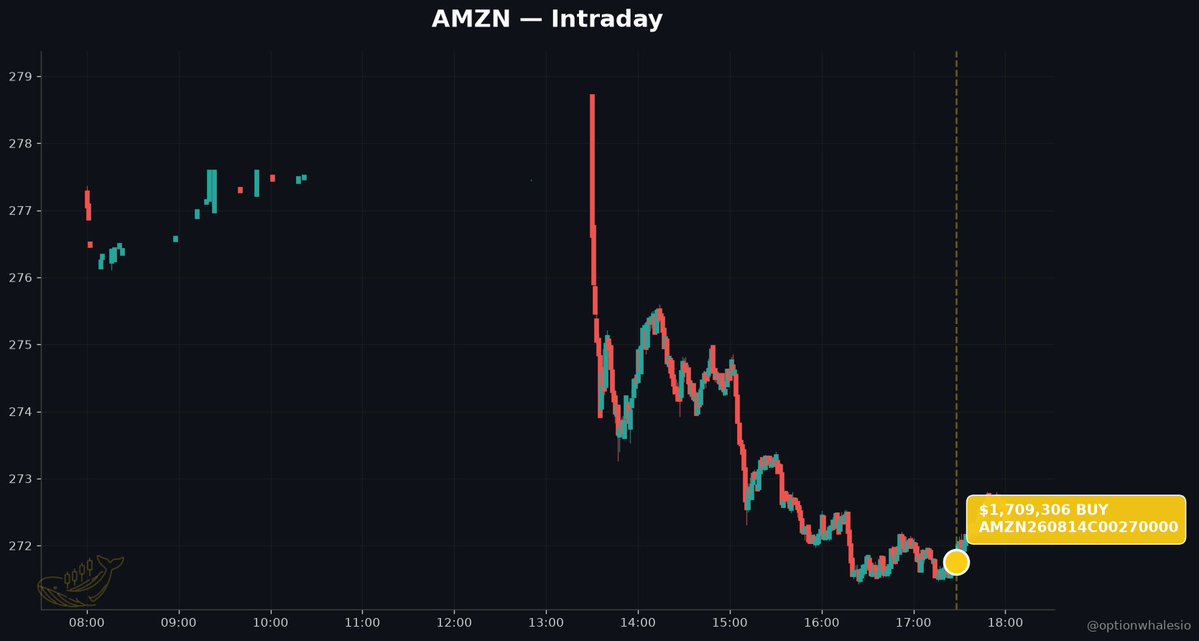
🐳 $AMZN's ad war just got louder — and a $1.7M sweep says the tape sides with the giant, not the disruptor.
THE THESIS
The ad-tech pecking order is being redrawn in real time, and the option desk just cast its vote for the incumbent. AMZN is not the disrupted here — it's the disruptor doing the disrupting.
THE NEWS
On August 11, The Motley Fool published "What's Going On With The Trade Desk Stock?" — a post-mortem on TTD's revenue miss and its guidance for a Q3 revenue DECLINE. The article names the culprits directly: intensifying competition from AMZN, Google, and Meta in the digital advertising market. TTD built its business on being the independent demand-side platform of choice. That moat is visibly cracking, and the crack is being pried open by the same mega-caps that own the inventory, the data, and the checkout.
AMZN's ad business is the quiet monster inside the retail giant — high-margin, Prime-Video-adjacent, and increasingly the default for brands that already sell on the platform. When TTD guides down, that share doesn't vanish. It migrates.
THE TAPE AGREES
At 13:27 ET, a sweep buyer paid roughly 1.71 million dollars in premium for 4,119 contracts of the AMZN August 2026 270 calls at an average of 4.15. Spot at execution: 271.75. That is a directional, dated bet — one year of runway on a strike sitting essentially at-the-money. Sweeps route across multiple exchanges to fill fast; that is urgency behavior, not patient accumulation.
Zoom out on the session and total flow ran 4.46 million dollars in premium across five prints, with bullish premium (2.46M) edging bearish (2.00M). The headline print is what carries the message.
WHAT IT SIGNALS
This is not a lottery ticket. A one-year 270 call bought near spot is a considered position — the buyer wants delta exposure with time to let the ad-share thesis compound. Pair it with the TTD narrative and the read is straightforward: someone is positioning for AMZN to be the named beneficiary as independent ad-tech gives ground to the walled gardens.
WHAT TO WATCH
One, whether AMZN's next quarterly ad-services line accelerates while TTD's Q3 print confirms the guided decline — that is the pair trade thesis in numbers. Two, follow-on flow into the AMZN 2026 upside calls; a single sweep is a signal, a cluster is a campaign. Three, any commentary from Google or Meta on ad-market share, which will tell you whether AMZN is taking the whole pie or splitting it.
Consensus still treats AMZN as a retail-plus-cloud story. The tape is telling you the third leg — advertising — is where the next re-rating comes from.
#Options #OptionsFlow #AMZN #AdTech #MegaCap #UnusualOptions
@optionwhalesio
🐳 The Motley Fool called SpaceX exposure overvalued today. $SPCX buyers just wrote a $1.75M check saying otherwise.
THE THESIS
Wall Street's SpaceX-exposure trade just got its first real bear note of the cycle — and the option desk waved it off inside the opening hour. When the biggest premium print of the morning is a leveraged, one-year bet on a name that just got called overvalued in print, that's not noise. That's disagreement with conviction.
THE NEWS
On August 11, The Motley Fool ran a piece framed around Alphabet's 2015 SpaceX stake — now worth roughly $94 billion off a $900 million check, a 52.6% CAGR. The headline was celebratory. The takeaway was not. The article pivoted to a valuation warning: SpaceX's implied $1.8 trillion mark against $7.8 billion in quarterly revenue and ongoing net losses. Musk's timelines slip. AI spend may not pay off. The stock — via any listed exposure vehicle — looks priced for a future that has to arrive on schedule.
That's the bear case, spelled out by a mainstream retail publisher on a day the tape was watching.
THE TAPE DISAGREES
At 09:38 ET, a buyer stepped in for 3,000 SPCX October 16, 2026 $180 calls at $5.85, paying $1.75 million in premium in a single clip. Spot was $134.94. That strike sits roughly 33% above spot with fourteen months to work.
Zoom out on the session and the picture sharpens: $3.51 million total premium across three prints, 100% bullish, zero bearish premium on the other side of the book. Nobody is fading this. Nobody is hedging it with puts of any size worth mentioning.
WHAT THE PRINT SIGNALS
Three things stand out. First, the size — $1.75M in one strike on a small/mid-cap vehicle is not a retail lottery ticket, it's a positioned trade. Second, the duration — October 2026 expiry means the buyer isn't playing a headline or an earnings pop. They're funding a thesis that needs quarters, not days. Third, the strike selection — $180 is a specific number. It implies the buyer sees a path to a materially higher mark on the underlying SpaceX exposure between now and next October, valuation warnings notwithstanding.
Put simply: someone read the same $1.8T number the Fool did and concluded it's going higher, not lower.
WHAT TO WATCH
One, whether that October $180 line builds open interest through the week — a single print is a bet, repeat prints are a campaign. Two, any follow-on flow in nearer-dated strikes; a barbell of long-dated upside plus short-dated calls would confirm the buyer expects a catalyst path, not just a drift higher. Three, watch the put side. As long as bearish premium stays near zero, the valuation bear case has no institutional sponsorship on the tape.
#Options #SpaceX #UnusualOptions #Valuation #SmallCap #FlowVsNews
@optionwhalesio
One trader spent $289M betting $SNDK goes nowhere for 17 months — and it was the loudest print on the tape today.
THE SETUP
$900M in premium across 191 prints and the story is not what led — it's HOW it led. The top three tickers by premium (SNDK, MSFT, DASH) were all dominated by neutral or short-call structures. Bearish premium outweighed bullish in every one of them. This was a session where institutions monetized calm and capped upside, not a session where anyone chased.
THE $289M ANCHOR
SNDK printed $328M in premium off five tickets. The whole name was effectively one trade: a $289M block on the January 2027 $166 puts, tagged neutral at 10:51 ET. That is not a directional bearish bet — that is a long-dated vol or collar structure, almost certainly paired against stock or a call leg we don't see on this tape. Bearish-tagged premium ran 4x bullish, but the giveaway is the neutral flag and the 17-month tenor. Someone is locking in a range, not calling a top. When a single print is a third of the day's flow, everything else is context.
THE OVERWRITE TAPE
MSFT and DASH tell the same story from the other side. MSFT saw $33M of Oct-2026 $510 calls sold at 13:07, part of $213M in flow that skewed $119M bearish to $94M bullish across 36 tickets. DASH was cleaner still: a $67M sale of the Sep-2026 $145 calls WAS the name. INTC ran the same play in miniature — $5.4M sold on the Aug-2026 $85 calls, bearish premium nearly 3x bullish, with the ASML/China DUV story giving overwriters a convenient narrative to lean on. Four of the top eight names, all showing desks writing upside into strength.
THE DOG THAT DIDN'T BARK
NVDA had 63 trades — the highest ticket count on the board — and only $55M in premium. That is a retail footprint. The Nebius investment and Vera Rubin deployment news screened positive, but nobody sized up. The largest print was a neutral Jan-2027 $220 call at $7.3M. If this were a real AI-momentum day, NVDA leads on dollars, not tickets. It didn't.
THE ONE BREAKOUT BID
GLW is the counter that makes the rest credible. A clean $49.7M BUY of the Nov-2026 $140 calls at 10:37 ET, bullish and bearish premium dead even at ~$49.5M. Somebody actually paid up for upside in optical/display exposure — the only name on the board where that's true. Watch it.
THE READ
When the biggest trades of the day are long-dated puts flagged neutral and short calls on mega-caps, the message is not bearish — it's that volatility is being sold and rallies are being capped. That is a late-cycle tape posture. The chase is gone. The hedge is on.
#OptionsFlow #SNDK #MSFT #DASH #NVDA #GLW
@optionwhalesio
🐳 $NVDA just told you where the next AI cloud boom is going — and it isn't the hyperscalers.
THE THESIS
Nvidia is no longer just selling GPUs to hyperscalers. It's now funding the neoclouds that compete with them — and the option tape is following the money.
On Aug 10, The Motley Fool laid out why Nebius Group's Aug 12 earnings could be a violent repricing event. Nebius reported Q1 revenue up 684% year-over-year, locked in a $27B deal with Meta, and — most importantly for this thesis — received a $2B investment from NVDA plus a commitment to deploy the next-generation Vera Rubin chips on its infrastructure.
That is not a passive check. Nvidia does not park $2B into a GPU-as-a-service operator by accident. It is a directed bet that the neocloud tier — the layer beneath AWS, Azure, and GCP — is where the next leg of GPU demand compounds. And every dollar of Nebius revenue is, effectively, an NVDA revenue proxy.
THE TAPE AGREES
At 14:56 ET, a $3.38M sweep hit the NVDA Aug 21 2026 220 calls — 6,892 contracts at $4.90 average, with spot at $218.66. Sweeps are urgency prints: the buyer paid the spread across multiple exchanges to get filled now, not later.
Zoom out and it's not an isolated ticket. Total NVDA premium on the session ran $10.7M across 6 blocks, with $9.47M on the bullish side against just $1.26M bearish. That is an 88/12 split. When the aggregate skews that hard on a single-name mega-cap, it is not retail noise — it is desk positioning.
WHAT THE PRINT IS SIGNALING
The 220 strike sits roughly at-the-money with a year-plus of duration. That is not a lottery ticket. It is a directional lean with time to let the Nebius Q2 print, the Vera Rubin rollout narrative, and the broader neocloud capex cycle play out. The buyer is paying for exposure to the compounding — not a one-day pop.
The consensus view on NVDA is that hyperscaler capex is the whole story. This tape says the desk is already trading the next chapter: Nvidia as the arms dealer AND the venture capitalist for the tier below.
WHAT TO WATCH
Nebius Q2 earnings on Aug 12 is the near-term catalyst — a beat validates the $2B NVDA bet and the neocloud thesis in one report. Beyond that, watch for any incremental Vera Rubin deployment announcements and further NVDA equity stakes in GPU-as-a-service operators. Each one is a new demand channel the sell-side models haven't fully priced.
#Options #NVDA #AI #Nebius #OptionsFlow #Semiconductors
@optionwhalesio
The biggest single options ticket today bet AGAINST $PLTR's 27% earnings rip — and it printed at the highs.
MARKET-CLOSE SYNTHESIS — FRI AUG 7
$1.39B in tracked premium across 299 prints. Headline read: AI keeps winning, PLTR ripped another 9.4%, NVDA held bid, SpaceX cloud numbers dropped. But the tape underneath told a more skeptical story.
THE PLTR PARADOX
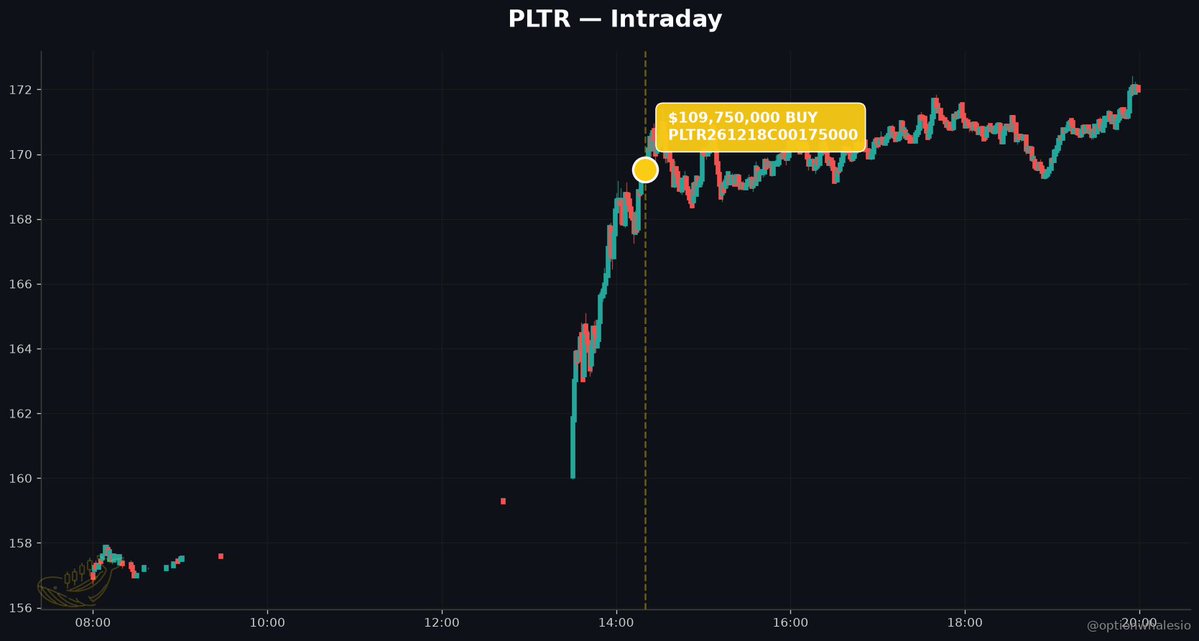
Palantir was the day's largest premium name at $430M — and it was NET BEARISH. Bearish premium $253M vs bullish $166M. The single biggest ticket of the entire session was a $110M print on the Dec-26 175 calls at 10:19 ET, direction flagged BUY, but the surrounding flow tells you desks were monetizing the 27% earnings rip from earlier in the week. When a stock is up ~40% in five sessions and the largest options ticket of the day is a nine-figure call print, that's often exit liquidity being manufactured, not fresh conviction. The Motley Fool piece framed it as easing AI-disruption fears. The tape didn't fully buy it.
THE MCHP TELL
Microchip is the trade nobody is talking about. Two trades. $182M premium. One ticket: $126M buying Dec-26 65 calls at 10:47 ET. No news. No catalyst in the feed. That's the profile of a size allocator building an analog semi cycle-turn thesis quietly while everyone is staring at Palantir. When you see 2-trade / $182M concentration with zero headline, that IS the signal.
AI INFRASTRUCTURE, NOT AI SOFTWARE
Where desks DID lean bullish was picks-and-shovels. NVDA carried a $63M bullish premium edge with a $61M same-day 200 call sweep at the closing print — classic gamma pull. META printed a $70M neutral block on Jan-27 750 calls tied to the Vistra 2.6GW nuclear PPA disclosed in the power-demand article. The Elon-Musk 'AI needs more power than the grid can handle' piece framed the whole day: capital is chasing the electrons, not just the models. SPCX saw 36 trades and $77M premium as Rocket Lab's 13th Electron launch and SpaceX's $14.1B cloud print pulled the space complex.
THE GOLD FADE
GDX is the counter-tell to the risk-on narrative. $83M premium, bearish $40M vs bullish just $2.9M. Somebody was aggressively selling upside in gold miners on a day when the July jobs report showed the economy shed 23,000 jobs and Warsh's Fed got messier. That's a bet that the rate-cut path is priced in and miners have run.
BOTTOM LINE
Headline tape said AI unstoppable. Premium tape said: fade the parabolic single-stock winners, own the infrastructure, and stop paying up for gold hedges. Two different market-close stories on the same session.
#OptionsFlow #PLTR #NVDA #AITrade #MarketClose #UnusualOptions
@optionwhalesio
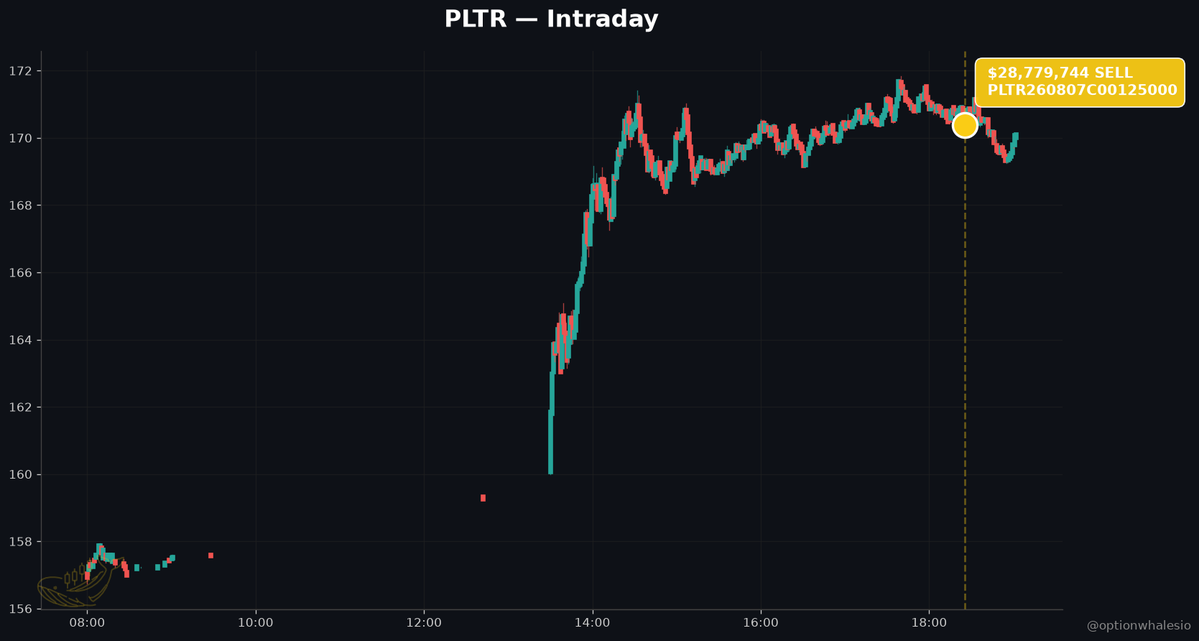
🐳 $PLTR just ripped on blowout earnings. The biggest option print today says the party has a ceiling.
THE THESIS
Palantir just delivered one of the loudest earnings prints of 2026 — and yet the largest option trade on the tape today was a bet AGAINST further upside. When the news and the flow disagree this loudly, the flow is usually the one that gets paid.
THE NEWS
On August 7, The Motley Fool reported PLTR surged another 9.4% Friday, extending a 27% jump earlier in the week following Q2 earnings. The numbers were legitimately extraordinary: 93% year-over-year revenue growth, 156% EPS growth, and 12 consecutive quarters of accelerating revenue. The narrative writes itself — Palantir is proving AI isn't cannibalizing software, it's supercharging it. Retail is euphoric. Analysts are chasing.
AT 14:25 ET, THE TAPE DISAGREED
With spot at $170.39, a whale SOLD 6,328 August 2026 $125 calls at $45.48 — collecting $28.7 million in premium. Read that again: someone wrote deep-in-the-money calls, $45 below spot, and pocketed nearly $29M to do it.
That is not a bullish trade. That is someone either:
1. Locking in gains on a long stock position via a synthetic short (covered call so deep it's effectively a stock sale with a $125 floor), or
2. Expressing a view that PLTR does not sustainably hold above $125 into August 2026 expiration.
Zoom out and it gets worse for bulls: total premium across today's notable prints was $89.3M — and 100% of it was on the bearish side. Zero bullish premium. Four trades, all leaning the same direction.
WHAT THIS SIGNALS
When a stock is up 40%+ in a week on genuinely strong fundamentals, and the smart-money option desk is EXCLUSIVELY selling upside or buying downside, it tells you two things. First, whoever owns PLTR at these levels is monetizing rather than adding. Second, the marginal informed bet is that valuation — not fundamentals — is now the binding constraint. PLTR at $170 trades at a multiple that requires the next twelve quarters to look like the last twelve. The tape is skeptical.
WHAT TO WATCH
The $125 strike is the line in the sand this trader drew. As long as PLTR holds well above it, the write prints premium. A move back toward $140-150 on any macro or AI-multiple compression would validate the fade. Watch for follow-through bearish flow next week — if the $89M becomes $150M+, the euphoria trade is officially over.
#Options #Palantir #AI #OptionsFlow #Earnings #OptionFlow
@optionwhalesio
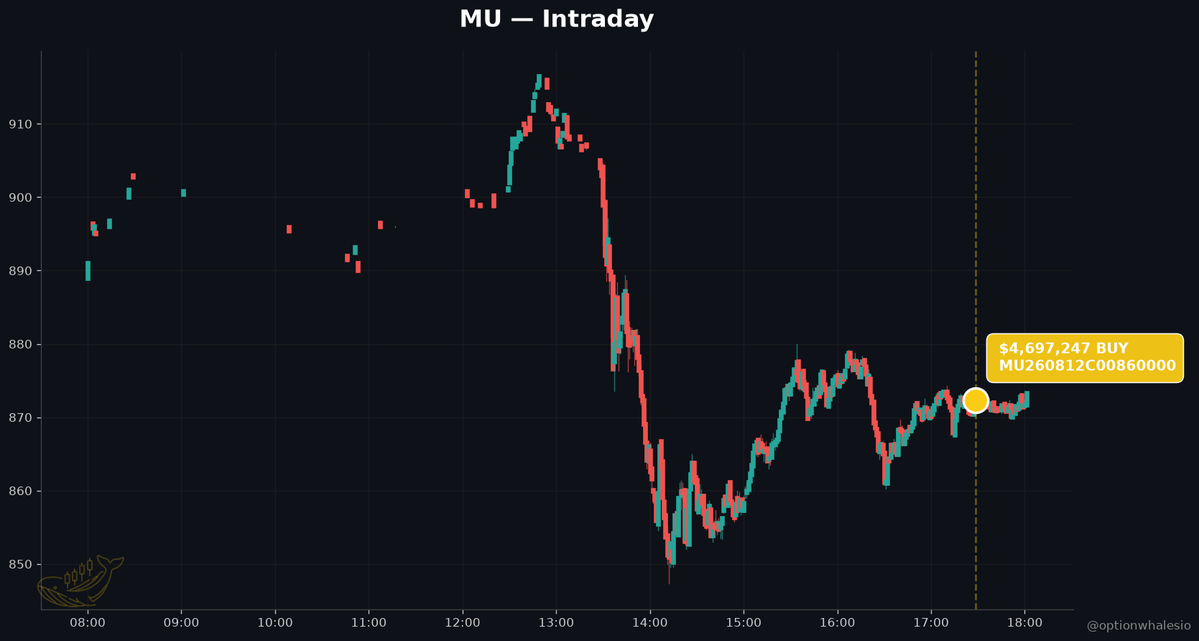
🐳 $MU at $872 and someone just paid $4.7M to say it's going higher. The memory squeeze thesis has a believer.
THE THESIS
Micron is not a semi story right now. It is a supply story. And the tape today just wrote a $4.7M check on it.
THE NEWS
The Motley Fool published a piece on August 7 spotlighting the Vanguard Information Technology ETF (VGT), which ripped 11% in four trading days. The reason: a combined 33% weighting across NVDA, MSFT, MU, and AVGO — the exact names carrying the AI hardware trade. The framing on MU specifically was that memory chip supply constraints are driving massive earnings growth, and that constraint is what justifies its premium multiple inside the ETF.
Translation: MU is no longer being valued as a cyclical memory commodity name. It is being valued as an AI infrastructure choke point. That is a completely different multiple regime.
THE TAPE AGREES
At 13:28 ET, a sweep hit the tape — 1,398 contracts of the August 2026 860 calls, bought at an average of $33.60, for $4.70M in premium. Spot at the time was $872.29.
A sweep means the buyer chewed through multiple exchanges to fill fast. They did not want to negotiate. They did not want to wait. They paid up across the board to get long delta before the market moved away from them.
And across the full session, bullish premium in MU outweighed bearish premium by roughly 588 to 1. This was not two-sided flow. This was one voice, loud.
WHAT THE PRINT SIGNALS
An 860 strike with spot at 872 is barely in the money. This is not a lottery ticket — this is a directional conviction trade with a full year of runway to August 2026. The buyer is paying real premium for the right to be long MU through the entire next earnings cycle, the next capex cycle from the hyperscalers, and the next round of HBM (high-bandwidth memory) pricing updates.
If you believe the memory constraint story is a quarter or two of tightness, you do not structure the trade this way. You buy front-month. The August 2026 expiry says the buyer thinks the constraint is structural — that the AI buildout keeps HBM supply tight well into next year.
WHAT TO WATCH
Next MU earnings print — specifically the HBM commentary and any pricing guidance. Hyperscaler capex updates from MSFT, AMZN, META, GOOGL. Any competitor supply announcement from SK Hynix or Samsung that could break the tightness narrative.
Until one of those cracks, the tape is telling you which side of MU to be on.
#Options #Semiconductors #AI #Memory #UnusualOptions #OptionsFlow
@optionwhalesio
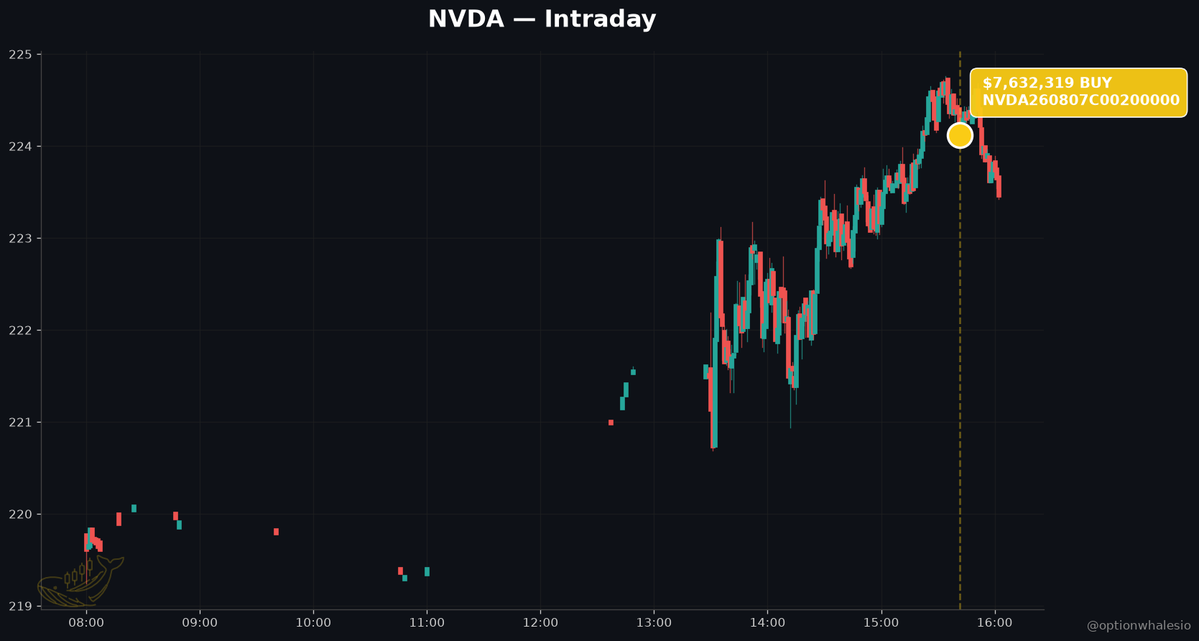
🐳 SOXX just plunged 21% on AI bubble fears. $NVDA's tape today isn't scared — $7.6M says buy the dip.
THE THESIS
The AI trade got a valuation scare in July. The biggest NVDA option print today says the scare is the opportunity.
THE NEWS
The Motley Fool published two pieces this morning framing exactly the debate the market is wrestling with. The first walks through why the iShares Semiconductor ETF (SOXX) plunged 21.2% in July after ripping 112.8% in the first half of 2026 — a collapse driven by Michael Burry's short thesis on overvalued AI names, the release of China's low-cost Kimi K3 model raising competitive fears, and a broader rotation out of expensive semis.
The second piece cuts the other way. The Vanguard Information Technology ETF (VGT) has ripped 11% over four sessions on the back of strong Microsoft and Amazon earnings, with NVDA sitting as the top holding at a 16.10% weighting. The Fool's argument: earnings growth is still justifying the valuation, even against brutal comparisons. A third article notes capital is rotating OUT of crypto and INTO AI names like NVDA and MU as the stronger risk-adjusted bet.
So the setup on August 7 is a market that just took a 21% haircut on semis three weeks ago, is now bouncing hard on mega-cap earnings, and is unsure whether to trust the bounce.
THE TAPE DISAGREES WITH THE BEARS
At 11:41 ET, with NVDA at $224.12, a single buyer swept 3,128 contracts of the August 7 $200 calls for $7.63M in premium at $24.40 average. That is not a lottery ticket. That is deep in-the-money, near-dated exposure — a directional bet with high delta and minimal decay optionality. Someone paid up for something that behaves almost like stock, because they wanted leverage without waiting.
Zoom out on the session tape: $19.05M in total NVDA premium across 14 significant prints, with $13.26M bullish against $5.79M bearish. The ratio is 2.3-to-1 long.
WHAT IT SIGNALS
Deep ITM call sweeps on a name that just corrected 21% at the sector level are the signature of conviction, not speculation. Whoever bought $7.6M in $200 calls with spot at $224 is not fading a rally — they are pressing one, and they are willing to pay intrinsic value to do it fast.
The consensus narrative post-July was that AI multiples had gotten ahead of fundamentals and Burry's short was the smart-money tell. Today's biggest single print is the counter-punch: earnings backed the valuation, the China competition fear was overplayed, and the July drawdown was a rotation, not a top.
WHAT TO WATCH
- Whether follow-on flow tomorrow confirms this as accumulation or one-off hedge unwind.
- SOXX relative strength — if semis broadly reclaim July highs, the bull thesis validates.
- Any incremental China / Kimi K3 headlines that could reignite the bear case.
#Options #AI #Semiconductors #OptionsFlow #MegaCap #OptionFlow
@optionwhalesio
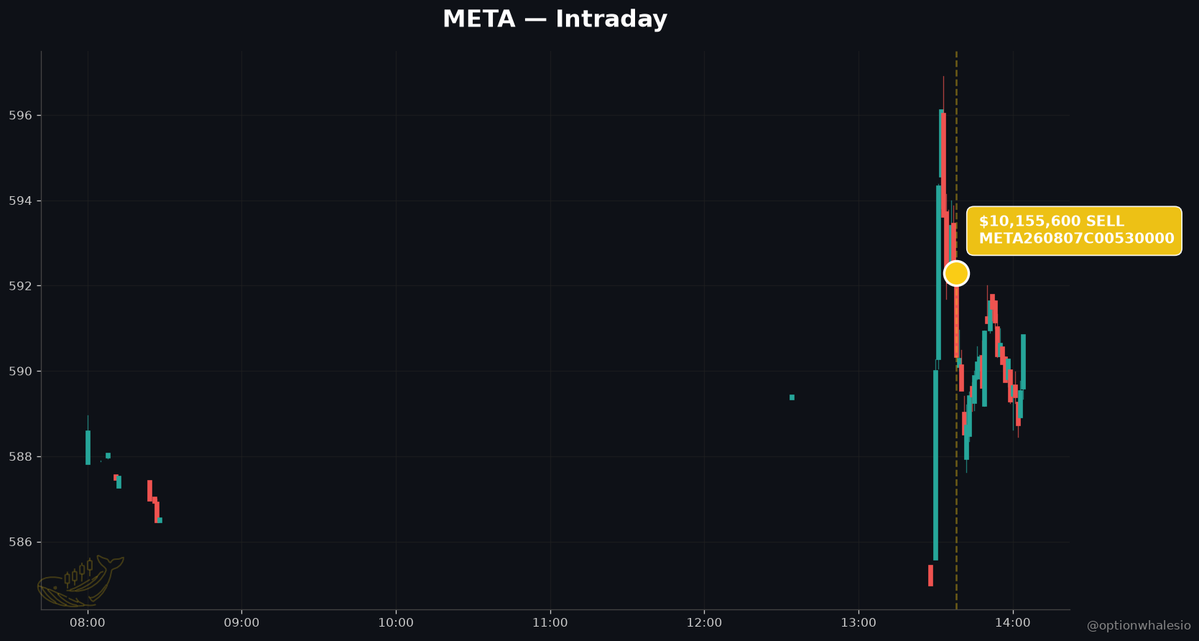
🐳 The Street says $META is a 5-year winner. At 9:37am, someone sold $10M of upside and disagreed.
THE THESIS
Wall Street woke up bullish on META today. The tape didn't.
At 9:37am ET, with shares at $592.29, a single sweep hit the Aug 7 2026 530 call line — 1,638 contracts SOLD at $62.00, worth $10.16M in premium. One print. One direction. No offsetting bullish flow on the ticker this session.
THE NEWS BACKDROP
The Motley Fool published a piece this morning titled "Where Will Meta Platforms Stock Be in 5 Years?" — arguing META is set up for a 21.6% annualized revenue CAGR through 2028, with advertising revenue potentially doubling by 2030. New revenue streams from hardware and compute-capacity sales. Forward P/E of 18.6. The author's conclusion: "a winning investment opportunity."
Sentiment on the tape today: 2 positive articles, 0 negative. Consensus is that AI is META's tailwind, not its risk.
THE TAPE DISAGREES
Selling $10M of deep in-the-money 530 calls a year out is not a retail trade. It is a size-holder either:
1. Writing covered calls against a long META position — capping upside at 530 (well below spot) in exchange for $62 of premium per share. That is a monetization trade, not a conviction trade. It says: I do not need more upside from here.
2. Or opening a naked short call — an outright bearish bet that META does not sustain above ~$592 into next August.
Either read cuts against the "double by 2030" narrative. The premium collected implies the seller is comfortable that $62 of extrinsic + intrinsic will not be breached meaningfully to the upside over the next 12 months.
WHAT IT SIGNALS
The most concentrated names in the S&P — and META is one of them, per today's XLC concentration piece — are where institutions monetize positions when they think the easy money is behind them. This print has that fingerprint. It is not a panic sale. It is a coldly-priced ceiling.
WHAT TO WATCH
- Whether follow-on flow next session confirms bearish positioning or this stays a one-off hedge.
- The 530 strike as psychological support if META rolls over.
- Any repeat sweeps on further-dated calls — that would escalate the read from "hedge" to "thesis."
The bull case is loud. The tape is quiet, and short.
#Options #OptionsFlow #META #AI #MegaCap #Hedging
@optionwhalesio
The AI memory story just got a $286M vote of no-confidence — and it landed on the exact name Wall Street called the AI winner.
MARKET-CLOSE SYNTHESIS — AUG 6, 2026
$849M of tracked premium across 120 prints, and the loudest trade of the day did not agree with the loudest headline of the day.
THE SETUP
Motley Fool ran a piece this afternoon framing Sandisk as the runaway AI-memory story — revenue accelerating from $1.9B to $9.0B, 77% net margins, hyperscalers paying up for tight supply. It is exactly the kind of narrative that normally drags call premium in like a magnet.
Instead, SNDK printed $349M of premium and $347M of it was bearish. At 11:17 ET a single trader sold an $286.5M block of the Jan-2027 1660 puts. You can read that two ways, and both are worth respecting. Read one: someone was long enormous downside protection and just took it off, which means the marginal hedge in this name is being unwound at the top of the hype cycle. Read two: a size player is systematically short volatility and short downside skew into a story that has already been paid for. Neither reading is bullish new-money. Both say the same thing — nobody with real size is buying SNDK upside up here.
WHERE THE BULLISH DOLLARS ACTUALLY WENT
AMD. Opening trade of the day, 9:30:09 ET, $28.6M buy of the December 2028 760 calls. That is not a hedge, that is not a roll, that is a two-and-a-half-year directional bet by someone who read the same AMD-vs-Sandisk comparison and drew the opposite conclusion — that steady sequential compute growth to $11.5B is more durable than an explosive memory ramp. Bull/bear split in the name was 57 to 1.
NXPI got a late $21.8M call buy on the Dec 300 line. Edge silicon and auto — the parts of semis that are not the crowded trade — quietly attracted fresh upside premium.
WHERE THE UPSIDE GOT CAPPED
TSM: $81.9M of premium, zero bullish. A $35.4M sale of Dec 560 calls at 15:33 ET. The foundry that fabricates the entire AI stack had its ceiling monetized into the close.
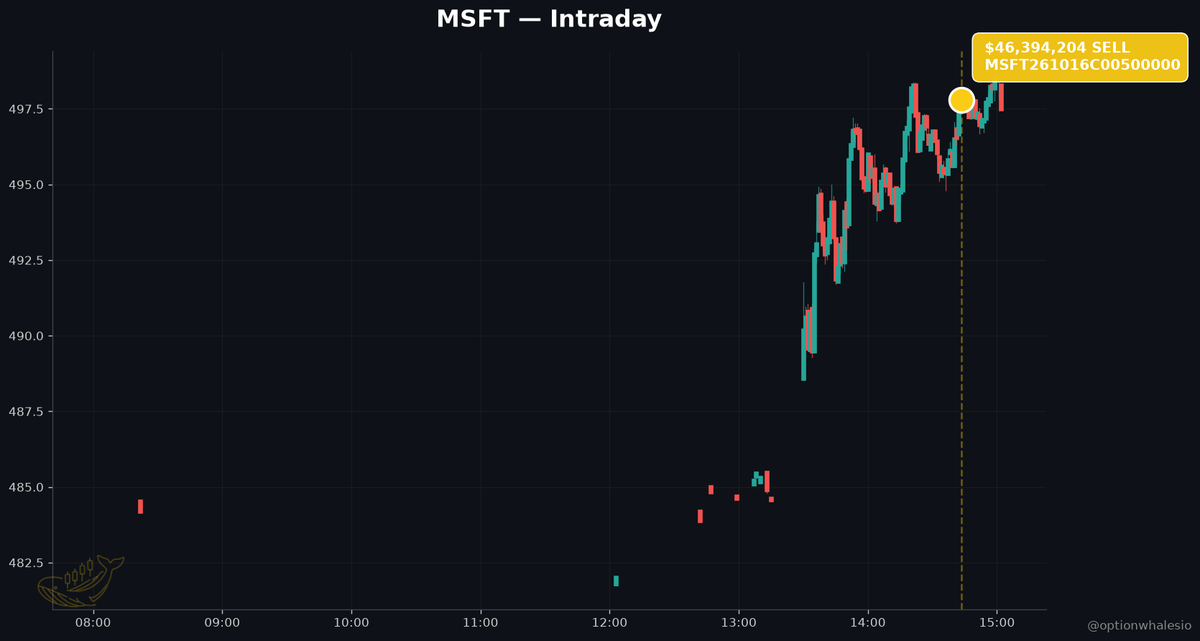
MSFT: $113M traded roughly balanced, but the largest ticket was a $46.4M sale of the Oct 500 calls. Hyperscaler bull case being harvested, not extended.
THE COUNTER
AppLovin — a name with genuinely positive fundamental news today from the Pixalate Q2 index — saw a $17.4M buy of August 500 puts at 15:20 ET. Somebody is not waiting for the story to break on its own. Worth flagging because it is the one clean bearish new-money print inside a name the news would tell you to be long.
THE READ
Today was not risk-off. It was rotation inside the AI complex — out of the memory euphoria the media is selling, out of the foundry ceiling, and into multi-year compute optionality. When the biggest bearish print of the day lands on the name with the most bullish headline of the day, that is the tape telling you which narrative it does not believe.
#OptionsFlow #SNDK #AMD #AI #Semis #MarketClose
@optionwhalesio
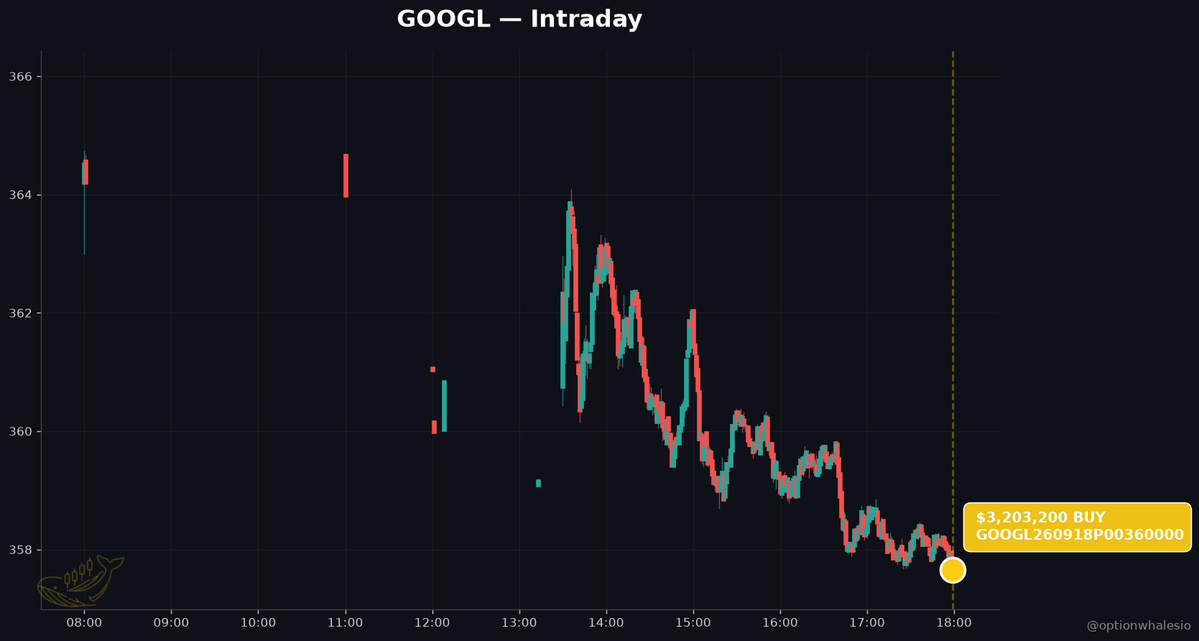
🐳 $GOOGL tape today: $3.2M sweep bought Sep '26 $360 puts while flow tilts bullish. Someone's hedging the AI winner.
THE THESIS
GOOGL is the least-questioned name in the AI trade right now — and that is exactly why the biggest print on the tape today was defensive. On Aug 6, 2026, with shares at $357.66, someone paid $3.2M in a single sweep to buy Sep 2026 $360 puts. That is not a bearish call on Google. That is a large holder buying insurance on a position they refuse to sell.
THE NEWS BACKDROP
The AI narrative around Google keeps compounding. Motley Fool's Aug 6 piece framing Astera Labs vs AppLovin treats AI infrastructure and AI-driven ad platforms as the two dominant 2026 tech theses — and GOOGL sits at the intersection of both, as the ad platform incumbent and the hyperscaler with in-house silicon. A separate GlobeNewswire piece the same day flagged AlphaFold — a DeepMind product — as the reference example for AI-driven drug discovery attracting billions in venture capital.
In other words: the news tape is unambiguously constructive. There is no negative catalyst to hedge against.
THE OPTION TAPE
That is what makes the print interesting. Aggregate flow today ran $6.78M across 4 trades — $4.63M bullish vs $2.15M bearish, a net long tilt. But the single largest ticket, at 1:59pm ET, was a SWEEP BUY of 2,002 Sep 18, 2026 $360 puts for $16.00 each. Sweep means the buyer paid up across multiple exchanges to get filled fast. They wanted the protection now, not at a better price tomorrow.
A sweep-bought put slightly in-the-money, six weeks out, on a stock hitting new highs — that is a portfolio hedge, not a directional short.
WHAT IT SIGNALS
When the biggest, most urgent trade on a stock is defensive while the news flow and smaller trades stay bullish, one profile fits: a large long who has ridden the AI rerating, is unwilling to sell into strength, and is paying $3.2M to lock in the gains through September earnings and into the Fed window.
The message is not "GOOGL is going down." The message is "GOOGL is priced for perfection, and someone with size is no longer willing to be naked long."
WHAT TO WATCH
Watch whether follow-on put buying at $350 and $355 strikes builds through the week. Watch the Sep 18 expiry open interest — if it keeps stacking on the put side while spot holds, that is institutional hedging, not sentiment turning. And watch the Aug earnings setup: this print expires well after it.
#Options #AI #BigTech #Hedging #GOOGL #OptionsFlow
@optionwhalesio
🐳 $MSFT just rallied 25% on earnings. The biggest option print today is betting the top is in.
THE THESIS
MSFT's 25% post-earnings rally is being faded by size. While the financial press debates whether the stock is still cheap after the run, the largest option trade on the tape this morning is a bet that upside above 500 is worth selling — not buying.
THE NEWS BACKDROP
On August 6, The Motley Fool published "Is Microsoft Still Undervalued After Its 25% Post-Earnings Rally?" — noting cloud revenue grew 27% YoY to $59.3B, with Foundry crossing 100,000 customers and 60% YoY growth in enterprise AI users. Same morning, GlobeNewswire's SNS Insider report placed MSFT among the leading names in the healthcare chatbot market, projected to compound at 27% CAGR through 2035.
The consensus read is obvious: cloud is accelerating, AI monetization is real, and secular tailwinds keep stacking. Wall Street's instinct is to chase.
BUT THE TAPE DISAGREES
At 10:43 ET, a burst order sold 17,000 MSFT October 2026 500-strike calls for $46.4M in premium at an average of $27.29. Spot was $497.80 — the strike is essentially at-the-money with 14 months of duration.
Zoom out on the session flow and it's not a one-off. Total MSFT option premium today: $99.5M across 7 large prints. Bearish premium: $54.3M. Bullish premium: $45.2M. The book tilts short-vol and short-delta into the strength.
WHAT THE PRINT SIGNALS
Selling $27 of premium on an ATM 14-month call is not a small directional bet — it is a conviction that MSFT does not meaningfully exceed 527 (strike plus premium collected) by October 2026. That is a call on the ceiling of the AI-cloud narrative, not the floor.
This is the profile of an institution either (a) monetizing a long stock position by writing covered calls into euphoria, or (b) taking an outright short-volatility view that the 25% rally has already priced the good news through late 2026. Either way, the message is the same: the easy money in MSFT for the next four quarters was made last week.
WHAT TO WATCH
Follow-through prints above the 500 strike — if sellers keep stacking size on the same tenor, dealer positioning gets pinned and rallies get sold. Watch Azure guidance and Foundry customer growth on the next print; the seller is implicitly betting neither reaccelerates from here. And watch implied vol on the October 2026 tenor — if it bleeds lower into any pullback, the short-vol crowd is winning.
#Options #Microsoft #AI #CloudComputing #OptionsFlow #MegaCap
@optionwhalesio
🐳 Wall Street says $NVDA prints a blowout on Aug 26. The biggest tape this morning just faded that call.
THE THESIS
The consensus on NVDA heading into Aug 26 earnings is euphoric. The Motley Fool published a piece this morning (Aug 6) titled "Prediction: Nvidia CEO Jensen Huang Will Shock Wall Street on Aug. 26," arguing for ~$95B in revenue against a $91B guide, and framing the low-20s forward P/E as a coiled spring versus the 35x+ multiples NVDA has historically carried into August prints.
That is the setup the retail tape is being fed. The institutional option tape is telling a different story.
THE NEWS
Two positive articles hit the wire this morning, both from Motley Fool. One reiterated NVDA as the anchor holding of QQQ at 8.08% weight and the poster child of the AI trade. The second is the Aug 26 blowout call — explicitly arguing the valuation gap is an entry, not a warning.
Both pieces lean the same direction: buy the print.
BUT THE TAPE DISAGREES
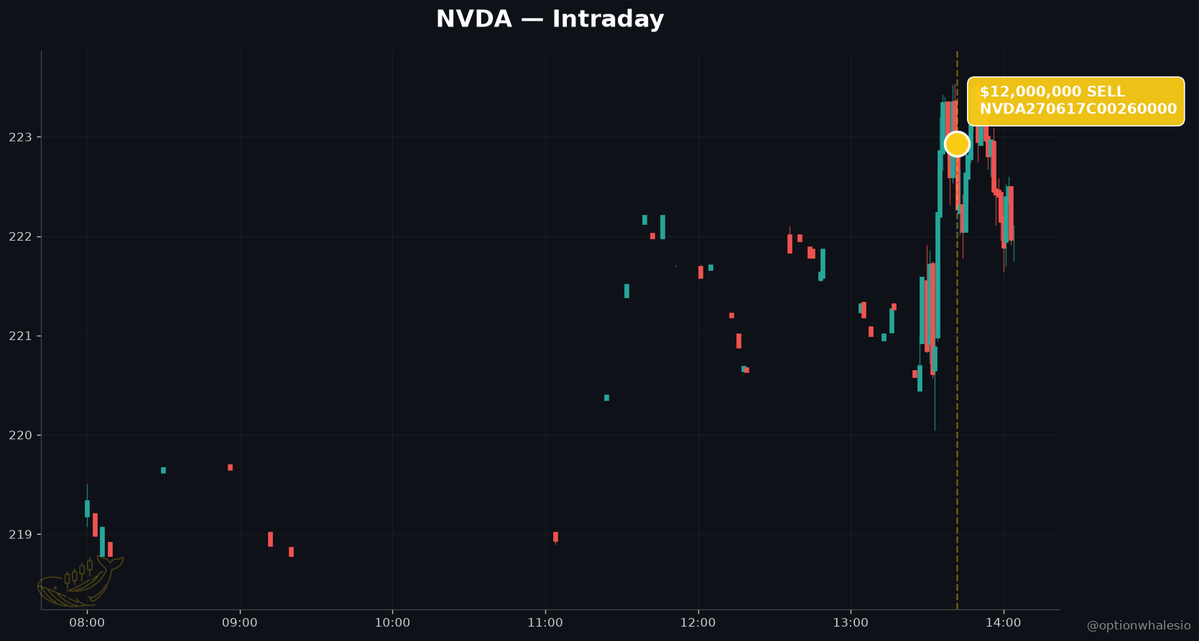
At 09:41 ET, 5,000 contracts of the NVDA Jun 2026 260 calls printed on the offer for $24.00 — a $12M premium SALE. Spot was $222.93. That is a single desk writing upside 17% out of the money, ten months forward, and collecting the premium rather than paying it.
Zoom out and the pattern hardens. Across 20 prints this morning, bearish premium ran $24.2M against $8.3M bullish — a near 3-to-1 skew against the tape the news is selling.
WHAT THE PRINT SIGNALS
Selling a June 2026 260 call is not a directional short. It is a statement that upside is capped, or at minimum, that the implied vol being paid for that upside is too rich. The desk on the other side of that $12M is willing to bet NVDA does not close above $284 by June — through the Aug print, through the Nov print, through Q1 2027 guide.
When the largest single trade of the morning is a call SELLER, and the aggregate tape is 3-to-1 bearish while every headline is bullish, the read is straightforward: someone with size is fading the euphoria into the event, not chasing it.
WHAT TO WATCH
Watch the Aug 26 print itself — a beat that fails to break $240 validates the seller. Watch for follow-on call selling in the Sep and Oct expiries; a stacked short-vol structure into earnings is the tell that this is a positioning trade, not a one-off. And watch the 260 strike open interest tomorrow — if it builds, this desk is not alone.
#Options #NVDA #AI #Earnings #OptionsFlow #Semiconductors
@optionwhalesio
Someone paid $65M for $NVDA upside into 2026. On the same tape, AMD and INTC calls got dumped.
MARKET-CLOSE NOTE — Aug 5, 2026
THE SETUP
$569M in tracked options premium across 256 trades, and 41% of it — $236M — sat on one ticker: NVDA. That's not a broad AI bid. That's a concentrated one. The rest of the semi complex got treated very differently, and that split IS the story of the session.
THE WHALE PRINT
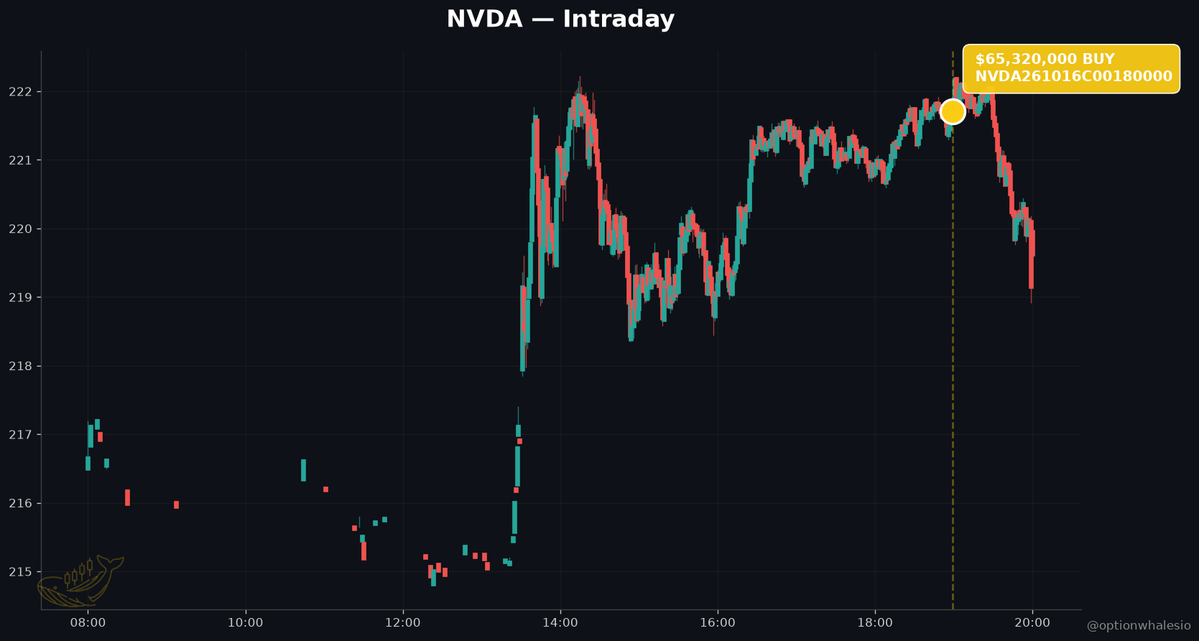
At 14:58 ET, roughly one minute before the closing bell, a buyer paid $65.3M for the NVDA Oct 2026 180 calls. That is not a hedge, not a roll, not a delta-one substitute — that is a directional bet with fourteen months of runway. It also landed AFTER the day's cautionary AI headlines hit the wire, including a Motley Fool piece invoking Buffett's airline mistake as a warning to AI investors, and a second piece dissecting Sam Altman's singularity claim. The whale read the caution and stepped over it.
THE FADE UNDERNEATH
Here is where the tape gets interesting. On the same day NVDA saw $147M in bullish premium, AMD saw $30.7M in BEARISH premium against just $4.7M bullish — the Oct 2026 450 calls were sold for $19.25M. INTC was 95% bearish, with the Nov 2026 70 calls sold for $17.9M at the open. NBIS and DRAM also skewed bearish on call supply. The message: institutional flow is no longer treating AI as a sector trade. It's treating it as an NVDA-and-TSM trade.
THE CONFIRMATION
TSM backed the read up. $48M premium in just three tickets, 92% bullish, with a $24.5M buy of the Aug 2026 400 calls. Foundry side of the AI supply chain — bid. Second-tier accelerators and legacy silicon — offered. That's the barbell.
THE OUTLIER
GDX drew a $19.8M put buy on the Dec 2026 75 strike — the single biggest non-AI print of the day. Whether that's a hedge against a stronger dollar, a fade of gold miners into year-end, or protection on an existing long, it's the one line item that had nothing to do with silicon.
WHAT DOESN'T FIT
The bearish AI news cycle. If you only read the headlines today, you'd think NVDA got sold. The tape said the opposite — and it said it AFTER the caution hit. When narrative and flow disagree, flow gets the last word.
BOTTOM LINE
The AI trade did not broaden today. It narrowed. NVDA and TSM absorbed the capital; AMD, INTC, NBIS and DRAM absorbed the call supply. Watch whether that dispersion holds — or whether the laggards catch a bid on the next leg.
#OptionsFlow #NVDA #SemiTrade #AIStocks #MarketClose #UnusualOptions
@optionwhalesio
🐳 Wall Street calls $MSFT the AI winner. A whale just spent $2.9M betting the rally cracks first.
THE SETUP
Microsoft is being handed the AI crown. Alphabet, Amazon, Oracle and MSFT collectively added $1.9 trillion in market cap in just three trading sessions after earnings, per The Motley Fool (Aug 5). Dan Ives called the recent software sell-off the most disconnected from fundamentals since the late 1990s. Sam Altman is declaring the AI singularity. Consensus is loud, and it is long.
The biggest option print on the MSFT tape today disagrees.
THE NEWS
The bull case is real and it is on paper. Azure cloud revenue is growing 43% year over year. Microsoft 365 Copilot has crossed 30 million paid users. Analysts are pointing to durable AI monetization as the reason MSFT's post-earnings run 'isn't over.'
But buried in the same coverage is the tension nobody wants to underwrite: infrastructure spending has doubled to $35.8B. That is the number that has to be fed by revenue growth, and the number that turns into a problem the moment growth even hints at slowing. The bull thesis and the fragility thesis are the same thesis.
THE TAPE
At 14:28 ET, with spot at $489.72, a buyer paid $8.42 for 3,500 contracts of the Sept 18, 2026 $460 puts. Total premium: $2.95M. That single ticket accounted for 82% of the day's notional flow in the name.
This is not a scalp. September 2026 is a 13-month tenor — the buyer paid up for time, not gamma. The $460 strike sits roughly 6% below spot, meaning breakeven on intrinsic terms is closer to $451, or about 8% lower. Whoever wrote this check is either hedging a very large long, or expressing the view that MSFT trades with a 4-handle again before next fall.
WHAT IT SIGNALS
When the news is uniformly positive and the biggest premium on the tape is a long-dated put, that is not noise. That is a professional saying: the risk is not that the AI story is wrong. The risk is that $35.8B in capex meets a quarter where Azure prints 38% instead of 43%, and the multiple compresses hard.
This flow is not calling a top. It is buying protection at a level where the crowd currently sees only upside — which is precisely when protection is cheapest.
WHAT TO WATCH
Next Azure growth print — anything under 40% reprices the entire hyperscaler basket. Capex guide revisions from AMZN and GOOGL as read-throughs. And whether this $460 line attracts follow-on size in coming sessions. One print is a view. A stack of them is a positioning shift.
#Options #AI #Cloud #Hedging #BigTech #OptionFlow
@optionwhalesio
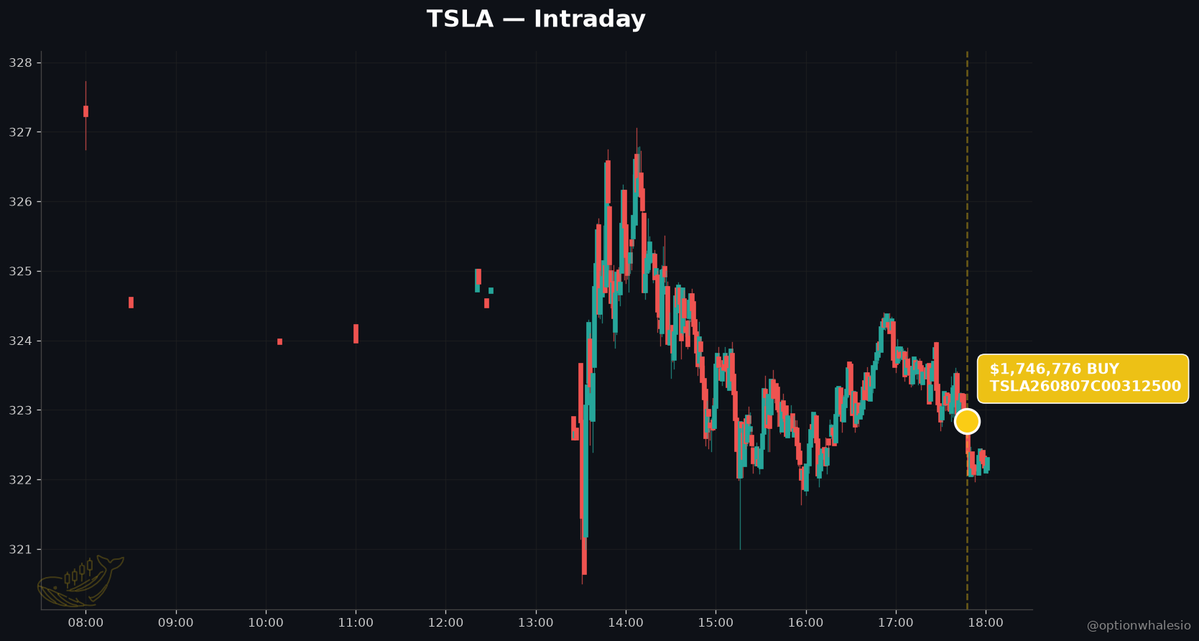
🐳 $TSLA has bled $1.19T in market cap since June. The biggest option print today just bought the dip anyway.
THE SETUP
Tesla is in the middle of one of the ugliest resets in mega-cap tech. Since June, TSLA and SpaceX have collectively shed $1.19 trillion in value. Tesla alone is down roughly 20%, and Q2 earnings did nothing to help: capex doubled, and management laid out a $30 billion borrowing plan to fund Optimus and full self-driving.
The Motley Fool framed it plainly on August 5: this is a company burning cash on two ambitious AI bets — humanoid robots and autonomous driving — with no clear commercialization timeline for either, and a regulatory overhang on FSD approval. The bear case writes itself.
THE NEWS
The headline question from that piece — 'Is this a buying opportunity?' — is exactly the debate splitting the tape right now. Bulls see a generational drawdown in a name that has repeatedly punished doubters. Bears see a stock that still trades like a growth story while the growth is being pushed further out and financed with debt.
With TSLA at $322.84 and sentiment this negative, the market is pricing in continued pain.
THE TAPE
Here is where it gets interesting. Aggregate flow on the session was mildly bearish — $3.68M bullish premium versus $3.46M bearish, across 11 institutional-size prints. On the surface, that fits the narrative.
But the single largest trade of the day cuts the other way.
At 13:47 ET, a buyer swept 1,507 contracts of the August 7 $312.50 calls for $11.59 average, spending $1.75 million in premium. That is not a hedge. That is not a covered structure. That is someone paying up for short-dated upside with strikes just under spot — a directional bet that TSLA bounces, and bounces within days.
WHAT IT SIGNALS
A $1.75M weekly call buy at these strikes is a conviction trade against the exact narrative the Motley Fool article captured. Whoever wrote this check is betting the drawdown is overextended, that the $30B borrowing headline is priced in, and that a reflex rally is closer than the tape suggests.
The bearish premium in the rest of the flow is real, but it is spread across smaller, later-dated positions. The dominant single print is bullish, aggressive, and short-dated.
WHAT TO WATCH
The $312.50 level is now the line. If TSLA holds above it into August 7 expiry, this print prints. If it breaks, the aggregate bearish tone wins and the weekly calls decay into nothing. Watch for any follow-on FSD regulatory news or capex commentary — either can move this fast.
#Options #Tesla #OptionsFlow #UnusualOptions #AI #OptionFlow
@optionwhalesio
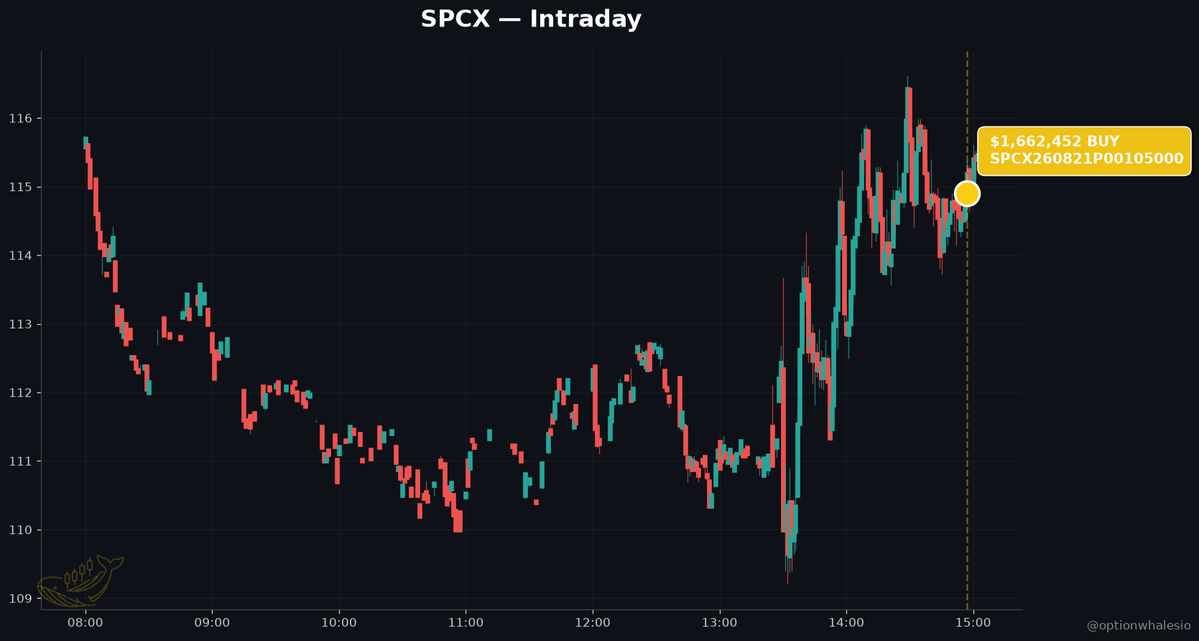
🐳 $SPCX guides $1T by 2030 — and the biggest trade today just paid $1.66M to bet against it.
THE THESIS
SpaceX just handed the market one of the most aggressive growth guides in mega-cap history — and the stock is getting crushed anyway. The biggest options print of the session says the selling isn't done.
THE NEWS
Per The Motley Fool (Aug 5): SPCX reported Q2 revenue of $7.8B, up 92% year-over-year, and guided to a $100B annual run rate by December with $1T of revenue by 2030. Numbers that should, on paper, mint a bull thesis.
The tape reacted the opposite way. Shares fell 11.2% pre-market and are now down 40% since June. Why? Q2 capex hit $18.4B. Goldman Sachs is modeling negative free cash flow of $105B by 2029 as orbital data center buildout accelerates. And a lockup expiration is imminent — up to 912 million shares potentially unlocked into a tape that's already broken.
THE FLOW
At 10:57 ET, a burst buyer took down 3,500 contracts of the Aug '26 $105 puts for $1.66M in premium at an average of $4.75, with spot at $114.90. That is the largest single print in today's SPCX tape.
Zoom out and total premium across the name hit $5.92M on just 7 trades. Bullish premium: $3.07M. Bearish premium: $2.85M. The headline number looks close to balanced — but the composition matters. The bearish side is concentrated in a single conviction print buying downside a year out. That's not a hedge against a rally. That's someone underwriting the lockup.
WHAT THE TAPE IS SAYING
Wall Street is being asked to price a trillion-dollar 2030 against a $105B FCF hole in 2029 and a supply overhang measured in hundreds of millions of shares. The put buyer isn't disputing the guide. They're saying the path to get there runs through a much lower stock price first.
Strike at $105, roughly 9% below spot, expiring after the lockup fully absorbs. That's the specific bet: dilution and cash burn drag the tape before the revenue narrative can catch up.
WHAT TO WATCH
- The exact lockup expiration date and any insider Form 4 filings.
- Any capex revision on the next call — the market is pricing burn, not growth.
- Follow-on put activity at the $100 and $95 strikes. If the chain builds down, this print becomes the anchor of a broader bearish structure.
#Options #SpaceX #OptionsFlow #Lockup #Bearish #Capex
@optionwhalesio
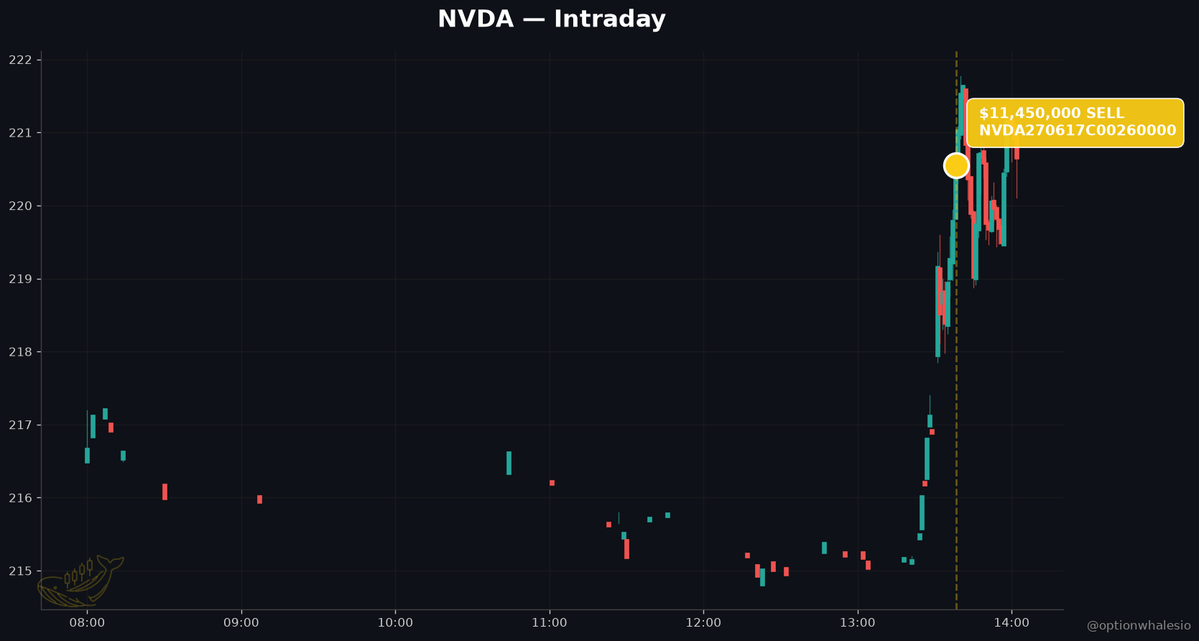
🐳 $NVDA opens with an $11.4M seller of June 2027 260 calls — someone is fading the AI bid.
THE THESIS
The AI capex trade is entering the phase where growth stops being rewarded and spending starts being punished. NVDA is the most exposed name in that repricing, and the largest option print of the session says a size player already knows it.
THE NEWS
On August 5, The Motley Fool reported that AMD posted record Q2 revenue of $11.5B, with data center doubling to $6.7B and total growth of 41% year-over-year. The stock fell 9% after-hours. The reason: flat Q3 gross margin guidance at 56% and capex nearly tripling to $808M. In other words, the market got the growth it demanded and sold it anyway because the cost of that growth is now visible on the income statement.
Same morning, a separate Motley Fool piece flagged AI as the most likely epicenter of the next bear market, calling out Oracle and CoreWeave for debt loads tied to AI spend. SpaceX guided to a $100B run rate and got crushed 11% pre-market on capex fears. The pattern across three unrelated tickers is identical: strong AI-linked revenue, punished multiples, capex anxiety.
NVDA sits at the center of all of it. Every dollar of AMD, Oracle, CoreWeave and hyperscaler capex flows through NVDA's order book. If the market is starting to punish the payers, it will eventually reprice the payee.
THE TAPE AGREES
At 09:38 ET, a burst seller unloaded 5,000 contracts of the June 2027 260 calls at $22.90 — $11.45M in premium, sold, not bought. Spot was $220.55, so those calls are roughly 18% out of the money with ten months to expiry. Selling that structure in size is a bet that NVDA does not sustainably clear 260 before mid-2027, or at minimum that implied volatility on long-dated upside is overpriced right now.
Zoom out on the full session: $77M in total NVDA premium across 34 qualifying trades, and the split is $41.9M bearish versus $35.1M bullish. The screen prints bullish. The dollars do not.
WHAT IT SIGNALS
This is not panic. It is positioning. A seller of long-dated upside is usually either an overwriter monetizing rich vol against a long stock position, or a directional player expressing a ceiling. Either way the message is the same: the person with $11M of risk on does not believe the next leg is a melt-up. They believe the AMD reaction is a preview.
WATCH FROM HERE
Watch whether NVDA holds 220 into the next hyperscaler capex print. Watch AMD's follow-through — if it fails to reclaim the gap, the read-through to NVDA multiples gets louder. And watch for a second block sale on the same 260 strike. One print is a hedge. Two is a view.
#Options #AI #Semiconductors #OptionsFlow #Nvidia #OptionFlow
@optionwhalesio
The Dow ripped 800 points on AI earnings. The biggest options tape faded the winners — starting with SNDK.
THE SETUP
The Dow closed up 800 points. Palantir printed +27% on faster-than-expected commercial AI adoption. Caterpillar helped drag the tape higher. On the surface, this was another clean leg of the AI-industrial melt-up.
Underneath, the options tape told a different story. Of the $933M in premium we tracked across 163 trades, the largest single conviction print of the day was a bearish one — and it wasn't in a name anyone was tweeting about.
THE FADE
SNDK saw $158.7M in premium and 99.6% of it was bearish. The anchor trade: a $138.75M January-2027 1650 put sold at 12:41 ET. Whether that's a naked short-vol bet or the short leg of a synthetic, the size alone puts it on the leaderboard for the week. Someone with real balance sheet is either collecting decay against a floor or funding downside elsewhere.
Right next to it: TSM, $98M premium, 89% bearish, headlined by a $31.9M September 425 call sold at 11:10 ET. That is a desk capping upside in the AI foundry monopoly into a green semiconductor tape. It is not the trade you make if you think NVDA earnings on Aug 26 are going to blow the roof off.
And on NVDA itself — 63 separate trades, $103M in premium, 62% bearish, with the largest print a $9.9M June-2027 260 call sold. That aligns uncomfortably well with today's Nadella headline: CPUs matter as much as GPUs for agentic AI, and Microsoft will order AMD CPU racks. The narrative that pure-GPU exposure carries the next leg of AI is quietly being priced down.
THE TENSION
PLTR is the giveaway. Stock rips 27% and the options premium splits almost evenly — $51.9M bullish against $55.8M bearish. The biggest single trade was a $32.6M March-2027 165 call bought, so there's real chase. But the fact that nearly equal money is on the other side of a 27% up-move tells you the sophisticated bid is not chasing indiscriminately. It's picking.
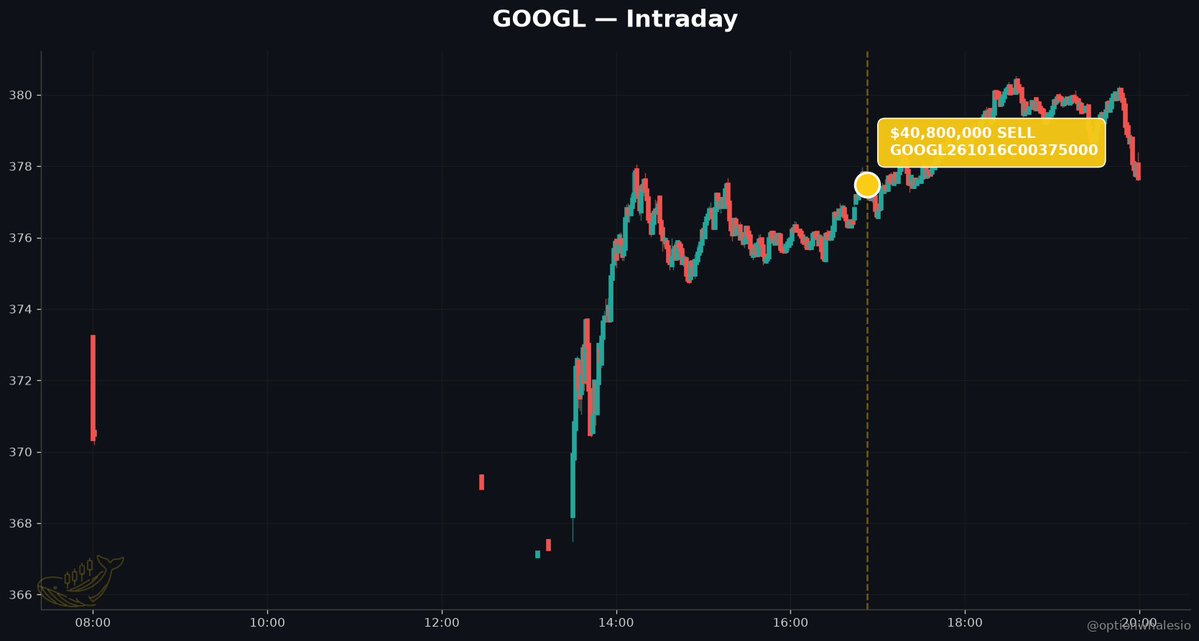
GOOGL bracketed the whole session — $200.6M in premium, 66% bearish, capped by a $40.8M October-2026 375 call sold at 12:52 ET with Waymo/Uber partnership headlines circulating. Upside is being monetized, not accumulated.
THE COUNTER
Give the bulls their due. MCHP had exactly two prints today and one of them was a $121.9M December-2026 65 call bought outright — the single largest bullish premium commitment on the tape. MSFT ran 71% bullish on 17 trades, led by an $11M September 510 call bought at the open. Both are consistent with a rotation thesis: out of the crowded GPU-AI trade, into analog/edge silicon and the software layer that captures the agentic workflow.
THE READ
The indexes closed green on an AI earnings beat. The tape closed positioned for the next leg to look nothing like the last one. When the biggest single trade of a euphoric day is a nine-figure bearish put in memory and the second-biggest is capping upside in TSM, the smart money is telling you the easy part is over.
#OptionsFlow #PLTR #NVDA #Semiconductors #AgenticAI #MarketClose
@optionwhalesio
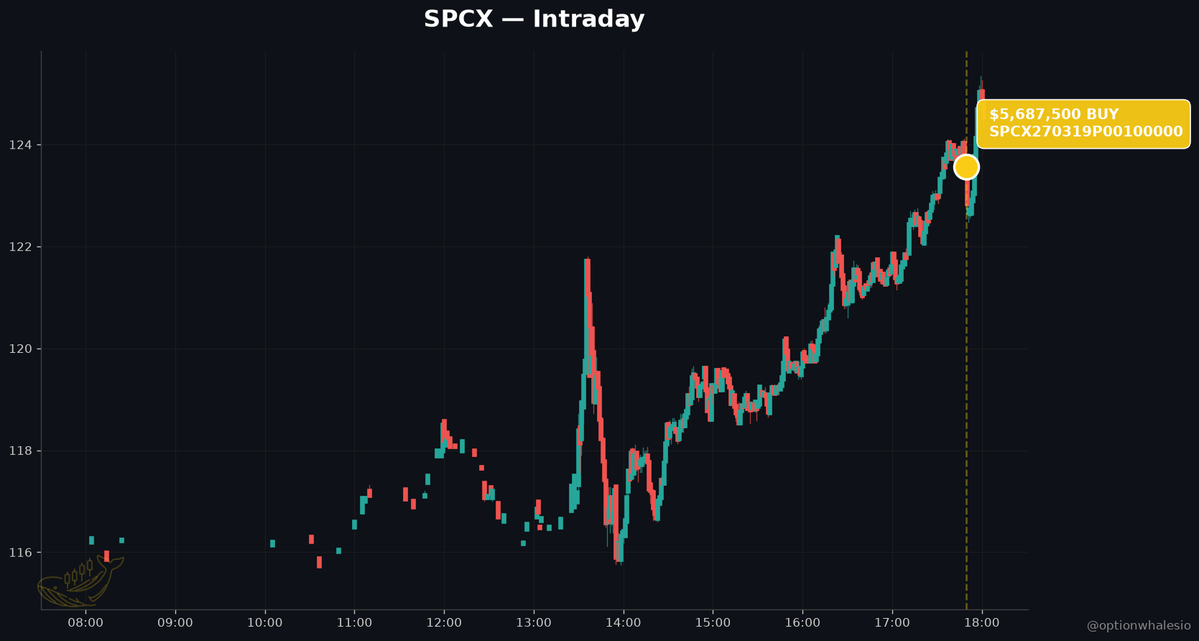
🐳 $SPCX rips 8% into its first earnings as a public company — and someone just paid $5.7M betting it unwinds.
THE THESIS
SPCX is trading like the euphoria is priced in. The stock is up 8.1% into its first quarterly earnings report as a public company, riding a broader tape that saw Palantir explode 27% and the Dow tack on 800 points. Somebody with real size just paid up to bet that story ends badly.
THE NEWS BACKDROP
Per The Motley Fool (Aug 4, 2026), Tuesday's session was a full risk-on melt-up — Palantir +27% on faster-than-expected AI platform adoption, Caterpillar +6% after crushing Q2 with 17% revenue growth, and semis broadly recovering. That is the tape SPCX is rallying into. It is not a stock-specific catalyst. It is beta plus anticipation of a maiden earnings print that has not yet happened.
Maiden reports are asymmetric. There is no history, no guidance cadence, no analyst muscle memory. Expectations get built on vibes, and vibes going into the print are 8% green.
THE TAPE DISAGREES
At 13:49 ET, a single block bought 3,500 of the March 2027 100-strike puts for $16.25, laying out $5.7M in premium. Spot was 123.57. That is a strike roughly 19% below the current price, purchased outright, with over seven months of duration.
This is not a scalp. It is not a stop-loss hedge on a same-week position. $5.7M in long-dated downside on a small/mid cap, funded in a single print, is a conviction structural bet — and it accounts for 80% of today's total options premium in the name.
WHAT IT SIGNALS
One of two things is happening. Either this is a large holder monetizing the 8% rip by locking in a floor into an unknown earnings event — which itself tells you they think the downside tail is fat enough to pay $16.25 per contract for. Or it is a directional short expressing that the pre-earnings ramp is the top, and the print (or the guide that follows it) resets the multiple.
Either reading is bearish on the stock's next leg. Nobody pays that much for 100-strike protection if they think 123 holds.
WHAT TO WATCH
The earnings print itself — and specifically the guide, since there is no prior bar to beat. Watch whether IV crushes post-print (normal) or stays bid (someone is still reaching for downside). And watch the 100 strike open interest tomorrow to confirm this was opening, not closing.
#Options #OptionsFlow #Earnings #SmallCap #Hedging #UnusualOptions
@optionwhalesio