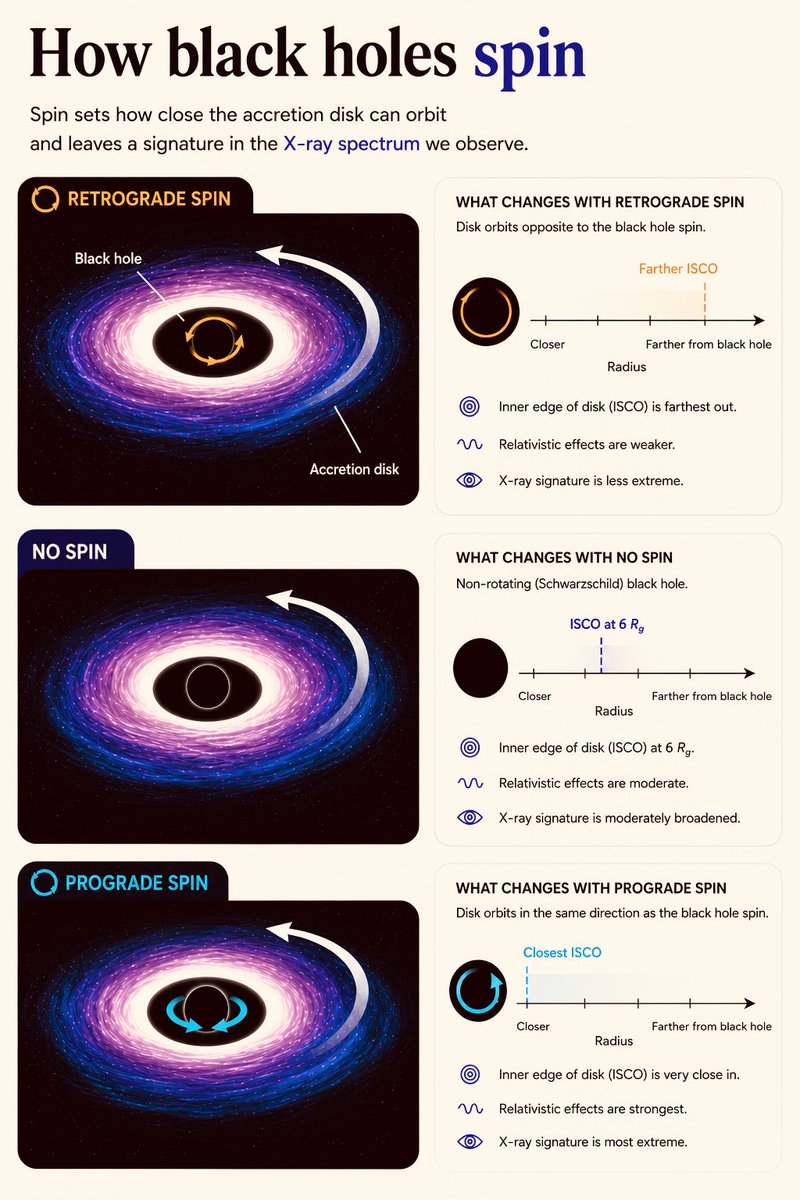
How do we measure the spin of a black hole?
The answer is written into the X-ray light from its accretion disk. As spin increases in the prograde direction, the inner edge of the disk can move closer to the black hole, where stronger relativistic effects broaden and shift the iron Kα line. That distorted X-ray signature lets astronomers estimate black-hole spin.
Sine looks elementary. It is an infinite polynomial of odd powers:
sin(x) = x − x³/3! + x⁵/5! − x⁷/7! + ⋯ = Σ (−1)ⁿ x^{2n+1}/(2n+1)!
A few terms already give high accuracy near zero; more terms extend the match.
Graphics rotations, audio filters, and physics engines evaluate sine this way (after range reduction).
The wave that defines oscillation is built from nothing but powers and factorials.
A visual reference to common mathematical notation, covering logarithms, special functions, limits, summation and products, derivatives, integrals, vector calculus, and the symbols used to describe change and variation.
That little λ you type every day?
It began as a typesetting workaround. Alonzo Church (1903–1995), a reserved Princeton logician, wanted a clean way to write functions.
He borrowed the “hat” notation (ˆx) Whitehead and Russell used in Principia Mathematica for classes, moved the caret in front to distinguish functions, then changed it to λ because printers handled it better.
Years later he joked the choice was almost “eeny, meeny, miny, moe.” That humble Greek letter became the foundation of functional programming and the Church-Turing thesis that still defines what computers can do.
The pressure that empty space exerts on two perfectly conducting plates is
F/A = −π²ħc / 240d⁴.
The inverse-fourth-power law and the purely kinematic constants ħ and c are all that remain after an infinite vacuum energy is subtracted from another.
Modes whose wavelengths cannot fit between the plates are simply absent; the resulting drop in zero-point energy grows as the gap shrinks, producing an attraction that becomes measurable only at sub-micrometre separations.
Casimir extracted the finite remainder in 1948. The same regularisation that isolates the number 240 also shows that the vacuum is not a passive backdrop: its energy density depends on the boundaries that contain it.
A capacitor treats DC and AC very differently.
DC: Current flows while it charges, then falls to zero at steady state.
AC: The voltage keeps changing, so the capacitor continually charges and discharges, allowing current to flow.
That frequency dependence makes capacitors essential in filters, signal coupling, and smoothing circuits.
Einstein’s field equations do more than describe gravity. In cosmology, they turn the contents of the Universe into a prediction for how space itself evolves.
For a homogeneous, expanding Universe, they lead to the Friedmann equation:
H² = 8πGρ/3 − k/R² + Λ/3
The remarkable part is that matter, curvature, and the cosmological constant all shape the expansion rate. The Universe’s history is written into that equation.
In 1926 Schrödinger wrote iħ ∂ψ/∂t = Ĥψ. In 1981 Feynman asked whether those same waves could compute.
The answer became Shor’s factoring algorithm, Grover’s search, and machines whose state is a complex vector of amplitudes.
A qubit is |ψ⟩ = α|0⟩ + β|1⟩ with |α|² + |β|² = 1.
That geometry now threatens public-key cryptography and promises faster molecular simulation.
From NISQ devices to algorithmic fault tolerance, the mathematics is racing the hardware.
Why can stacked cubes give you √14 but never √7?
Every colored segment is the straight-line distance from one lattice point to another: √(x² + y² + z²) for integers x,y,z.
√7 is impossible; 7 cannot be written as the sum of three squares.
The same lattice distances appear in voxel engines, protein packing, and robot motion on grids.
Some numbers simply refuse to live in three perpendicular directions.
log(1 + √2) is the radius at which circles turn from space into time.
Inside that value the orbits of constant radius stay spacelike; exactly there they become null; beyond it they are timelike and close upon themselves. A traveler who follows one of the larger circles returns not merely to the same place but to the same event, having aged while coordinate time has looped.
Gödel found the rotating dust metric that realizes this in 1949, an exact solution of Einstein’s equations whose uniform vorticity tips every light cone until the future can lean into the past. The spacetime is homogeneous, so such closed timelike curves thread every point.
Alan Turing (23 June 1912 – 7 June 1954) was a British mathematician, logician and computer scientist who laid the foundations of theoretical computer science and artificial intelligence.
In 1936 his paper on computable numbers introduced the Turing machine and the concept of the universal computer.
During WWII at Bletchley Park he led work that broke the German Enigma cipher using the Bombe, helping shorten the war. After the war he designed the ACE computer, proposed the Turing Test, and pioneered mathematical biology.
Turing was gay, which was still a crime during his life, and meant that his groundbreaking accomplishments were never fully recognised. He committed suicide at the age of 41.
In 1928, #Dirac published his eqn where he predicted the antimatter (electron with -ve energy), after 4 years, an American man discovered this particle 👇
It's the birthday of #CarlDavidAnderson
He received the 1936 #NobelPrize in physics for discovering the #positron
One equation quietly connects some of mathematics’ most important ideas.
Leonhard Euler’s formula, developed in the 18th century, says
e^{iθ} = cosθ + i sinθ
Put θ = π and it becomes e^{iπ} + 1 = 0, bringing together e, i, π, 1 and 0 in a single line.
What looks simple is really a bridge between exponential growth, geometry, trigonometry and complex numbers.
An infinite bell curve hides a circle.
The volume under z = e^{-(x² + y²)} across the entire plane equals π.
In polar coordinates the integral separates:
∫₀^{2π} ∫₀^∞ e^{-r²} r dr dθ = 2π · ½ = π
This identity underpins the normal distribution, the heat equation, quantum ground states, and the Gaussians that shape modern machine learning.
Infinity can be finite when symmetry is complete.
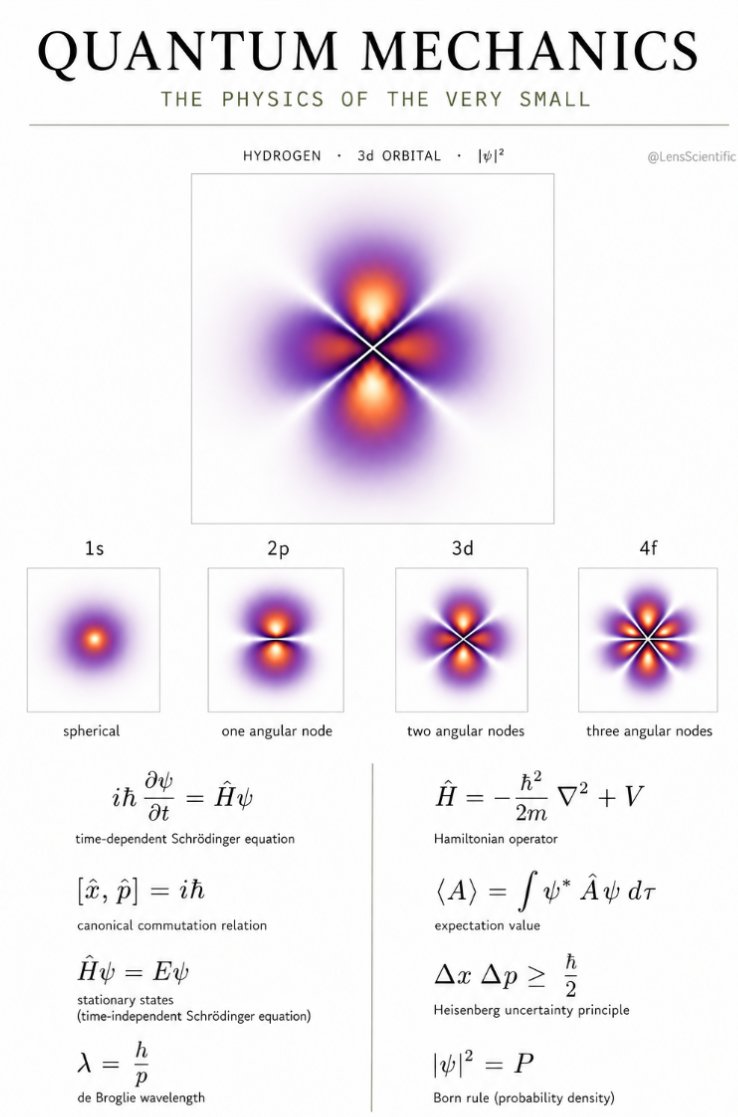
Quantum Mechanics 101
Electrons do not occupy fixed paths around the nucleus. Their quantum state is described by a wavefunction, ψ, and ∣ψ∣^2 gives the probability density for where the electron can be found.
The strange shapes of atomic orbitals are solutions to the Schrödinger equation, with their nodes emerging naturally from the mathematics. Even the familiar s, p, d, and f shapes are probability distributions, not electron trajectories.
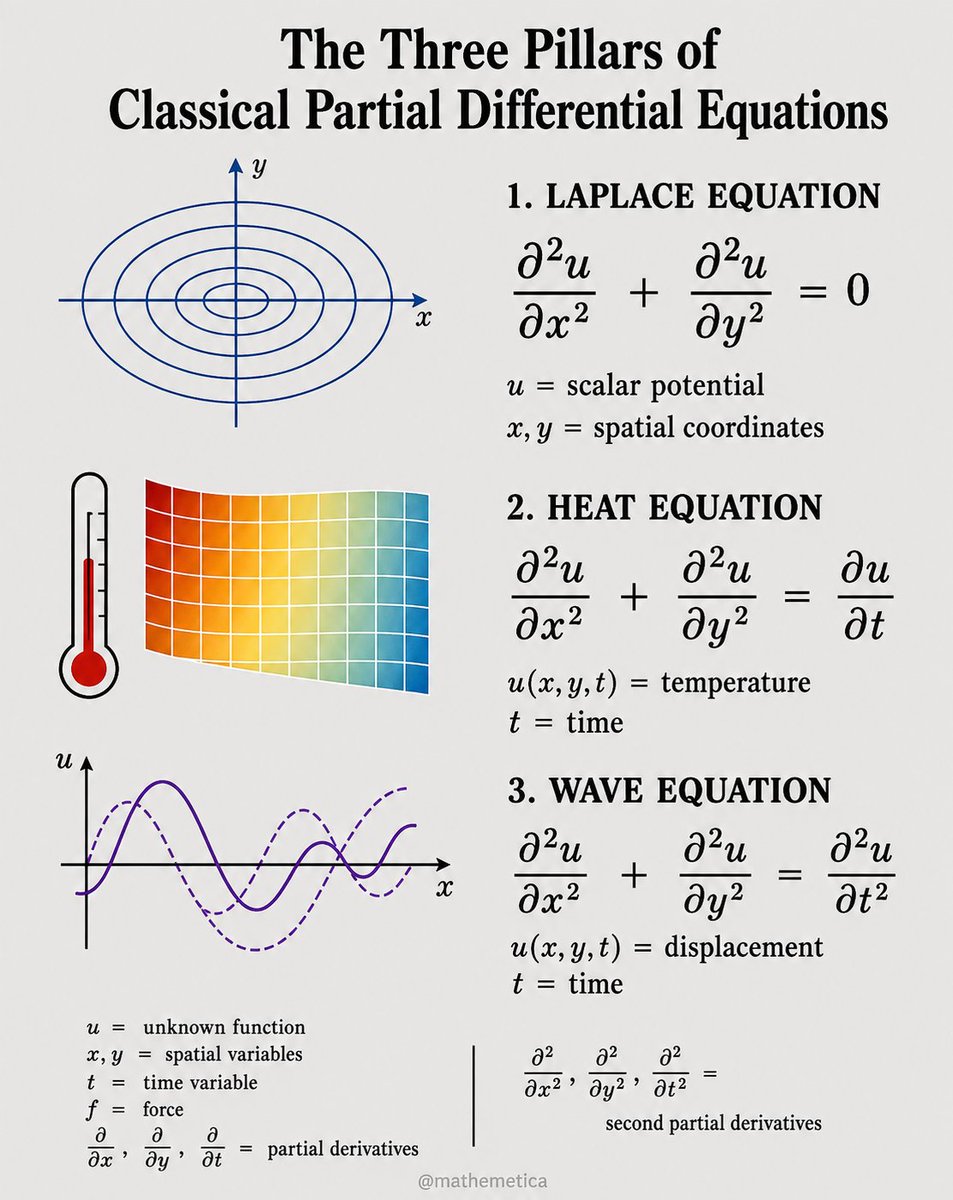
Δu = 0, Δu = ∂u/∂t, Δu = ∂²u/∂t².
One spatial operator, three possible companions in time. The first leaves a potential in equilibrium, the second lets a quantity diffuse, the third lets a disturbance travel as a wave.
Laplace applied the equilibrium case to gravitational potentials; Fourier extracted the diffusion case from heat flowing through a solid; d��Alembert found the traveling case in the motion of a string.
They remain the classical elliptic, parabolic and hyperbolic prototypes.
The ionosphere can act like a natural radio mirror.
Its free electrons interact with radio waves, changing the wave’s effective permittivity. In the simplest cold, collisionless plasma model:
εᵣ = 1 − ωₚ²/ω²
When the wave frequency is below the plasma frequency, ω < ωₚ, the wave cannot propagate normally through the plasma and becomes evanescent, allowing HF radio signals to return toward Earth.
That simple electron response is why radio signals can travel far beyond the horizon.