Today we’re introducing Orbis1.
A platform that provides an extensive and expressive toolkit (bricks and shovels) built on top of LN/ RGB.
It will make bitcoin-native stablecoins and RWAs easily available for - applications & wallets, merchant payments, and business workflows.
https://t.co/HBb2ydtuLH
1/n
A stablecoin is only as useful as the infrastructure beneath it.
Explicit settlement states. Deterministic validation. Backup and restore that works the first time, not the third.
Boring by design. That is the bar.
Stablecoin infrastructure on Bitcoin has one job: make asset state boring to reason about.
Orbis1 SDK surfaces consignment sync, issuer policy, and restore paths as first-class primitives.
When the plumbing is explicit, operators stop guessing and start building.
Multisig security is not a policy. It is an architecture.
The question is not how many keys. It is: who holds them, under what conditions, and what happens when one signer goes dark.
Key distribution without a recovery runbook is just latent risk.
Testnet checkpoint: RGB stablecoin settled over Lightning. No bridge. No custodian. No wrapped token. Bitcoin as settlement layer, Lightning as rails, RGB as the primitive. Mainnet path is operational.
Bitcoin Pizza Day Challenge Is Over 🍕
Thank you to everyone who celebrated Bitcoin Pizza Day with us, traded using CryptoRobotics tools, and shared your feedback!
🏆 It’s time to announce the results. Here are the lucky winners on X who will each receive 50 USDT:
🟢Trig D’Ace
🟢Wongah
🟢Crypto_queen
🟢Quomie san
🟢Zephyr
🟢Yasmin
🟢Pablo
🟢Harris
🟢Wolverine Of Wall Street
The prizes will be sent within 3 days.
Stay tuned — more activities are coming soon 🔥
Lightning compatibility in Orbis1 is not a feature. It is a constraint we designed around from the start.
Witness transactions, state sync, and consignment handling all resolve before the channel touches routing.
Ops stay boring. Settlement stays predictable.
RGB's tradeoff is explicit: scalability and privacy in exchange for operational responsibility.
Wallets must handle proofs. Backups must be reliable. Validation must be local.
Infrastructure that treats those as afterthoughts will fail users quietly.
Three questions every RGB wallet operator should answer before going live:
1) What is the exact restore path when a device is lost?
2) What happens when a consignment is missing at restore time?
3) Who holds backup state, and can they prove it?
If any answer is 'we figure it ou
Client-side validation in the Orbis1 SDK is not a UX compromise.
It is the mechanism. Asset state lives with the holder. Proofs travel with consignments. The chain timestamps commitments, nothing more.
Privacy and settlement guarantees are structural.
Inheritance planning on Bitcoin-native rails is an ops problem, not a legal one.
Who holds the proof bundle. Where the backup lives. Which key survives device loss.
Define those before the wallet is issued, not after the incident.
Institutions bought Bitcoin above $80k.
Liquidations cleared below $77k.
Neither event changes the settlement guarantee.
The infrastructure layer is the part that should be boring. We focus on that part.
Most RGB integrations stall at the same point: the gap between protocol correctness and application behavior.
The Orbis1 SDK closes that gap.
Witness transactions, schema validation, and transfer flows that operators can actually reason about.
𝐏𝐫𝐢𝐯𝐚𝐭𝐞 𝐏𝐚𝐲𝐦𝐞𝐧𝐭𝐬 𝐎𝐧𝐥𝐲 𝐁𝐞𝐜𝐨𝐦𝐞 𝐏𝐨𝐰𝐞𝐫𝐟𝐮𝐥 𝐰𝐡𝐞𝐧 𝐭𝐡𝐞𝐲 𝐏𝐥𝐮𝐠 𝐃𝐢𝐫𝐞𝐜𝐭𝐥𝐲 𝐈𝐧𝐭𝐨 𝐁𝐢𝐭𝐜𝐨𝐢𝐧'𝐬 𝐋𝐢𝐪𝐮𝐢𝐝𝐢𝐭𝐲.
That's what makes USDT on Bitcoin actually useful at scale.
Without the Lightning Network, stablecoin transfers stay slow and expensive. With it, they become instant, cheap, and private.
But sending USDT privately on Bitcoin today is still very messy.
You either use Ethereum or Tron and give up Bitcoin's security Or you try to build on Bitcoin and deal with clunky infrastructure, no privacy, and slow settlement.
Then layer in the custodial risk, the fees, and the lack of developer tooling. It's a lot.
That's why private stablecoin payments on Bitcoin haven't scaled yet.
It's not a demand problem, It's a "too hard to build and use" problem.
Most teams don't even try. The ones who do take forever and still cut corners on privacy.
This is where @utexocom changes things.
Utexo simplifies everything.
Instead of all that heavy setup, you get instant USDT transfers over Lightning, with full privacy built in through RGB Protocol, and zero custodial risk.
You just send and receive.
That makes private Bitcoin payments easy for developers AND regular users, opening the door for more private transactions, more onchain activity, and more people who actually want to hold USDT without leaving Bitcoin.
Private stablecoin payments are the real unlock and Utexo is making it simple enough to actually scale.
Hardware wallets solve key custody.
They do not solve asset state custody.
For RGB, you need keys plus consignments plus a restore path that reconstructs state or fails closed. A Ledger with no proof backup is not a recovery plan.
500ms. 1 sat. RGB collectible transferred over Lightning. ⚡️
That's the real bar for digital ownership: instant settlement, near-zero cost, no custodian, Bitcoin-native.
Speed isn't the flex. Self-custody at that speed is.
Orbis1 SDK gives operators three things out of the box:
1) Stablecoin issuance and transfer over RGB
2) Consignment sync with deterministic validation
3) Backup and restore as first-class APIs
Not abstractions. Concrete primitives ready to integrate.
Been a while since I talked about @utexocom
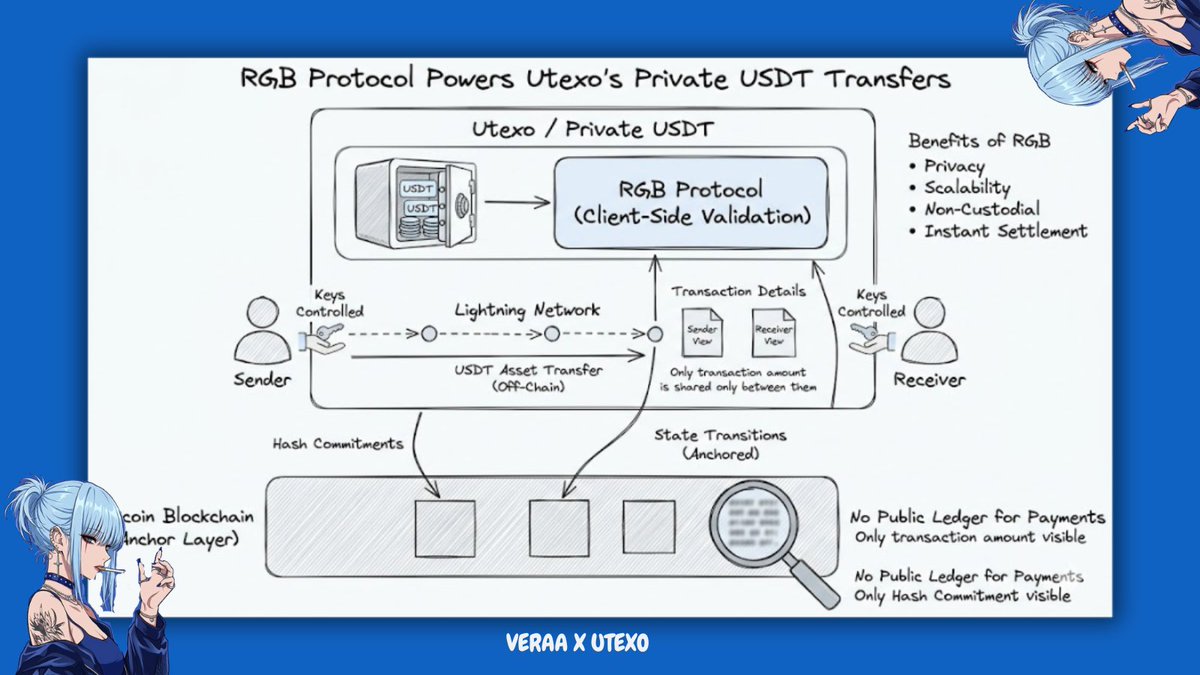
Let's talk about one of the things making their private USDT work ⇒ RGB Protocol
RGB basically lets you move assets on Bitcoin without putting your business on the blockchain.
Most people still don’t know it exists.
RGB is the client-side validation protocol powering Utexo's private USDT transfers.
It lets you send money over Lightning without the whole world seeing your balance or who you paid.
𝐇𝐞𝐫𝐞'𝐬 𝐰𝐡𝐲 𝐑𝐆𝐁 𝐦𝐚𝐭𝐭𝐞𝐫𝐬:
• Transaction data stays off-chain
• Only sender and receiver see the details
• Payments route through Lightning instantly
• You keep control of your keys and funds
𝐒𝐨 𝐡𝐨𝐰 𝐝𝐨𝐞𝐬 𝐭𝐡𝐢𝐬 𝐰𝐨𝐫𝐤 𝐰𝐢𝐭𝐡 𝐔𝐓𝐄𝐗𝐎?
USDT gets issued as an RGB asset on Bitcoin.
When you send it:
• the amount stays private
• the receiver stays private
• Lightning handles speed
• Bitcoin handles security
That’s the piece most people miss.
RGB is what makes private instant USDT on Bitcoin actually possible instead of just another crypto idea on paper.
Bitcoin scales when infrastructure knows its own boundaries.
Settlement layer: Bitcoin.
Asset state: client-side.
Validation: local, deterministic, auditable.
Operators who build within those boundaries do not need to redesign when volume grows.