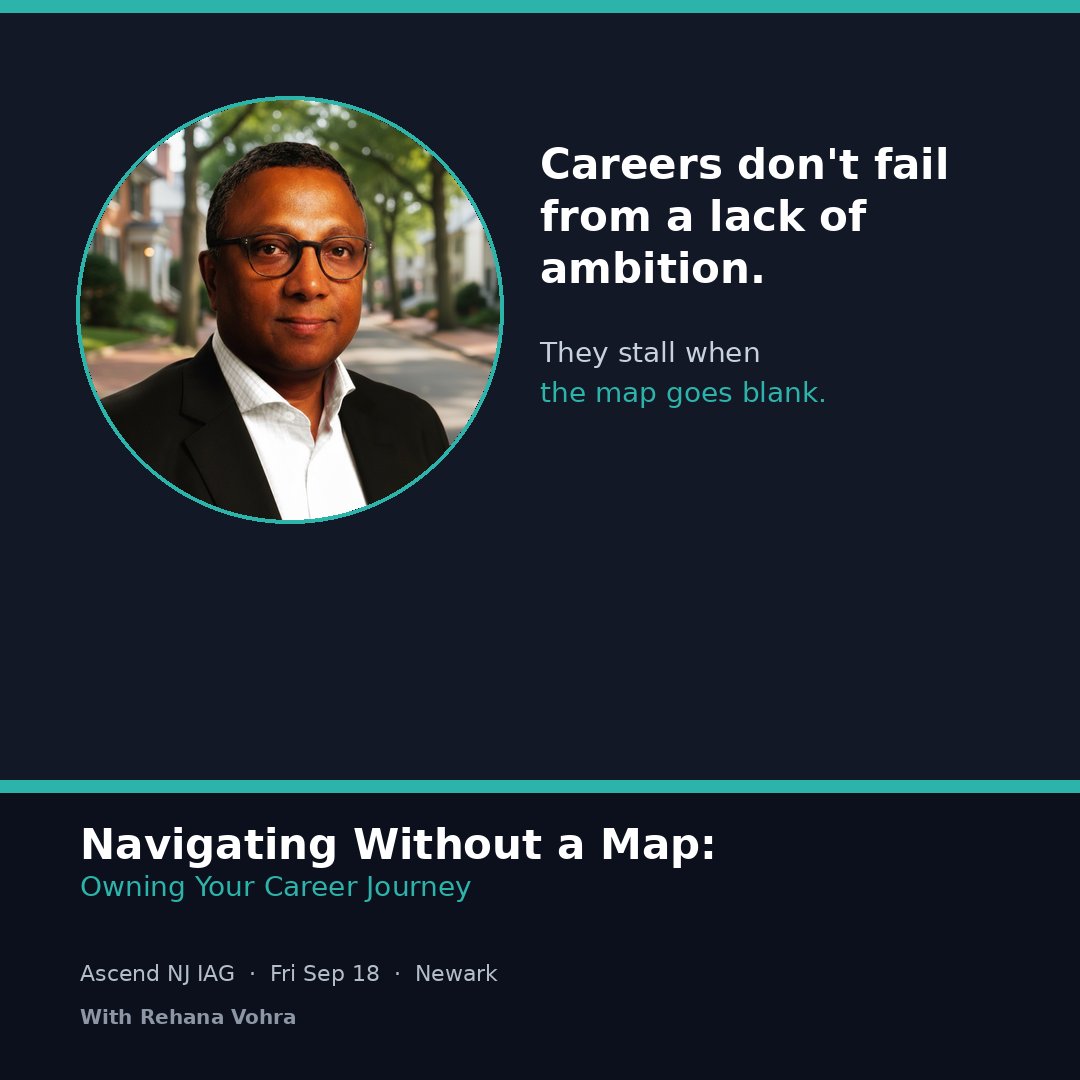
Careers don’t fail from a lack of ambition.
They stall when the map goes blank.
This Friday at Ascend NJ — Navigating Without a Map: Owning Your Career Journey — with Rehana Vohra.
If you’re mid-change and the old playbook stopped working, this one’s for you.
Fri Sep 18 · Prudential Plaza, Newark
https://t.co/XQ0Ojg27sG
#AscendNJ #Career
Monday challenge: spend $50 on an AI idea before you spend another hour reading about AI.
The best way to understand AI is not to read another thread from a 23-year-old “AI strategist” who discovered Zapier last Tuesday.
Build something.
Buy the domain.
Sketch the app idea.
Spend $20 on ChatGPT, Claude, or another AI tool.
Put $10 or $20 into API credits.
Use Replit, Cursor, Lovable, Supabase, or whatever tool gets you moving.
Then try to build something real that someone might actually pay for.
You will learn more in one weekend of trying to ship a usable product than in six months of AI hype, podcasts, webinars, and “top 10 prompts” posts.
The bar is not perfection.
The bar is this:
Can you turn an idea into a working prototype?
Can you explain the value?
Can you get one person to say, “I would pay for that”?
That is where the learning starts.
In this AI cycle, the separation will not be between people who “use AI” and people who do not.
It will be between people who talk about AI and people who build with it.
This Monday, spend a few bucks.
Make something useful.
Break it.
Fix it.
Show it to someone.
The AI bros can keep the buzzwords.
You keep the receipt, the prototype, and the scars.
IT spend is no longer just a budget category.
It is a leadership system.
CIOs see architecture and risk.
CFOs see cost and ROI.
Procurement sees vendors and contracts.
https://t.co/g4KC2vzJAP is focused on helping all three make better decisions from the same intelligence layer.
#ITSpend #CIO #CFO
The Rise of the Double-Agent CIO: SaaS founders, empower your CIOs & CISOs to engage prospects directly.
I trusted vendor CIOs/CISOs far more than sales teams. Peer conversations build real credibility and close deals faster.
Huge opportunity—don’t ignore it.
Read: https://t.co/0BJB1OyPPH
#DoubleAgentCIO #SaaS #CIO #CISO #EnterpriseSales
Post‑Conference Reflection - Back from AI Hot 100 at Civic Hall, a few patterns stood out for me.
1️⃣ The adoption gap is still the biggest risk
Most organizations are better at buying AI than changing behavior. The best conversations I had were about incentives, operating models, and how to measure real usage, not just licenses.
2️⃣ AI–cyber is moving from slides to stories
Leaders shared real incidents and near‑misses tied to AI — from shadow tools to data lineage issues. The common thread: boards don’t want model diagrams; they want clear blast‑radius scenarios and response plans.
3️⃣ Decision intelligence is the next frontier
The tools that resonated most were not “yet another copilot,” but systems that act like an AI data analyst. Wisdom AI was a good example — watching CIOs and investors react to the idea of asking questions in natural language and getting grounded, explainable answers about their own business was a highlight.
I’m seeing the same thing: the leaders who will win the next 24 months are those who can say:
Here’s where AI is moving our P&L
Here’s how our people are actually using it
Here’s how we’re keeping that system safe
I’m a global CPG CIO turned advisor and builder at the intersection of AI adoption, cyber, and decision intelligence, and I’m pulling my notes into a short briefing for CIOs, CISOs, and CFOs on “What AI Hot 100 confirmed about enterprise AI in 2026.”
If you’d like a copy, comment “briefing” and I’ll share it once it’s ready.
Afternoon/Evening: Post‑Panel Takeaways
Some quick, unfiltered takeaways from today’s AI Hot 100 conversations at Civic Hall:
1️⃣ Most AI projects still die in the org chart, not the model
The hardest part isn’t accuracy — it’s incentives, training, and process redesign. The CIOs who are winning are treating AI programs like product launches, not IT deployments.
2️⃣ AI–cyber is no longer a separate track
Every meaningful AI initiative is now a security initiative. If security isn’t in the room when you design it, they’ll be in the room when you explain the incident.
3️⃣ Analytics fatigue is real
A lot of leaders are drowning in dashboards and starving for answers. That’s why there was so much interest in “AI data analyst” concepts like what Wisdom AI is building — systems that can explain why a KPI moved, not just show that it did.
As a global CPG CIO turned advisor and builder at the intersection of AI adoption, cyber, and decision intelligence, I’m leaving today even more convinced that the next wave of enterprise AI success will come from:
Clear adoption metrics
Opinionated guardrails
And tools that answer business questions in plain language
If any of this resonates and you’d like a short post‑event briefing on what I’m seeing across CIOs, CISOs, and AI builders, comment “briefing” and I’ll make sure you get it once I pull my notes together.
Morning: Live From the Event - Kicking off AI Hot 100 at Civic Hall today.
My theme for the day is simple: in 2026, adoption > tools.
We’ve spent years buying models, copilots, and platforms. The winners now are the leaders who can show how AI is changing daily behavior for planners, operators, and frontline teams — and how that translates into margin, resilience, and growth.
Today I’ll be:
Moderating a conversation on why “stop buying tools, start buying human adoption” is the key line item for 2026
Joining a session on AI + cybersecurity and what the next breach will really look like
Hosting Wisdom AI’s CEO and walking him into conversations with CIOs, CISOs, and investors who are tired of dashboard sprawl and want an AI data analyst that actually answers the business
I’m a global CPG CIO turned advisor and builder at the intersection of AI adoption, cyber, and decision intelligence — and that’s the lens I’m bringing into every discussion today.
If you’re here and want to compare notes on AI adoption, AI–cyber guardrails, or see Wisdom AI in action, come find me or drop me a quick DM.
See you at - Civic Hall for the AI Hot 100 Summit
I’ll be listening for three things this week:
What’s actually impacting the P&L
Where adoption is breaking down
Where risk is quietly increasing
Questions I’m Bringing to AI Hot 100 : As I prep to moderate at the AI Hot 100 Summit this week, these are the questions I’m bringing into the room:
1️⃣ For CIOs and business operators
Which AI initiative actually moved a P&L line for you — and what behavior had to change for that to happen?
2️⃣ For CISOs and risk leaders
What’s one AI use case you were excited about but had to slow down or reshape because of security, privacy, or compliance concerns — and was that a bug or a feature?
3️⃣ For vendors and builders
Can your product answer “why did this KPI move?” in plain language for my operators, without a data team sprint every time?
I’m a global CPG CIO turned advisor and builder at the intersection of AI adoption, cyber, and decision intelligence. That’s the lens I’m bringing into every panel and hallway conversation.
I’ll also be walking the CEO of Wisdom AI into a set of conversations because they’re one of the few teams leaning hard into this “AI data analyst” idea: conversational, grounded in your data, and trusted by the people who own the numbers.
If you’re going to be at Civic Hall and any of these questions hit close to home, comment which one (1, 2, or 3) and why — I’ll weave as many perspectives as I can into my moderation.
3 AI Metrics Every CIO Should Know - As we head into another AI‑heavy week, here are three numbers I think every CIO should know in 2026:
1️⃣ Workflow coverage
What percentage of your critical workflows (sales, supply chain, finance, operations) are meaningfully impacted by AI today? Not pilots — real production impact.
2️⃣ Adoption rate
How often are frontline employees actually acting on AI‑generated recommendations? If the model is “right” but no one uses it, value is zero.
3️⃣ AI incident / near‑miss count
How many AI‑related incidents or near‑misses have you logged in the last 12 months (data exposure, bad recommendations, policy violations), and what changed as a result?
These are exactly the kinds of signals I want on a single page that CIOs, CFOs, and COOs can share — which is why I’m building TekLedger as a CIO/CFO intelligence layer, and why I’m spending time with teams like Wisdom AI who treat analytics as an AI data analyst, not just another dashboard.
If you’re a CIO, CISO, or finance leader coming to AI Hot 100 and want to talk about how to actually capture and visualize these metrics, let’s find 15 minutes while we’re at Civic Hall.
Mythos & OpenClaw: Most AI conversations are about capability. The real story is risk.
Headed into AI Hot 100, I’m thinking a lot about AI‑driven risk.
Three AI–cyber risks I expect to come up in my conversations this week:
1️⃣ Shadow AI
Teams quietly pasting sensitive data into unvetted tools because they just need to get the job done. No logs, no controls, lots of exposure.
2️⃣ Era emergent - Mythos & OpenClaw threats
3️⃣ Supply chain and partner attack surface
In CPG, supply chain, and healthcare, the combination of connected plants, logistics partners, and data feeds creates a massive attack surface. A subtle integrity breach can change forecasts, allocations, or safety decisions before anyone notices.
On the positive side, I’m excited about teams like Wisdom AI that are using agentic analytics to remove reporting bottlenecks and make it safer and faster to get the right answer from your enterprise data — so people stop routing around the system just to get insight.
If you’ll be at Civic Hall and want to dive into AI–cyber scenarios, or see what an “AI data analyst” looks like in practice, DM me. I’m happy to walk you over and introduce you.
Nobody handed CIOs this mandate.
The best ones picked it up anyway — AI strategy, cyber posture, data governance, board accountability. All of it.
The title is CIO. The job is Chief Integration Officer.
#CIO#AI#Leadership#CEO#Cybersecurity
5 things CEOs need to do on AI in the next 90 days.
Most orgs are behind on at least 3.
The gap isn't technology. It's who owns the decision.
#CEO#AI#CIO#Leadership#EnterpriseAI
Gartner Orlando → iWill NYC. Same week. Different rooms.
Same lesson: the technology is not the variable.
Who's in the room deciding how to use it — that's the variable.
#AI#Leadership#CIO#CEO#GartnerDA
Gartner say - 50% of AI agent failures by 2030 will be due to insufficient governance.
Not bad tech. Not bad data.
No accountability structure.
#AI#AgenticAI#AIGovernance#GartnerDA#CIO
At the iWill Summit in NYC today.
A room full of leaders who stopped waiting for permission.
After a week of Gartner data on AI — this is the room that will actually execute it.
#iWill#WomenInLeadership#AI#NYC
White House cyber strategy + Gartner data summit. Same week. Same signal.
AI agents are running your network defense AND your data infrastructure.
Your CISO and CDAO need one shared agenda. Now.
#Cybersecurity#AI#CIO#CISO#GartnerDA
Gartner just reframed AI ROI as 3 returns: intelligence, integrity, individuals.
Most orgs are funding the first. Ignoring the other two.
That's why pilots don't scale.
#AI#GartnerDA#CIO#CEO#DataStrategy
Two questions your board will ask in the next 90 days. Most CEOs can't answer either cleanly.
Q1 (for the CEO):
"What did we spend on AI and what moved because of it?"
Weak: 'We're investing in the future.'
Strong: One pilot. One metric. One result. One lesson.
Q2 (for the CFO):
"Are we paying the right price for our tech?"
Weak: 'IT handles that.'
Strong: 'Audited 6 months ago. Saved $X. Here's the next move.'
Boards already have the data.
$250B spent on AI. 56% saw zero ROI.
They are going to ask.
Which question are you less prepared for?
Drop your answer below. I'll share the one thing I'd do first — no pitch.
#CEOLeadership #CFO #BoardPrep #AIStrategy #Founders