I think it’s time to revisit the accredited investor laws in the US.
Companies are staying private longer, where only accredited investors (aka rich people!) can invest. Retail investors can only come in after IPO, when much of the upside has already been captured.
These rules were created with the best of intentions, to protect regular people from scams - a noble idea. Unfortunately, in practice they've often made it illegal to get richer, unless you're already rich. A regressive tax!
We have to judge policies based on their outcomes, not on their intentions.
These are two possible routes I see:
1) Replace the rule with something merit-based, like a financial literacy test. Pass it and you're accredited. Having a qualification based on competency rather than your bank balance or income seems far more fair.
2) Remove the rule entirely. Let consenting adults assess their own risk. Disclosure requirements stay and fraud enforcement stays to punish bad actors.
When people say we need to find a balance between privacy and allowing law enforcement to do their job, I remind them that the 4th Amendment is that balance.
If you want access to someone's life, get a warrant.
My 17-year-old daughter:
“I’m confused. We’ve always been taught not to share personal information or anything that identifies us online because it isn’t safe. Now they want us to do exactly that to access social media.”
Zcash is hardened.
No privacy breaches. ✅
No backdoors. ✅
10 years fair distribution. ✅
Supply enforced. ✅
Mythos checked. ✅
World class dev teams. ✅
No compromises. No co-opt. No stop.
Full send.
This post by @DavidSacks about the Anthropic/Fable situation is noteworthy, but not for the reason most people think.
Put the details aside for a second.
Anthropic released a blog post with their side of the story a few hours ago. David is responding with a bullet point list in a tweet about a different side of the story.
Years ago both sides would be jockeying to get mainstream reporters to tell their version of the truth and the American public would be fed some edited narrative that was filtered through a bureaucratic media organization.
That world doesn't exist anymore.
Now both sides share their versions publicly so the American people can hear directly from them. It is up to the individual citizens to make up their mind who they believe.
I haven't read a single article about the situation, but rather just read the various players' statements.
Fascinating how fast the world has changed.
I am filled with optimism at the fact that the world's first trillionaire was made not by hedge funds or market manipulation, but by building the infrastructure to take America to the stars.
.@balajis to @jswihart: “Zcash is one of the most important projects in the world.
Not one of the most important crypto projects, but one of the most important projects in the world.”
The enemy is once again at the gates. Today is a good day for all Americans who are concerned about the constant erosion of their privacy to speak out.
https://t.co/7lcOVo6MDl
The more I attend Federal Budget briefings delivered by skilled and experienced tax experts
The more shocked I am at how ill thought through some of these budget measures are, particularly around the CGT and trusts
It is like the government has no idea what it is doing, and has no idea what the commercial impacts of these decisions will be
What's the point of a Senate inquiry if you only invite partisan supporters of the policy and generalists who don't understand the technical issues, while excluding the people who've actually done the analysis?
People like @GeoffWilsonWAM, @DerekFranc90653 and former Treasury official and CGT expert Geoff Francis have spent countless hours analysing these proposals, yet apparently their expertise isn't wanted.
I've had five opinion articles published on these tax changes, covering the impact on startups, innovation, shareholders, investor behaviour, young savers trying to buy a home and the broader economy.
Stockspot works with more than 20,000 investors and we've quantified the diversification penalty these changes create for everyday Australians using real world portfolio examples.
Yet we're excluded from appearing, and our submission hasn't even been published on the inquiry website.
Surely a proper inquiry should hear from people with different perspectives and subject matter expertise?
If you're only inviting people to sing the praises of the policy, it's not really an inquiry... it's the town hall meeting for the Springfield Monorail.
Why bother with hearings at all? Just get the like minded think tanks together to sing "Monorail" and call it a day!
@KyleSamani zec is in a class of its own
zcash focus is singularly on being an SoV and it structurally should not be programmable so it can reduce the scope of potential risks
but obviously we also need programmable private finance for tradfi to come onchain
Dunking on Zcash for finding this exploit is like laughing at someone for catching cancer early.
Your favorite chain is still saying “I feel fine” and refusing the check up.
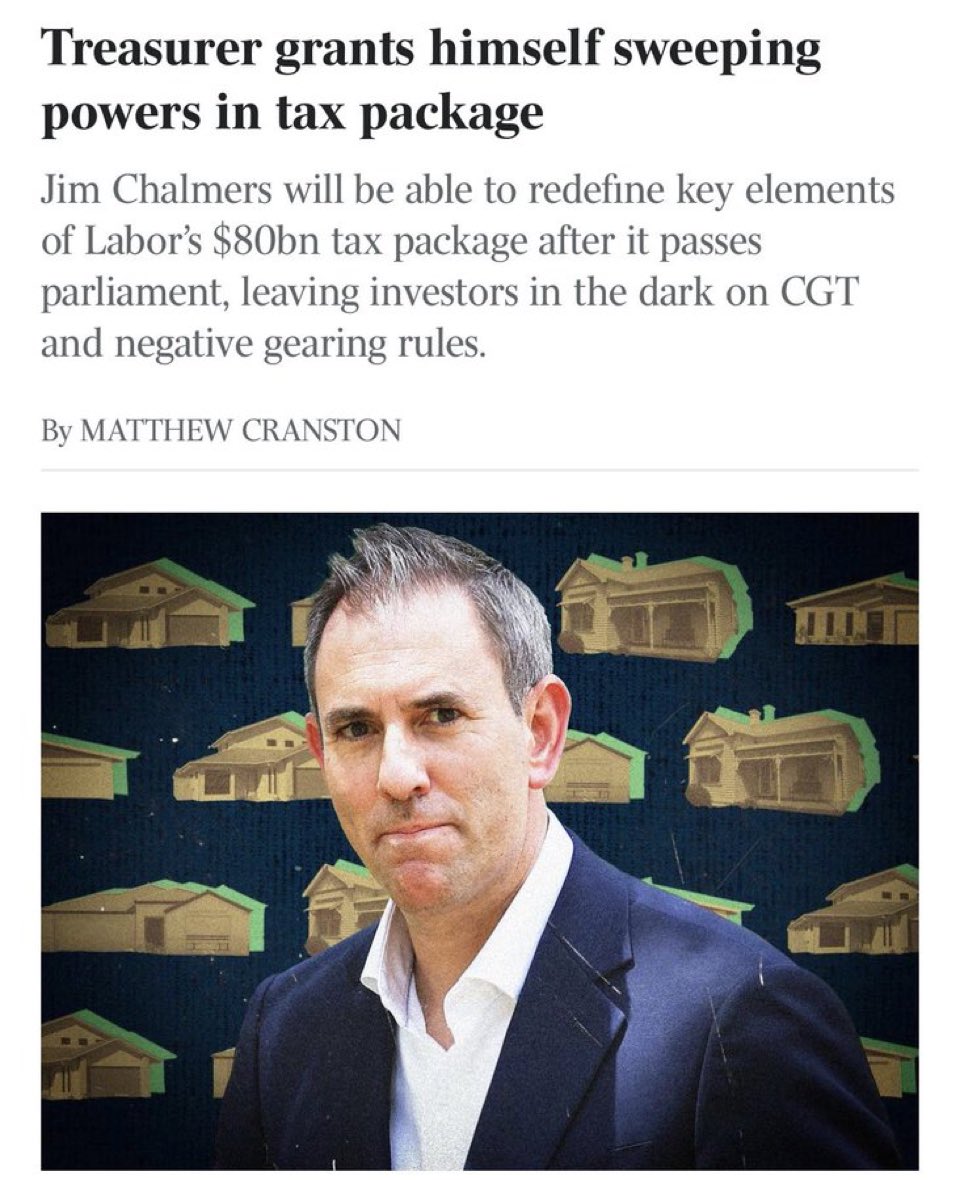
Treasurer @JEChalmers quietly gave himself god like editing rights over the $80bn CGT package after it passes Parliament.
CGT, negative gearing, whatever he feels like. Unbelievable. All subject to one bloke’s whim.
This isn’t governance. This is a banana republic power grab.
Australia deserves better than this amateur authoritarian behaviour.
Great article. Exceptional reporting @mcranston1
On what planet do these idiots think giving a minister the powers to decide, without consultation or consent, which assets should be taxed and at what rates?
Labor are completely off the rails.
Ça fait un moment que je me pose des questions sur le bilan (provisoire) de Milei en Argentine. On lit tout et son contraire. Alors j'ai arrêté de lire les commentaires et j'ai regardé les chiffres bruts.
L'Argentine, c'est l'expérience grandeur nature que les économistes attendaient depuis 50 ans. Même pays. Même peuple. Même culture. On change UNE variable : la méthode économique.
Avant : des décennies de gestion étatiste et péroniste, "redistributive". Le résultat concret ? 211% d'inflation, 42% de pauvreté, un État en déficit permanent qui finance son train de vie en faisant tourner la planche à billets.
Puis arrive Milei. Méthode inverse, brutale, assumée : on coupe, on déréglemente, on arrête d'imprimer.
Deux ans plus tard (photo à son arrivée (fin 2023) vs aujourd'hui) :
Inflation annuelle : 211% → 31%
Inflation mensuelle : 25% → ~2%
Déficit public : −5% du PIB → +1,8% (excédent)
Croissance : −1,6% → +4,4%
Pauvreté : 42% → 28%
Sans débat. Jugez par vous-mêmes.
Et le point essentiel : ces gains ne vont pas "aux riches" ou "aux marchés". Ils vont d'abord aux plus pauvres.
L'inflation est l'impôt le plus injuste qui existe — elle frappe ceux qui n'ont aucun actif pour se protéger. La diviser par 7, c'est rendre du pouvoir d'achat à ceux d'en bas. Et 14 points de pauvreté en moins, ce sont des millions de gens, pas une ligne Excel.
Pendant un siècle, on a expliqué aux Argentins que l'État les protégerait en dépensant toujours plus. Résultat : un des pays les plus riches du monde en 1910, ruiné. On vient d'inverser la méthode. Regardez le résultat.
À un moment, il faut accepter ce que les faits racontent : sur le terrain économique, la méthode libérale a livré en deux ans ce que des décennies de socialisme avaient promis sans jamais tenir. Et ça profite d'abord aux plus modestes.
On peut détester le style de Milei — la tronçonneuse, l'outrance, les sorties improbables, il n'a rien d'un homme d'État classique. Mais on ne juge pas une politique économique au style de celui qui la mène. On la juge à ce qu'elle fait à la vie des gens.
Et les chiffres ont parlé.
@Cryptopathic@zooko That is the entire point!
ZCash should *not* implement ZSAs and should focus on its core strength, as a private store of value
Let a different chain focus on Shielded Assets as its core strength
Invest in both, in proportion to your conviction of the need for each use case