1951- 1st Precovery images
2004- Officially discovered.
2010- Dr. Tancredi submitted a recommendation I become an official #DwarfPlanet 2 @IAU_org
2019- Resubmitted to @IAU_Org 4 official #DwarfPlanet reclassification by Noemi Pinilla-Alonso et all . #DwarfPlanetsArePlanetsToo
Today is the 96th anniversary of Pluto's discovery in 1930. And it still hasn't even made half an orbit around the Sun since!
It'll take another 152 years to complete its first full orbit since its discovery. That'll happen on March 23, 2178. Maybe your great-grandchildren will get to see that day.
Eris is a confirmed dwarf planet located in the distant Kuiper Belt.
On average, this unique body is 3 times further from the Sun than Pluto.
Eris’ discovery in 2005 was a major reason for the declassification of Pluto from a planet to a dwarf planet.
Interesting object.
Ganymede is a supporting character in my just published middle grade chapter book for kids "The Moon Contest." Jupiter enlists Ganymede's help to hoard satellites in hopes of winning the title "Solar System's Most Moons."😄https://t.co/6cU0GDVNXY
Orcus is a probable dwarf planet located in the distant Kuiper Belt.
With a diameter of 595 miles, Orcus is similar in size to Ceres. It also has a large moon named Vanth, which is about one-third the size of Orcus.
The solar system is full of interesting objects akin to Orcus.
The largest unnamed #DwarfPlanet#2002MS4 was discovered 06-18-2002 by C. A. Trujillo & M. E. Brown. A cubewano with an orbital period of 273 years. Semi-major axis of 42.03 Eccentricity of 0.14 & inclination of 17.68° #2002MS4 is about 778 KM & observed 78 times dating to 1954.
#DwarfPlanet#2003AZ84 was discovered on 1.13.2003 by C. A. Trujillo & M. E. Brown. It's moon was discovered in 2007, but is since lost. A plutino with an orbital period of 246 years. (a=39.27 AU, e=0.18, i=13.58°, diam=772 KM). It has been observed 357 times dating back to 1996
Triton, discovered #OTD 10-10-1846, is one of the few moons on which active eruptions have been observed. In 1989 Voyager 2 observed geyser-like eruptions of nitrogen gas & dust from beneath the surface in plumes up to 5mi (8 km) high.🤩#Space
Uranus, rings and moons captured this morning under good, but variable conditions. Note the rings exhibit a dimming on the bottom side of the image - this is actually a real feature and is seen in Hubble imagery.
See thread for a timelapse of Uranus' motion and the 'raw' images.
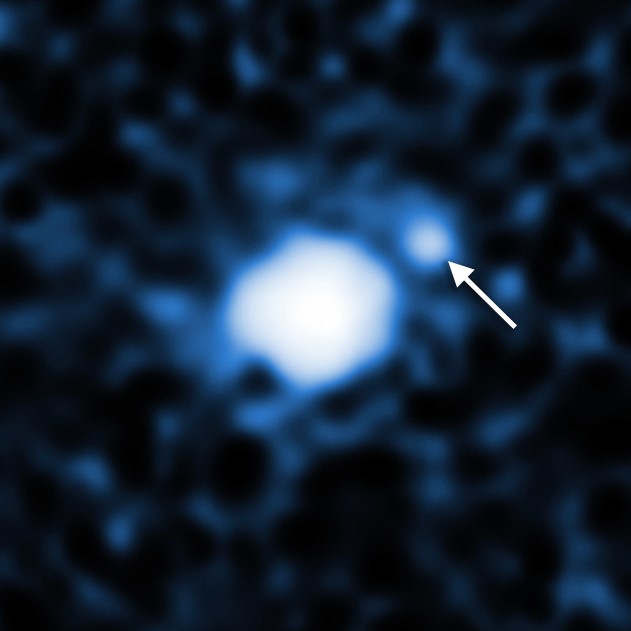
#OTD 9-18-2010 Xiangliu, moon of dwarf planet Gonggong (2007 OR10), was discovered! In 2016 astronomers learned Gonggong had an unusually slow rotation. Tidal forces exerted by a satellite could explain this, so they went hunting in archival Hubble images & found Xiangliu🤩#Space