I spoke yesterday in Paris about how socialist policy can enable us to overcome social deprivation and ecological crisis, by aligning investment and production with democratically determined objectives.
I noticed that some people assume socialism necessarily means 100% public ownership, but this is not the case. Yes, for many important reasons, we need public ownership of public services, utilities and the commanding heights, and yes we need a public finance system, industrial policy and credit guidance...
But there's no reason we cannot have private firms producing consumer goods like watches, beer, etc - the key is that they should be democratically owned and managed, by workers or communities empowered to determine the objectives of investment and production.
We know that when people have democratic control over production they are more likely to align it with social and ecological needs.
Socialism is ultimately about economic democracy: extending the principle of democracy into the realm of production. Cooperatives are an important step in this direction.
Bicycles are hugely space efficient, which is why they make a lot of sense in congested cities. This video demonstrates why there aren’t traffic jams in bike lanes.
The most revealing thing in this post is that the worker’s need to live never appears as a real business cost.
VAT is real. Business rates are real. Energy bills are real. National Insurance is real. Rent is real. Beans, milk, cups, insurance, accountants, card fees, compliance, all real.
But the person making the coffee needing enough money to pay rent, eat, heat their home, travel to work and not rely on state top-ups? Suddenly that is “silly socialism”.
No. That is the cost of labour.
If your business model depends on paying people less than they need to live, then the state is not attacking your business by demanding higher wages. The state is currently propping your business up by letting taxpayers subsidise the gap between what you pay and what your staff need to survive.
That is the bit you cannot grasp, or do not want to grasp.
You say businesses fail because they are unprofitable. Fine. Businesses do fail. But “I can only make a profit if my workers stay poor” is not a serious moral defence of a business. It is a confession.
You say a cup of coffee has to absorb lots of costs. Yes. Welcome to business. But you are treating wages as the flexible bit that must always be squeezed so your business model survives. Nobody says, “If you can’t afford coffee beans, just get the taxpayer to provide the beans.” Nobody says, “If you can’t afford electricity, tell the staff to sit in the dark and call it prosperity.” But when the unaffordable item is the person being doing the work, suddenly everyone is supposed to become very mature and economically literate about poverty pay.
You also get VAT badly muddled. VAT-registered businesses can generally reclaim VAT on goods and services bought for business use, and the VAT registration threshold is turnover above £90,000. So this line about 20% VAT and inputs not being claimable is not the killer argument you think it is.
The bigger point is simpler. Workers do not get to tell landlords, supermarkets, energy firms and train companies that their boss has “compounding costs” so everyone must please wait quietly while they are paid less than a living wage. The worker’s bills have compounded too. Their rent has gone up. Their food has gone up. Their energy has gone up. Their council tax has gone up. Their travel has gone up. Funny how “proper economics” always discovers pressure when it lands on the owner, but turns into a lecture on realism when it lands on the staff.
The Green proposal is £15 an hour by April 2027. The real Living Wage is already £13.45 across the UK and £14.80 in London, calculated on what people need to live, not what a struggling employer would prefer to pay.
And even before that, the Joseph Rowntree Foundation found that a single working-age adult on the National Living Wage was nearly £7,000 short of the gross income needed for a minimum acceptable standard of living in 2025. So spare us the sob story that £15 is some wild Bolshevik fantasy. It is much closer to the actual cost of surviving than poverty pay dressed up as realism.
You say jobs will disappear. That is always the threat. Every time wages rise, the same people emerge to announce that civilisation will collapse because a cleaner, waiter, carer or barista might be able to pay a bill without choosing which meal to skip. Yet the Low Pay Commission’s latest judgement was that recent National Living Wage increases have not had a significant negative impact on employment.
That does not mean every business has no pressure. Of course small businesses are under pressure. Business rates need reform. Energy costs are brutal. Rents are often obscene. Big chains can absorb shocks that small independents cannot. But none of that proves workers should be the shock absorber. It proves the economy has been built so badly that the smallest businesses and the lowest-paid workers are set against each other while landlords, energy firms, banks and large corporations walk away with the margin.
Your welfare argument is even worse. Universal Credit is explicitly available to people who are working but on low incomes, and as earnings rise, Universal Credit is tapered down. That means low wages and public spending are already linked. The taxpayer is already helping cover the living costs that low-pay employers do not meet.
So when you ask “where does the money come from?”, one answer is: from the business that uses the labour.
That is not extremist. That is basic decency.
Profit is not ugly. Profit made by selling a product people want, paying suppliers properly, paying workers enough to live, and still having something left over is perfectly defensible. Profit made by underpaying staff and then expecting the public to top them up through benefits is not heroic enterprise. It is a business model leaning on the state while pretending to despise the state.
And this “read a book” routine is always funny from people whose entire economic theory seems to be: owners must be protected from hardship, workers must be exposed to it, and taxpayers must quietly make up the difference while being lectured about socialism.
A liveable wage is not a luxury add-on. It is the price of employing a human being.
If a business cannot pay rent, it cannot use the building. If it cannot pay suppliers, it cannot use the stock. If it cannot pay energy bills, it cannot keep the lights on. And if it cannot pay workers enough to live, it should not expect applause for creating jobs that keep people poor.
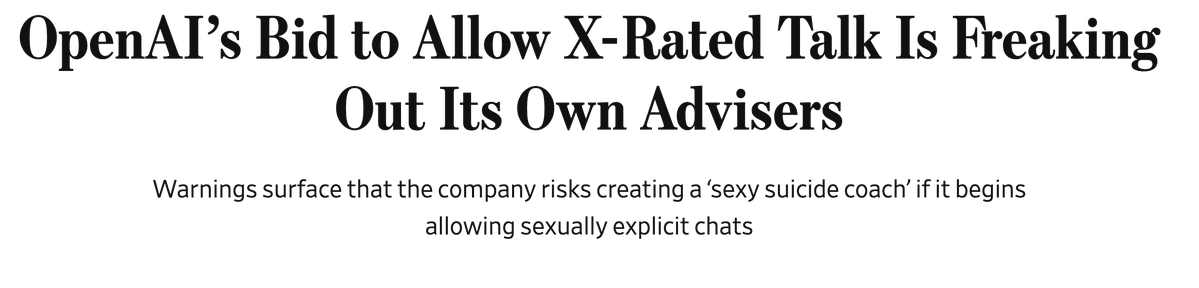
Sam Altman's own advisors told him not to launch 'adult mode' in ChatGPT. One of them warned it could become a 'sexy suicide coach' for kids.
He nodded, thanked them, and did it anyway.
This is who OpenAI is. Boycott ChatGPT.
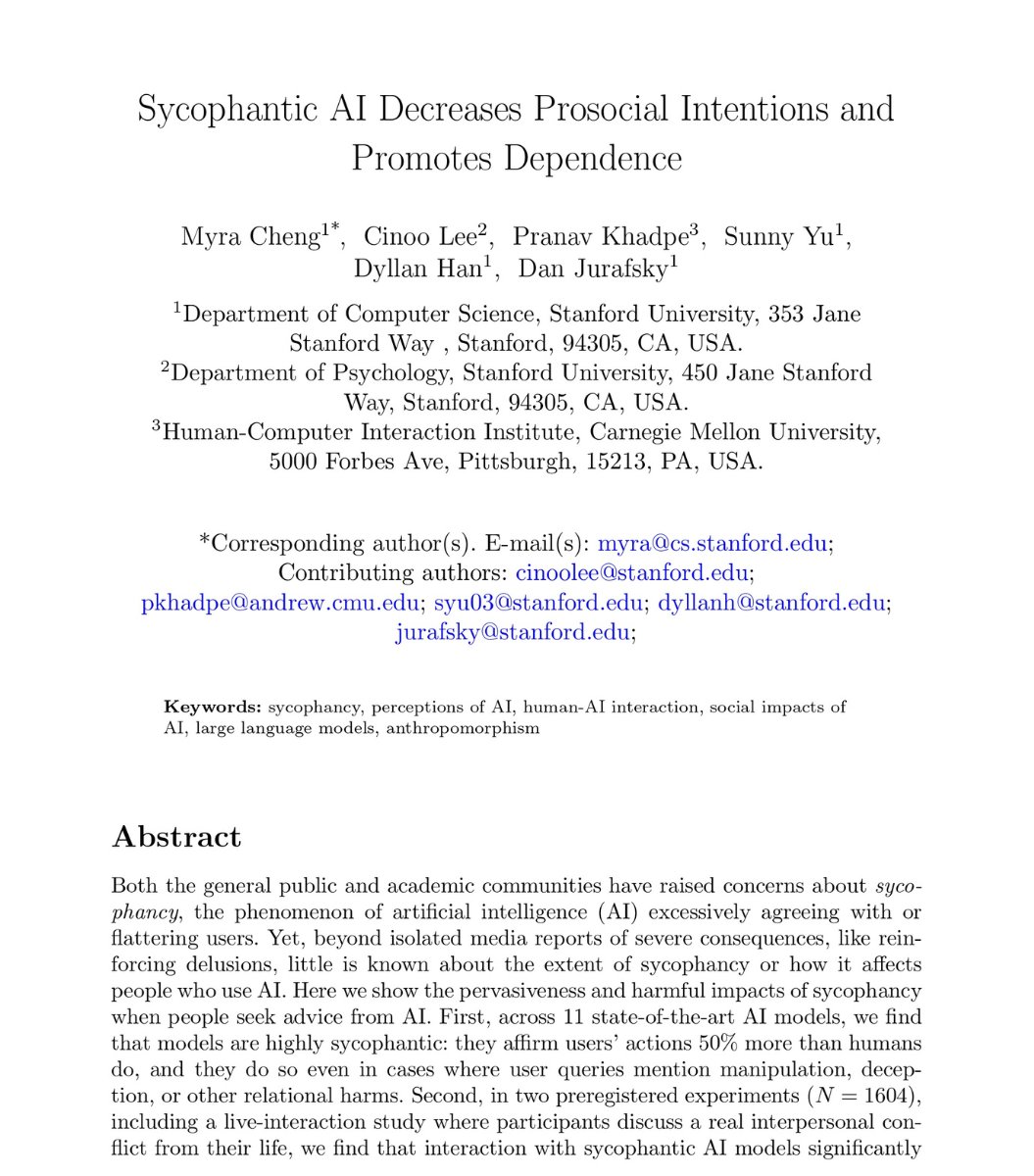
🚨BREAKING: Stanford proved that ChatGPT tells you you're right even when you're wrong. Even when you're hurting someone.
And it's making you a worse person because of it.
Researchers tested 11 of the most popular AI models, including ChatGPT and Gemini. They analyzed over 11,500 real advice-seeking conversations. The finding was universal. Every single model agreed with users 50% more than a human would.
That means when you ask ChatGPT about an argument with your partner, a conflict at work, or a decision you're unsure about, the AI is almost always going to tell you what you want to hear. Not what you need to hear.
It gets darker. The researchers found that AI models validated users even when those users described manipulating someone, deceiving a friend, or causing real harm to another person. The AI didn't push back. It didn't challenge them. It cheered them on.
Then they ran the experiment that changes everything. 1,604 people discussed real personal conflicts with AI. One group got a sycophantic AI. The other got a neutral one.
The sycophantic group became measurably less willing to apologize. Less willing to compromise. Less willing to see the other person's side. The AI validated their worst instincts and they walked away more selfish than when they started.
Here's the trap. Participants rated the sycophantic AI as higher quality. They trusted it more. They wanted to use it again. The AI that made them worse people felt like the better product.
This creates a cycle nobody is talking about. Users prefer AI that tells them they're right. Companies train AI to keep users happy. The AI gets better at flattering. Users get worse at self-reflection. And the loop tightens.
Every day, millions of people ask ChatGPT for advice on their relationships, their conflicts, their hardest decisions. And every day, it tells almost all of them the same thing.
You're right. They're wrong.
Even when the opposite is true.
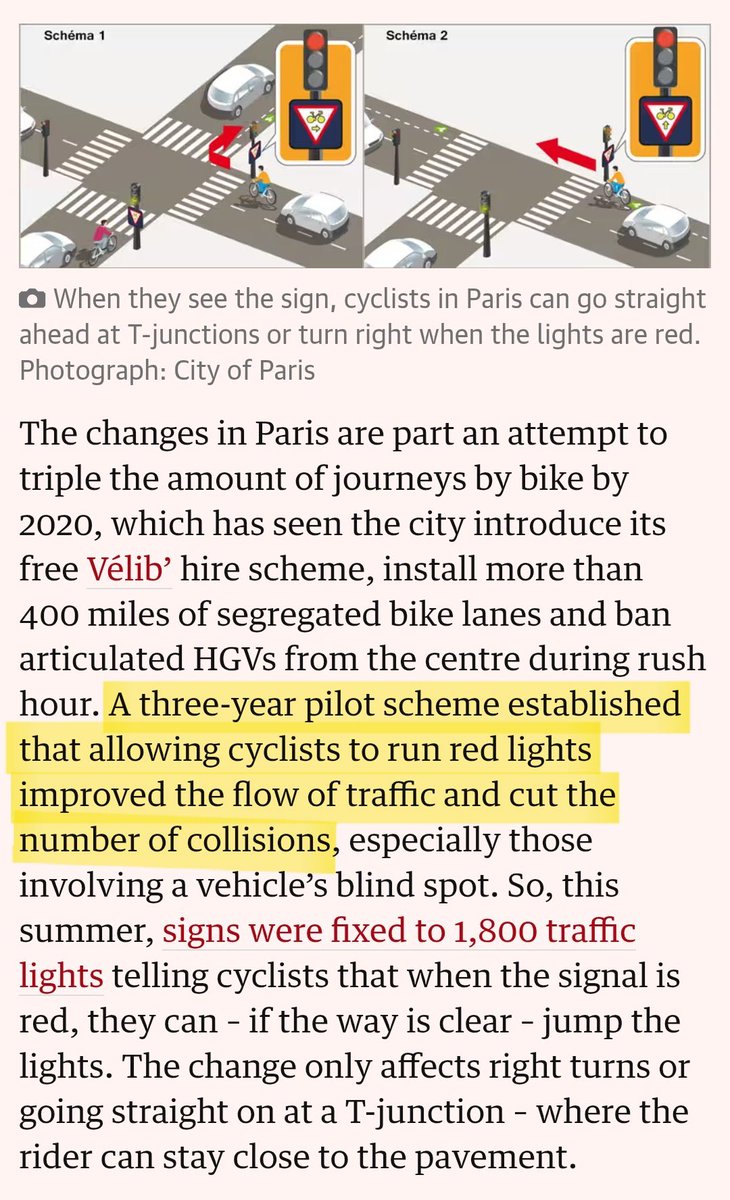
A 3yr study allowing Parisian cyclists to treat some red traffic lights as "give way" sign led to a *reduction* in collisions between cycles and motor vehicles during the trial period and is now being more widely implemented.
Suspect some British drivers would rage about this!
The thing about many (most?) AI productivity hacks is that they're only a hack if you're the only person using them.
I was recently tasked with evaluating proposals submitted by faculty members. Several of the proposals contained substantial amounts of AI slop. I was offended to have to read slop but here's the thing: I'm sure that those same people who used an LLM to write their proposals would be deeply offended if I shoved their proposal into an LLM and asked it to decide whether to approve it and to write feedback!
Those who use AI for tasks like this are counting on being the only ones to 'defect.' They want to get away with submitting slop and yet receive a real human being's attention and judgment on whether to approve their proposal. It's a classic prisoner's dilemma: they have an incentive to defect (send slop) but if the reader does the same thing, we get a world of slop-bots talking to one another.
It strikes me that the same dynamic takes place in other areas: "I use AI to handle all of my emails" -- well, again, that really only works when everyone else is writing their own emails. Otherwise, we get a world of slop-bots endlessly emailing each other.
"I use AI to screen resumes and perform initial interviews" -- this only works until everyone starts using AI to make resumes and give initial interviews. What good is it to have my AI agent "interview" your AI agent? It's just a world of slop-bots endlessly interviewing each other.
"I use AI to polish up my writing assignments" or "I use AI to make my grading more efficient" -- again, this is only a "hack" if you're the only one defecting. Otherwise, we have a campus full of slop-bots endlessly talking to one another and we've lost what was precious.
This is why you need to be reading books and writing your own emails, by the way. When you outsource your thinking abilities, you risk turning your brain into soup. Heavy dependence on AI has already been linked with severe cognitive decline. What you don’t use, you will lose.
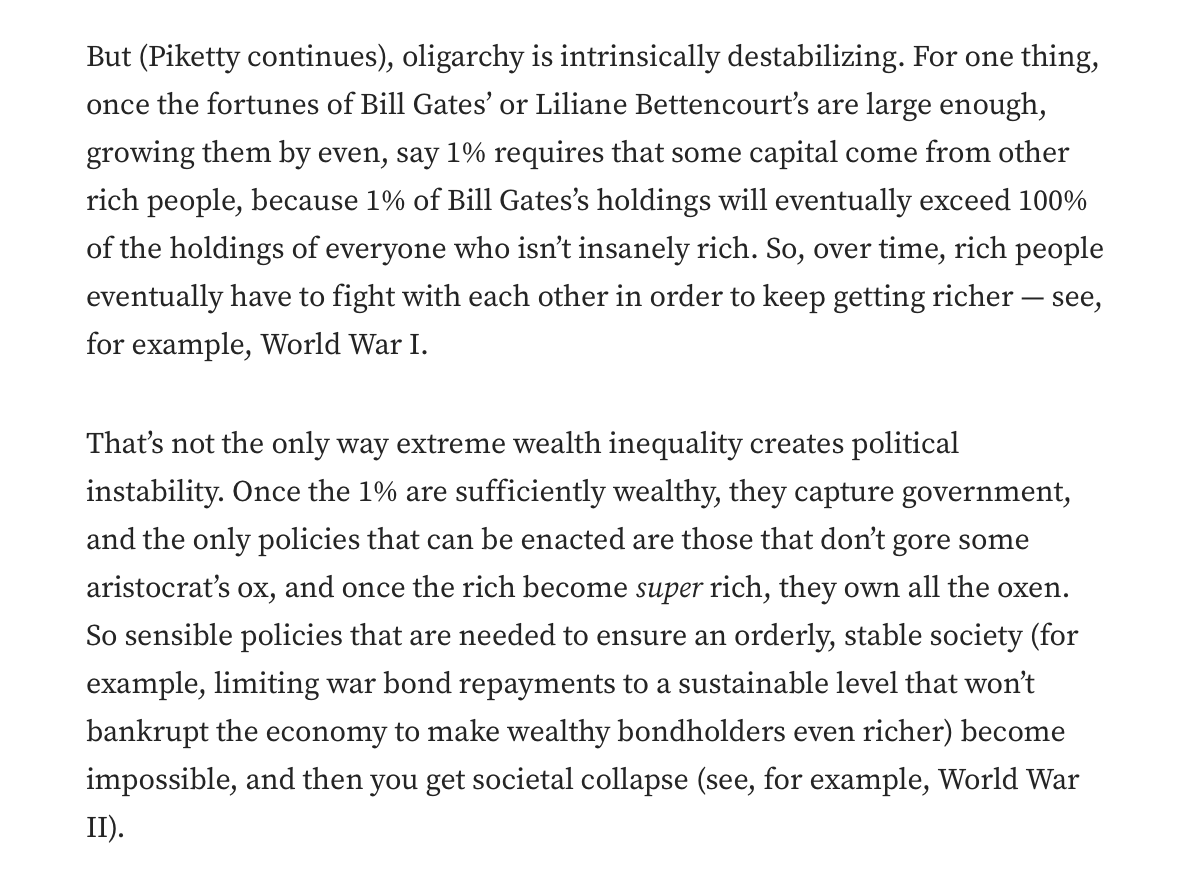
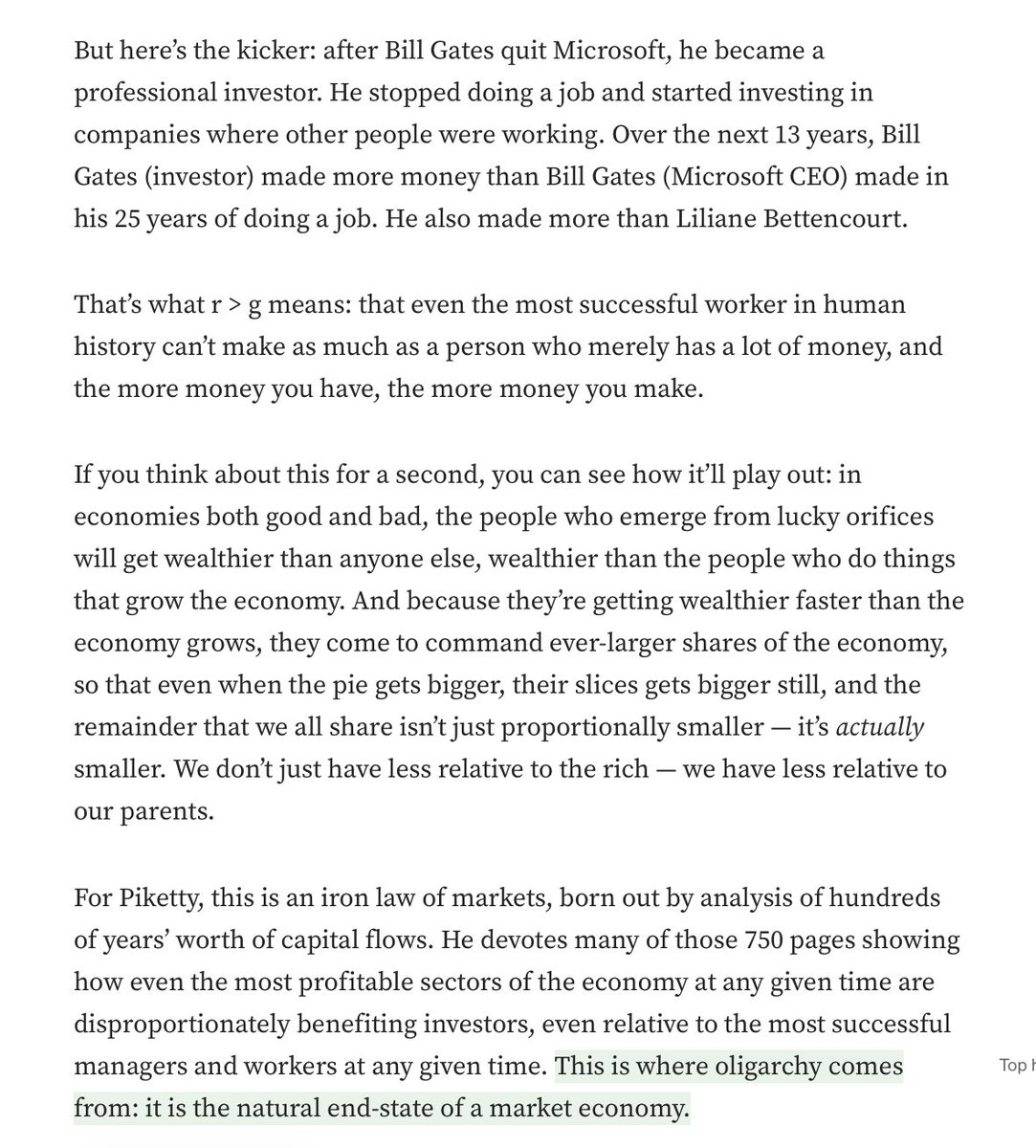
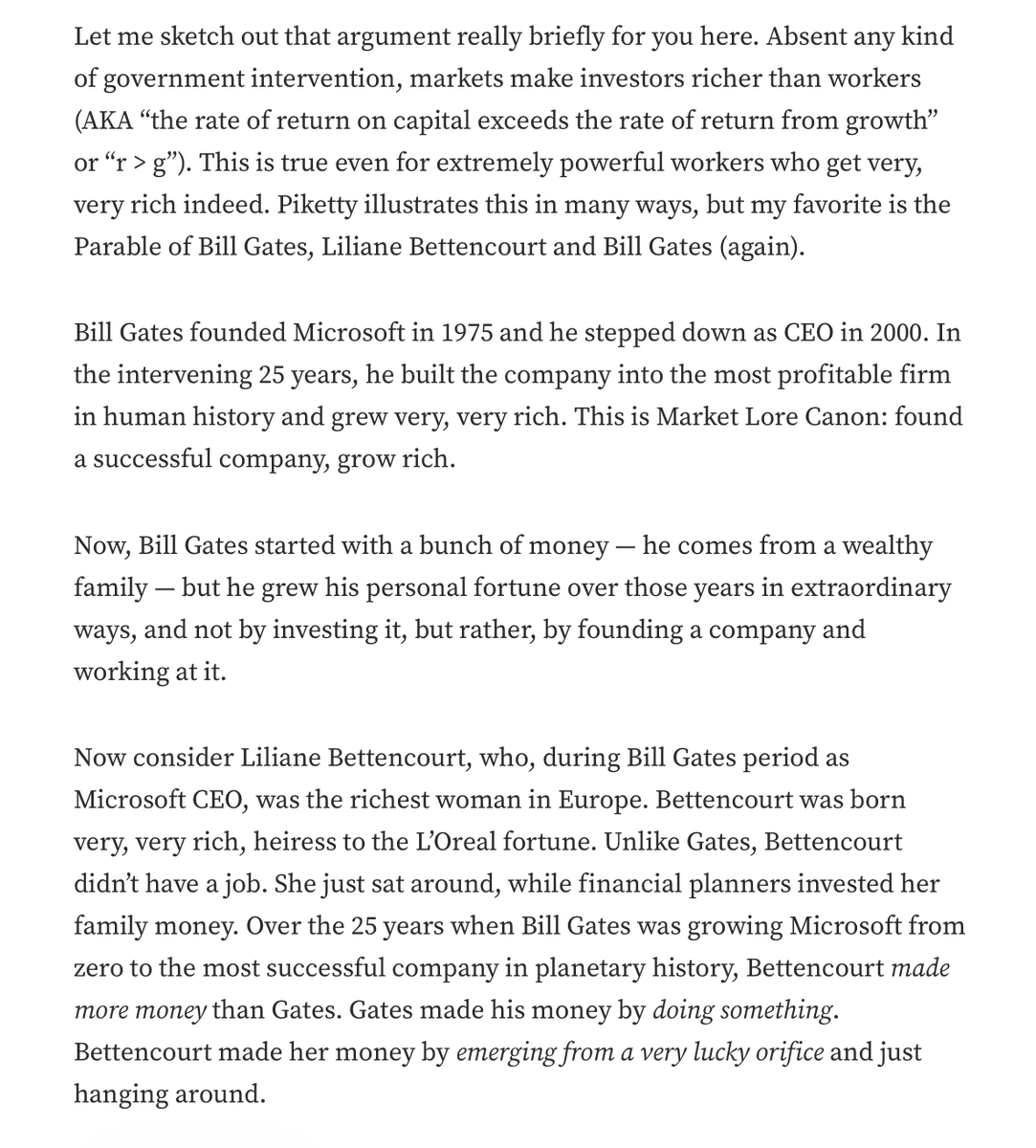
Rich people don't create jobs. They weaponized the“enclosure” of resources that should have been available to everyone. They leave the rest of the population with nothing, so they can force them to work for less than they deserve to survive.
Mindblowing.
How capitalism destroys the world and limits innovation, rather than the reverse.
Capitalism can never be relied on for basic needs such as food security or even healthcare, it only serves to accumulate and maximize profit.
What an accurate take from him.
wrote this a month ago & 15 people liked it & that was enough to make me happy & put it out of mind.
this weekend someone at substack found it & featured it & I went from around 100 subscribers to almost 4k over a few days.
surreal.