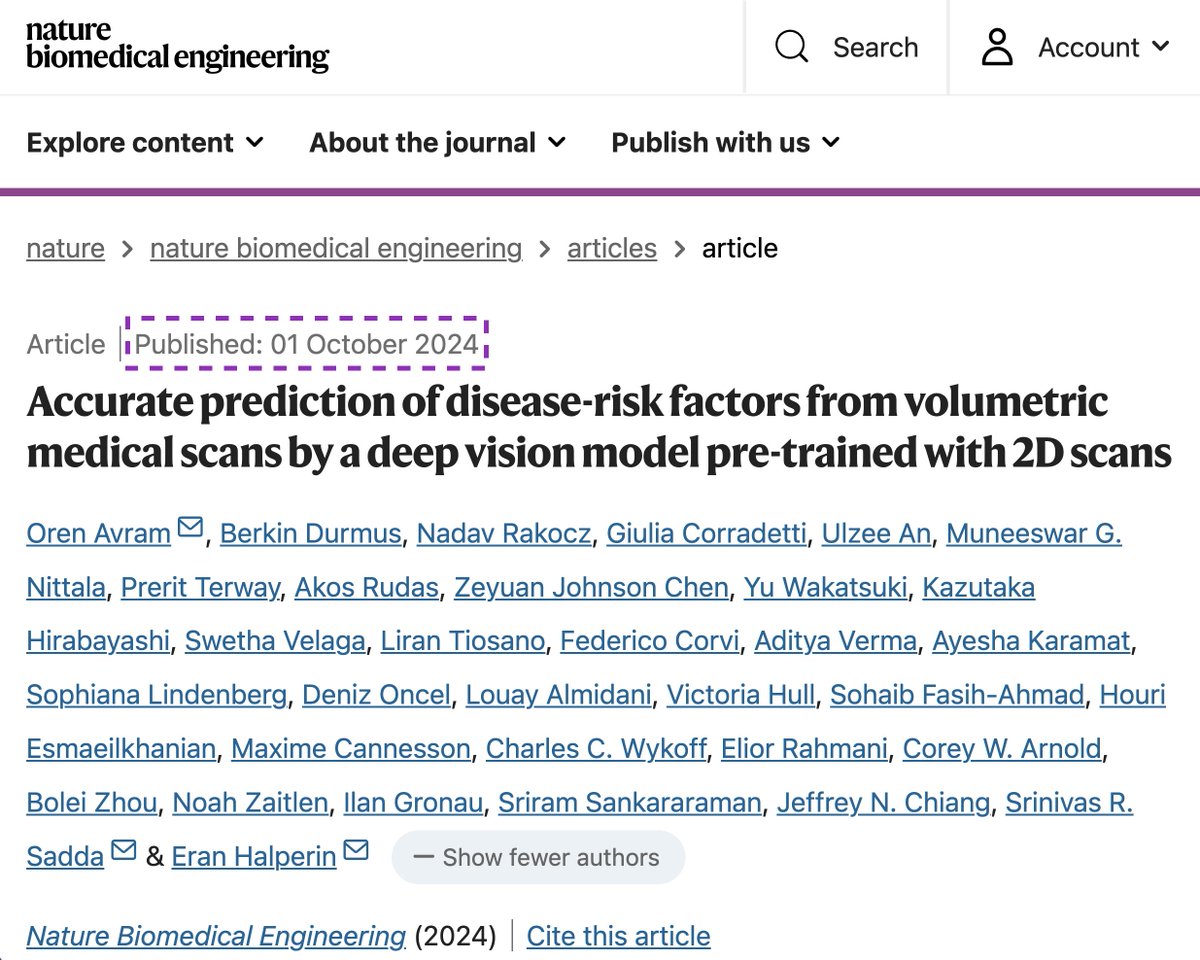
Our research is now published in #Nature 𝗕𝗶𝗼𝗺𝗲𝗱𝗶𝗰𝗮𝗹 𝗘𝗻𝗴𝗶𝗻𝗲𝗲𝗿𝗶𝗻𝗴! 🤩🤯🤩 And it's like the stars have aligned perfectly: this publication is coming out on... my birthday! 🎂 Best gift I could ask for! 😍😍
@halperineran@UCLA@CompMedUCLA@UCLAHealth@natBME
Introducing TriFetch: your clinic's first AI employee.
Only do the work you want to do; give AI everything else.
We will change the US healthcare system, forever.
@Trifetchai@rosemary0680
📢 Just published!
M1CR0B1AL1Z3R🦠 v2.0 is now live and published in Nucleic Acids Research 🧬
A powerful, user-friendly web server for large-scale #microbial#genome#analysis. Proud to be co-senior author on this follow-up to my PhD work 🚀
@NAR_Open
📣📣📣
Thrilled to speak at @CUAnschutz about potential avenues to tackle pressing challenges in research and care using #AI. I’ll be for a few days so if you’re in the area, hit me up!
This Week! Bytes to Bedside: Oren Avram, PhD
🗓️ Thursday, Feb. 27
⏰ 12 (noon)—1 p.m.
📍 AHSB 7042
➡️ DBMI is excited to welcome Oren Avram, PhD to campus for a special Bytes to Bedside seminar, Practical Pathways to Better Health.
UCLA just unveiled SLIViT, an AI model that analyzes 3D medical images faster and cheaper than human experts.
Key points:
1️⃣ Analyzes MRIs, CTs, and more in a fraction of the time.
2️⃣ Detects disease markers across multiple scan types
3️⃣ Outperforms other models, making imaging more accessible
4️⃣ Can handle large data and adapt to new imaging techniques
5️⃣ Useful in areas lacking medical imaging experts.
6️⃣ Trained on 2D data, fine-tuned for accurate 3D analysis
7️⃣ Applies knowledge from one scan type to another.
SLIViT could revolutionize fast, affordable medical diagnoses
Researchers @halperineran and @orenavram at #UCLA have developed a new, #AI-powered foundation model that can accurately analyze #3D medical imagery, like MRIs and CT scans, in a fraction of the time it would otherwise take a human expert.
➡️ https://t.co/MQCxgxHRh7
The model was pre-trained on publicly available, relatively inexpensive 2D imagery, and fine-tuned on a relatively small amounts of #3D medical imagery, meaning it can potentially be an affordable and scalable model with widespread impact for different communities around the world.
The researchers found the model can do transfer learning across different types of organs and image modalities. A retinal scan—or OCT— of an eye can improve the model’s ability to identify disease biomarkers in MRIs of livers, or other types of organs.
This #AI-powered model can potentially democratize expert level analysis of 3D medical images.
@CompMedUCLA@UCLAengineering
@EricTopol@natBME@EricTopol thanks for highlighting our research. This is the (second-)best birthday gift I could've asked for! ;-) https://t.co/URMq5Q9PVe
Our research is now published in #Nature 𝗕𝗶𝗼𝗺𝗲𝗱𝗶𝗰𝗮𝗹 𝗘𝗻𝗴𝗶𝗻𝗲𝗲𝗿𝗶𝗻𝗴! 🤩🤯🤩 And it's like the stars have aligned perfectly: this publication is coming out on... my birthday! 🎂 Best gift I could ask for! 😍😍
@halperineran@UCLA@CompMedUCLA@UCLAHealth@natBME