@adamtaggart Who provoked first?
Given how USA and Israel repeatedly threatened Iran while committing war crimes in the middle east for decades, I can easily make the argument that Iran is forced to increase its leverage, with nuclear and strait of Hormuz.
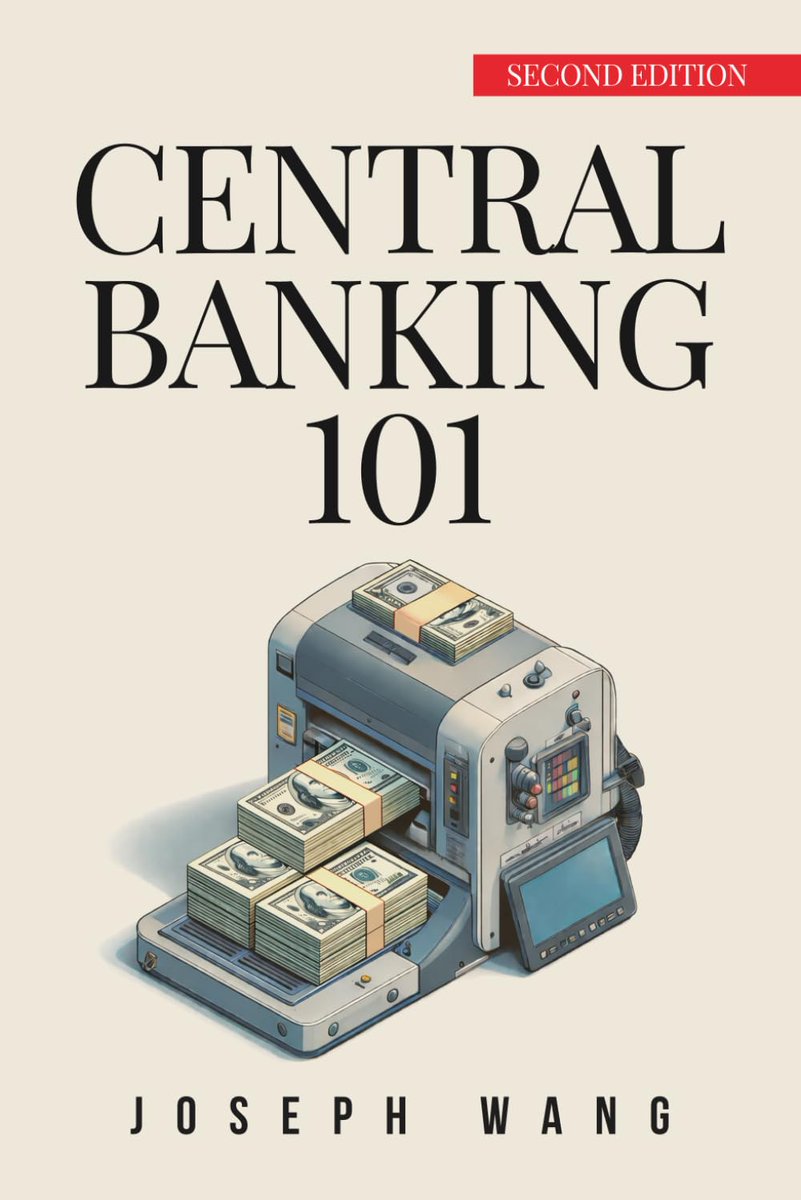
Happy to announce the 2nd Edition of Central Banking 101. This edition updates the data and adds 15% more content, including sections on SOFR transition, Treasury buy backs, SVB run, private credit etc. Available on amazon worldwide.
Thank you for you attention to this matter.
@bobbyfruit56@hkuppy Nothing 5D. US is telling Iran, you can sell oil to me to refine, but not to the rest of the world. More energy security for the US, less for the world.
if they’re lying to your face about things happening right now in real time with cameras everywhere and the internet at your fingertips imagine how bad the history books are
@TheMichaelEvery LLMs are language statistical models. Train them on "anxious" data, and you’ll get "anxious" response. It’s just pattern completion. Please don't buy into hype bro's hype. We are no where close sentient AI.
178 yrs ago today, Karl Marx and Friedrich Engels published The Communist Manifesto.
It's one of the most influential political documents ever written. It also provided the intellectual blueprint for what became the deadliest ideology in human history.
Marx was 29 and Engels was 27 when the Manifesto was published in London on February 21, 1848. Europe was a powder keg. Workers in newly industrialized cities labored in brutal conditions (children included). The old feudal order was crumbling. Poverty was grinding and visible. People were searching for answers.
And Marx was a decent observer of problems. Give him that much. His descriptions of industrial exploitation, of workers treated as disposable inputs in a machine, of wealth concentrating among a connected elite while masses suffered: these observations had real substance.
He saw genuine suffering and wanted to explain it. Many of the conditions he described were indefensible. Child labor in coal mines. 16-hour workdays. Dangerous factories with no recourse for the injured. These were real problems that deserved real scrutiny.
But diagnosing a disease correctly doesn't mean your prescribed cure won't kill the patient.
Marx and Engels looked at the suffering around them and concluded that the problem was private property itself, that the solution was the abolition of individual ownership, the centralization of all production in the hands of the state, and the revolutionary overthrow of the existing order by force.
The Manifesto doesn't hide this: "The theory of Communists may be summed up in the single sentence: Abolition of private property."
They called for centralized control of credit, communication, transport, factories, and education. All of it. In the hands of the state.
What they failed to understand, fatally, is that the very problems they identified were largely products of state power, not free exchange.
The monopolies, the exploitation, the barriers to advancement that crushed workers in 1848 were enabled by governments granting privileges to the politically connected. The solution to state-enabled cronyism was never more state power. It was less.
But the Manifesto's call to revolution spread like wildfire, and the 20th century became its proving ground. The results are now a matter of historical record, and they are staggering.
The Soviet Union: roughly 20 million dead under Stalin alone through forced collectivization, purges, and the Gulag system. Mao's China: 40-80 million dead, w/ the Great Leap Forward producing one of the worst famines in recorded history, entirely man-made.
Cambodia under the Khmer Rouge: nearly 2 million killed, roughly a quarter of the entire population, in just four years. North Korea, Cuba, Ethiopia, Vietnam, Eastern Europe. The pattern repeated everywhere the ideology took root. Centralized control. Suppression of dissent. Economic collapse. Mass death.
The total body count of communist regimes in the 20th century is conservatively estimated at 100 million people. (!!)
These weren't casualties of natural disaster or unavoidable tragedy. They were the direct, predictable consequences of an ideology that believed individual rights could be sacrificed for the collective, that a vanguard class of planners could allocate resources better than millions of free people making voluntary decisions, and that the ends justified any means necessary to achieve utopia.
Every single time, the utopia never arrived. What arrived instead was poverty, surveillance, political imprisonment, and death.
And yet. Walk through any university campus today and you'll find the Manifesto assigned sympathetically in classrooms, Marx quoted approvingly by tenured professors, and hammer-and-sickle imagery worn without a shred of the revulsion that would rightly accompany any other symbol of mass murder.
Imagine wearing a swastika to class. Now ask yourself why the communist equivalent gets a pass despite a higher death toll.
The answer, I think, is that Marx's diagnosis still resonates emotionally. People see inequality, suffering, exploitation, and they want someone to blame and something to fix it.
The Manifesto offers both: blame the property owners, and fix it with revolution. It's seductive in its simplicity. It validates resentment and promises justice.
But resentment isn't a foundation for a just society. Envy dressed up as compassion is still envy.
And centralizing power in the hands of the state doesn't liberate workers. It replaces one set of masters with another, only now those masters have absolute authority and no competition.
Free markets aren't perfect. But they're the only system in human history that has consistently reduced poverty, increased prosperity, and respected individual choice.
The answer to exploitation has always been more freedom, not less. More competition, not central planning. More individual rights, not collective ownership enforced at gunpoint.
The Communist Manifesto turns 178 today. Read it if you haven't. Know what it says. Understand its appeal. Then look at what happened every single time someone tried to implement it.
Ideas have consequences. These ideas had 100 million of them.
@HasanKhxnx I am not suicidal. I eat healthy food. The brakes on my car and truck are in good shape. I practice good trigger discipline and never point a gun at anyone, including myself. There are no deep pools of water on my farm and I’m a pretty good swimmer.