600 MILLION blocks and counting...
@kaspaunchained, according to Kaspa Explorer, has now processed more than 600,000,000 individual blocks on the $KAS L1.
At the same time, Kaspa's total transaction count has been growing, now at some 2.45B, and fast-approaching the 2.5B milestone.
With the advent of smart contract functionality, the next few months could be big for the Kaspa ecosystem.
Latest Kaspa news: https://t.co/oLgq0292GG
Kaspa Users Can Now Register .kas Domains in One Transaction
KNS Domains (@knsdomain) has launched its new Covenant system on Kaspa’s (@kaspaunchained) $KAS TN10 testnet.
Existing testnet domains have already migrated, and new names can be registered in one transaction.
The upgrade also adds profile, subdomain, and transfer management tools.
Mainnet domains are not affected yet.
KNS says their migration will happen automatically when the mainnet rollout begins.
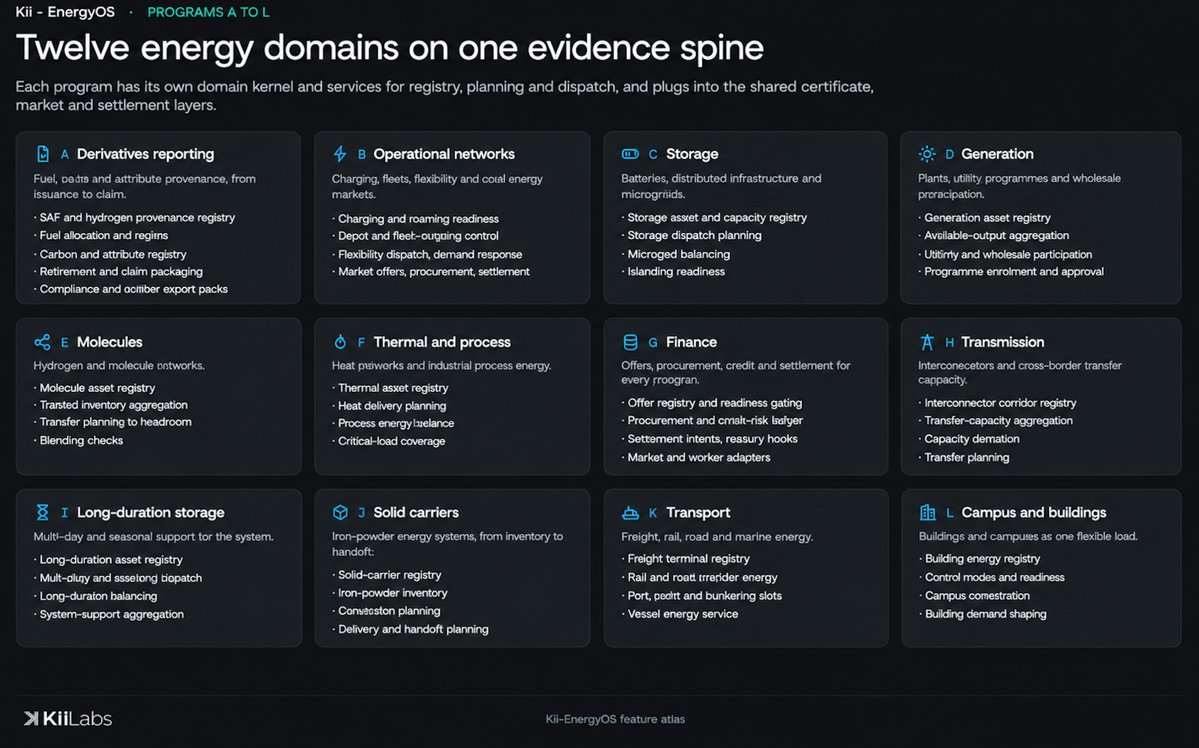
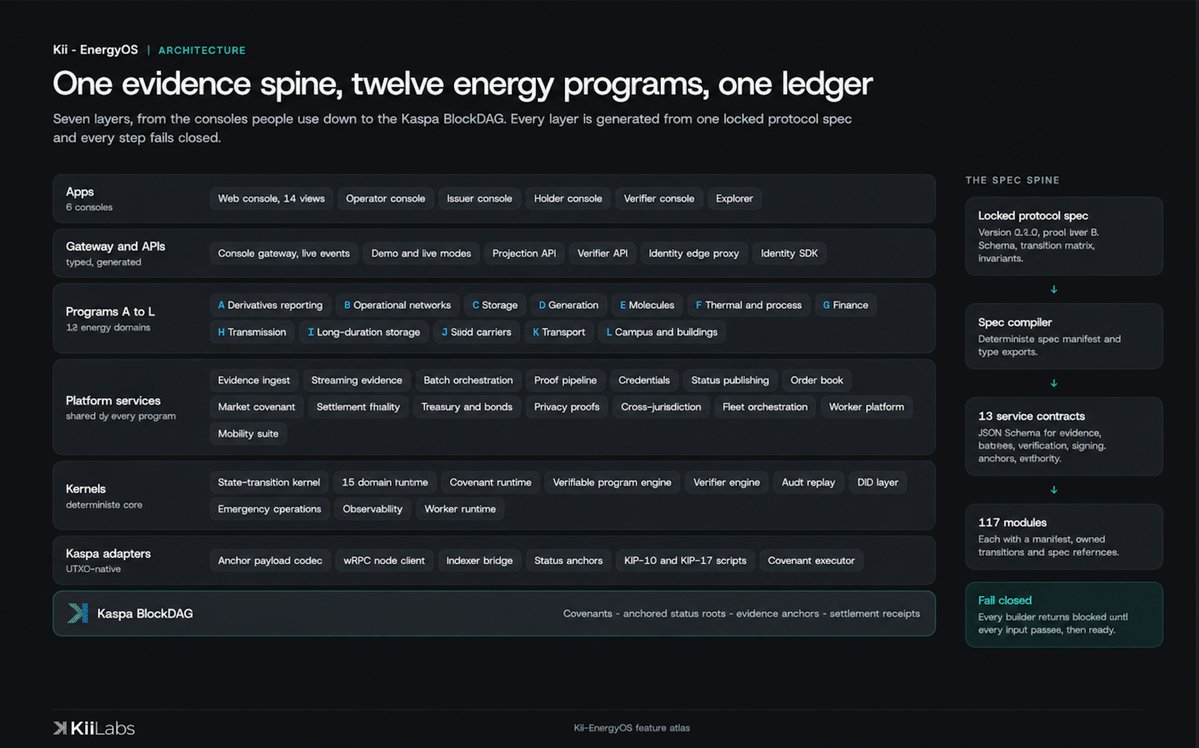
One platform for the whole energy market.
Kii-EnergyOS brings generation, storage, flexibility, heat, hydrogen, transport, buildings and finance onto one console, with every trade, certificate and settlement on a single shared record.
Now open for pilots. Speak to our team.
Build on Kaspa.
#kaspa $kas #EnergyTransition #carbonmarkets
0.5% → 0%.
Trestly just killed the fee on its Kaspa bridge. Both ways.
Same week: covenant transactions more than doubled and network fees jumped 8x.
Something is moving on $KAS 👀
Something else to note personally I have constantly used USDC on the polygon network never cared how it actually worked under the hood. Just always used it cause it worked.
Stables are not meant to store your life savings in. They are meant to easily live on a crypto network and still have some stable value to trade for something else.
Kaspa has this now with @trestly_io and this development is the most exciting thing I’ve seen on Kaspa in a while.
This is why @KaChat_ is going to be integrating full support so that you can finally live on the kaspa network and still have access to a stable value. (kUSDT) This is game changing for Kaspa. No L2, no gas from another network, no wrapped Kaspa needed. Just Kaspa is all you need to easily acquire kUSDT or sell it back into Kaspa.
@KaChat_ will also undergo an entire rebrand to be known as just K. This is because KaChat has grown into so many things. K will be your decentralized X platform.
More details coming soon. kaspa:native
KaChat is going through a full rebrand to become K.
No longer will require separate apps.
K will be an all in one app with all features to ensure that K can be your app to do everything Kaspa.
Download the beta NOW to test!
https://t.co/P9ldNBGmDU
Beta includes kUSDT support via @trestly_io
kaspa:native
Already got me some kUSDT. It's backed 1:1 by USDT, whatever KAS does.
A week ago, the only way out of KAS was an exchange. Now you can swap into dollars and back without leaving L1.
The pool is small today, but this is the first dollar market for KAS that isn't a CEX, and I don't think people appreciate what that does for price discovery once it has depth.
🚀 Stablecoins Finally Hit Kaspa
Stablecoins finally arrived on the Kaspa network. A stablecoin is a token that tracks the US dollar one to one.
$KAS #kaspa#crypto
Try Premium for 7 days:
https://t.co/bJjgUmvwCY
We're genuinely excited about Kii-EnergyOS.
Energy is turning into a system of millions of moving parts: buildings, depots, chargers, heat networks, storage, molecules, ships. Every one of them has to be coordinated, paid and trusted. Today that trust still lives in spreadsheets, invoices and phone calls.
EnergyOS gives all of it one record:
· 12 programme families, from generation to buildings
· settlement held by covenant until delivery is proven
· verification anyone can run, with private data kept private
· one record, reported in every regulator's format
Powered by Kaspa.
Pilots commencing shortly.
#kaspa $kas #EnergyOS #EnergyTransition
The case for the uniqueness of fast pow
tl;dr
Finality has two moving parts: (i) fast inclusion (= high bps, how quickly a tx gets into a block), and (ii) fast confirmations (= how quickly that tx becomes irreversible). Any system with rapid block production can achieve the first. The second is where the tension shows: in pos, fast confirmations press directly against decentralization. In fast pow, the two properties are decoupled.
prologue
A few weeks ago I came across Solana’s founder claiming: “Solana is the fastest monetary system in the world”. Since Kaspa already runs at a faster block rate, I was curious to check Solana’s finality times. That curiosity quickly pointed me to a deeper issue: not raw speed, but how speed interacts with decentralization.
——————
The tension is structural. In pos, finality means accumulating staked votes, and the more decentralized the stake distribution, the more time is required to reach finality. Here I’m not talking about hardware requirements or validator specs. The axis I’m discussing is centralization around the security mechanism itself: stake in pos vs. hardware in pow. To be secure, a block must be confirmed by a supermajority--typically >66.7% of the total economic stake. In a truly decentralized network, where n stakers with uniform share grows without bound, the time to coordinate this supermajority becomes a real bottleneck.
Pow works differently. It samples the hardware space without requiring the protocol to explicitly collect evidence from a majority of miners. Each block is itself a statistical proof that the finder out-competed the full network’s hash power. This process--and its timing--remains independent of how many individual miners participate.
Ethereum’s researchers understood this when moving to pos. Unlike Solana, which tolerates concentration to reach ~13-second finality, Ethereum’s designers could not accept that trade-off. Their solution was to introduce rotating committees. A rotating committee is a smaller subset of validators, randomly chosen from the full set, that votes on behalf of everyone else.
But this comes with a different security model, known in the literature as exposure to a BFT adaptive attacker. The committee is selected first and then votes. That “select-then-work” sequence is theoretically exposed to adaptive attackers, since members are known in advance. Pow, by contrast, is “work-then-select”: the winner is only revealed after the work is done. Think of it this way: in pos, you know who the referees are before the game starts, which gives an attacker time to pressure them. In pow, you only learn who won after the work is already done, which removes that attack surface. So n confirmations provide consistent confidence regardless of miner granularity, and the system stays secure even under adaptive targeting.
Beyond attack subtleties, the real issue is economic weight. When I send a billion-dollar transfer in a pos system, the question I care about is simple: how much stake is actually securing it? A committee vote provides strong statistical evidence, but only a true supermajority puts the full economic stake of the network behind my confirmation. In other words, a sampled committee may convince me that things are probably safe, but only the weight of the entire stake provides an overwhelming guarantee. And this is exactly where pow shines: each confirmation is not just a probability estimate, but a direct proof of work done against the full hash power of the network, no matter how many miners there are.
closing remark
I don’t claim to know every engineering detail of Ethereum or Solana. But I’m convinced the core principle holds.
I’ll state it simply: fast pow uniquely enables fast finality without forcing a compromise on decentralization.
🚨 NEW Episode w Toby from @st0x_io
"Kaspa is Getting Tokenized Stocks"
Full Video - https://t.co/MFmdH3mQZP
@st0x_io brininging $150 Trillion Market OnChain
CC @AppKaskad + @AlpacaHQ making it happen.
kaspa:native
Kaspa turns 5, and for the birthday party at Wolfy’s in London we animated a Kaspa stick fighter to go with it. Here is the birthday film. The rest of the series follows on YouTube. 🔊
https://t.co/u29RKszHod
@WolfysBar@BlockchainBants#kaspa $KAS