Introducing the July Trading Competition 🏆
Enrolment is now open.
Top 10 traders can win massive prizes up to a $200K Instant Zero account.
Every participant gets a free account to compete.
No cost. Just skill.
Sign up today: https://t.co/FrXkSxONoS
Total Payout from June 22nd - 26th: $180,697.95
Amounts of Payout: 57
Top 3 payouts:
Maximilian Klein - $19,754.41 - 1 Step Access - $400,000 - DE
Logan Jackson - $17,888.81 - 1 Step Access - $300,000 - US
Liam Brunner - $11,775.62 - Instant - $400,000 - CH
Literally consistent execution, weekly payouts and no restrictions at all.
Ready to see your next payout?
Get funded right now: https://t.co/hDScQJJGrn
$0 Access is now live. 🚀
No upfront fee.
Only pay after you pass.
This is your chance to get started with Atlas without paying on day one.
Big opportunity. Big momentum. Big month ahead.
Start now: https://t.co/rF2ENxvWlp
Earn over $40/hour as an English instructor📢
📍 Fully Remote
💰 $30 - $40/hour
You meet different people who need instructors
Open to everyone one✅
Apply👇
BRIGHTON'S GAMBLE THAT KEEPS WINNING
By Dr. Mehifu Egogwe Jaiyeola
In modern football, many clubs spend fortunes chasing success. Brighton & Hove Albion, however, have mastered a different game — buying potential, developing talent, and selling at extraordinary profits. At the centre of this remarkable strategy is Tony Bloom, a man whose background in professional gambling has shaped one of the smartest football business models in the world.
Before owning Brighton, Bloom made his fortune through poker and sports betting. In those industries, success depends on identifying assets that are undervalued and investing before everyone else notices their true worth. He has simply applied the same principle to football.
The most famous example remains Moisés Caicedo. Brighton signed the Ecuadorian midfielder for approximately £4 million and later sold him to Chelsea for a staggering £115 million. The profit was extraordinary, but it was not an isolated case.
Marc Cucurella arrived for around £15 million and was sold to Chelsea for £62 million. Alexis Mac Allister was recruited from Argentina for approximately £7 million before eventually moving to Liverpool in a deal worth around £35 million. João Pedro followed a similar path, arriving for about £30 million and later attracting a transfer package worth up to £60 million.
The pattern is unmistakable. Brighton consistently identifies young talents before they become household names, develops them within a structured football environment, and sells them when their market value reaches its peak.
What makes Brighton different is that their success is not based on luck. The club relies heavily on sophisticated data analysis. Tony Bloom's experience in betting analytics has helped create a football recruitment system that scans leagues across the globe, searching for players whose market value is significantly lower than their actual potential.
Rather than focusing solely on traditional football powers, Brighton searches in emerging football markets such as Ecuador, Argentina, Japan, and now Sweden. The club often identifies replacements before their current stars are sold, ensuring continuity and reducing risk.
This strategy has produced remarkable financial results. Brighton recorded one of the largest profits ever seen in Premier League history, reportedly around £123 million in a single financial year. Even more impressive is that they achieved this while operating with one of the league's lowest wage bills and comparatively modest squad costs.
Chelsea, perhaps unknowingly, have become one of Brighton's biggest customers. Through the transfers of Caicedo, Cucurella, and João Pedro, the London club has handed Brighton approximately £237 million. Ironically, they continue paying enormous sums to acquire players developed by the very recruitment machine they struggle to replicate.
This week, Brighton made another statement by signing an 18-year-old Swedish talent for approximately £21.5 million despite competition from clubs including Chelsea and Newcastle United. To many observers, that may appear to be a significant risk.
To Brighton, however, it is simply another calculated investment.
If history is any guide, this teenager could become the next player sold for over £100 million within a few years. And when that happens, Brighton will once again demonstrate why they are not merely a football club competing in the transfer market—they are perhaps the most efficient talent-investment operation in world football.
While other clubs chase established stars at premium prices, Brighton continues to identify tomorrow's stars before the rest of the football world catches up. It is a strategy built on patience, intelligence, data, and discipline.
For now, Tony Bloom's gamble continues to pay off. And judging by the numbers, the house keeps winning.
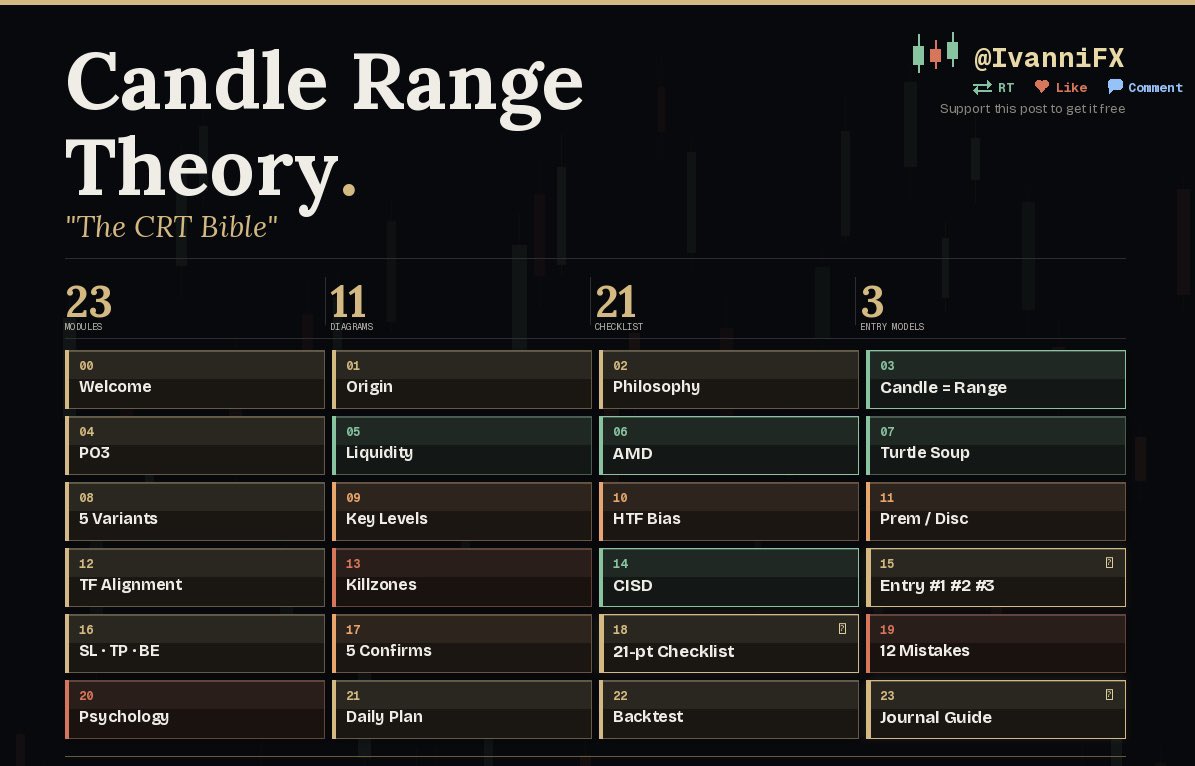
I just finished building something I wish I had 3 years ago.
A full CRT course. 23 modules. From scratch.
I’m giving it away for free 👇
What’s inside:
→ Candle as a range (the core idea)
→ PO3, AMD, Turtle Soup TWS vs TBS
→ 5 CRT variants and when to trade each
→ CISD — the concept nobody explains well
→ Entry Models #1 #2 #3 with full diagrams
→ 21-point checklist (not 21/21? don’t trade)
→ Trading psychology backed by real science
→ Journal fields guide so your data means something
23 modules. Zero filler.
I want to see the support before I drop it.
🔁 Retweet
❤️ Like
💬 Comment “CRT”
If this blows up, I release it this week.
The CRT Bible.
Troy Deeney on Amorim's sacking.
"One of shock. I'm a big Amorim fan. He's done things wrong but he's tried to create a foundation for Man Utd to be long-term successful. Getting rid of Rashford, Garnacho. Player power overrule it."
Dropping facts!