Because we get asked a lot.
The Technological Republic, in brief.
1. Silicon Valley owes a moral debt to the country that made its rise possible. The engineering elite of Silicon Valley has an affirmative obligation to participate in the defense of the nation.
2. We must rebel against the tyranny of the apps. Is the iPhone our greatest creative if not crowning achievement as a civilization? The object has changed our lives, but it may also now be limiting and constraining our sense of the possible.
3. Free email is not enough. The decadence of a culture or civilization, and indeed its ruling class, will be forgiven only if that culture is capable of delivering economic growth and security for the public.
4. The limits of soft power, of soaring rhetoric alone, have been exposed. The ability of free and democratic societies to prevail requires something more than moral appeal. It requires hard power, and hard power in this century will be built on software.
5. The question is not whether A.I. weapons will be built; it is who will build them and for what purpose. Our adversaries will not pause to indulge in theatrical debates about the merits of developing technologies with critical military and national security applications. They will proceed.
6. National service should be a universal duty. We should, as a society, seriously consider moving away from an all-volunteer force and only fight the next war if everyone shares in the risk and the cost.
7. If a U.S. Marine asks for a better rifle, we should build it; and the same goes for software. We should as a country be capable of continuing a debate about the appropriateness of military action abroad while remaining unflinching in our commitment to those we have asked to step into harm’s way.
8. Public servants need not be our priests. Any business that compensated its employees in the way that the federal government compensates public servants would struggle to survive.
9. We should show far more grace towards those who have subjected themselves to public life. The eradication of any space for forgiveness—a jettisoning of any tolerance for the complexities and contradictions of the human psyche—may leave us with a cast of characters at the helm we will grow to regret.
10. The psychologization of modern politics is leading us astray. Those who look to the political arena to nourish their soul and sense of self, who rely too heavily on their internal life finding expression in people they may never meet, will be left disappointed.
11. Our society has grown too eager to hasten, and is often gleeful at, the demise of its enemies. The vanquishing of an opponent is a moment to pause, not rejoice.
12. The atomic age is ending. One age of deterrence, the atomic age, is ending, and a new era of deterrence built on A.I. is set to begin.
13. No other country in the history of the world has advanced progressive values more than this one. The United States is far from perfect. But it is easy to forget how much more opportunity exists in this country for those who are not hereditary elites than in any other nation on the planet.
14. American power has made possible an extraordinarily long peace. Too many have forgotten or perhaps take for granted that nearly a century of some version of peace has prevailed in the world without a great power military conflict. At least three generations — billions of people and their children and now grandchildren — have never known a world war.
15. The postwar neutering of Germany and Japan must be undone. The defanging of Germany was an overcorrection for which Europe is now paying a heavy price. A similar and highly theatrical commitment to Japanese pacifism will, if maintained, also threaten to shift the balance of power in Asia.
16. We should applaud those who attempt to build where the market has failed to act. The culture almost snickers at Musk’s interest in grand narrative, as if billionaires ought to simply stay in their lane of enriching themselves . . . . Any curiosity or genuine interest in the value of what he has created is essentially dismissed, or perhaps lurks from beneath a thinly veiled scorn.
17. Silicon Valley must play a role in addressing violent crime. Many politicians across the United States have essentially shrugged when it comes to violent crime, abandoning any serious efforts to address the problem or take on any risk with their constituencies or donors in coming up with solutions and experiments in what should be a desperate bid to save lives.
18. The ruthless exposure of the private lives of public figures drives far too much talent away from government service. The public arena—and the shallow and petty assaults against those who dare to do something other than enrich themselves—has become so unforgiving that the republic is left with a significant roster of ineffectual, empty vessels whose ambition one would forgive if there were any genuine belief structure lurking within.
19. The caution in public life that we unwittingly encourage is corrosive. Those who say nothing wrong often say nothing much at all.
20. The pervasive intolerance of religious belief in certain circles must be resisted. The elite’s intolerance of religious belief is perhaps one of the most telling signs that its political project constitutes a less open intellectual movement than many within it would claim.
21. Some cultures have produced vital advances; others remain dysfunctional and regressive. All cultures are now equal. Criticism and value judgments are forbidden. Yet this new dogma glosses over the fact that certain cultures and indeed subcultures . . . have produced wonders. Others have proven middling, and worse, regressive and harmful.
22. We must resist the shallow temptation of a vacant and hollow pluralism. We, in America and more broadly the West, have for the past half century resisted defining national cultures in the name of inclusivity. But inclusion into what?
Excerpts from the #1 New York Times Bestseller The Technological Republic: Hard Power, Soft Belief, and the Future of the West, by Alexander C. Karp & Nicholas W. Zamiska
https://t.co/8igjazz1On
💢📰 REPORT | New reporting from NYT reveals how Trump decided to go to war with Iran — after a closed-door Israeli pitch and despite deep internal divisions inside his own team.
At a secret Feb. 11 Situation Room meeting, Israeli Prime Minister Benjamin Netanyahu presented a four-part pitch for regime change, including a video montage of potential replacement leaders such as Reza Pahlavi. JD Vance was absent, stuck in Azerbaijan.
Appearing alongside Mossad chief David Barnea and military officials, Netanyahu argued: Iran’s ballistic missile program could be destroyed in weeks. The regime would be too weak to close the Strait of Hormuz. Street protests — fomented with Mossad help — could trigger an uprising. Kurdish fighters from Iraq could open a ground front in the northwest.
Trump’s response: “Sounds good to me.”
Trump’s response: “Sounds good to me.”
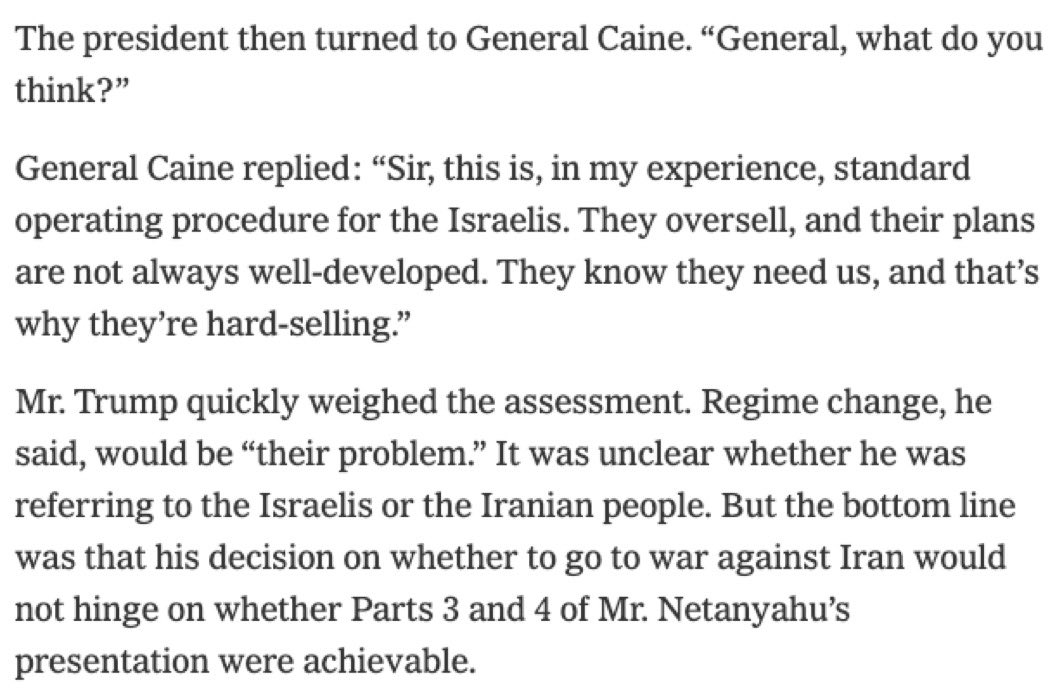
The next day, U.S. intelligence pushed back sharply. CIA Director John Ratcliffe called the regime-change scenario “farcical,” with Secretary of State Marco Rubio adding: “In other words, it’s bullshit.” Gen. Dan Caine told the president: “This is, in my experience, standard operating procedure for the Israelis. They oversell, and their plans are not always well-developed.”
Trump dismissed regime change as “their problem” — but remained focused on targeting Iran’s leadership and military.
By Feb. 26, in a final Situation Room meeting, opposition inside the room was clear but fractured. Vice President JD Vance warned the war could spiral and drain U.S. resources, but ultimately said: “You know I think this is a bad idea… but I’ll support you.”
Rubio said regime change was unrealistic, but destroying Iran’s missile program was achievable. Defense Secretary Pete Hegseth was the biggest proponent of war and backed immediate action. Military leadership outlined risks, including depleted munitions and the threat to Hormuz, but all stopped short of opposing the plan.
Key officials responsible for managing the fallout, like the Treasury Secretary, and DNI Gabbard were notably absent.
Trump went around the table asking advisors their view, then made the call:
“I think we need to do it.”
The strikes began two days later.
#FatimaHousina was a photo journalist in Gaza. A documentary was made about her. It got accepted into the Cannes film festival. Israel found out. 24 hrs later, she & 10 members of her family including her pregnant sister were murdered by the IDF.
This is #Israël
Damn CNN can never show you this : Tucker Carlson plays a deeply disturbing video of an Israeli Rabbi openly plotting to shoot a missile into the Al-Aqsa Mosque and blame it on Iran
This perfectly exposes the calculated deception and false flag tactics used by Israel...
An unarmed Iranian ship was invited, along with the U.S., to be part of an Indian Naval exercise, and its sailors paraded on land before the president.
The U.S. at the last minute pulled out of the exercise and instead attacked the Iranian ship with a torpedo.
Breaking with all norms of civilization and warfare, we then refused to rescue the drowning survivors. The Sri Lanka Navy was left to pull the dead bodies from the water.
I am hard pressed to think of any other nation throughout history that would do something so cowardly and despicable. We are genuinely in a league of our own, and American media — mostly shrugging off the bombing of a girls school and acting as if carpet bombing Tehran is a normal military tactic — is deeply complicit.
This is the most insane and absurd definition of an ‘imminent threat’ I have ever heard in my life. Our ally and proxy, Israel, that we arm and fund, was about to illegally attack Iran so we joined in the attack because that illegal attack would have led to an attack on us
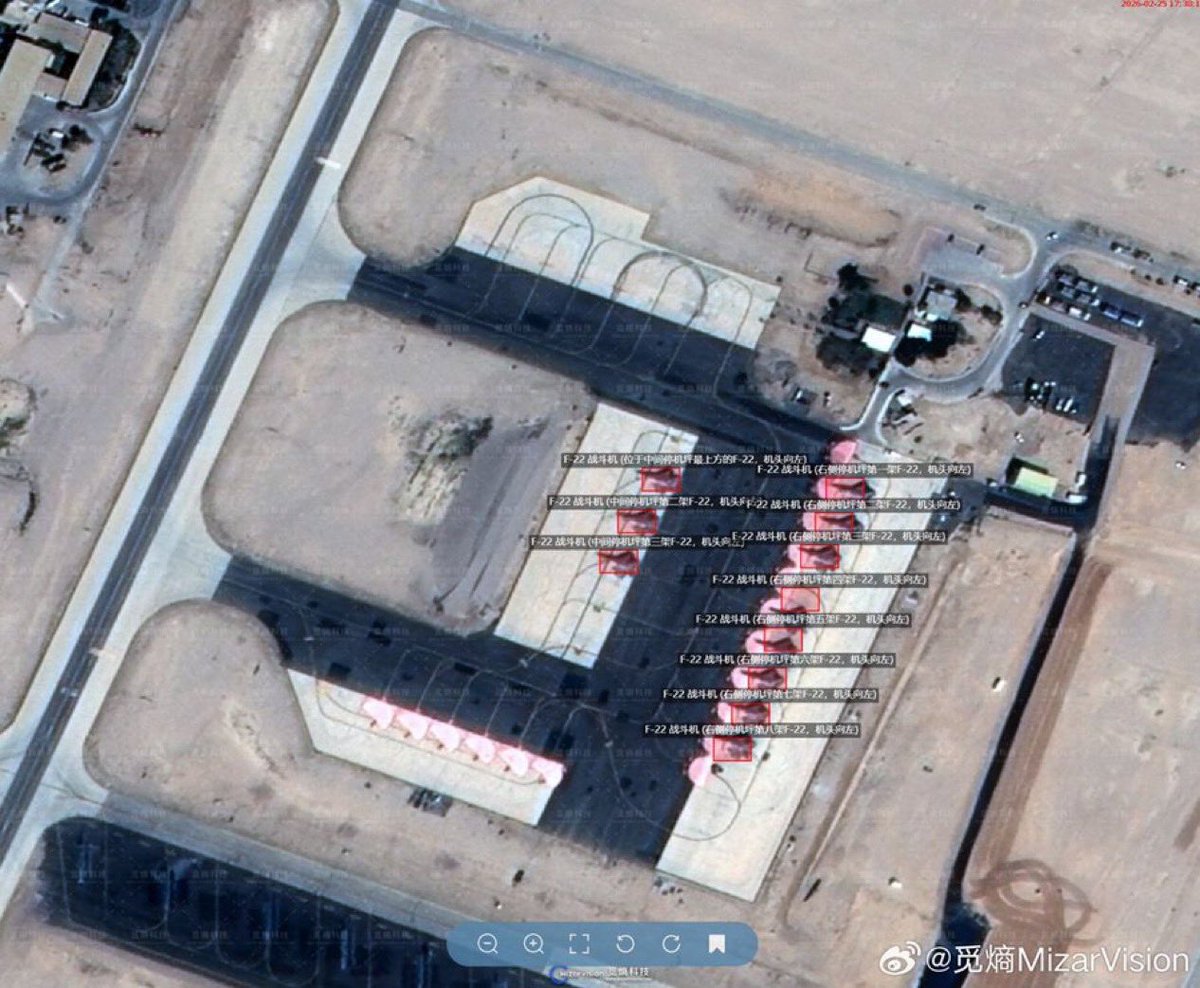
China just published annotated satellite imagery of every F-22 Raptor at Israel’s Ovda Air Base. Each aircraft individually tagged in Chinese characters on Weibo. Eleven stealth fighters that cost $67 billion to develop for the sole purpose of being invisible, cataloged and distributed on social media like a restaurant menu.
The same week, China sold Iran CM-302 supersonic anti-ship missiles. The same week, China photographed every warship leaving Bahrain. And today, as Geneva talks began, Politico dropped the real bombshell buried beneath the diplomacy: senior Trump advisers prefer Israel to strike Iran first because “the politics are a lot better.”
Read that sentence until it burns.
Washington does not want to throw the first punch. Washington wants Israel to throw it, absorb Iran’s retaliation, and then use that retaliation as political justification for the full American response. The 500 aircraft, the two carriers, the F-22s, the C-17s, the munitions, all of it positioned not to lead but to follow. Israel pulls the trigger. Iran retaliates. America enters as the defender, not the aggressor. The politics are a lot better.
This is not a military strategy. This is a liability structure. And Israel knows it, which is why JPost reports Israeli officials believe the US should lead, not follow. Both allies want the other to go first. That hesitation is the most dangerous variable in the entire crisis.
Meanwhile in Geneva today, Araghchi arrived saying a deal has a “good outlook.” The talks are ongoing. No outcome. No breakthrough. No collapse. Just process, buying hours while the architecture outside the negotiating room grows by the day.
Now here is the dimension that explains everything China is doing.
Every missile the United States fires at Iran is a missile it cannot fire at China. Fox News reported in December that the US could burn through key munitions in one week of conflict over Taiwan. The Pentagon’s own war games show critical shortfalls in long-range anti-ship missiles, precision-guided munitions, and interceptors. An Iran campaign consuming hundreds of Tomahawks and thousands of JDAMs directly degrades the stockpile earmarked for the Taiwan contingency.
China is not just arming Iran. China is not just photographing American bases. China is measuring whether the United States will commit irreplaceable munitions to a Middle Eastern conflict while the Taiwan Strait remains unwatched. Every JDAM dropped on Fordow is a JDAM absent from a Taiwan scenario. Every Tomahawk spent on Isfahan is a destroyer magazine that will not be full when it matters most.
Beijing is running a strategic stress test in real time. Arm the adversary. Map the force disposition. Publish it to degrade operational security. Then watch whether Washington depletes itself against a regional power while the peer competitor conserves everything.
Iran is the bait. Taiwan is the prize. And every satellite image China publishes is a page in the manual they are writing for what comes after. https://t.co/BrzGRrU3VW
NEW:
After X opened up its algorithm, users discovered that those criticizing Israel were massively censored and had their reach reduced by 90%.
The entire algorithm is now based on whether or not the user criticizes Israel.
Scientific literature refers to “Palestinian hanging” (not a Palestinian invention but): a torture method inflicted on them (suspendsion by arms bound on the back).
Straight from the Inquisition Torture book. Documented since the 1970s, long bfr Oct7.
What followed Oct 7 is HELL
I will yell to the next European journalist calling the USA “the greatest democracy in the world”.
A violent police-state where untrained officers can legally beat citizens up or slam girls on the floor by pulling their hair… for standing with a sign on a bridge. Russia does it
CIA declassified documents detailing how they engineered what they call a "coup" in Iran in 1953.
It was due to Iran's nationalistic desire to control their oil. CIA exaggerated the government's brutality, paid armed protesters who used violence, false flag attacks and more:
Israeli army just shot and killed 11 year old Mohammad Bahjat Hallaq in south Hebron. The bullet pierced through his lower body and killed him.
In the West Bank, in the last ten months alone children and minors constitute at least 17% of all Palestinians killed by Israelis.
It's important to be factual. Hamas did not kill "more than 1,100 Israelis." Israel killed some of those Israelis by enacting the Hannibal Directive, which says that Israel would rather kill its own people than have to negotiate for their release (by releasing some of the thousands more Palestinian hostages in Israeli captivity). We don't know how exactly how many Israelis were killed by Israel because Israel won't allow an investigation.
Also, hundreds of the Israelis killed on Oct. 7th were soldiers enforcing the siege and imprisonment of the Gaza concentration camp.
Zohran's laudable opposition to Israeli genocide is not served by adopting, or failing to challenge, some of the propaganda used to wage it.