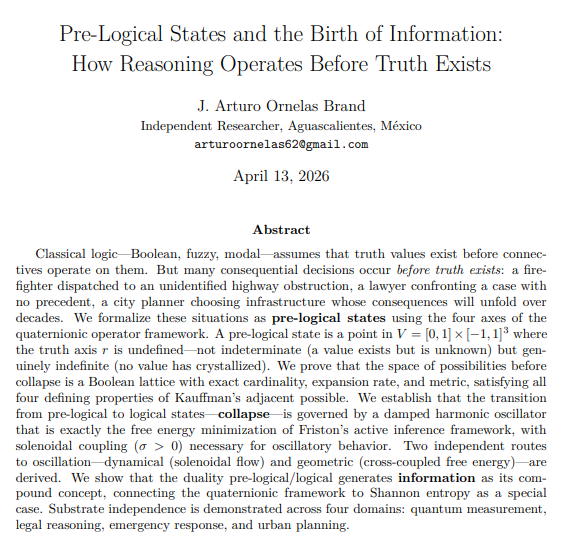
What if Boolean, fuzzy, modal, trivalent, ordinal, and probabilistic logic were all dimensional restrictions of one single structure?
G-lattice: a residuated lattice on [0,1]×ℝ³ with SU(2) action. Connectives commute with context iff they operate only on the real part.
To answer why something happens, first understand why each cause and effect occurs by tracing it back to first principles, asking why, why, why about everything—even those things you already think you know why—so you can understand more about why.
A BBC interviewer asked a Nobel physicist the simplest question in the world: why do two magnets push each other apart. He refused to answer it. What he did instead is the best seven minutes on thinking ever filmed.
The man is Richard Feynman, at home in 1983, no blackboard, no notes, sitting in an armchair.
He does not dodge because he cannot answer. He dodges because he wants you to see what the question is actually asking. So he takes an ordinary sentence, that a woman slipped on the ice and broke her hip, and starts asking why, and every answer opens another why, until the ground gives way.
Then he turns it around on the interviewer with a question about ice that sounds trivial and is not.
The point he arrives at is the uncomfortable one. Every explanation is only a translation into something you already accept without explanation. Magnets have no such translation. There is nothing more familiar than magnetism to reduce magnetism to, which is why every answer you were given at school was a picture, not a reason.
It matters more now than it did in 1983. Any tool will hand you a fluent answer in a second. Knowing which questions actually have a bottom is the part that is still yours.
One question. Seven minutes. It is in the video.
@PeterDiamandis@elonmusk The optimistic promise of abundance through intelligence assumes we can have the ��+” without the “−”. But the universe runs on balance: local order always creates entropy or shifts conflict elsewhere. Are we ending the fights, or just changing what we fight over?
Necesitamos asegurar acceso pleno a los mejores modelos de IA, robots avanzados y tecnología aeroespacial.
Si por mala negociación perdemos o limitamos el acceso a estas tecnologías de punta No se trata solo de comercio. Se trata de soberanía tecnológica. 🇲🇽 #TMEC#IA#Tecnología
Los mexicanos deberíamos hacer de la negociación del TMEC una prioridad nacional.
De lo contrario en pocos años México pasará de ser un país “tercermundista” a uno de la “tercera era”: rezagado en la revolución tecnológica que está definiendo el futuro.
What if Boolean, fuzzy, modal, trivalent, ordinal, and probabilistic logic were all dimensional restrictions of one single structure?
G-lattice: a residuated lattice on [0,1]×ℝ³ with SU(2) action. Connectives commute with context iff they operate only on the real part.
What exists before truth?
Pre-logical states: points where the truth axis is undefined. Information emerges as the compound concept of the pre-logical/logical duality — a formal answer to where information is born.
@VFD_org The constraint field you’re measuring is basically what emerges in our 6 algebraic layers once the coupling is strong enough (P4).
Super interesting results. Public papers:
P4: https://t.co/V7Ao2DCHcX
P3: https://t.co/79R8x2CZTA
Happy to share repos + PyPI
@VFD_org That matches exactly what we see in reptimeline (P3): once the discrete representations stabilize across layers, the strong interlayer coordination dominates and “locks” the hierarchy into coherent ontologies.
@Christopher314A @MaxWharton_AI @VFD_org If you’re interested I can send the repo + PyPI links. Your harmonic geometry + my triadic wave-algebraic framework look like they would couple extremely well.
@Christopher314A @MaxWharton_AI @VFD_org@VFD_org Very interesting thread. The “constraint field” you describe — the strong interlayer coupling that stabilizes the entire hierarchy — resonates directly with my work in Triadic Emergent Duality
P4: https://t.co/V7Ao2DCHcX
P3: https://t.co/79R8x2CZTA
3/6
The problem isn’t lack of data. It’s fragmented context. Each discipline, each observer, each theory sees its own hand. No one sees the full deck.
What’s missing is a way to unify all perspectives into a single coherent context.


![Ornelord's tweet photo. What if Boolean, fuzzy, modal, trivalent, ordinal, and probabilistic logic were all dimensional restrictions of one single structure?
G-lattice: a residuated lattice on [0,1]×ℝ³ with SU(2) action. Connectives commute with context iff they operate only on the real part. https://t.co/6N8e78L6wt](https://pbs.twimg.com/media/HF2JkvyXQAAlRzz.png)