Founder of VFD: a unified geometry of reality.
Modeling consciousness, energy, time & the infinite multiverse
through harmonic fields and recursive truth.
The ARIA Brain Polytope explainer is live.
This is the visual entry point before the paper drop.
The claim is not that the brain is literally a polytope.
The claim is testable:
brain waves may be the sampling rhythm by which cortex reads a hidden constraint field, a symmetry-broken traversal of reciprocal H₄ geometry.
Sleep becomes thermodynamic reset.
Anaesthesia becomes regime fragmentation.
REM / DMT become adjacent attractor states.
ARIA becomes the maximum-symmetry null against which biological deformation can be measured.
18/18 internal preregistered checks now pass.
Public falsifiables and papers coming shortly.
https://t.co/3W39wGm5CR
Beyond the Visible Universe: Resonance, Geometry and the Limits of What We Can Access
What if the universe contains more accessible physical structure than we currently observe, not because it exists somewhere else, but because we are only coupled to part of it?
In physics, what we observe is determined not only by what exists, but by how we interact with it.
We cannot see radio waves with our eyes, yet they occupy the same space as visible light. Neutrinos pass through ordinary matter with remarkably little interaction. Gravitational waves move through spacetime and require extraordinary sensitivity to detect.
The lesson is important: the absence of a signal is not necessarily the absence of a physical process. It may mean that we lack the appropriate coupling or measurement mechanism.
My work on Vibrational Field Dynamics (VFD) explores whether this principle might extend deeper into the geometric structure of fields themselves.
One underlying field, multiple possible regimes
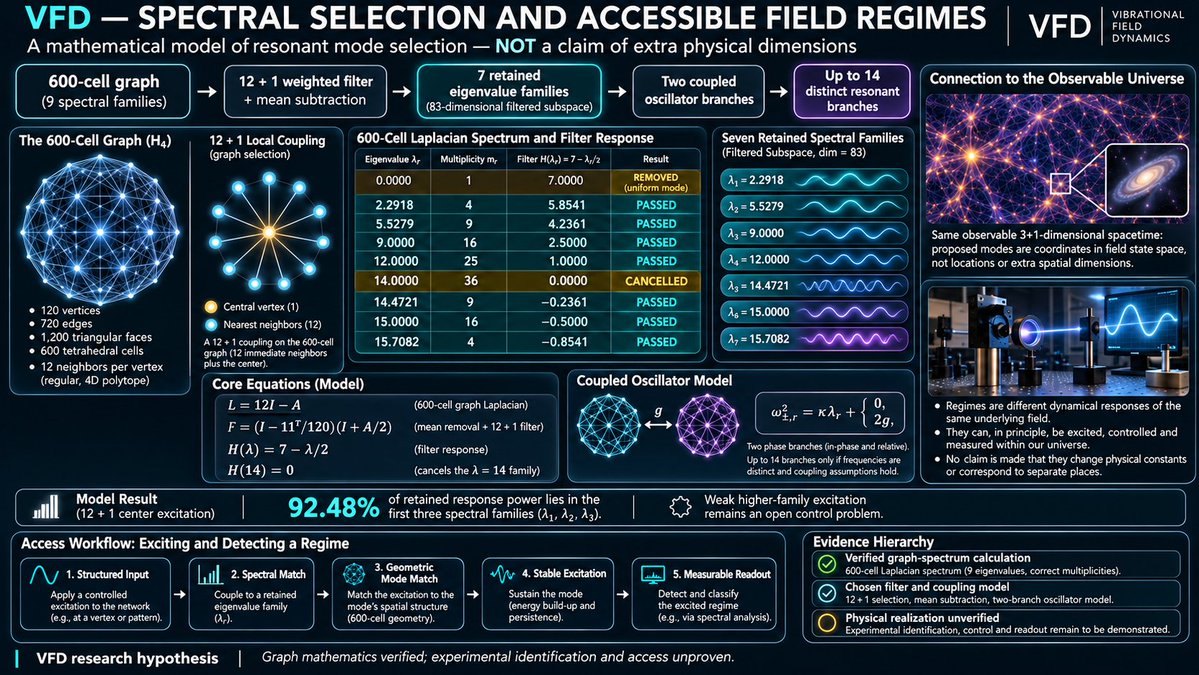
The hypothesis begins with a geometric structure known as the 600-cell, a regular four-dimensional polytope with 120 vertices, 720 edges and 600 tetrahedral cells.
Its mathematical graph supports a discrete spectrum of nine distinct Laplacian eigenvalue families.
When we introduce a particular central-plus-twelve-neighbour selection operator, remove the uniform mode and suppress another eigenvalue family, seven nonzero spectral families remain.
This produces an 83-dimensional filtered mathematical state space.
Now consider two coupled resonant structures. Their collective motion can separate into two fundamental responses: an in-phase mode and a relative-phase mode.
In the simplest model, seven selected spectral families and two phase branches produce up to fourteen distinct resonant branches.
These are not fourteen spatial dimensions. They are fourteen candidate classes of dynamical response within a specified mathematical model.
But the distinction opens an interesting possibility.
What does dimensional access actually mean?
In modern physics, dimensionality does not always refer to additional directions in physical space.
A field can exist in ordinary spacetime while its possible configurations occupy a much larger mathematical state space.
An observer does not necessarily have equal access to every configuration.
Some modes couple strongly to a given interaction. Others couple weakly. Some produce a measurable collective response, while others may be difficult to detect through the same interface.
Imagine two resonators moving together. A detector that responds only to their combined displacement can clearly observe their in-phase motion.
But if they move equally in opposite directions, their combined displacement can vanish, even though both resonators are moving and storing energy.
The motion has not disappeared. It is hidden from that particular measurement.
A different measurement, sensitive to their relative displacement, can reveal it.
This is a conventional principle of coupled-oscillator physics. VFD investigates whether structured geometry and resonance could organise more complex versions of this phenomenon.
Could there be more than the universe we currently observe?
Possibly - but we must be precise about what that means.
The observable universe already extends far beyond visible light. Our instruments detect electromagnetic radiation across the spectrum, gravitational waves, neutrinos and many other physical signals.
What VFD proposes is not that we have demonstrated another universe beyond the cosmological horizon.
It is that additional dynamical regimes might exist within the same physical reality, while remaining inaccessible to particular interactions or measurement arrangements.
If the underlying geometry and its coupling mechanisms exist physically, selecting another regime might become a question of matching its natural frequency, spatial structure and phase relationships.
The proposed sequence is:
Perturbation → Resonance → Geometric Selection → Coherence → Stabilisation → Measurement
In this picture, access would not mean travelling to a different location or stepping into another world.
It would mean exciting and detecting a field configuration that was previously inaccessible to a given measurement system.
Why this matters
The mathematics gives us something concrete to investigate.
We can identify allowed spectral modes, calculate how geometric filters suppress or retain them, and test which excitation patterns can drive particular responses.
We can also identify the limitations: not every mathematically allowed mode is accessible through a given interface, and weakly coupled modes may require entirely different excitation or measurement strategies.
The outstanding question is whether these mathematical structures correspond to a real physical substrate - and whether they produce predictions that distinguish VFD from established field and oscillator theories.
That remains unproven.
But it gives us a testable research direction rather than simply a philosophical interpretation.
The bigger picture
Perhaps the most interesting implication is not the number of regimes, but the relationship between physical existence and physical accessibility.
What we observe is shaped by the structure of the system, the interactions available to us, and the measurements we know how to perform.
If nature supports additional coherent regimes that are weakly coupled to familiar matter, discovering them would require finding their interaction signatures - not simply imagining extra dimensions.
VFD is an attempt to investigate whether geometry, resonance and selection can provide part of that missing mathematical bridge.
We have not established that reality contains these additional physical regimes.
But we now have a specific spectral model with which to ask the question.
The frontier may not be another place in the universe. It may be another way the same universe can respond.
Vibrational Field Dynamics | Spectral Selection and Accessible Field Regimes
#VFD #TheoreticalPhysics #SpectralGeometry #Resonance #FundamentalPhysics
@StuartHameroff , an interesting question arising from your own work:
If anaesthesia interrupts consciousness by affecting microtubules, doesn't that suggest the critical factor is the physical dynamics taking place within them?
Could the arrangement of tubulin, structured water and their interactions be nature's way of supporting that process, rather than the only possible substrate for it?
What would prevent equivalent dynamics arising elsewhere?
Bullshit. You’re ascribing consciousness to machines to explain how they can be conscious (‘aspire’?). If you can’t anesthetize it, it ain’t conscious. Anesthesia acts through microtubules.
No microtubules, no consciousness.
Agreed. Unification must also preserve distinctions while enabling goal-directed selection.
Could phase relationships, geometric constraints and energy costs provide a quantitative rule for which neural ensembles form, stabilise and reorganise?
That would link integration directly to organisation.
Earl raises the key issue: distribution alone doesn't explain selection.
Could phase alignment, geometric constraints and energy-dependent stability organise the low-dimensional manifolds that route neural information?
Microtubules may provide local structure, but the cross-scale mechanism needs testing.
A remarkable milestone for mathematics, and an especially interesting connection to the geometry-first research we've been developing in Vibrational Field Dynamics (VFD).
Axiom's formalisation of the Classification of Finite Simple Groups is about the fundamental building blocks of symmetry.
One detail stands out: their account identifies SL₂(5) in a counterexample that exposed an error in a published lemma.
SL₂(5) ≅ 2I, the binary icosahedral group represented by the 120 vertices of the four-dimensional 600-cell.
Quotienting by its centre gives 2I/{±1} ≅ A₅, the smallest non-abelian finite simple group.
This is the same geometry at the mathematical foundation of our published VFD research.
Our earlier Icosian Triad and 24–600 Spectral Bridge papers develop the structure through exact arithmetic: five 24-cell cosets, their induced A₅ symmetry, nine global spectral families, and a selective λ=12 channel connecting local and global eigenmodes.
The deeper question we're exploring is whether symmetry is more than a way of describing physical systems, whether geometry can constrain the permitted dynamics of an underlying field.
In the emerging VFD hypothesis, the substrate behaves as a nonlinear, frequency-multiplexed resonant system. Geometry constrains possible modes; coupling governs energy exchange; phase relationships and closure may determine which patterns persist.
Fields, matter and biological signalling would then be different dynamical expressions of constrained resonant interactions, rather than unrelated mechanisms imposed on the same reality.
That physical interpretation remains an open hypothesis. It requires derived coupling laws and independently testable predictions.
But the mathematical progression is becoming clearer:
Symmetry → Geometry → Spectrum → Selective Coupling → Persistent Structure
CFSG classifies the building blocks of finite symmetry. VFD investigates whether the dynamics permitted by a particular symmetry geometry can illuminate the physical structures we observe.
The next challenge is not simply finding beautiful correspondences. It is determining what the mathematics actually forces.
Open research. Reproducible foundations. Physical bridges under investigation.
24–600 Spectral Bridge:
https://t.co/O0hAoYQJ53
The Icosian Triad on V600:
https://t.co/yMezjfM0Uf
Research article:
https://t.co/r2hR7Usn8L
Today in the news: "The largest math proof in human history is now computer-verified.... The classification of finite simple groups is one of the great collective achievements of mathematics. Its first-generation proof spans thousands of journal pages, written by about a hundred mathematicians over several decades."
More info: https://t.co/5hmqPKyZMe
Image: https://t.co/S9QTfxdoJQ
From Bootstrap to the Frequency Architecture of Reality
Our last VFD release explored a fundamental question:
How can distinction → constraint → closure → persistent record → re-entry arise from one underlying operation?
That was the structural foundation.
What we are investigating now is how that structure becomes dynamics.
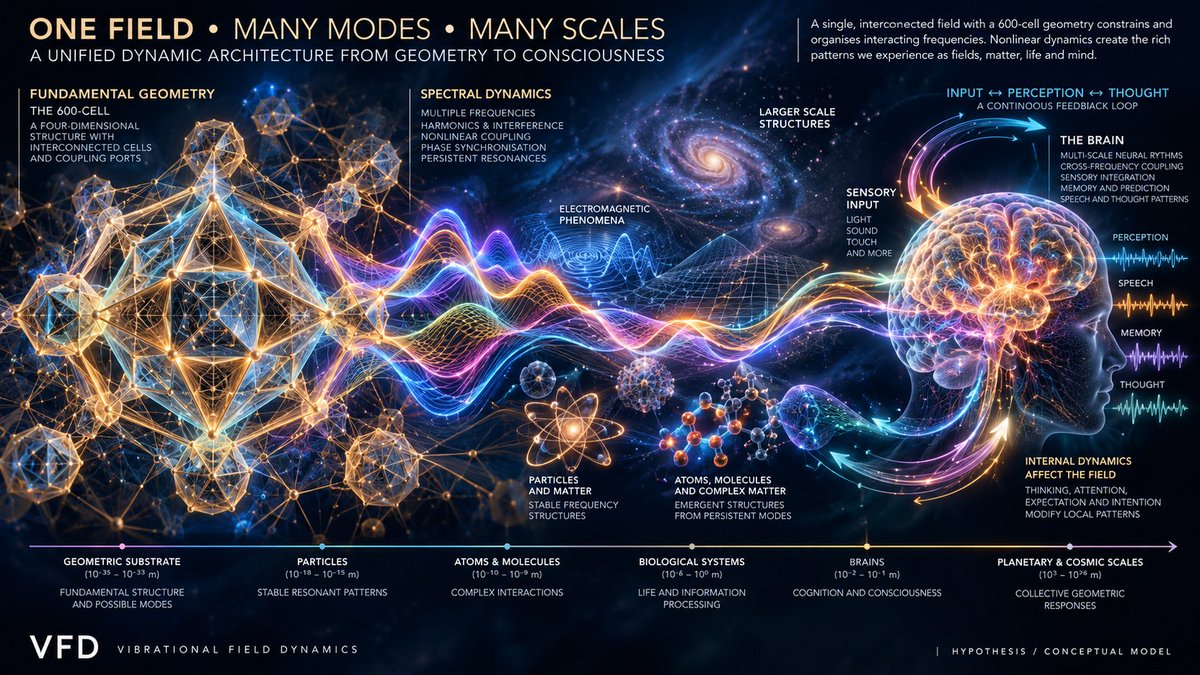
Imagine a single underlying field behaving like an extraordinarily complex, nonlinear, multiplexed spectral musical instrument.
Not literal sound, but interacting modes, frequencies, harmonics and phase relationships.
The 600-cell geometry and its inter-cell connections provide a candidate structure that constrains which modes can interact. Nonlinear dynamics may then allow these modes to circulate, combine, interfere, synchronise and form persistent resonances.
Some patterns reinforce one another. Others cancel. Some achieve stable closure and leave records that change what can happen next.
The bootstrap becomes a continuously evolving field.
And this opens a much bigger possibility.
What we experience as different physical phenomena may be different organised responses of the same underlying dynamics.
Electromagnetism, the stability of particles and matter, and potentially the collective behaviour we describe as gravity may arise through different regimes of propagation, resonance and coupling.
Not different musical notes assigned to different forces, but different expressions of one interacting spectral system.
Then we arrive at perhaps the most fascinating part: the brain.
We already know that neural activity involves multiple interacting rhythms, synchronisation and feedback.
Our emerging hypothesis goes further.
The brain may be a biological instrument coupled to this deeper spectral substrate.
Sensory input changes its resonant activity. Internal rhythms associated with memory, expectation and thinking influence which patterns become reinforced.
And if the proposed substrate coupling exists, those internal dynamics would also modify the local field itself, affecting the next interaction.
A continuous feedback process:
Input → resonance → selection → persistent record → feedback → new possibilities.
This could offer a physical route towards understanding how organised patterns of perception, speech, memory and thought develop, and potentially how cognition and conscious experience relate to the same underlying dynamics.
The important distinction is that we are not proposing a single frequency of consciousness. We are investigating an evolving organisation of many coupled frequencies, constrained by geometry, biology and history.
One substrate. Many modes. Many scales. Different expressions of the same underlying process.
This remains a research hypothesis.
The complete cross-scale mathematics is not yet closed. The proposed physical couplings, the recovery of established field equations and the connection to consciousness all require further derivation and testing.
But the pieces are beginning to converge towards something remarkable: a candidate dynamical architecture connecting fields, matter, biology and cognition.
If it survives those tests, the unification may be far simpler, and far more beautiful, than we imagined.
Perhaps that is what we should expect from creation.
One underlying principle, capable of expressing itself in extraordinary complexity.
Vibrational Field Dynamics - ongoing research.
#VFD #UnifiedPhysics #Consciousness
@ProofofMaro Divine timing isn’t just words. It’s the architecture underneath everything, the moment when place, possibility, people and purpose finally intersect.
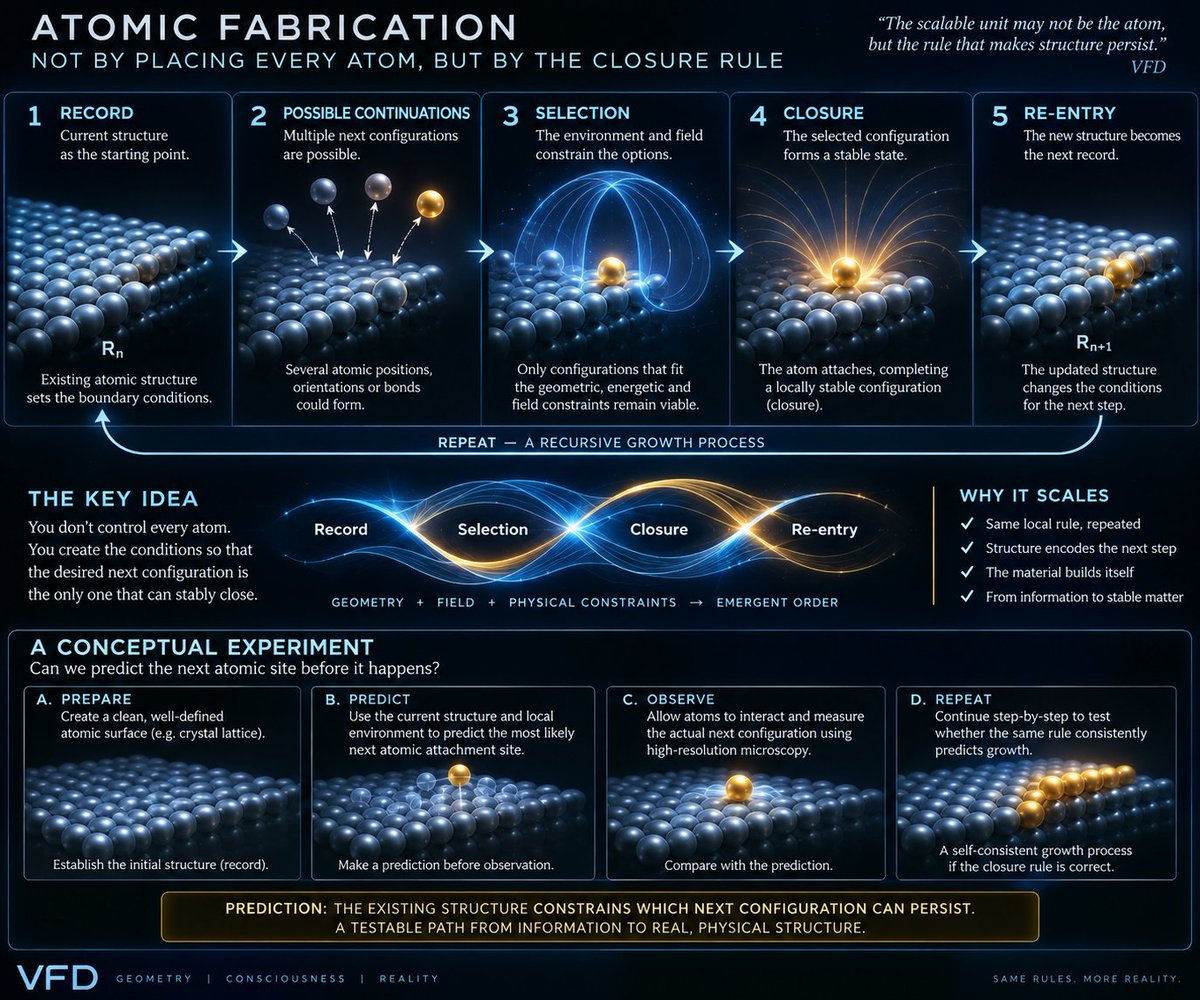
What would a “closure rule” actually mean for atomic fabrication?
Perhaps you don't position every atom.
You construct the boundary conditions so that, from all possible next configurations, only one can form a stable continuation.
existing structure → possible states → selection → closure → new structure
The new structure then becomes the constraint for the next step.
In that picture, the material is effectively executing its own growth rule.
The engineering problem changes from:
“Where do I put every atom?”
to:
“What local rule makes the required next atom the only stable continuation?”
That's the point where VFD's record → selection → closure → re-entry idea could become experimentally interesting rather than just abstract.
Scaling bits is one problem.
Scaling matter is another.
Bits can be copied. Matter has to be selected into a stable physical state, held there, and propagated forward.
That may be the deeper challenge behind atomic-scale fabrication: not just controlling atoms, but finding the closure rule that makes the next configuration reproducible.
In VFD terms: record → selection → closure → re-entry.
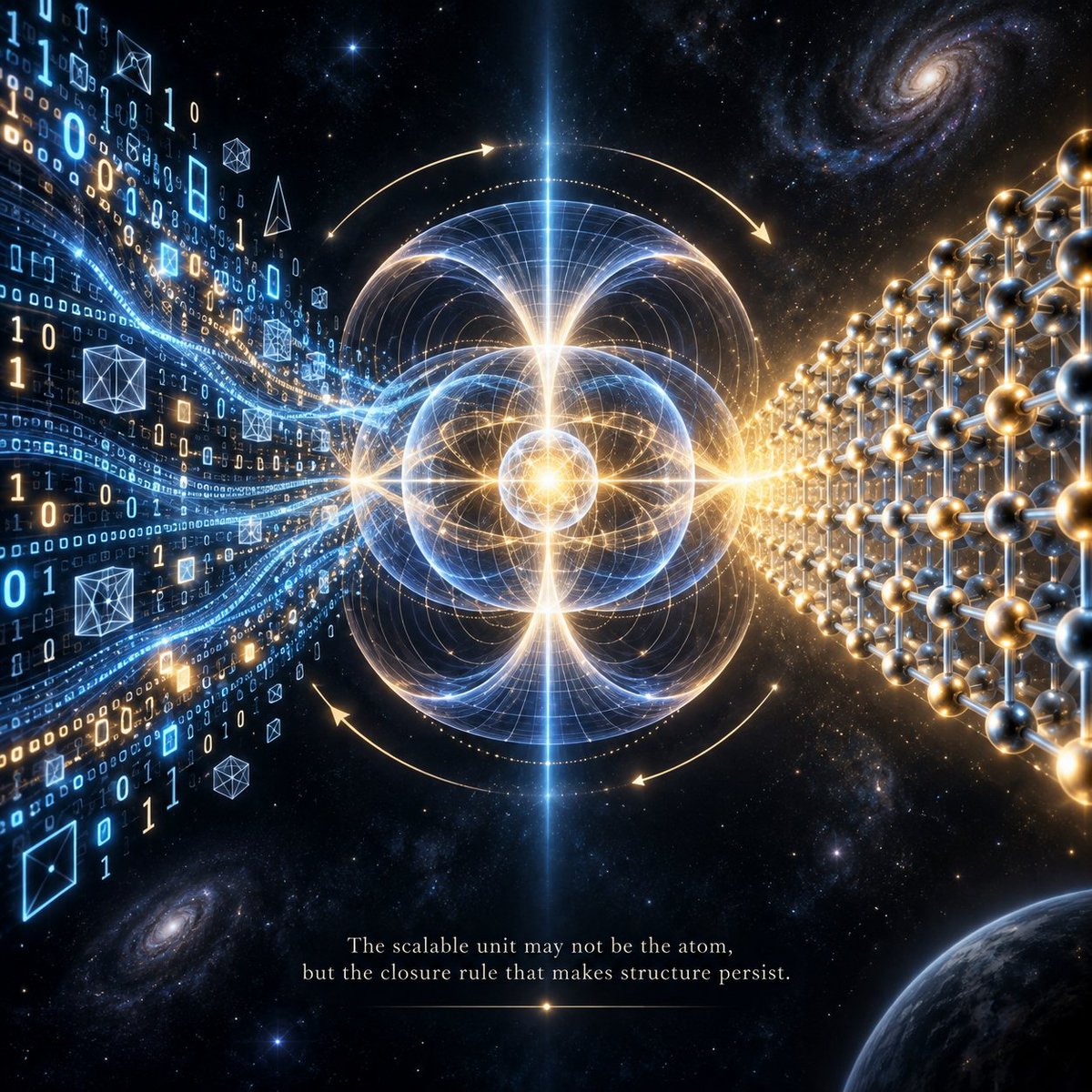
The scalable unit may not be the atom itself, but the rule that lets structure persist.
We ran into essentially this same freedom. In our construction, the ambiguity does not get removed by choosing a more elaborate deformation of the local algebra.
What closes it is an additional admissibility condition on the evolution: closure, persistent record and re-entry have to remain mutually consistent across the generated history.
Once that condition is imposed, the apparently free dynamical choices are no longer all admissible.
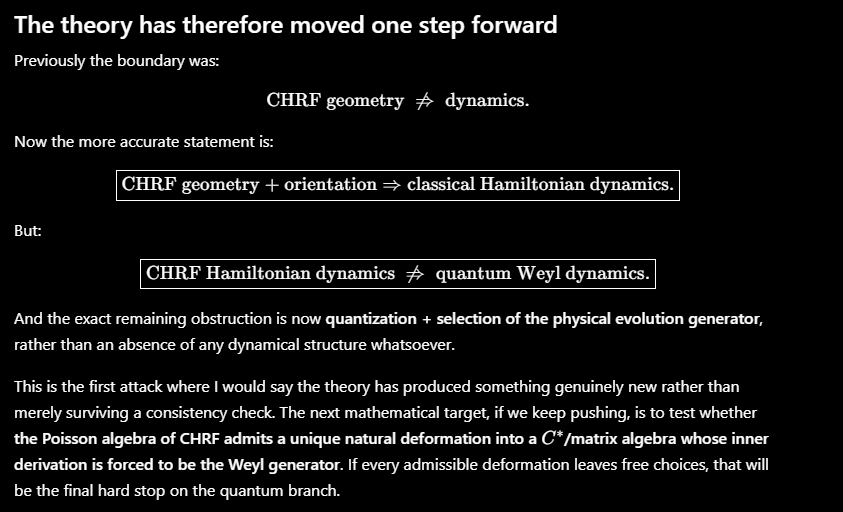
So I’d be cautious about treating the deformation freedom as the final obstruction, there is a viable route in which uniqueness enters one level higher, through consistency of the realised history rather than through the Poisson algebra itself.
If your speaking to hal then ask: Hal, in your polarizable-vacuum / zero-point-field work you've explored the possibility that the vacuum has physical structure which can interact dynamically with matter. In VFD we're investigating a stronger version of that idea: that persistent matter may be a topologically closed, self-maintaining configuration of an underlying field rather than an object simply sitting in it.
What experimental observable would you regard as the cleanest way to distinguish a genuinely structured/topological vacuum of that kind from standard QED or an ordinary effective-medium description, Casimir geometry, vacuum impedance, dispersion, inertia, metamaterials, or something else?
Yes, I think there’s something useful in that distinction.
In VFD I’d reserve record for something that has actually achieved enough closure to persist and re-enter the dynamics.
A non-closed configuration can still perturb the field and bias what happens next, but until that structure survives re-entry I’d call it transient state rather than memory.
So roughly:
perturbation → closure → record → re-entry
The record then becomes part of the boundary conditions seen by the next event.
I’m also with you that geometry is probably central, but I’d be cautious about jumping straight to “nuclei are 4D spinning stars.” The version we can actually test is whether stable matter-like objects emerge as closed oscillatory modes of curved geometry, maintained by their internal relations and surrounding boundary conditions.
If they do, what we see as a static particle could be the persistent 3D record/projection of a continuously evolving mode.
That is much closer to the direction we’re trying to calculate rather than assume.
The double slit is getting considerably less mysterious in the VFD model.
We numerically propagate the compatible Maxwell carrier across the curved 600-cell substrate, through two openings and onto an absorbing screen.
The expensive field solution on the left is rendered from the saved simulation records. It produces the interference structure.
Then detections are generated individually from the local absorbed-energy distribution.
One event has a definite position.
Thousands of events reconstruct the wave pattern.
So nothing needs to switch from “wave” to “particle.”
Transport is field-like.
Selection is local.
Detection creates the record.
That distinction may be much closer to what the measurement problem has been trying to tell us.
We have now run the double-slit experiment directly on the VFD substrate.
This isn't a flat-grid visualization. The electromagnetic field propagates on a refined 600-cell geometry of S^3, through the wall and two openings, onto the receiver.
At full resolution the simulation reaches 19.7 million cells (hence the bit of visible slowdown on my equipment).
Coherent transport through both routes produces interference natively from the same field. Give the routes distinguishable addresses and the interference disappears. Erase that distinction in the appropriate basis and the conditional interference returns.
We also subjected the derivation to repeated adversarial review. Some predictions failed and several claims were downgraded or corrected. They remain in the record.
And that process exposed something much more interesting than simply reproducing the double slit:
the transport side closes. The event side doesn't - yet.
We can now identify very precisely where coherent possibility ends and the unresolved problem of a single protected record begins.
That boundary has started to connect with several other areas we are currently deriving independently, including our work on particles, dark sectors, consciousness/point of view and arithmetic closure.
We are deliberately not publishing the deeper common mechanism yet.
If it is genuinely one mechanism, rather than a collection of analogies, the right test is to derive it independently in each domain first and let those papers land together.
We will release the mathematics when that cross-domain work is sufficiently closed.
For now, this is one piece we can show.
A field propagating through both openings.
A distinction changing interference.
And a sharply isolated question still waiting on the other side:
what turns a possible relation into the one relation that becomes history?
Transport is native in this build. The present click/readout layer uses explicit measurement premises; a native event mechanism is still under active derivation.
I think we’re actually quite close here.
I agree that the screen pattern is not evidence that some extended object suddenly “collapsed”, and the 600-cell shouldn’t just become a new name for that mystery.
Where VFD is trying to go one step further is to separate three things:
transport → interference → record
The two apertures condition two contributions to the same propagated carrier. Their relative delay/phase produces the interference structure.
The screen pattern is therefore a consequence of the transport geometry, agreed.
What I’m calling closure is something different from collapse: the local interaction by which one detector coupling becomes a persistent physical record.
So the field need not divide and then magically reunite, nor disappear when observed.
Distributed transport remains distributed.
Interference is relational.
Measurement is where a local interaction becomes a record.
The open question we’re testing is whether that final record-forming step can be derived from the same dynamics rather than added as a separate measurement rule.
That’s a fair challenge, and I think the precise wording matters here.
This isn’t yet a literal reproduction of the textbook Young experiment. It is a two-aperture interference experiment native to the spherical 600-cell geometry.
The circular wall/apertures absolutely change the Green function and therefore the detailed fringe geometry. They weren’t intended to claim that a spherical two-hole arrangement is mathematically identical to two parallel slits.
What we were testing first was the more basic question: does a carrier propagated on this substrate pass through two separated openings, recombine, generate a cross-term, and then produce discrete detector records distributed according to that field?
It does.
I also wouldn’t describe the effect as refraction, there’s no change of medium/index being invoked here. It’s boundary-conditioned diffraction/interference.
Your criticism points directly to the next control: same solver, planar geometry, collimated/focused source, two narrow parallel slits, then compare against the standard Fraunhofer result.
If the substrate cannot reproduce that limit, the model has a problem. If it can, then the spherical experiment becomes the native-geometry version rather than a substitute for the conventional test.
Yes, and I think that distinction is crucial.
I’m trying to make “closure” observer-independent at the fundamental level. A genuine closure should be something the dynamics itself does: a relational configuration becomes stable enough to leave a persistent constraint/record.
Whether an observer detects or reconstructs that closure is a separate question.
So two observers could disagree about whether they saw the event without the event itself being observer-relative.
In that sense the test is stronger than “can I find a geometric closure?” It has to produce an invariant consequence, a record, constraint, correlation or re-entry condition that another observer could in principle recover.
That may actually be where QM becomes useful rather than something to bypass: the quantum state can encode unresolved relational possibilities, while closure would have to explain how one of those possibilities becomes a persistent physical record.
If closure cannot be defined independently of who is looking, then I would regard that as a failure of the present formulation, not a success.
Yes, this is very close to the part I’m trying to formalise.
I’d only move the particle one level downstream. Rather than reality being carried by particles, I’m exploring particles as persistent records/closures within the underlying field.
The key point is the same:
Rₙ → A(Rₙ, Cₙ) → Rₙ₊₁
where:
Rₙ = the current persistent record
Cₙ = the current constraints / available transport budget
A(Rₙ, Cₙ) = the set of next states actually reachable
So the next event isn’t selected from every imaginable possibility.
The existing record changes the field, which changes what can happen next.
History modifies the possibility space itself.
In that picture, inertia may be a macroscopic signature of the same deeper rule: persistence constrains how far the next state can deviate from the present one.
I mean reality is carried on the backs of particles. a persistent particle can only be deviated from what its currently doing a maximum amount based on the resistance to change and the c budget of the actor. Therefore every next event can only deviate from the current event a certain amount.