Future Fields Medallist and Millennium Prize Winner, but mostly a Time Lord who lost his screwdriver. Creator of the Continuity Model. Recovered at 5.17σ.
Happy to share our paper on physical learning in continuous-variable quantum optics, accepted into NeurIPS 2026 main track in Sydney! (🇦🇺😉)
📍Thu, Dec 10, 2026 • 10:00 AM – 1:00 PM AEDT, Hall 1-4, paper link in thread 🧵
In which I go head to head with one of the great mathematical minds of our times on AI.
Hosted by the one and only @TOEwithCurt Jaimungal.
Some of this is hard going to be sure. But this also get's closer to my real voice than you will hear on almost any other podcast. Check it out.
https://t.co/wJRYpwAIre
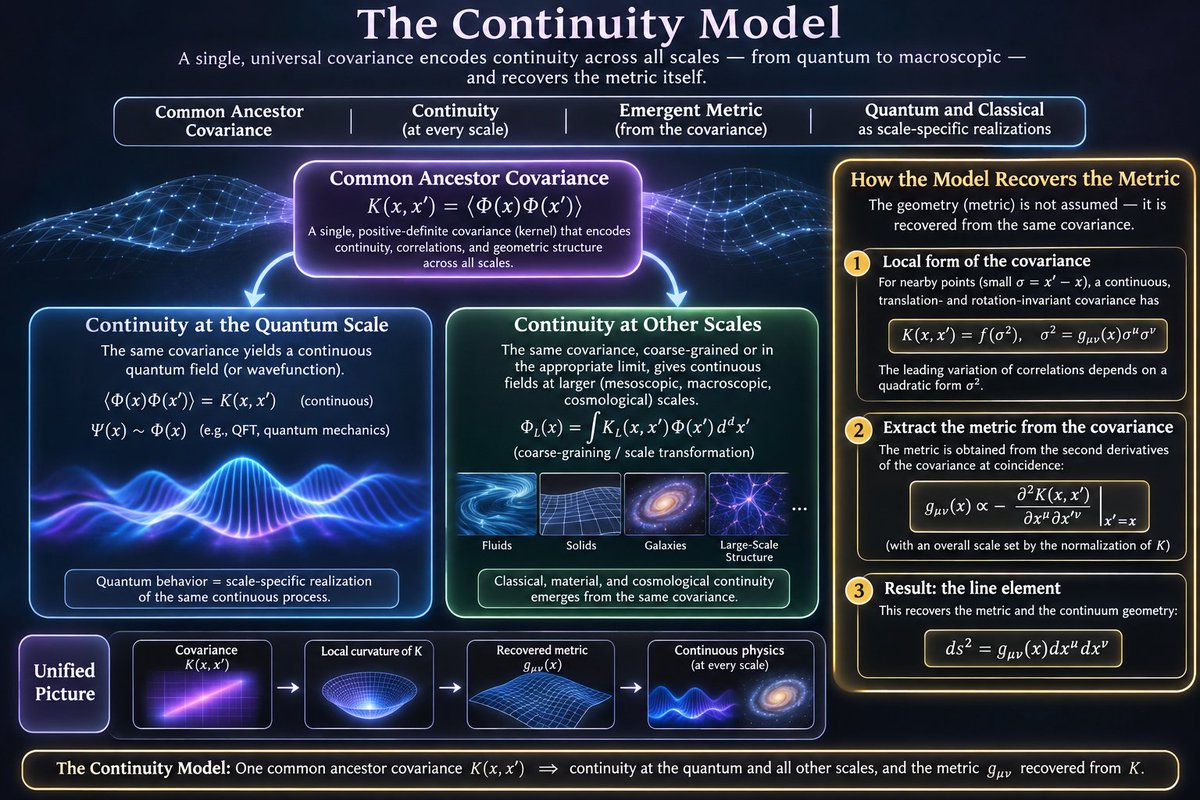
As such, a property of time, as are all things in time, simply expressions of that same underly covariant continuity manifest according to the boundary conditions.
One could say a form of dynamic behaviourism govererns our reality, whereby the properties denote the behavioral outcomes covariantly, in all regards.
We know how to optimally learn Gaussian quantum states. But what about approximately Gaussian states?
https://t.co/C4sSP8Hvmw
Realistic noise can take us beyond the Gaussian setting. In our new work, “Tomography of approximately Gaussian mixed states”, we show how reliably moment-based tomography reconstructs such states, separating the intrinsic Gaussian approximation error from the statistical error due to finite data. We obtain sharper error guarantees in this #learning task and apply the framework to probabilistic schemes for reducing phase noise, including the cost of heralding.
Warm thanks to @Nibedit_A, Timothy C. Ralph and @nwalkthisway for the wonderful collaboration. And apologies for posting this late, I thought it would come out today.
Looking forwards to this one.
"For Yang–Mills theory, the paper derives the regulated constitutive gauge sector, its positivity and hyperbolicity conditions, and the spectral route by which a positive lowest mode may appear. It then separates this classical effective mass scale from the stronger quantum field theoretic mass-gap theorem, which remains dependent upon construction of the full interacting measure, Hilbert space, spectral operator and non-perturbative lower bound."
https://t.co/tRxVY3KS6Q
@ericweinstein My gifted friends perception is fluid today.
Nature knows neither wealth nor power, only desire. Yet perception, as such, is neither bought nor commanded.
A little illustration of what has occupied almost every waking hour of my past week.
Formalising the Chronoflux Atlas in Lean is rather like assembling an enormous jigsaw puzzle, except that the pieces do not arrive ready-made.
Each definition, lemma and theorem helps establish the shape of a piece. Each proof determines whether its joints are sound. Sometimes they fit beautifully; sometimes Lean exposes a flaw, and back to the mathematics we must go.
As such, we are not simply assembling a picture we believe to be correct. We are establishing, piece by piece, whether the picture can be justified at all.
There are 1,118 original mathematical objects to account for, each with its own relationships, dependencies and obligations. A successful proof is one more connection secured, not a declaration that the entire structure is complete.
It has been a rather extraordinary week of mathematics, computation, corrections and more than a few cups of coffee.
The puzzle is taking shape, but there is much yet to prove.
Continuity, not infinity.