Today we’re launching Ornn Depreciation Curves, modeling GPU hardware values from A100 to GB300 using real transaction data.
As new generations of GPUs enter the market, the future value of existing hardware becomes increasingly uncertain.
Depreciation Curves provides a foundation for estimating GPU residual values, helping lenders and fleet operators better quantify the risks underlying financing and investment decisions.
Explore the curves → https://t.co/oxQ9uR98Bq
Most GPU price indexes track listed rates. We track what buyers paid.
Over the past year, transacted prices went up across every generation, led by B200 and H200. While new chips usually push down prices for the one before them, B200 kept climbing even after B300 arrived in June.
Explore our data → https://t.co/oxQ9uR98Bq
@AnthropicAI’s S-1 has been making headlines, specifically its $895 billion committed to compute, roughly half of which is due by the end of 2030.
Those commitments, spread across Google, Amazon, Microsoft, Broadcom, SpaceX, and others, come with some hard questions. How much revenue does Anthropic need to pay the bill? And what happens if demand falls short of the plan, or runs past it?
Read the full breakdown is in our latest research: https://t.co/Wc3GHfs7d9
@a16z@mavolpi GPU economics are changing faster than traditional depreciation models can account for. Real market pricing tells a different story.
Thanks @a16z for using Ornn data to tell it.
Tokenization makes private assets easier to trade. It doesn't make them easier to price.
Our co-founder and CTO @wayne_nelmz spoke with Bloomberg on why price transparency means indexing true market-clearing prices.
More on @business: https://t.co/reQeSZO3dU
Buying 1,024 B300 GPUs? If you need financing, lenders will ask: who’s committed to renting the capacity, at what price, and for how long?
Long-term contracts, on-demand rentals, and interruptible spot capacity offer different levels of revenue certainty, and financing depends on that certainty.
Introduction to Compute Markets explores how compute is priced, contracted, and financed.
Read Part 1 on The Primary Market: https://t.co/yh3xIhUdfW
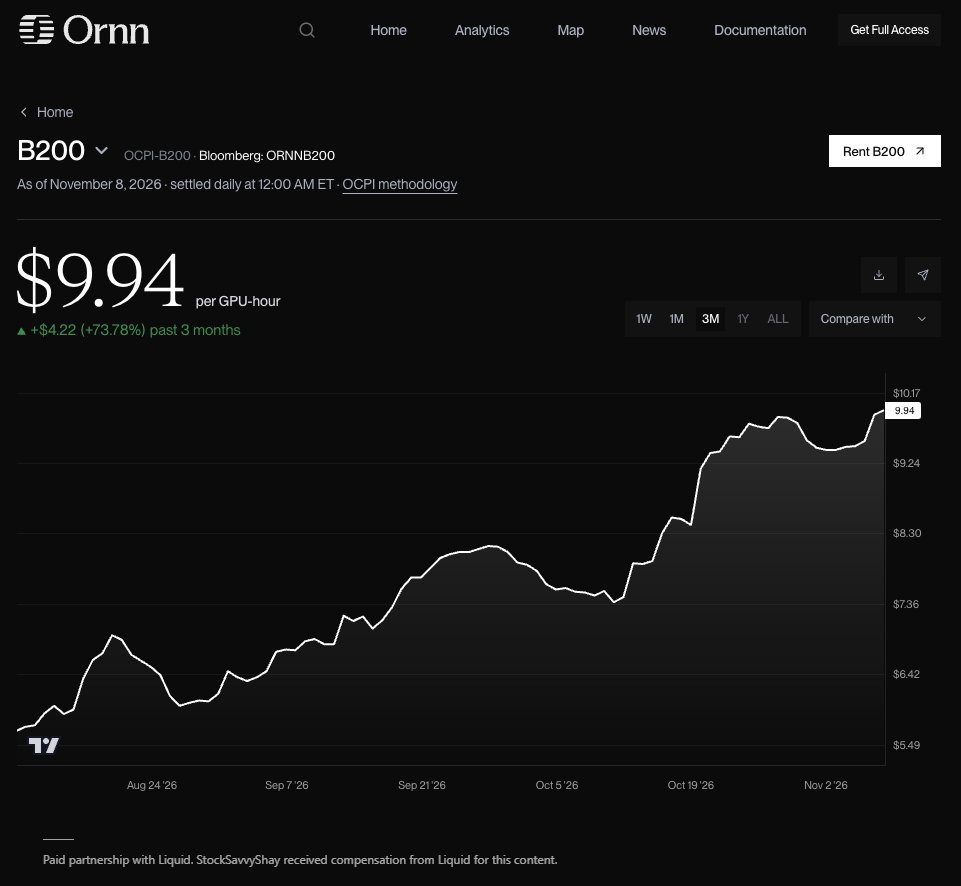
@liquidtrading As Blackwell capacity scales, having daily settled benchmarks like ORNNB200 helps the market price compute with real clarity. Thanks for using Ornn data.
Public sentiment changes daily but settled rental rates reflect physical demand. Benchmarks like ORNNB200 on Bloomberg give an accurate reference point for what compute is actually worth right now.
While market has been selling AI infrastructure stocks over the past three months the rental rates for $NVDA B200 GPUs have surged 74%.
Super interesting for AI clouds because higher rental pricing could shorten payback period on the billions they're spending to deploy Blackwell capacity.
“Compute is the next commodity. The GPU hour is the new oil,” shared our Co-founder & CEO @Bavaria_kush on @NYSE Wired with John Furrier.
Key takeaways:
→ Price action: A B300 contract locked at $2.90/hr last December now trades above $6.
→ Risk mitigation: Futures let neoclouds hedge customer credit risk across multi-year contracts.
→ Market infrastructure: Ornn is building the benchmark compute index, with our partner ICE.
Watch Kush’s full session with @Furrier: https://t.co/zO6bQCbaRw
AI compute is becoming one of the most important themes in financial markets, yet the derivative market for it remains immature. Platforms like @HyperliquidX and @OrnnExchange are among the first to change that.
Grayscale Head of Research @LowBeta spoke with @a16zfrontier partner @guywuolletjr on why this gap may be one of the biggest opportunities in markets today, and why Hyperliquid is already positioned to bring these markets onchain.
Introducing a new weekly roundup of all things compute. It’s your quick debrief on market drops, hardware pricing, and infra shifts:
• Tech stocks took a hit Thursday, with the Nasdaq down 5%+ after Texas’s incoming administration pledged to pause new data center approvals.
• Soft guidance from $QCOM and $ARM weighed heavily on AI trade sentiment, though $AMD bucked the trend with data center revenue nearly doubling.
• Ornn’s H100 Index averaged $3.08/GPU-hour this week, reflecting relatively stable pricing amid broader shifts in compute supply and demand.
The takeaway: Supply bottlenecks from data center moratoriums may reprice installed capacity higher.
Why commit to GPU capacity for five years? Because longer commitments can mean lower hourly rates.
Ornn’s H100 pricing curve shows $2.61 per GPU-hour for a one-month term, $2.29 for one year, and $1.58 for five years.
That’s a nearly 40% lower hourly rate in exchange for a longer commitment, and contracted revenue that can help providers secure financing.
Read Part 1 of our Compute Markets series: https://t.co/OZ0u7DlrLB
New to compute markets? We started Introduction to Compute Markets, a series for anyone who wants to understand how GPU capacity is bought, sold, and financed.
Part 1 covers the primary market and the three ways compute gets sold:
1. Reserved: commit for a fixed term, typically for a lower rate
2. On-demand: pay as you go, with no long-term commitment
3. Spot: discounted spare capacity, until the provider needs it back
Next up: what happens when customers become sellers, in the secondary market.
Read Part 1: https://t.co/OZ0u7DlrLB