wow great paper
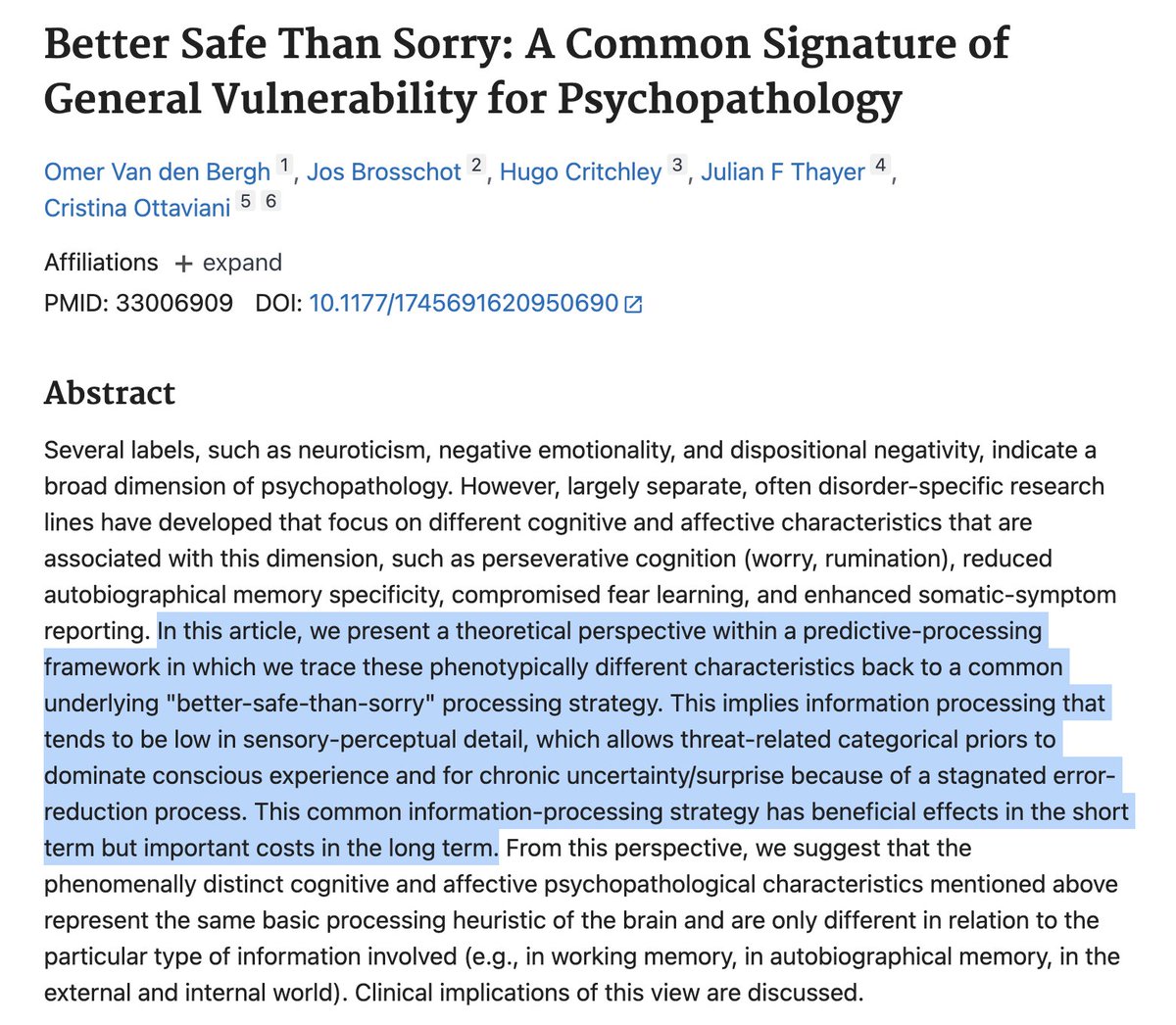
perseverative cognition (worry, rumination) may be protective in the short-term bc it generalizes & prevents from focusing on specific, emotionally-heavy episodes, but is costly long term bc it makes it harder to update from disconfirming & corrective experiences
First they came for the software engineers and I said nothing for I was not a software engineer.
Then they came for the mathematicians and I said nothing for I was not a mathematician.
Then they came for the lawyers and I said "make sure you get all the lawyers"
recently learned one of the smartest most productive people i know smokes pot almost every morning before running 3-5 miles while blasting classical music
has had the same routine for a decade+. happily married, multilingual and has multiple kids too. never seen anything like it
@MatjazLeonardis well the problem is that past the first few loops the thinking just becomes unconstructive & repetitive without generating new solutions and mostly just worsens your frame
rumination persists partly bcs ruminators hold positive beliefs about it ("this lets me be more prepared") so there's an epistemic distortion that reinforces the rumination beyond just the emotionally protective mechanism. this is true of many dysfunctional/obstructive behaviors
many early childhood adaptations/behavioral loops that end up obstructive in adulthood are directly downstream of overfit epistemics and/or carried over ontological distortions
but bcs ontology is pre-verbal & the very frame that colors your experience, you cannot observe it directly & have to seek it in the cracks
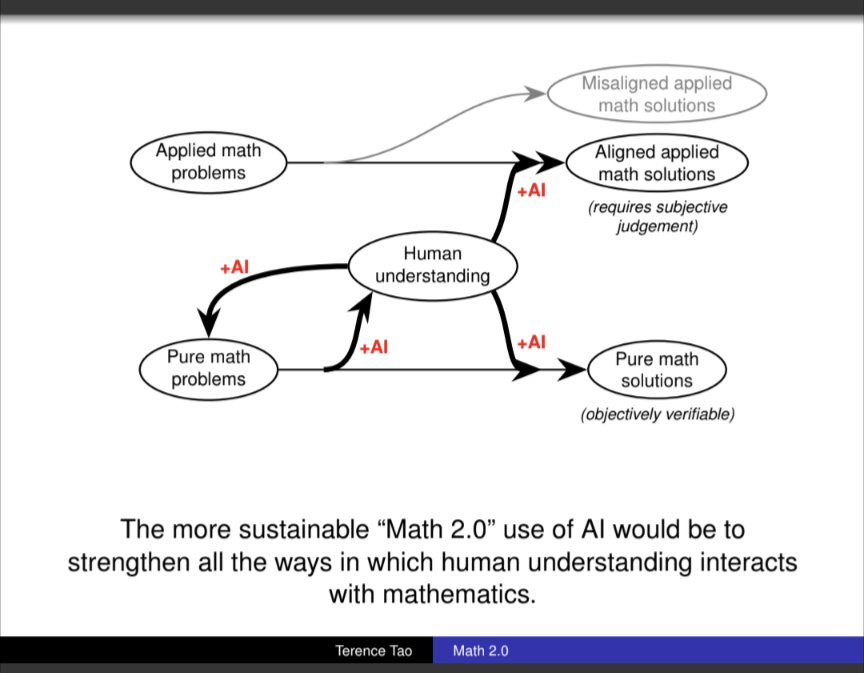
besides the cancer analogy, Tao's Math 2.0 slides are quite clear-headed & illustrate a path forward
Math 1.0 operated under the assumption of "proof scarcity", and most institutions and incentives were designed around this
Math 2.0, under proof abundance, has to expand the research frontier & decenter problem solving in favor of deeper human understanding, experimentation, and new principles and syntheses of research.
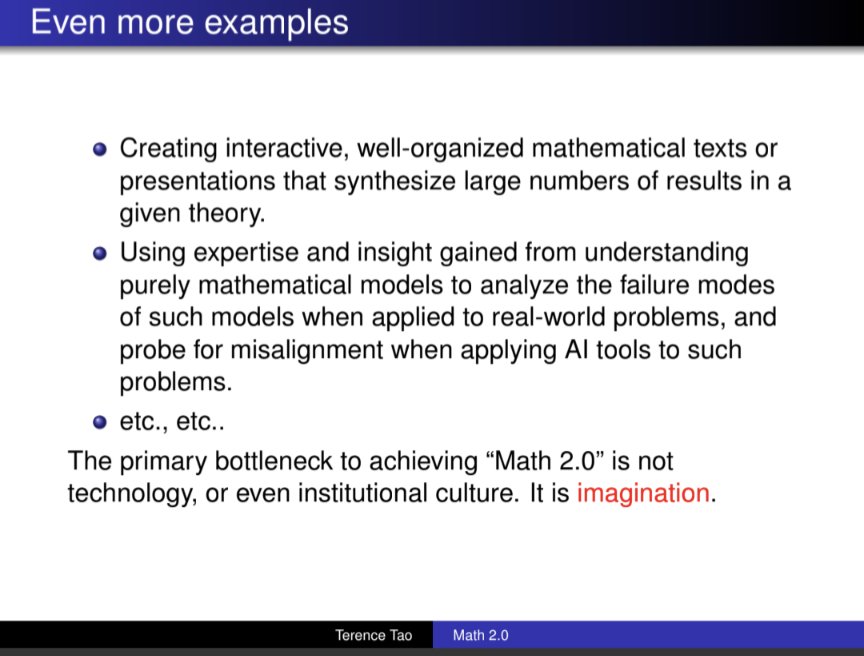
"The primary bottleneck to achieving “Math 2.0” is not technology, or even institutional culture. It is imagination."
some of you may know that I lost my Dad to cancer when I was 7yo
when doing attachment repair exercises, where you are supposed to imagine a Perfect Attachment Figure, I usually go with God and my Dad
i mean i agree with this but let's entertain his thought experiment
the proposing AI could have been trained on different data & have had much more compute to work with & develop the drug
the auditing AI would have to deal with the information assymetry and may be compute constrained
auditing AI may themselves act misaligned & intentionally hack the auditing job
@JohnBryBry the people that opt out of chemo usually do it bcs they 1) may have other options 2) they are certain to die and they deem extending lifespan with a bad QoL not worth it
this is not what we're talking about here
This is a slide from Terence Tao's 'Math 2.0' public lecture yesterday evening at Caltech. I am highly confident that, if the cure actually worked, almost any Stage 4 cancer patient would tell you that human comprehension of its mechanism is completely irrelevant to them.