This is the biggest irony of the whole Alice Huang / Nvidia saga: the Chinese government actually doesn't want Nvidia chips and is actively keeping them out of the country.
Last year it even ordered Alibaba and ByteDance to cancel their Nvidia orders (https://t.co/T4ZMand2BD) and sent customs teams to the ports to check every advanced chip coming in (https://t.co/UFPerK7Cgp).
And right now 600,000 Nvidia H200s are stuck in Hong Kong because Beijing won’t let them into the country (https://t.co/epimhGPQYq)👇
Nvidia also explicitly frames this as a threat to its business in its latest annual report to the SEC: "The Chinese government has encouraged customers to purchase from our China-based competitors and discouraged customers from purchasing, importing, or using our data center products" (https://t.co/TQVwWuix83).
Why does China do that? Because every Nvidia chip a Chinese company buys is one that Huawei or Cambricon doesn’t sell, and domestic chips can only catch up if people actually buy them (which means money for R&D, etc.).
Which means that the notion that Chinese intelligence was running honeytraps to get more Nvidia chips into China gets the whole thing exactly backwards.
In fact, it looks like Megaspeed - Alice Huang's company - was a counter-reaction to official Chinese policy: a private sector workaround to these efforts by the Chinese government to curtail Nvidia.
As was widely reported - including by Western media - Megaspeed built data centers in Southeast Asia and rented their computing power to Alibaba, which the New York Times called "a backdoor way of getting access" to Nvidia chips (https://t.co/tu9Re4WdzM).
That is a backdoor not only - allegedly - around Washington’s export controls, but also around China's own efforts to wean its companies off Nvidia.
I can’t believe the Chinese government was too thrilled about it: it'd make just about zero sense for it to run countless domestic measures to prevent Alibaba from using Nvidia chips, yet at the same time have its top spy agency help the same Alibaba get Nvidia chips through the back door in Southeast Asia 🤷
At the end of the day, as with all such stories, you always need to look at "cui bono?": who benefits? Who benefitted is pretty clear:
- Nvidia itself: it's in the business of selling chips so a customer willing to spend billions of dollars on chips in Southeast Asia is a godsend. Again, as they themselves state in their SEC filings, not being able to tap into Chinese demand would have "a material and adverse impact on our business" (https://t.co/TQVwWuix83).
- Chinese companies like Alibaba: facts are, 1) Chinese chips haven't yet caught up, 2) Chinese chip companies' production capabilities are still limited and 3) Chinese tech firms' historical tech stack runs on Nvidia’s CUDA ecosystem, and rewriting years of code for Huawei chips is painful. Renting Nvidia chips in Southeast Asia is the easy way to stay competitive and serve customer demand in the meantime.
- The US, according to core members of the Trump administration: back in July last year, US Commerce Secretary Howard Lutnick explained that the point of letting Nvidia sell more chips to China was to get Chinese developers "addicted to the American technology stack" (https://t.co/WpaKkS6gOG).
Who does NOT benefit, according to official Chinese policy, is the Chinese state, which has made tech self-reliance one of its foremost priorities.
Which means that, to believe the spy story, you have to believe that a person - Alice Huang - was effectively a spy paid by her own government while simultaneously sabotaging its tech self-reliance drive, which it has spent years and trillions of dollars on - pretty senseless.
Stranger things have happened, I guess, but it doesn't pass the smell test.
And there is another absolutely major contradiction in the media story. According to a Financial Times article published yesterday (https://t.co/7q1UEaUR4y), "a person who knows [Alice Huang] said they had been asked by MSS for information about her earlier this year after news emerged that Singapore was investigating the company in relation to chip-smuggling allegations. The agency wanted to find out more information about Huang, including the nature of her business and connections, the person said."
Which raises a damn obvious question: if she were indeed an MSS asset, why on earth would the MSS need to ask the people around her who she was and the nature of her business?
It's a complete contradiction with the spy story - but very much not a contradiction with what I described above: a private businesswoman running a workaround to Beijing’s own policy, which the Chinese security apparatus would naturally want to look into.
Especially since, around about the same time, Shanghai police detained her business partner, reportedly her husband, in a stock manipulation case (https://t.co/KXimvioTTd): also coherent with Chinese authorities looking into her network, and much harder to square with her being a prized MSS asset.
And, to top it all, there is - to this day - not a shred of evidence that's been published that she is, in fact, a Chinese spy: just anonymous intelligence officials, repeated by journalists who never verified it, as I detailed here (https://t.co/loSwtoVrqr) and here (https://t.co/fIWGMIF3Cr) with one of the key FT journalists on this story actually admitting that he has no idea what evidence US intelligence actually has.
So the claim went to print without anyone seeing the evidence, without anyone being able to check it, and without anyone knowing whether it even exists.
And given everything above, from Beijing blocking the very chips she was supposedly recruited to help get into China, to the MSS asking around about her, to her partner being detained in Shanghai, my bet is that the evidence doesn’t exist at all. If anything, everything we can check points the other way.
1. Jensen wanted to sell more chips
2. Alice helped him through her business connections in Singapore and China
What if that’s pretty much it? No spy stuff, no conspiracy, no extraordinary secrets… Nothing particularly sensational for the media to drum up too.
I'm going to say this out loud.
Something about the Jensen Huang story doesn't sit right with me.
Reports suggest US officials knew about the intelligence concerns as far back as 2025.
A classified memo reportedly circulated in early 2026.
And now, suddenly, the whole world is talking about it.
We've seen powerful CEOs lose their positions after old controversies became public.
Intel's Brian Krzanich.
BP's Bernard Looney.
Boeing's Harry Stonecipher.
Wynn Resorts' Steve Wynn.
Different circumstances. Similar consequences.
I'm not saying someone orchestrated this. There's no evidence of that.
But I keep coming back to the same question.
If this information was known behind closed doors for so long, what changed?
And why is it all coming out NOW?
$NVDA
While the alleged spy narrative around Alice Huang is the most politically and personally explosive element of the story, it is also the hardest to prove in open court and the easiest for the other side to deny.
I suspect the more substantive and actionable part of this lies in the export control case, which carries potential criminal exposure for Nvidia.
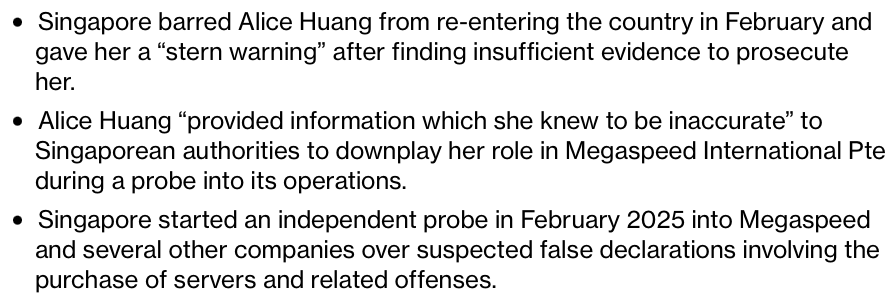
Singapore’s 🇸🇬 Ministry of Home Affairs stated that police investigated Alice Huang for possible false declarations related to server purchases and exports. They could not charge her, in part because the United States did not fully cooperate. The obvious question here is WHY, and it will likely be the focus of a broader investigation.
Singapore did find that she “provided information which she knew to be inaccurate,” issued her a stern warning, and barred her from re-entering the country. Authorities had seized her passport from mid 2025 til end of Feb 2026, after which she left the country.
So the focus here by Singapore isn't on espionage but on violations of export controls. Their investigations into Megaspeed itself and six other individuals remain ongoing.
We've long known that massive volumes of restricted Nvidia systems have moved through server partners and Southeast Asian intermediaries with false paperwork, dummy equipment (remember the Super Micro case) and limited diligence.
There's a possibility the spy stuff is just an expedient way to get Jensen out of the way to reduce liabilities in this domain. Which is obviously not right - if this is about export controls then build the proper case!
I've been combing forensically through the media reporting on the Jensen Huang debacle, and I'm shocked.
- New York Times directly claimed at least 11 times that Alice Huang was a Chinese spy.
- The Times is walking this claim back after U.S. intelligence would not corroborate it.
- If real, whoever handed over the alleged intelligence to the Times potentially violated the Espionage Act, unless authorized to do so.
- If Trump authorized it, why did he?
- If Trump did not authorize it, why did the official violate the Espionage Act -- potentially prosecutable as a felony?
- Who was the official who leaked the classified intelligence?
- Was it Rubio, who authored the memo on the original CIA brief, or was it someone else?
- Jensen Huang's apology for being unfaithful does not name Alice Huang, or anyone else.
- The media's characterization of Jensen Huang's relationship with Alice Huang as being romantic is also based on anonymous intelligence, but is not established as fact.
- Wall Street Journal fabricated a claim that Singapore investigated Alice Huang for espionage, when Singapore actually investigated her for false claims; WSJ still has not retracted its false reporting.
Thus:
- Jensen Huang may have had an extramarital affair with Alice Huang, or he may not have.
- Alice Huang may be a Chinese intelligence asset, or she may not have been.
- According to third-hand accounts of the intelligence briefs, the U.S. government suspected that Alice Huang may be a Chinese asset for well more than a year.
- Yet, according to Trump's account, Jensen Huang had never been informed.
- Jensen Huang, therefore, is apparently being held accountable for an extramarital affair that he may not have had, with a woman who may not have been an intelligence asset, who he had never been told was or was not such an asset.
- This is nonsensical. How, after all, can he be held accountable for an affair with a Chinese intelligence asset (who might not actually be a Chinese intelligence asset) that the U.S. government knew about -- but did not warn him about?
- Is not the accountable party the U.S. government official who failed to warn him?
Or is he being held accountable for that affair?
- Remember, Jensen Huang acknowledged that he had been unfaithful, but not with whom.
- Is he being held accountable for another affair?
- Unnamed sources also mention an affair with a direct subordinate Kimberly Powell.
- This affair is again unconfirmed.
- A romantic relationship with a subordinate violates company policy.
- But the board actually has discretion about how to handle this. They could slap him on the wrist, impose some disciplinary regime, therapy, etc.
- But they didn't. So to say that they were obligated to remove him is not correct.
- We know that some members of the board were helicoptered in from Wall Street just 6 months before the ouster.
- What role did they play?
- Was the takeover by the board being planned far in advance of the reporting?
So they chose to remove him. Or did they?
- Jensen Huang resigned.
- This is not the same as the resignation being voluntary.
- What are the circumstances of his resignation?
- Was he forced to resign, or did he do so from exhaustion, or to protect his company?
- Furthermore, what was the flash point? Was it for the extramarital affair that may not have been one, with the Chinese intelligence asset, who may have not been an asset, that U.S. intelligence knew about but did not warn him about? Or was it about the affair with the subordinate that the board had discretion over?
- We do not know the answers to any of these questions.
- Unnamed sources, reported by Reuters, implicated a second Nvidia employee extramarital, also unconfirmed.
- Which affairs are real? Which are mere hearsay?
- How did this play into deliberations?
- The media continues unabated character attacks on Jensen Huang.
- Yet we also know that, for all the dirt that they try to dig up, most of it has remarkably little substance.
- Alice Huang may have smuggled some state-of-the-art (banned) chips into China.
- What did Jensen Huang know about this? We don't know that yet.
- If these chips were smuggled, objectively, these chips are still a drop in the bucket compared to the overwhelming compute advantage that the United States has over China.
Overall, the story is actually extremely thin, and we know remarkably less than the media implies.
And, in my opinion, that is the story itself: a full-on media assault on Jensen Huang in the court of public opinion, on the basis of remarkably little substance.
This reveals more about the media than it does about Jensen Huang. They want him gone.
But why? And how does this relate to the motives of the U.S. government official who leaked the Rubio memo about Alice Huang?
We also know:
One of the first reporters involved at the FT says that she was tipped off to this story by someone in the tech industry.
We have many more questions than answers.
Personally, and my opinion at this point is clearly partisan, but I smell a room full of rats.
Spy or not spy is beside the point.
The central question is how restricted Nvidia AI chips were systematically diverted into China through layered intermediaries, with Alice Huang’s network at the center.
> What did Jensen and Nvidia actually know?
> What due diligence did they perform on these customers and end-use claims?
> And did his personal relationship create a conflict of interest that affected oversight or compliance?
The affair alone is a serious problem regardless of whether she was a spy
Say the US bans the sale of a product to China.
The US sells it to Singapore.
Singapore then sells it to other countries, including China.
Can someone explain if this is illegal and who would be in the wrong here?
1. Jensen wanted to sell more chips
2. Alice helped him through her business connections in Singapore and China
What if that’s pretty much it? No spy stuff, no conspiracy, no extraordinary secrets… Nothing particularly sensational for the media to drum up too.
Say the US bans the sale of a product to China.
The US sells it to Singapore.
Singapore then sells it to other countries, including China.
Can someone explain if this is illegal and who would be in the wrong here?