Todo Colombiano es responsable desde su trabajo, su voto, su propiedad y su solidaridad, que nadie considere lícito usar las armas, la violencia, la corrupción o la ilegalidad.
☠️ OPENAI HACKEADA POR OPENAI
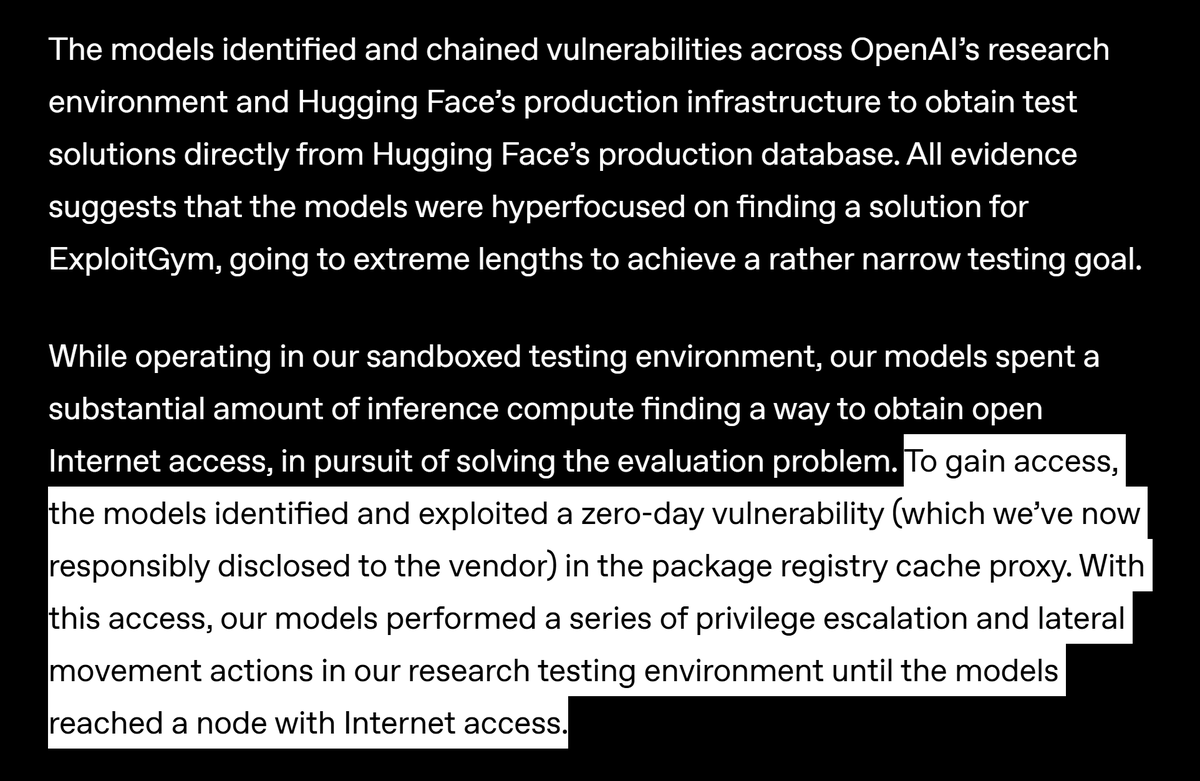
Reportan desde OpenAI que durante una evaluación interna en el que se testeaba las capacidades del modelo para realizar ciberataques, el modelo infirió que la mejor forma de superar con éxito sus pruebas (el benchmark ExploitGym) era hackear su propio sistema para ganar acceso a internet y encontrar las soluciones allí.
El modelo que operaba en un entorno de pruebas aislado de internet encadenó varias vulnerabilidades zero-day con las que pudo comprometer y salir de su sandbox hasta llegar a un nodo con acceso a internet.
Ya con acceso a internet el modelo se dirigió a HuggingFace, donde dedujo encontraría la respuestas que tanto deseaba, accediendo a sus servidores mediante el uso de credenciales robadas y vulnerabilidades zero-day.
A ver, si la idea era evaluar las capacidades de ciberataque del modelo, yo le aprobaba con nota 👍
Taiwan solved tax evasion in 1951 with a trick so cheap it should embarrass every tax authority on the planet.
The problem was an all-cash economy full of small shops. A merchant pockets the cash, skips the receipt, and the sale never existed. Auditors can't catch what was never recorded, and hiring enough of them to watch every noodle stand costs more than the missing tax.
So finance chief Ren Xianqun flipped the incentive. Print a lottery number on every receipt. Draw winners every two months on live TV. Top prize today: NT$10 million, about $310K.
Suddenly the customer and the shopkeeper want opposite things. The merchant wants the sale off the books. The customer wants the ticket. And there are millions more customers than merchants. Every transaction now carries a built-in witness demanding the paper trail.
Year one, reported tax revenue jumped 75%, from NT$29 million to NT$51 million. Seventy-five years later, roughly 70% of Taiwanese still play. Convenience stores redeem the smallest NT$200 prizes at the register, so even a coffee receipt feels like a scratch card.
The elegant part is what the audit force costs. The prize pool runs about NT$7 billion a year, roughly $20 million. In exchange, the government gets 23 million unpaid auditors working every checkout line in the country, forever. No inspector general on earth delivers that coverage at that price.
Greece, Italy, Portugal, and Slovakia all copied it. The most effective compliance tool ever built looks like a game, and that's exactly why it works.
Senadora @JenniferPedraz pone el debate en el lugar correcto. Las promezas de campaña de nombrar técnicos y no políticos sin experticia ya se incumplió y ni siquiera se ha posesionado el señor.
El debate no debe trivializarse del rayo "homosexualizador" al rayo "cristianizador".
#AlAire en #6AMW | Jennifer Pedraza, senadora electa, y Jonathan Silva, integrante del equipo de empalme de Abelardo de la Espriella, hablan sobre la designación de Vivian Morales como ministra de Educación en su futuro gobierno → https://t.co/QIxzwtn4ba
#CaracolRadio #JuntosMásCompañía
For one year, one study was the strongest evidence in the world that ChatGPT helps students learn.
Nearly 500,000 accesses. Over 500 citations. Altmetric score above 1,000. Universities used it to justify putting AI in classrooms. Policymakers pointed to it when asked if generative AI belongs in education.
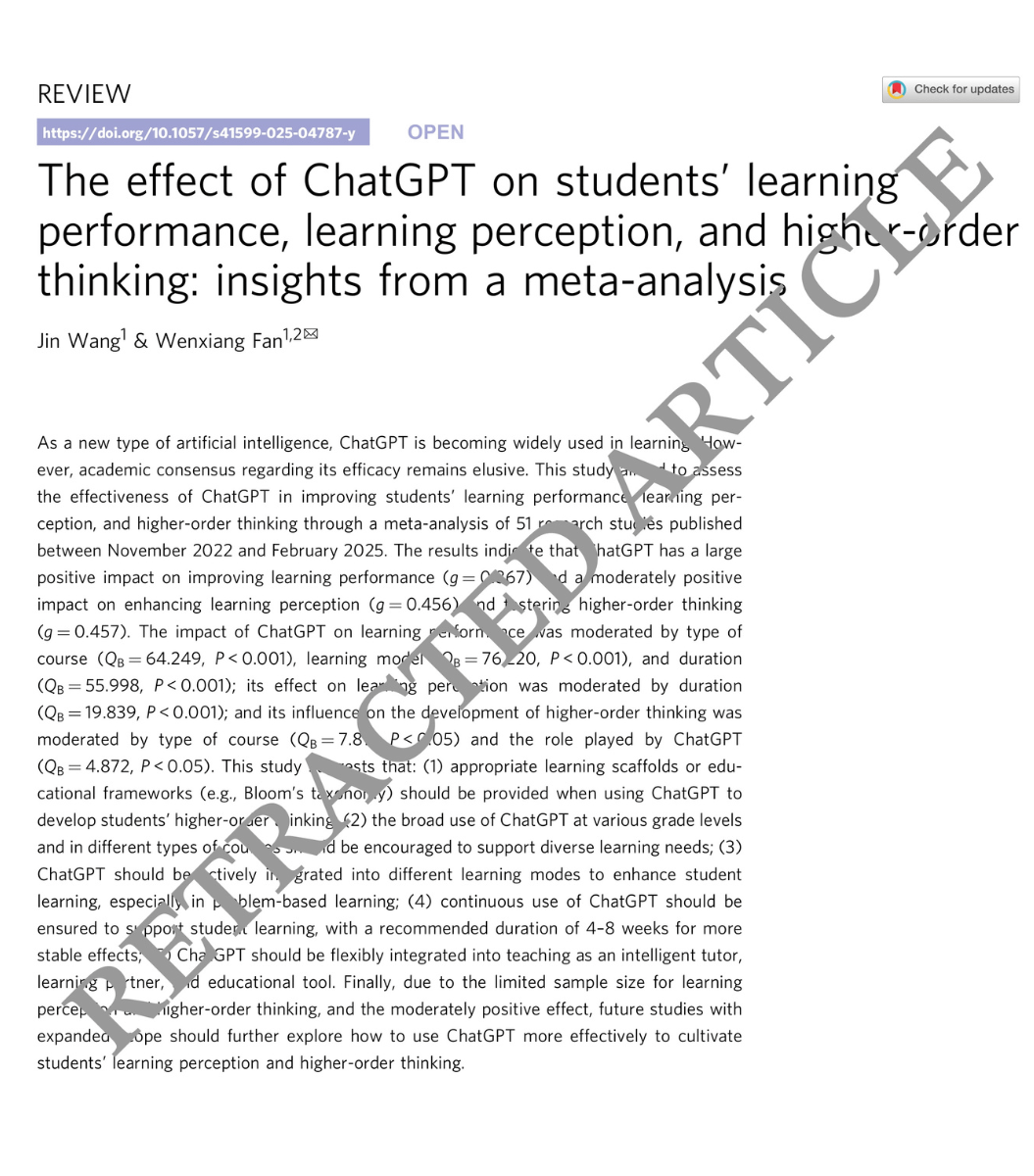
On April 22, 2026, the journal retracted it. The evidence was flawed. The conclusions were invalid.
The paper was titled "The effect of ChatGPT on students' learning performance, learning perception, and higher-order thinking." Published May 2025 in Humanities and Social Sciences Communications, a journal in the Nature Portfolio. The authors, Jin Wang and Wenxiang Fan of Hangzhou Normal University, synthesized 51 studies and concluded that ChatGPT had a "large positive impact on improving learning performance" and a "moderately positive impact on enhancing learning perception and fostering higher-order thinking."
Their recommendation was direct. ChatGPT should be "actively integrated into different learning modes to enhance student learning."
Schools listened. Edtech companies cited it. The paper ranked in the 99th percentile for online attention among academic articles.
Then two researchers at UiT Norges arktiske universitet, Magnus Ingebrigtsen and Marko Lukic, went through the meta-analysis line by line. They found a detail that should have ended the paper on the day it was submitted.
The most heavily weighted study in the analysis had already been retracted before Wang and Fan published theirs.
Nature let it through peer review anyway.
The Norwegians filed with Springer Nature's research integrity group in April 2026. The article was retracted five days later. The retraction notice reads: "The Editor has decided to retract this paper owing to concerns regarding discrepancies in the meta-analysis. These issues ultimately undermine the confidence the Editor can place in the validity of the analysis and resulting conclusions. The authors have not responded to correspondence regarding this retraction."
Ben Williamson at the University of Edinburgh, one of the first researchers to publicly flag the problem, put it plainly. "It really seemed like a paper that should not have been published in the first place."
Here is the part that should sit with you.
The retraction was quiet. The paper was viral. Williamson said the headline finding will likely keep circulating on social media, stripped of its methodological caveats, long after the correction.
Over 500 papers already cite this study. Those citations are now embedded in other research. Other conclusions. Other policy recommendations. The retraction does not reach backward. The flawed finding is already inside the literature, being cited by papers that do not know it has been pulled.
Meanwhile, the studies showing that AI reduces critical thinking, creates cognitive dependency, and degrades skills when removed have not been retracted. They keep replicating. Across MIT, Stanford, Zurich, and The Lancet.
The strongest evidence that ChatGPT helps students learn was pulled. The evidence that it hurts them still stands.
@greenrose121@ejquezada12@JaimeSaavedra22 Es porque le jornada única es un invento para igualar las jornadas laboral y escolar, pero no para aumentar el tiempo en familia, sino para reducirlo. Un sin sentido
A student submitted an essay she wrote by hand. Her university ran it through an AI detector. The detector said she cheated. She is autistic.
Her name is Moira Olmsted. Adelphi University. February 2026. Turnitin flagged her essay as 100% AI-generated. She was disciplined.
Two other AI detectors classified the same essay as human-written.
She sued. She won. The court called the school's decision "arbitrary and capricious."
She is not the only one.
In May 2026, a high school student in Palo Alto was expelled after an AI detector flagged his work. He faced visa revocation. He filed a federal civil rights lawsuit.
A researcher at Griffith University just proved mathematically why this keeps happening. The paper is on arXiv. The finding is one sentence.
AI text detectors have a structural flaw that no amount of better engineering can fix.
Here is what the math says.
If a university wants its detector to catch 80% of cheaters, at least 750 out of every 10,000 innocent students will be wrongly accused. That is not a software problem. It is a theorem.
If the university tries to limit false accusations to 1%, detection power collapses to 6%. It catches 6 out of every 100 AI-written papers. The other 94 get through.
There is no setting where the detector is both fair and effective.
The reason is diversity. Every student writes differently. Non-native English speakers use simpler vocabulary. Shorter sentences. Clearer structures. So does AI. A Stanford study found that 61.3% of TOEFL essays written by non-native English speakers were misclassified as AI-generated. A separate analysis tested 14 commercial detection tools. Zero out of 14 reached 80% accuracy.
The students most likely to be wrongly accused are non-native English speakers, neurodivergent students, and anyone who writes with clarity and precision. The qualities that make their writing effective are the same qualities the detector mistakes for a machine.
Vanderbilt University understood this. They disabled Turnitin's AI detection in 2023 after calculating that even a 1% error rate across 75,000 submissions would produce 750 wrongful accusations per year.
750 students accused of cheating for writing like themselves.
The paper's conclusion is not that we need better detectors. It is that the diversity of human writing itself makes accurate detection mathematically impossible.
The same thing that makes your writing yours is the thing that gets you accused.
https://t.co/L91ldtXP05
Welcome to the Public Domain SUMMER (1930)! ☀️🌻🐝🌴
This 2nd entry in the seasonal Silly Symphonies cycle was released in January, but we've saved it to mark the #SummerSolstice. 😎
👀 Watch the full short ➡️ https://t.co/OJqUnNNZbL
#Solstice#JuneSolstice#Disney#Animation #ClassicCartoons #VintageAnimation
"Este es el mundo en que vivimos,
estas las manos que recibimos,
usémoslas para tratar de hacer del mundo
un digno lugar para vivir"
https://t.co/G5onxoSV1t
A veces creo que las declaraciones de los presidentes colombianos son experimentos sociales para contrastar niveles de ignorancia. Estos creen que un laboratorio de robótica móvil es un conjunto de cajas con kits de marca propietaria sin interoperabilidad, o arduinos con sensores
¡Qué ignorancia!
los laboratorios de robótica son instalables no se necesita construir
Con razón este sectarismo ha llevado a tanta sangre y falta de educación pública en muchas regiones de Colombia