Used to be important news and opinion site dedicated to our heroic genetically modified mosquitos. Then they say GMM's figment of Vatnik drunkenness...
It's like they have a checklist in russian.
Stop USAID
"Dismantle" the ICC
Trash NATO allies, threaten Greenland and Canada
Fund right wing parties in Europe
Why would the Pentagon be involved in domestic political activities? Unless, of course, this is all more bullshit to fund and enable Trump‘s personal federal shock troops, the equivalent of Putin’s Rosgvardiya, and crack down on elections and any domestic opposition.
Shtilierman: The company’s goal is to help humanity avoid the Fermi paradox and not destroy itself as a civilization.
Russia stands in the way. It fuels war and confrontation to keep Europe from living in peace.
2/
Fire Point co-founder Shtilierman: When Russia enters a territory, it kills at least 20% of the population.
It happened in the Holodomor, the Baltics, western Ukraine, and Chechnya. If they come here, they will cut down 20% as “prevention.”
1/
@LetsArmUKR All democratic countries that support Ukraine should immediately freeze all funding to the IOC until they reverse their decision to allow russian athletes to return to competition! They should also consider boycotting the Olympic Games until they kick the russians out!
The ITTF just folded like wet paper, letting Russian athletes compete under their flag and anthem from July 28. IOC said jump, they asked how high. This isnt sports neutrality. Its another Western institution laundering Kremlin normalization while Ukrainian cities still eat missiles.
Every time we pretend "culture" or "athletes" are separate from the imperial machine, we signal weakness. Moscow loses 35k per month on the front, burns its rear daily to our strikes, yet gets Olympic rehab. The only language they understand is decisive military defeat. Everything else is theater that buys them time.
If Putin or anyone like him stays in power, the only way Russia will survive is as a Chinese vassal state, increasingly repressive internally and used as a resource depot and Xi's puppet on the world stage. Russia's disintegration is the more attractive option for the free world.
Fire Point co-founder Shtilierman: The small goal is to destroy the Russian Empire.
Russian empire is the last empire on Earth. As long as it exists, Ukraine will stay poor and unattractive for investment.
1/
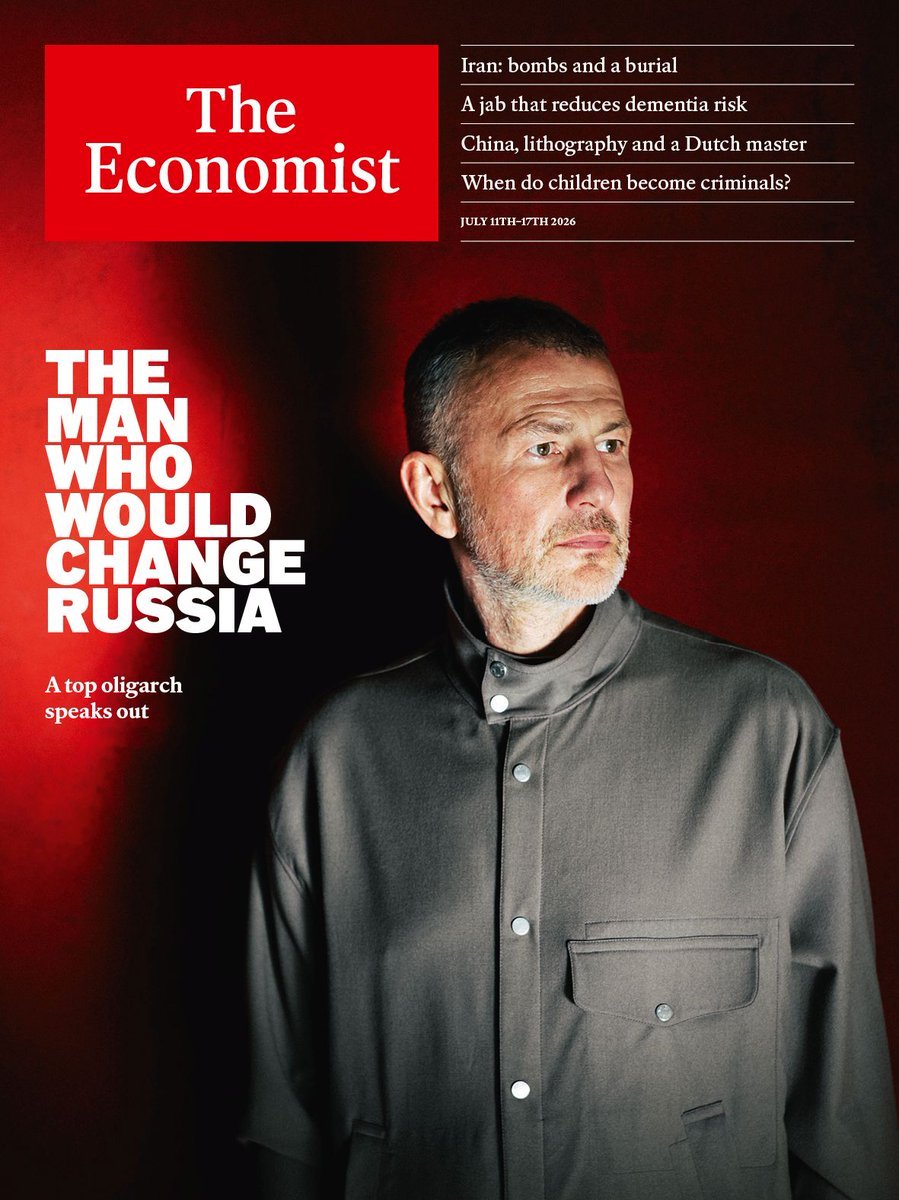
It is astonishing that @TheEconomist expects us to believe this interview wasn’t pre-approved by the Kremlin.
Also, “Russia’s most enigmatic oligarch”? Really? Melnichenko is a key member of the Kremlin-linked business elite, not some mysterious outsider. Stop romanticizing him.
@alex_kokcharov@TheEconomist cannibalized by warlords.
With the West freezing his assets and superyachts, he has nowhere left to run. That's why he's suddenly doing massive media interviews, desperately trying to pitch a post-war system that protects elite property rights before the ship sinks.
2/
@alex_kokcharov@TheEconomist Melnichenko is a ruzzian oligarch who is merely trying to save his own arse & fortune.
If ruzzia collapses, the consequences for these billionaires will be catastrophic. They'll lose their Kremlin protection, their sweet state deals, and their domestic assets will be
1/
I finally collected my thoughts on Melnichenko's essay in last week's issue of @TheEconomist .
Melnichenko claims to offer a pragmatic warning about the dangers of a weakened Russia, but his core argument rests on a massive logical fallacy: it completely divorces Russia’s current instability from the exact Kremlin policies that created it. It treats Russia's predicament as if it were the weather or some other natural phenomenon, rather than the direct result of Putin's actions over the 26 years of his rule.
By framing Russia's internal and economic fragility as abstract geopolitical risks, the essay conveniently omits the principal drivers of its isolation: the full-scale invasion of Ukraine, the ongoing occupations in Georgia and Moldova, and the systematic dismantling of domestic freedoms and rights.
Here are the three major flaws in this "geopolitical realism" approach:
- The essay ignores Ukrainian agency: It treats Ukraine as a passive chessboard for a superpower showdown, entirely ignoring that Ukrainians are sovereign actors who have repeatedly chosen their own political future through elections, mobilisation, and fierce resistance.
- The essay recycles Kremlin narratives: It subtly shifts the blame away from Kremlin's ongoing aggression abroad and repression at home and onto Western policies, implicitly arguing that European security depends on accommodating Russia's revisionist demands.
- The essay is based on analytical asymmetry: It treats Russia’s violent behaviour as an unchangeable, fixed constraint while demanding that the choices of Ukraine and the West be the variables that must bend.
Ultimately, this perspective doesn't analyse the crisis - it normalises it by ignoring the root causes. I honestly have no idea why The Economist chose to provide a platform for Melnichenko’s - or the Kremlin’s - voice.
So @TheEconomist, are you interested in journalism or are you stopping here with Kremlin propaganda, in which things will be fine if Europe keeps appeasing Russia & Ukraine is irrelevant? Talk to @khodorkovsky_en about why Melnichenko could never say a word Putin didn’t approve.
“This has not been a peace process. It has not even been appeasement. It has been the US throwing its power on Russia's side in a war of aggression.”
Timothy Snyder
Every new statement about “dismantling” @IntlCrimCourt is far more than just another political message. It signals a willingness to call into question the very system of international criminal justice, which has been built over decades through the tremendous efforts of states, lawyers, diplomats, and civil society. Yes, the decisions of the #ICC may be open to debate. Yes, certain approaches or individuals may be subject to entirely legitimate criticism. But disagreement with particular decisions should not turn into calls to dismantle an institution established to investigate the gravest #InternationalCrimes. International criminal justice has never been perfect. Yet its development has been one of the most significant achievements in international law since the Second World War. The world should unite around strengthening and improving the mechanisms of international justice, rather than around the idea of dismantling them.
https://t.co/Aoibh11QJh
Beijing is cultivating officials and elites across Russia who will shape the country after Putin, extending its reach far beyond the Kremlin, per WSJ.
Mid-level Russian officials have also drawn growing Chinese espionage attempts. Moscow is holding back from raising them with Beijing, wary of straining the relationship.
For years, I’ve argued that Russia wasn’t moving forward, it was moving back.
Back towards the USSR.
Step by step, the Kremlin has expanded state control, dismantled freedoms, militarised society and revived many of the instincts of the Soviet system.
Now comes another warning sign.
Moscow is reportedly considering the return of Soviet-style exit visas, meaning Russians could once again require state permission to leave their own country. Officially, it’s about “protecting citizens abroad.” In reality, it appears far more likely to be about preventing talent, wealth and dissent from walking out of the door.
I’ve written for years that Putin’s Russia isn’t simply authoritarian; it is steadily recreating many of the mechanisms of the Soviet state, led by a political elite who came of age and built their careers during that era, only now adapted for the 21st century.
If this proposal becomes law, it won’t just restrict travel. It will mark another milestone in Russia’s long journey back behind a self-imposed Iron Curtain, reinforcing a trend I first began writing about years ago.
Worth keeping an eye on.
For Putin, a ceasefire is a tool to win the war politically. Freeze the front, rebuild the army, break Ukraine's ties with Europe, then strike again.
He did exactly this after Minsk in 2014. — Michael Kimmage & Hanna Notte, Foreign Affairs.
1/