Want to know what the SpaceX IPO is actually about?
Just ask D0: "Write me a SpaceX IPO report."
It reads the full 287-page roadshow deck for you, pulls from the S-1, CNBC, Reuters and Bloomberg, and gives you the answer in seconds: the valuation, the seven business segments, the catalysts, and everything before the June 12 listing.
No more reading hundreds of pages yourself. Just ask D0.
Everything on $SPCX before it lists, in one ask.
Lately, while juggling investment research and on-chain trading, the biggest source of fatigue for me has been the "fragmented environment." Even after reading through hundreds of pages of whitepapers or corporate financial reports to find meaningful metrics, constantly switching between DEXs, wallets, and chart analysis tools often caused me to miss crucial timing.
Recently, however, I came across a solution that completely shifted the paradigm of my workflow. It’s a project that goes beyond simply "viewing" the internet, seamlessly connecting research and immediate execution into a single, cohesive flow.
What impressed me the most was how it handles massive amounts of financial data. By simply uploading complex investment prospectuses or market analysis reports, its AI extracts hidden risks and core metrics in just a matter of minutes. The information discovery process—which would have previously kept me wrestling in front of a monitor all day—has become incredibly streamlined. It feels like the noise is cleared away, leaving only the insights that truly matter.
What’s even more surprising is the experience of taking action based on these insights. I could execute transactions instantly within the environment itself, without the hassle of copying addresses, switching apps, or signing multiple transactions across different platforms. From interpreting real-time market data to interacting with smart contracts, the user's intent translates directly into action without any friction.
Sitting quietly in front of my monitor analyzing the market after work, I can really feel how complex ideas in my head materialize into tangible results.
Ultimately, in a market exploding with data like today's, a true edge comes down to who can understand and act on information faster than anyone else. It seems we are entering an era where the web browsing experience itself becomes a powerful weapon. If you are seriously diving into the Web3 ecosystem and investing, you should definitely keep an eye on the new opportunities this technological evolution will create.
@DonutAI@GigiWillliams
Lately, as I’ve been diving deep into the intersection of blockchain and AI, I realized I’ve been looking in the completely wrong place.
We tend to obsess over the flashy things in the spotlight. We celebrate surface-level metrics like "how much did TPS increase?", "which chain is the fastest?", or "how smart is this new AI model?" But the true deciding factor of a system's success always lies in the invisible infrastructure behind the scenes.
Particularly in an onchain environment, Latency is not just about perceived speed. It is strictly a matter of power and capital. It’s a battle over who gets the data 0.001 seconds faster, who reacts first, and who ultimately captures the market edge. As autonomous AI agents fully enter the market, this competition will only intensify. For AIs that think and act at machine speed, today’s heavily bottlenecked networks are nothing but a frustrating shackle.
Ultimately, the key to enabling AI agents isn't just the intelligence of the models themselves. It's the Memory and Data Fluidity that allow that intelligence to sense its environment in real-time and execute actions instantly.
This is exactly why I've found myself completely captivated by @get_optimum recently.
Instead of forcibly overloading the main network to squeeze out a bit more speed, they are fundamentally altering the architecture of data transmission. Through RLNC technology—which shards messages and instantly recombines them—they can seamlessly recover and deliver information without even needing the complete data to arrive first.
Optimum doesn't try to be the flashy main character. Instead, they quietly take on the role of a "Memory Guardian," ensuring that massive decentralized systems don't collapse and that the arteries of information never clog.
True innovation is often invisible. The era of onchain AI can only truly begin once this robust, high-performance memory layer is established. Optimum is building the foundation for that future—quietly, but with absolute certainty.
@CryptoSundayz@cryptooflashh@aqccapital@sajidazouarhi
Let's be honest. If you're in the crypto market, you've probably experienced hitting the buy button at the perfect time, only to watch your profits vanish before your eyes due to network delays.
We always expect instant and seamless transactions, but in reality, blockchains bottleneck the moment traffic spikes. While nodes take forever to verify blocks, fees skyrocket and user frustration peaks. Aren't we all a bit tired of the "scalability limitations" excuse?
Ultimately, the root of all these problems comes down to how quickly and efficiently data propagates across the global network. This is exactly why I've been diving deep into a project called @get_optimum recently.
How Optimum is Changing the DNA of Blockchain
Optimum isn't just offering a flashy, superficial fix. They are fundamentally rewiring the deepest layers of the network.
- Building a Data Highway: They reduce unnecessary bandwidth waste and push data transmission speeds between nodes to the absolute limit.
- Zero-Lag Consensus: With reduced latency and faster block delivery, frustratingly slow transaction confirmation times are a thing of the past. It enables the network to seamlessly handle massive numbers of users and transactions without flinching, even during heavy traffic.
But what truly impresses me isn't just the product itself—it's the engineering team tackling this incredibly daunting challenge.
The People Building the Foundation Behind the Scenes
It's easy to get caught up in the flashy exterior of a project, but the true competitive edge of infrastructure lies in the technical prowess of its team. Efficiently moving massive amounts of data on a global scale isn't just about being good at coding. It requires a deep, masterful understanding of distributed systems, networking, and data architecture.
The sheer dedication of the Optimum team—quietly grinding away at backend optimizations that most users will never even notice—deserves immense respect.
A New Paradigm for Block Space
The consistent, low-latency data delivery environment Optimum is building is far more than a simple "performance upgrade." If they succeed at scale, block space—which has long been a symbol of volatility and delays—will finally evolve into a predictable, stable, and tradable asset.
This is a massive endeavor that could fundamentally restructure the entire blockchain market, extending far beyond a single ecosystem. I am incredibly excited to see their next steps.
@sajidazouarhi
Honestly, isn't crypto trading exhausting these days? Checking charts, refreshing your Twitter (X) feed, digging through research platforms... With dozens of browser tabs open, bouncing back and forth, you usually end up missing the actual entry setups. The friction and fatigue from this fragmented Web3 environment is real.
I recently found a tool that finally stopped this endless "tab switching," and it's @DonutAI (D0).
Usually, I'm pretty hesitant about AI trading bots because they feel like a sketchy "black box" where you have no idea what's going on under the hood, but this one is different. You just use plain language, and it automatically connects you to over 200 tools.
It's so reassuring because even while I'm asleep, its "Agentic Loop" ( Alert - Analyze - Execute - Contro ) is running 24/7. From grasping market trends to executing 150x leverage, I can do it all in one place while staying entirely in charge.
Plus, right now, they're running a promo where you get double the monthly credits on D0 and D0 Pro plans for the exact same price. Thanks to that, I don't have to ration my credits and can really dive deep into market intelligence.
If you hate complicated setups and just want to get your trading done cleanly in one place, I highly recommend giving it a shot right now. It definitely gives you so much more clarity in the market.
@GigiWillliams
X 시작 80일 차, 팔로워 곧 15,000명 달성.
엑스가 돈이 된다는 말을 듣고 3월 23일 시작했습니다.
3개월도 채 되지 않아 팔로워 15,000명을 달성했고, 지금까지 발생한 수익은 약 740만 원 정도 되네요. 이 수익은 제 빚 8천만 원을 갚는 데 사용했습니다ㅠ
항상 제 글을 읽어주시고 공감해 주시는 분들 덕분입니다.앞으로도 더 많이 소통하겠습니다.
진���으로 감사드립니다
그리고 가끔 제 글을 보고 “실행할 용기를 얻었다”, “동기부여가 된다”는 이야기를 들을 때가 있는데, 그럴 때마다 정말 기분이 좋네요.
앞으로도 함께 성장해 나갔으면 좋겠습니다.
Where is the Real Bottleneck in Blockchain? ePBS and Optimum
We shouldn’t get blinded by flashy metrics like TPS or the launch of shiny new chains. As liquidity and users flood onchain, the real question we must ask is: "Can the underlying infrastructure actually handle this weight?" At its core, every transaction is just data moving. If data can't travel efficiently, even the most brilliant architecture becomes useless.
ePBS: A True Solution or Just a Band-Aid?
The headliner for Ethereum’s next major upgrade (Glamsterdam) is ePBS (Enshrined Proposer-Builder Separation). It aims to scale the network by bumping gas limits and blob sizes by restructuring slot deadlines.
- The Current Issue: A block must be selected, proposed, propagated, and attested within a tight 4-second window, causing massive bandwidth bottlenecks as block sizes grow.
- The ePBS Fix: It decouples the block. Validators only need to receive the consensus block (a cryptographic commitment) within 4 seconds. The heavy execution payload and blob data are then propagated separately, utilizing the remainder of the 12-second slot.
While it's a clever design, let’s be realistic: this isn't a cure for the bandwidth bottleneck. It’s just buying time—a strategic sidestep. To unlock serious throughput and shorten slot times, we need to fundamentally change how fast data moves across the network.
When block propagation lags, validators end up building on outdated information. This leads to competing blocks, frequent reorgs, and delayed consensus. This is exactly why I'm watching projects like Optimum (@get_optimum). Instead of taking the easy route of launching yet another L2/L3 chain, they are fixing the foundational network layer.
Optimum’s Random Linear Network Coding approach propagates Ethereum blocks with ultra-low latency. Crucially, it doesn't slow down as block sizes increase or as the network grows more decentralized.
The Outcome: Better synchronization > Fewer reorgs > Stronger consistency > Maximum L1 scalability.
Most users will never think about how nodes communicate, but this invisible infrastructure is what makes mass adoption possible.
True progress isn't always about creating something brand new; sometimes, it’s about making the existing foundation unbreakable. The ultimate path to L1 scaling begins with the fastest flow of information.
𝐞𝐏𝐁𝐒, 𝐬𝐥𝐨𝐭 𝐭𝐢𝐦𝐢𝐧𝐠𝐬, 𝐚𝐧𝐝 𝐬𝐜𝐚𝐥𝐢𝐧𝐠 𝐚𝐩𝐩𝐫𝐨𝐚𝐜𝐡𝐞𝐬
Ethereum is targeting Q3 for the next major upgrade, Glamsterdam. ePBS is the headliner, restructuring the deadlines within a slot to allow for larger blocks (higher gas limit & more blobs).
In the current slot structure a block has to be selected, proposed, propagated and attested to by the network in under 4 seconds. Increasing block size means more data has to reach nodes in the same short amount of time, and you run into bandwidth constraints.
ePBS buys more time for data propagation by separating blocks into the consensus block, execution payload, and blobs, and changing the deadlines for when those different parts of the block need to arrive.
Instead of the entire block needing to reach validators before the 4 second mark, they only need to receive the consensus block- a cryptographic commitment to a certain block & set of blobs. They make their attestation without receiving the execution payload, then have the remainder of the slot to receive that payload and verify it. Blob data is propagated separately giving nodes the full 12 seconds to receive it.
This scheme makes it easier to increase the gas and blob limits, which is good for some additional scaling. However, it's more of a sidestep than a true solution to the bandwidth bottleneck.
If you want to unlock serious throughput gains you need to improve how fast and efficiently data can move across the network. That's the key to increasing block size while ALSO shortening slot times.
Removing the bandwidth bottleneck means fundamentally upgrading the way data moves across Ethereum. Optimum's Random Linear Network Coding approach propagates Ethereum blocks with lower latency AND in a way that won't slow down as the size of blocks increase, OR as the network becomes larger and even more decentralized.
Scale the L1.
Watching the AI market lately, it feels like everyone is obsessively focused on who can build the most massive model. But if we just keep scraping and training on the same recycled internet data, will we ever create an AI that truly understands our lives?
What really hit me like a wake-up call recently at Consensus 2026 (Solana Accelerate AI) in Miami wasn't some lofty, hype-filled vision—it was the quiet, grounded path @getoro_xyz is taking.
While everyone else is fighting over the same scraps of public data, ORO is looking somewhere entirely different: real people's everyday lives, voices, and raw health data straight from wearables. The fact that they already have over 600,000 contributors voluntarily delivering more than 11 million structured health data points every single month is honestly mind-blowing. This isn't just a statistic; it's the absolute perfect foundation for AI to genuinely understand human behavior and health patterns.
What really draws me to ORO amidst this massive technological shift is how it makes you tangibly feel that "the control over my data belongs to me."
Up until now, we've essentially been handing over our daily lives to Big Tech for free. The ORO ecosystem flips that script. Your actions and data are transparently protected, and you are tangibly rewarded for your contributions, complete with staking incentives. You don't just remain a passive user; you actually get to help shape the project's direction through governance voting, and you hold early access rights to experience new Web3 AI tools and services before anyone else.
I am convinced that the future of AI supremacy won't be decided by the sheer size of a model, but by who can secure the most ethical, overwhelmingly high-quality human data.
Stepping out of the spectator's seat, watching your everyday data become the raw material for real innovation, and actually getting that value returned directly to you - that’s exactly why I can't take my eyes off ORO's next moves.
Every click, search, and interaction we make is training Big Tech's AI. But why aren't we getting rewarded for it?
Who is your data actually working for?
Legacy digital platforms collected user data in centralized servers and used it for free to improve their products. ORO flips this outdated structure, proposing a new AI economic ecosystem where 'your data works for you.'
1. Complete Control & Fair Rewards
Instead of your info being collected without transparency, ORO lets you dictate 'what data to share and who gets access.' More importantly, when your data contributes to AI development and creates value, you directly receive a fair economic reward.
2. zkTLS & TEE: Ultimate Privacy, Zero Raw Data Exposure
Worried about your sensitive info getting leaked in exchange for rewards? ORO sends your data straight into 'Secure Vaults.'
zkTLS: Verifies the authenticity of information without revealing a single drop of the underlying raw data.
TEE (Trusted Execution Environments): Processes computation only in perfectly isolated, tamper-proof environments.
As a result, no human, platform, or node operator can ever see your 'raw data.' Only verified computations happen safely inside the vault.
3. Greater Protection = Higher Data Value
ORO's strict privacy protection prevents your data from being replicated without permission. By preserving its 'scarcity' and 'integrity,' your data retains a much higher economic value in the market.
Until now, we've basically been free volunteers training AI for mega-corporations. But the infrastructure ORO is building is completely redefining 'digital ownership' based on participation, consent, and privacy.
Far more than just a platform, we need to keep a close eye on how @getoro_xyz will rewrite the rules of the future AI data economy!
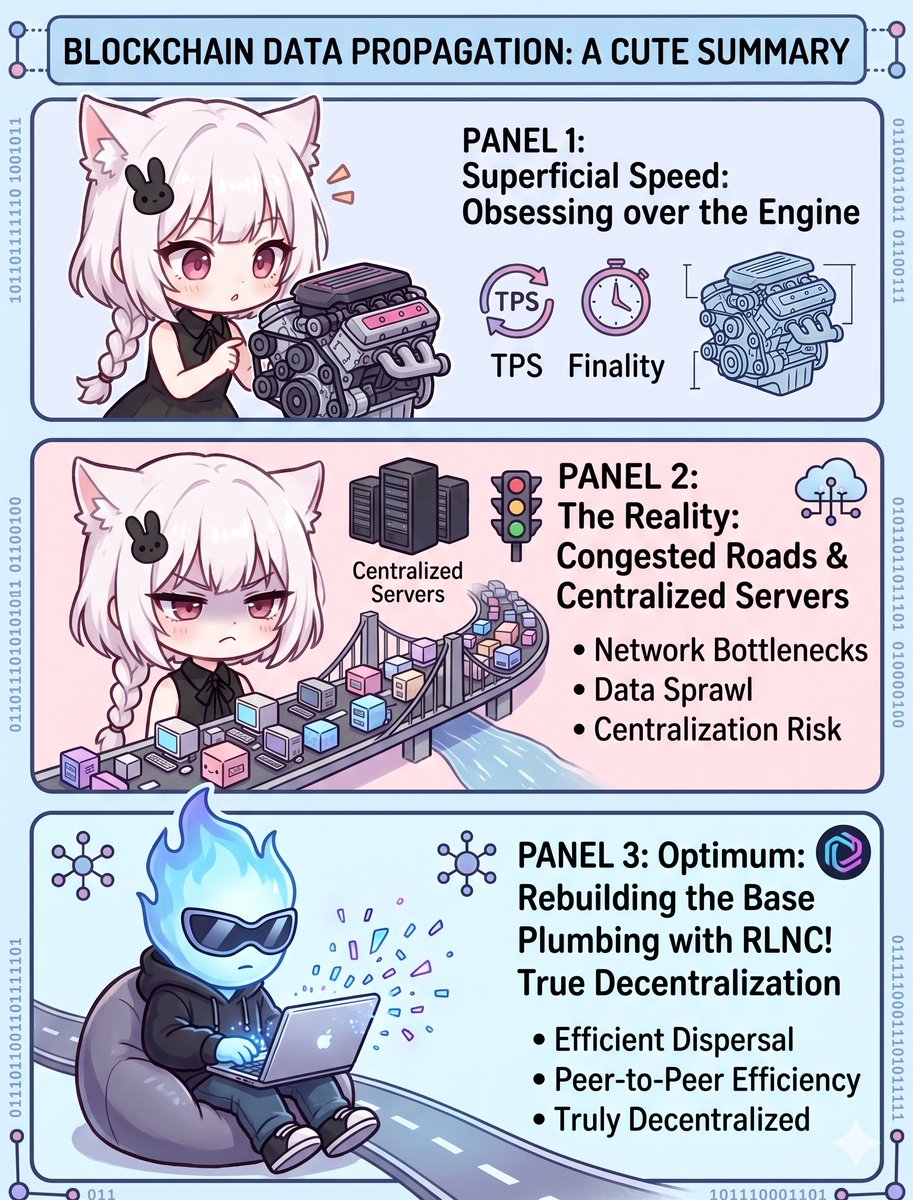
While everyone is obsessing over "supercar engines," some people are rebuilding the "highways."
Looking at the crypto scene lately, everyone seems fixated on "inner-network" mechanics like consensus algorithms, execution speeds, and Data Availability (DA). But there's a real bottleneck we are constantly overlooking: the physical time it takes for data to fly across the globe.
Take Solana, for example. Its speed is truly phenomenal. A single slot is a mere 400ms. But this incredible speed actually trips it up. Just the "propagation" process—where a leader produces a block and broadcasts it to the network—eats up over 100ms of that tight window.
As a result, delays happen. Nodes start receiving blocks late, and some miss them entirely. So, what do validators do to shave off even 0.1 seconds of delay? They end up flocking to the exact same data centers, getting as physically close to the leader as possible. Paradoxically, a system built for decentralization regresses into a perfectly centralized server room just to keep up with its own speed.
No matter how powerful the engine (the blockchain) is, it is useless if the roads the information travels on (communication infrastructure) are congested.
This is exactly why I've been keeping a close eye on @get_optimum lately. Instead of launching yet another shiny new chain, they are completely overhauling the base plumbing that every network shares: data propagation itself.
Their approach is incredibly smart. They aren't just clumsily tossing around heavy, full-block copies like before. By leveraging RLNC (Random Linear Network Coding) technology, they propagate coded fragments of data. This means nodes can gather useful data much faster, regardless of where they are physically located on Earth. Without the need to cluster in specific, expensive data centers, true decentralization becomes possible again.
The greatest infrastructure is often invisible. Users probably won't even realize this tech is running under the hood. They'll just notice the result: "Wow, the network is so much faster and more stable."
When everyone is distracted by flashy features and top-speed competitions, it's this kind of invisible, foundational work that truly pushes the entire ecosystem forward. That is real innovation.
The Evolution of Blockchain
Building a 'Perfect Road Network' Rather Than a 'Faster Car'
In the quest to boost blockchain performance, we have thus far obsessed over building 'faster cars' (hardware). However, as massive networks like Solana and Ethereum expand, the true bottleneck emerges elsewhere. The challenge has shifted from how fast blocks are produced to 'how quickly and reliably that information is propagated' to countless nodes.
Instead of forcing validators into exorbitantly expensive server upgrades, @get_optimum presents an entirely different solution: laying an invisible, 'ultra-fast fiber optic pipeline' directly beneath the existing blockchain highway.
At the heart of this innovation lies mump2p and RLNC (Random Linear Network Coding) technology. It abandons the traditional, fixed transmission model that passively waits for complete data delivery. Instead, it empowers network nodes to flexibly fragment, recode, and forward data, allowing the network itself to carve out optimal routing paths. As a result, latency seemingly evaporates, and the network boasts unwavering resilience even in the face of packet loss.
The shifts brought about by this sub-surface innovation are clear:
Validators: No longer need to pour massive capital into unreasonable hardware upgrades, dramatically reducing the risk of node failure.
Users: Experience a seamless, lag-free dApp environment, instantly ready to accommodate the influx of millions of new users.
Having already proven its overwhelming efficiency on the Ethereum testnet, @get_optimum's vision is more than a mere technical upgrade. It serves as a crucial milestone, demonstrating that the future of high-performance blockchains lies not just in 'production speed,' but in achieving the 'most flawless flow of data.'
Finding Your Perfect Calm in a Crazy Market
The world moves fast, and the markets fluctuate day and night. But your daily life doesn't need to get swept up in all that chaos!
Instead of staring at screens with tired eyes, we believe in the magic of a warm cup of coffee and good company. After all, the best ideas and true innovations don't spark over glowing red and green charts—they happen in real conversations and genuine connections.
So, go ahead and quietly leave the fast-paced market tracking to D0 @DonutAI .
Whether you're laughing and sharing ideas with friends, or catching some well-deserved sleep while the rest of the world is quiet, your trusty AI partner is on it. D0 stays perfectly synced with the market, quietly and flawlessly catching every opportunity for you.
No more stressing over endless charts.
Just smart, hassle-free decisions.
Let the AI crunch the cold, complex data. You just focus on connecting with the community and dreaming up a better tomorrow.
Don't trade harder. Live your life a little more beautifully.
@GigiWillliams
The Evolution of Blockchain
Building a 'Perfect Road Network' Rather Than a 'Faster Car'
In the quest to boost blockchain performance, we have thus far obsessed over building 'faster cars' (hardware). However, as massive networks like Solana and Ethereum expand, the true bottleneck emerges elsewhere. The challenge has shifted from how fast blocks are produced to 'how quickly and reliably that information is propagated' to countless nodes.
Instead of forcing validators into exorbitantly expensive server upgrades, @get_optimum presents an entirely different solution: laying an invisible, 'ultra-fast fiber optic pipeline' directly beneath the existing blockchain highway.
At the heart of this innovation lies mump2p and RLNC (Random Linear Network Coding) technology. It abandons the traditional, fixed transmission model that passively waits for complete data delivery. Instead, it empowers network nodes to flexibly fragment, recode, and forward data, allowing the network itself to carve out optimal routing paths. As a result, latency seemingly evaporates, and the network boasts unwavering resilience even in the face of packet loss.
The shifts brought about by this sub-surface innovation are clear:
Validators: No longer need to pour massive capital into unreasonable hardware upgrades, dramatically reducing the risk of node failure.
Users: Experience a seamless, lag-free dApp environment, instantly ready to accommodate the influx of millions of new users.
Having already proven its overwhelming efficiency on the Ethereum testnet, @get_optimum's vision is more than a mere technical upgrade. It serves as a crucial milestone, demonstrating that the future of high-performance blockchains lies not just in 'production speed,' but in achieving the 'most flawless flow of data.'