Nigerians pay attention ooo! 🇳🇬
Nigeria is rising. My hope is that you rise with it. Stop listening to empty-headed Agulu and cashtivists. If you ignore the opportunities ahead, foreigners will seize them, leaving you destitute in your own country.
“For the first time, Nigeria’s economy grows higher than her population..” Emir Sanusi
“I grew from $4b in 2023 to over $40b in 2026….” Nigeria’s NET External Reserves
“Through NELFUND, indigent students can now acquire university education without worrying about immediate payment of school fees or upkeep allowances….”-STUDENTS
“Inflation is down from 30% in 2023 to 15% in 2026 despite Mideast unrest…”
“Nigeria’s economic growth is steady…”- World Bank
“Our partnership with Nigeria has helped to reduce insecurity in Nigeria…” President Trump
“Lagos-Calabar Coastal Highway and Sokoto-Badagry Superhighway will connect Nigeria economically and politically….”
“No state in Nigeria owes Workers Salaries again…”
“We don’t borrow to pay salaries or do infrastructures again…”- Governors
This is too much!!!!
“Continuity Tinubu Continuity Tinubu 🙌”
LOVE LETTER TO THEE - OH YE EKUKES
When Election again beckons, bear in mind the following, or even put upon the tablets that they may never escape your mind...
1. The Church will not baptize you President. So you can as well tell the cardinal to spare himself the efforts. If it failed in 2023 when the Church was commanded to "take back their country", it will not succeed now when the church had since realized your deception.
2. The Mosque will not declare your Shahada into Presidency.
3. Your tribe will not christen you President.
4. The theatrics of pseudo-humility - carrying one bag, flying economy, wearing one singlet, and recycling one boxer, cutting grass - will not deceive everyone into electing you President.
5. Insults, curses, and slander will not bully your way into the Presidency.
6. A mob of arsonists, anarchists, rebels, uncultured irritants, coup-craving bandits, and nattering nitwits will not blackmail the Nation into making you President.
Etc…
To be President, you will need the embrace of all faiths - including the ancestral; the trust of all tribes - including the so-called minorities; and the confidence of all citizens - especially the sane, the strategic, and the sensible, not a litter of underfed ekukes (ill-bred dogs).
Above all, you will need a track record of performance, achievments, and bold leadership, not the childish rhetoric of sending citizens to verify acute barrenness and chronic failure.
Good Afternoon Severally... Awa na lo shi kan...
How can a bishop be Parisian? —This pastor just exposed how Cardinal Onaiyekan and other fake pastors failed in the last election 🔥🙆👇
Sunday sermons for Obidiot Bishop 🔥
FOR YOUR URGENT ATTENTION
Dear Mr. Peter Obi @PeterObi
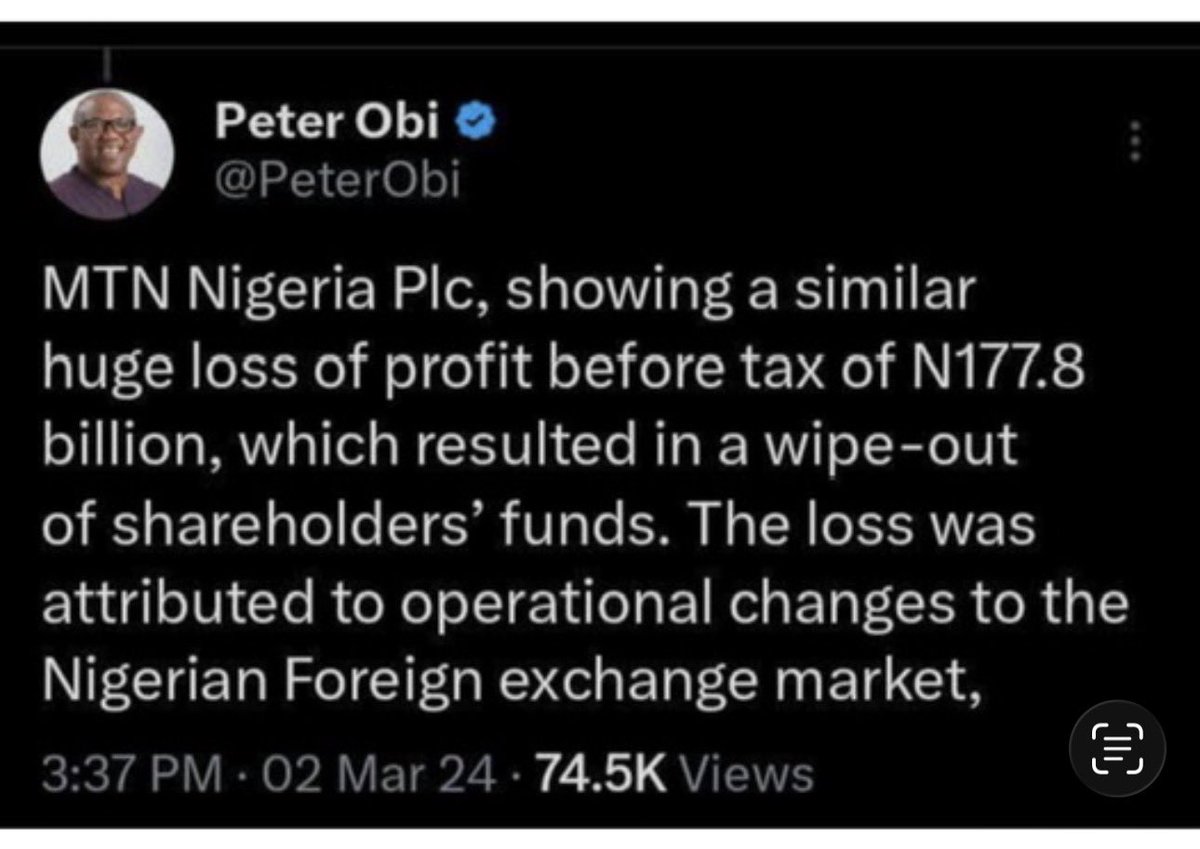
MTN indeed reported a PAT loss of about N400 Billion in 2024, You quoted PBT of N177.8 Billion - a figure consistent with the storm of that season, a season when the bold, radical, and revolutionary reforms of this government were still clearing the debris before laying the foundation.
The same MTN however posted a PAT of N1.11 Trillion in 2025, a magical, consequential, momentous turnaround from major loss to record profit.
Even in 2026, MTN has already reported H1 PAT of whooping N707.5 Billion, which is about 70.6% YoY increase, again, of course, largely on the back of the consistent, decisive, and coordinated economic stewardship of the Tinubu-led government.
But MTN Nigeria is not the only enterprise whose fortunes have responded favorably to Asiwaju's Midas touch - The List, my friends, is endless....
Now, Shall I Begin?
Dangote Cement: 2024 PAT — N503 Billion. 2025 — N1.015 Trillion. +102%
Aradel Holdings: 2024 PAT — N259 Billion. 2025 — N757 Billion. +192%
Lafarge Africa: 2024 PAT — N100 Billion. 2025 — N273 Billion. +173%
Nestlé Nigeria: 2024 PAT (LOSS) — N165 Billion. 2025 PAT — N105 Billion. +164%
Bold and revolutionary reforms are, in their infancy, painful - sometimes so painful they appear hopelessly needless. it is the bitter medicine that drives out the sickness - but bitterness on the tongue is precisely why most leaders flee to the sweeter, easier, populist road.
They are not confident the reform will bear fruit before the next campaign harvest, and no man wants to plant a tree he fears he will not live to sit under. They gamble their conscience for their comfort. They trade our collective good for the convenience of the ballot.
But the fellow we have in the Villa is no ordinary leader. He is irrational - gloriously, dangerously irrational. He is the kind of man who stakes his own political life for a harvest he may never personally taste.
Let me stop here for now.
Oh! Lest I forget:
MTN Nigeria by the way, which Peter hurriedly journeyed naked to the market celebrating their loss as a cheap political point against the government, recorded a turnaround of 377.9% between 2024 when you raised the mockery alarm and 2025 when the Tinubu Administration bold reforms finally settled.
Peter was loud when the company bled. Curious, then, that he has gone silent now that every enterprise is belching profit instead.
The season for rejoicing is not the season one chooses for mourning. Yet here we are - the melody has changed, and you have shamelessly misplaced your voice...
Good Afternoon Severally...
For broader analysis Egbon:
MTN indeed reported a PAT loss of about N400 Billion in 2024, Peter quoted PBT of N177.8 Billion - a figure consistent with the storm of that season, a season when the bold, radical, and revolutionary reforms of this government were still clearing the debris before laying the foundation.
The same MTN however posted a PAT of N1.11 Trillion in 2025, a magical, consequential, momentous turnaround from major loss to record profit.
Even in 2026, MTN has already reported H1 PAT of whooping N707.5 Billion, which is about 70.6% YoY increase, again, of course, largely on the back of the consistent, decisive, and coordinated economic stewardship of the Tinubu-led government.
But MTN Nigeria is not the only enterprise whose fortunes have responded favorably to Asiwaju's Midas touch - The List, my friends, is endless....
Now, Shall I Begin?
Dangote Cement: 2024 PAT — N503 Billion. 2025 — N1.015 Trillion. +102%
Aradel Holdings: 2024 PAT — N259 Billion. 2025 — N757 Billion. +192%
Lafarge Africa: 2024 PAT — N100 Billion. 2025 — N273 Billion. +173%
Nestlé Nigeria: 2024 PAT (LOSS) — N165 Billion. 2025 PAT — N105 Billion. +164%
Bold and revolutionary reforms are, in their infancy, painful - sometimes so painful they appear hopelessly needless. it is the bitter medicine that drives out the sickness - but bitterness on the tongue is precisely why most leaders flee to the sweeter, easier, populist road.
They are not confident the reform will bear fruit before the next campaign harvest, and no man wants to plant a tree he fears he will not live to sit under. They gamble their conscience for their comfort. They trade our collective good for the convenience of the ballot.
But the fellow we have in the Villa is no ordinary leader. He is irrational - gloriously, dangerously irrational. He is the kind of man who stakes his own political life for a harvest he may never personally taste.
Let me stop here for now.
Oh! Lest I forget:
MTN Nigeria by the way, which Peter hurriedly journeyed naked to the market celebrating their loss as a cheap political point against the government, recorded a turnaround of 377.9% between 2024 when Peter raised the mockery alarm and 2025 when the Tinubu Administration bold reforms finally settled.
Peter was loud when the company bled. Curious, then, that he has gone silent now that every enterprise is belching profit instead.
The season for rejoicing is not the season one chooses for mourning. Yet here we are - the melody has changed, and Peter has shamelessly misplaced his voice...
Good Afternoon Severally...
Datiemo: Mile 12 Market Women Travel From Lagos To Harvard Graduation In The United States To Celebrate Their Colleague's Daughter
A brilliant Nigerian woman received an emotional surprise on her Harvard University graduation day as her mother's fellow traders from Mile 12 International Market in Lagos traveled to the United States to celebrate her achievement.
The women, joined by other close members of their market community, made the journey to honor the daughter of their colleague, reflecting years of friendship, loyalty and mutual support built beyond business. Their presence highlighted the enduring bonds often formed in Nigerian markets, where relationships extend far beyond buying and selling and continue through life's most significant milestones.
Cardinal Onaiyekan's Abuse of Clerical Privilege
By Temitope Ajayi
There is something fundamentally inappropriate about Cardinal John Onaiyekan granting a television interview to offer his own account and interpretation of what transpired during the private meeting between the Catholic Bishops' Conference of Nigeria and President Bola Tinubu. It is, in my view, an abuse of clerical privilege.
The bishops requested an audience with the president. He granted the audience graciously. They presented, as was their right, a catalogue of the country's economic, social, and security challenges as they saw them. Except for their grudging acknowledgement of the benefits of NELFUND, they were dismissive of the other great things done by the administration. The bishops were notably acerbic in their submission, but the president listened to them patiently and responded.
That should ordinarily have been where the matter rested. None of the issues raised by the bishops is beyond scrutiny or rebuttal. Their assessment is neither scripture nor an article of faith. It is a perspective, and perspectives can be challenged with facts and evidence.
President Tinubu did exactly that, responding point by point to the issues they raised. On the bishops' demand for the return of schools to their owners, the President was surprised that such an issue could be tabled before him, as it is a matter for the states to resolve, in line with our constitution. So, he asked the bishops to take the matter to the governors and reminded them he returned mission schools in Lagos State when he was governor.
The President argued that the bishops’ characterisation of the country's current condition was incomplete and, in several respects, inaccurate. He pointed to measurable progress on the economic, social, and security fronts. He did not pretend that Nigeria's problems had disappeared. He acknowledged that significant economic and security challenges remain. His point was that the country has emerged from "a dark tunnel", that his administration has laid the foundations for recovery and that the next phase is to ensure the greatest number of Nigerians feels the gains.
What the clerics often overlook in these interventions is that governing a country is fundamentally different from shepherding a church. In a democracy, every interest group, including the Catholic Church, has every right to demand more from government. That is part of democratic engagement.
But the president of a nation of more than 200 million people is required to make difficult choices every single day. Those choices involve competing interests, limited resources, and imperfect options. They will inevitably disappoint some constituencies. There is no president, whether Tinubu or whoever succeeds him, who can wave a magic wand and make Nigeria's accumulated problems disappear overnight.
It is easy to compile a list of national problems. It is far more difficult to acknowledge the disasters that have been averted. Whatever anyone thinks of President Tinubu's policies, it is impossible to ignore the fiscal crisis he inherited and the measures taken to pull the country away from the edge of a financial cliff. Even the bishops themselves should recognise that one tangible consequence has been the restoration of greater fiscal stability across many states.
Countless civil servants and pensioners who, for years, endured unpaid salaries and pensions are now receiving them more regularly. That was certainly not the reality in many states from around 2014. Even about four years ago, 27 state governments struggled to meet even their most basic obligations. Many of those civil servants and pensioners are themselves parishioners in Catholic churches.
They know, from lived experience rather than official pronouncements, that there has been real relief in the regular payment of salaries and pensions. While this does not erase the discomfort many Nigerians still face, it is wrong to dismiss or ignore those improvements casually.
So when President Tinubu reminded the bishops of these facts during the meeting, he was not, as Cardinal Onaiyekan later suggested, being aloof or dismissive. He was presenting evidence to support his argument that the country is not standing still. A disagreement over facts should not be interpreted as arrogance.
The same applies to security. The bishops declared that Nigeria is bleeding. The President thinks otherwise. President Tinubu did not deny the seriousness of the security situation. Rather, he acknowledged the challenge while outlining the gains recorded by the Armed Forces and intelligence agencies across different theatres of operation.
As Commander-in-Chief, he receives operational briefings, intelligence assessments, and battlefield reports unavailable to the general public. The bishops, like other Nigerians, rely largely on media reports and public information. That does not make the President infallible, but it does mean he possesses information unavailable to the generality of the people. It is, therefore, legitimate for him to argue that the overall picture is more nuanced than newspaper headlines sometimes suggest.
Cardinal Onaiyekan's Arise News interview also reflected a familiar error that many ideological and professional critics make. They often assume that only critics speak truth to power, while everyone around a leader is either unwilling or incapable of doing so. It is an attractive narrative, but it is rarely true.
What truth does anyone really need to tell President Tinubu that he does not already know? As president, he has multiple channels for feeling the pulse of the country. He reads an average of 10 newspapers every day. He watches television, including discussion programmes, to gauge public opinion. He receives daily security, social, and economic intelligence reports from various arms of government, reports that are prepared for decision-making and are not sugar-coated. In a meeting earlier in the week, he still referenced a very harsh and largely uninformed opinion piece written by Dr. Chidi Amuta in his last Sunday Thisday Newspaper column.
Beyond that, he has friends and associates embedded in the social fabric of the country, drawn from different regions, professions, and political persuasions, who serve as informal sounding boards. Against that background, the suggestion that President Tinubu somehow needs only the Catholic Bishops to acquaint him with the truth is an overreach. They are an important constituency, but they are by no means the exclusive custodians of the national mood or the nation's conscience.
To assume that criticism delivered publicly is the only form of truth-telling is to misunderstand how government works. Presidents are exposed daily to competing advice, conflicting intelligence, uncomfortable assessments, and hard realities. Presidents are constantly confronted with information, much of it unpleasant. The real question is not whether they know the truth but what choices they make in response to it.
The Catholic Bishops discharged what they considered their moral obligation by presenting their concerns to the president. President Tinubu, for his part, accorded them respect by granting them an audience and responding to every issue they raised. That exchange reflected the civility expected in a constitutional democracy.
Reciprocity should have dictated that the confidentiality and dignity of that engagement be preserved. As such, it was inappropriate for one of the participants to emerge almost immediately on national television to provide his own version of what was essentially a private conversation with the president. Clerical office carries privileges, but it also imposes obligations. Among the qualities the Scriptures require of bishops are temperance, maturity, self-restraint, and the wisdom to remain above needless public controversy. Those virtues become even more important when dealing with matters of state. Public influence should be exercised with discretion, not by converting privileged access into a platform for post-meeting commentary.
-Ajayi is Senior Special Assistant to President Tinubu on Media and Publicity
2nd March 2024: MTN Shares:
1: @PeterObi raised alarm.
2: 2025, MTN returned to profitability.
3: 2026, MTN half year result, reported a strong profit.
4: @PeterObi has a penchant for negativity.
5: O ya Update your followers latest about MTN.
"Under your leadership, your country has seen significant macroeconomic and health sector reforms. And you have played an exemplary role by lending your voice and support, which has helped Gavi land with a successful replenishment." — Sania Nishtar, Chief Executive Officer of Gavi
Chike Okoli, the then Anambra Commissioner for Science & Technology under Peter Obi, was kidnapped in Agulu, Peter Obi’s hometown.
Despite ransom payment of N16 million, Chike Okoli was never seen again.
Obi couldn’t rescue his commissioner from his hometown of Agulu in 2 days.
I want to ask this thing bothering me sef, what is that "THING" Igbos are facing in Nigeria that other tribes have not faced or facing?
I want to know the "MARGINALIZATION" that Igbos are facing that other tribes are not facing.
Someone should clear my doubt
Cardinal Onaiyekan's Abuse of Clerical Privilege
By Temitope Ajayi
There is something fundamentally inappropriate about Cardinal John Onaiyekan granting a television interview to offer his own account and interpretation of what transpired during the private meeting between the Catholic Bishops' Conference of Nigeria and President Bola Tinubu. It is, in my view, an abuse of clerical privilege.
The bishops requested an audience with the president. He granted the audience graciously. They presented, as was their right, a catalogue of the country's economic, social, and security challenges as they saw them. Except for their grudging acknowledgement of the benefits of NELFUND, they were dismissive of the other great things done by the administration. The bishops were notably acerbic in their submission, but the president listened to them patiently and responded.
That should ordinarily have been where the matter rested. None of the issues raised by the bishops is beyond scrutiny or rebuttal. Their assessment is neither scripture nor an article of faith. It is a perspective, and perspectives can be challenged with facts and evidence.
President Tinubu did exactly that, responding point by point to the issues they raised. On the bishops' demand for the return of schools to their owners, the President was surprised that such an issue could be tabled before him, as it is a matter for the states to resolve, in line with our constitution. So, he asked the bishops to take the matter to the governors and reminded them he returned mission schools in Lagos State when he was governor.
The President argued that the bishops’ characterisation of the country's current condition was incomplete and, in several respects, inaccurate. He pointed to measurable progress on the economic, social, and security fronts. He did not pretend that Nigeria's problems had disappeared. He acknowledged that significant economic and security challenges remain. His point was that the country has emerged from "a dark tunnel", that his administration has laid the foundations for recovery and that the next phase is to ensure the greatest number of Nigerians feels the gains.
What the clerics often overlook in these interventions is that governing a country is fundamentally different from shepherding a church. In a democracy, every interest group, including the Catholic Church, has every right to demand more from government. That is part of democratic engagement.
But the president of a nation of more than 200 million people is required to make difficult choices every single day. Those choices involve competing interests, limited resources, and imperfect options. They will inevitably disappoint some constituencies. There is no president, whether Tinubu or whoever succeeds him, who can wave a magic wand and make Nigeria's accumulated problems disappear overnight.
It is easy to compile a list of national problems. It is far more difficult to acknowledge the disasters that have been averted. Whatever anyone thinks of President Tinubu's policies, it is impossible to ignore the fiscal crisis he inherited and the measures taken to pull the country away from the edge of a financial cliff. Even the bishops themselves should recognise that one tangible consequence has been the restoration of greater fiscal stability across many states.
Countless civil servants and pensioners who, for years, endured unpaid salaries and pensions are now receiving them more regularly. That was certainly not the reality in many states from around 2014. Even about four years ago, 27 state governments struggled to meet even their most basic obligations. Many of those civil servants and pensioners are themselves parishioners in Catholic churches. .....(1/2)
What is the World saying about the Nigerian Economy under President Bola Ahmed Tinubu?
When we dance and praise ourselves as we go, that is dance indeed. But what happens when it is not we who are dancing, and not we who are singing our own praises - when the world itself, unprompted, unpaid, unbegged, stops to applaud?
1. Dr. Ngozi Okonjo Iweala - WTO Director General
The daughter of Ogwashi-Ukwu, who has was Finance Minister many times over looked at what we have done with the CBN and took a bow of appraisal.
“I think what the central bank has done in trying to reposition itself and focus on its core mandate has been very commendable."
"The economy has been stabilized..."
In other words:
Tinubu's reforms have created the macroeconomic stability necessary for the next phase of economic growth.
2. Sanusi Lamido Sanusi - former CBN Governor
a man who does not flatter power, a man who once lost his job for speaking truth to it says:
“I have nothing but positive words for what the Central Bank has done. We are coming from the background of a very high level of instability as a result of loose money and uncontrolled growth in money supply. The Central Bank has taken one year to mop up all that money,”
In other words:
Tinubu's monetary policy is decisive and articulate.
3. IMF
The IMF Executive Board stated:
“Strong reforms over the past three years have yielded improved macroeconomic outcomes and built resilience.”
In other words:
Unlike eras before this one, the economy under Tinubu has consistently traveled on the right path.
4. Deloitte Africa
Deloitte Africa CEO, Ruwayda Redfearn did not send a memo. She led a delegation, in person, to commend the fiscal reforms of this administration.
5. S&P Global Ratings
In May 2026, S&P moved Nigeria from B- to B, stable outlook - citing oil production, refining capacity, the courage of exchange-rate liberalisation, tax reform, and a debt burden now bending downward.
A rating upgrade is not a gift. It is a confirmation of progressive outlook.
6. African Development Bank
The African Development Bank Group has also backed Nigeria's reform trajectory financially.
The Bank committed a further $500 million in budget support under a planned $1 billion programme, specifically linked to reforms initiated under President Tinubu, including fiscal and power-sector reforms.
Six voices. Six different rooms. Six different interests. And yet - one consensus: that Nigeria's economy, under Asiwaju Bola Ahmed Tinubu, is in steady, visionary hands.
And yet - and yet! - there are those who would have us set aside Okonjo-Iweala, dismiss Sanusi, ignore the IMF, wave off S&P, and turn instead to a 3rd Class Philosophy material whose most instinctive response to performance questions is "I cut Grass... No I won't.
Good Evening Severally...