Can AI model forest growth? 🌲📊
Machine learning improves accuracy, but long-term reliability still varies.
https://t.co/Iwpi2IE2Iv
#MachineLearning#Forestry#JFR
🌳📡📡FOREST and SIGNAL
Is signal attenuation in forests related to the tree-proximal microclimate? An interpretable KNN–SHAP modelling study | Journal of Forestry Research | Springer Nature Link https://t.co/6M7DEcu0DY
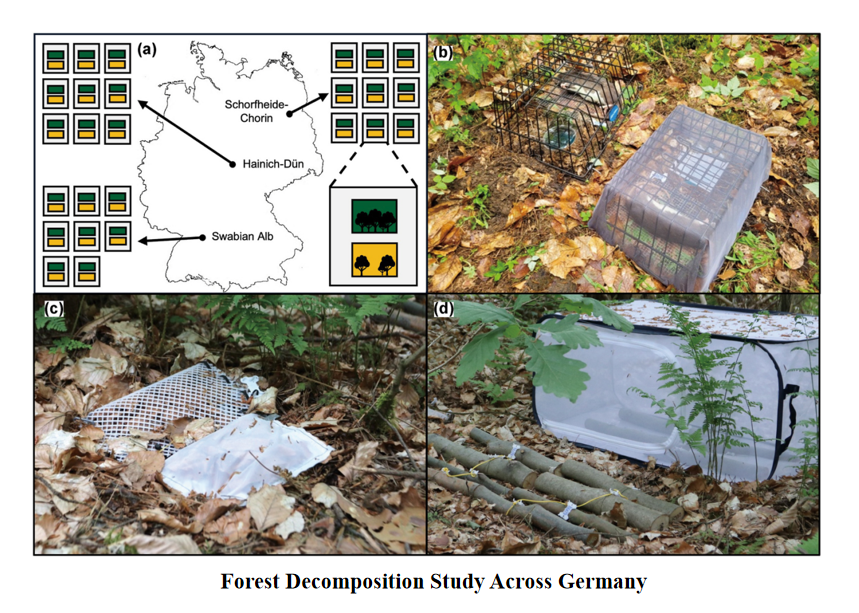
Animal carcasses rot 90 times faster than leaves or logs. Insects and #forest#canopy gaps shape each differently, with gaps speeding leaf decay but slowing log rot. This reveals decay rules vary by #material, guiding carbon forecasts as logging and storms open more canopies.🧐
@Forestecosyst
https://t.co/gNYiWbJ9iq
Long-term passive rewilding enhances total carbon stock but reduces annual productivity in abandoned bamboo forests | Journal of Forestry Research | Springer Nature Link https://t.co/Oe3O8QK84j
Vegetation growth carryover is a key driver of drought resilience in Qinghai spruce of the northeastern Qinghai-Tibet Plateau | Journal of Forestry Research | Springer Nature Link https://t.co/z9nKlysVxu
Bioclimatic analysis of winter physiological reddening in Douglas-fir Pseudotsuga menziesii (Mirb.) Franco, #France | Journal of Forestry Research | Springer Nature Link https://t.co/Pu3gPmpvlu
@ForestryRelay#Cold#Stress#Climate#Forest#Drought
Drought impacts last for years 🌵🌲
Forest decline reflects long-term climate memory, with tree mortality driven by both extreme events and cumulative stress over previous years.
🔗https://t.co/JAtHTqJKlb
#Drought#ClimateChange#JFR#Climatescience
Same-species trees handle heat and rain differently based on where they grew. A 10,000-tree European check shows tracking local adaptation, not blanket rules, sharpens survival #forecasts and guides #climate adaptation.🧐
@Forestecosyst
https://t.co/s9rxZjC7zj
🌳 Greater tree diversity lowers soil carbon Q₁₀ by enhancing carbon stabilization and shifting microbial strategies. Diverse forests help lock away carbon and reduce climate feedbacks 👉️ https://t.co/WoLqakHA2Q
“ In all investigated tree species, ectomycorrhizal associations were present to the deepest examined soil depth of 380 cm.” - Fine‐root trait variation in temperate trees follows arc‐shape pattern along deep soil profiles https://t.co/ClAYnH1ze8