Biochemistry scientist. Plant biostimulants. Agriculture. Technical Manager Brandon Bioscience. From Navarra to Ireland. Husband and dad. Views my own.
A few notable things happened yesterday in Ireland. In Debrecen, Hungary, we played Israel in a mostly empty stadium, watched by around 200 Israeli supporters and a handful of Irish fans who were not officially meant to be there at all. The Irish team scored three goals in twelve minutes, and the match was effectively decided before half-time.
For months beforehand, the Football Association of Ireland had been the target of a vitriolic "Stop the Game" campaign, backed by pro-Palestinian activists, trade unions, and far-left political parties. The Irish players wore black armbands, declined the customary handshakes, and bowed their heads during the Israeli national anthem. The team's goalkeeper Gavin Bazunu had withdrawn on grounds of conscience, citing "the atrocities in the region," and the squad had voted in an emergency meeting, reportedly by a margin of fourteen to eight, on whether to play at all. "By playing we are making some people unhappy," their Icelandic manager, Heimir Hallgrímsson, lamented later. After a 3–0 win, Ireland's biggest margin of victory in years, his first thought was for the people the game itself had offended.
As the match was taking place before a near-empty stadium in Hungary, a large crowd stood assembled on the Garvaghy Road in Portadown. For the first time in twenty-eight years, the Orange Order had secured the legal right to walk it: thirty-five men, no bands, in silence. That permission had been granted, struck down, and restored in a unprecedented night of courtroom drama that ran into the small hours of Sunday morning. By 8 a.m., around two thousand nationalists, including the First Minister of Northern Ireland herself, stood in the rain to prevent those thirty-five men from passing. Hundreds of police waited with water cannon, and the Orangemen waited in a church hall a quarter-mile away. Neither side moved all day. Around midnight the protesters went home, claiming victory, with a new "process" promised and, as I write, nothing resolved.
Another crowd filled The Well Hotel in Moate, Co Westmeath, and spilled outside to a large screen in the car park. The same organisers who led April's fuel protests demanded that carbon tax be abolished in the upcoming budget, promising to return to blocking roads if it is not. One speaker said people were being "taxed out of existence." Organizers pointed out that the State is running a surplus of €9 billion while elderly people cannot afford to heat their homes. And that same afternoon, St Patrick's Mental Health Services published a survey finding that 92 per cent of Irish adults agree there is a worrying amount of anxiety in society. Nearly three-quarters stated that their own mental health had suffered from the cost of living.
People will read each of these events differently, depending on their background and perspective. But what struck me on Sunday was not the causes but the shape of Irish life itself, which is increasingly hardening into toxic tribalism. Each crowd knew exactly what it was, and defined its identity by knowing who it stood against. Each offered its members something certain: a clear place to stand, a clear line to hold, and the reassurance of support from like-minded others. "#COYBIG" (Come on You Boys in Green) was once a hashtag everyone could rally behind, but we can no longer even unite behind our own national football team, who are now publicly being derided as traitors.
Why does so much of Irish public life feel like this, when by GDP metrics the country has never been richer? There are some obvious answers. The cost of living has been rising inexorably for years. House prices are still rising by more than five per cent a year. Tax rates, raised to emergency levels during the 2008 financial crisis, have not been lowered in 18 years, long after the crisis has passed. Government spending has doubled in the past decade, including absurdities like a €335,000 bike shed and a €2.2 billion hospital. A large majority feels that the current rate of immigration is unsustainable. These are serious matters, and people are not wrong to be angry about them. But I think a deeper anxiety underlies all this, one that people feel before they can name it. It concerns the future of the job itself.
I am bullish about artificial intelligence. I believe it will make us more productive and relieve millions of people of mundane tasks that were never worthy of their time. It will open new possibilities we can barely yet begin to envision. But the first thing it will change is the traditional idea of work that most of us grew up with: the job as a set of routine tasks, done reliably, in exchange for a salary. It will eviscerate a white-collar managerial class that exists to "oversee" other humans performing tasks and meeting deadlines.
The evidence of AI disruption in Ireland is already visible for younger workers, if not for older ones. The Department of Finance found earlier this year that employment among 15- to 29-year-olds in the technology sector fell by more than a fifth between 2023 and 2025. Over the same period, it grew by 12 percent for workers aged 30 to 59. So the change is not coming through mass redundancy. Rather, it is arriving in the shape of fewer entry-level roles as the bottom rung of the ladder is quietly removed.
Regardless, fear and "AI doomerism" are running ahead of the reality. In polls, over 60 percent of Irish people want a complete moratorium on new data centers. A survey this summer found that almost half of Irish workers expect AI to affect or replace their jobs, even as only 3.6 per cent of companies have actually replaced a full-time position with AI. So people might not yet be losing their jobs, but they are losing their faith that the job, as a core social institution, will hold. Traditionally, it is on the job that everything else that people want from life is built: home-ownership, family, vacations, security.
Due to its large multinational base, Ireland is more exposed than most to the AI revolution. But we have also spent the last three decades building a work culture around credentialism. Our National Framework of Qualifications now has a somewhat comical ten different levels, a ladder of accredited steps stretching from Junior Certificate to PhD. The Irish have climbed that ladder more eagerly than anyone in Europe, as 65 percent of 25- to 34-year-olds now hold a third-level qualification, the highest rate in the EU. But ESRI research suggests that those holding the most credentials may now be the most exposed to AI displacement. Meanwhile, Ireland has a chronic shortage of carpenters, electricians, plasterers, and bricklayers. An average of just 12 apprentices successfully qualify as plasterers each year.
Irish public institutions are also on shaky ground. The public service employs over 420,000 people, over 70,000 more than in 2020. But waste and inefficiency run rampant in the state sector, where productivity is around 30 percent lower than in the private sector. Widespread deployment of AI will make that kind of inefficiency harder to conceal and even harder to justify. In the long run, that is a good thing. In the short run, it is one more source of unease for people who feel like they did exactly what they were told to do to secure a decent life.
So what happens next? Social psychologist Michael Hogg's uncertainty–identity theory proposes that when people feel uncertain about themselves and their future, they are drawn more strongly to groups that offer firm boundaries and clear beliefs. The greater the uncertainty, the more extreme the groups that have appeal. The tribe supplies what the job used to supply, a settled answer to the questions of who you are, where you stand, and who stands with you.
Viewed in this light, Sunday's news stories look less like three different events and more like one dynamic. Palestine offers the illusion of moral clarity, even though few grasp the historical and political complexities of a conflict four thousand kilometers away. The Garvaghy Road offers more apparent moral certainty, benefiting extremists on both sides. Moate offers belonging through grievance: those of us who work and pay, pitched against a state that confiscates and squanders.
But each is also a refuge from a harder question. What will I do, what will I be worth, if and when the work I trained for no longer needs me? Ireland already has the highest prevalence of loneliness of any European country. So people are craving both a sense of purpose and a sense of belonging, and many, especially young people, are finding that in a quasi-religious devotion to Palestinianism and resurgent physical-force nationalism. But this does not put us on the "right side of history," as many believe. From the outside, much of this zealotry looks plain nuts.
If Ireland had proper political leadership, it could use its newfound wealth, its educated young people, and its close relationship with US technology companies to reinvent what work means. It could transition to the relational, creative and skilled work in which humans can thrive. Sadly, I fear that our ossified and captured institutions will not handle this transformation well, and we will take an alternative route where anxiety becomes grievance, grievance becomes identity, and identity turns every issue into an ideological purity test rather than a problem to solve. We will continue to double down on blaming scapegoats, like Israel or the Orange Order, while real problems remain unsolved.
For all the talk in recent weeks of a United Ireland, the country yesterday showed itself to be more divided than ever. That is not going to change until we can build a sense of belonging that is generous enough that we no longer need an array of enemies and scapegoats to feel at home.
"High-achievers are more likely to be male because men are more likely to focus obsessively on their area of interest, and this helps them to rise to the top." https://t.co/wI6BhbW88R
Qué es la anarcotiranía (y por qué caminamos raudos hacia ella):
«Aunque es perfectamente capaz de hacerlo, al gobierno no le interesa castigar a los delincuentes comunes que causan caos y miseria con regularidad (esto es la anarquía). En cambio, le interesa más controlar a los ciudadanos para que no se opongan a la élite gobernante (esto es la tiranía).
Los delincuentes comunes representan poca amenaza para la clase dominante, por lo que el castigo severo no es una prioridad. Se les deja en libertad para que sigan causando sufrimiento a la población. Mientras tanto, los ciudadanos comunes culpables de infracciones menores o "delitos burocráticos" sufren todo el peso del gobierno, a menudo de forma excesiva.
El poder del gobierno se utiliza para proteger a la élite gobernante de la gente común, no para proteger a la población de los delincuentes. El único peligro que representan los ciudadanos comunes es para el gobierno y la élite gobernante, por lo que su resistencia o protesta se castiga severamente como advertencia a los demás sobre las consecuencias de oponerse a la élite gobernante.
Los grandes medios de comunicación, al formar parte de la élite, ayudan a justificar el trato severo del gobierno hacia la gente común culpable de infracciones menores, al tiempo que se dedican a excusar a la clase criminal que causa caos y miseria a la gente en general».
Por @Viktyr79.
& at some point in your mid 20s to 30s, life will give you a second chance. a chance to break old cycles, heal from past wounds, rebuild your confidence, fulfil those small promises you made to yourself, get your life back on track and become the version of yourself you’ve always envisioned. when that moment comes, don’t waste it. see it through cos it changes everything.
Let me trace the timeline here because nobody's connecting it.
Step 1: Scrape the entire internet. Every book, every article, every conversation, every piece of art, every forum post. Do it without asking. Do it without paying.
Step 2: Train a model on all of it. Call it "artificial intelligence."
Step 3: Go to BlackRock's Infrastructure Summit and announce: "We see a future where intelligence is a utility, like electricity or water, and people buy it from us on a meter."
Step 3 is where you sell people's own knowledge back to them. On a meter.
They took the collective output of human thought, compressed it into a model, and now they want to charge you by the token to access a version of what you and everyone you know already created.
One Reddit user put it perfectly: "They stole all this data from us, the people, our life's work, creativity, art, by devouring the internet and blowing through all copyright laws. Now they want to sell it back to us in the form of a utility."
Imagine if someone photocopied every book in the public library, burned the library down, and then opened a subscription service for the copies.
That's the metered intelligence business model.
And they're pitching it to infrastructure investors as though they invented water.
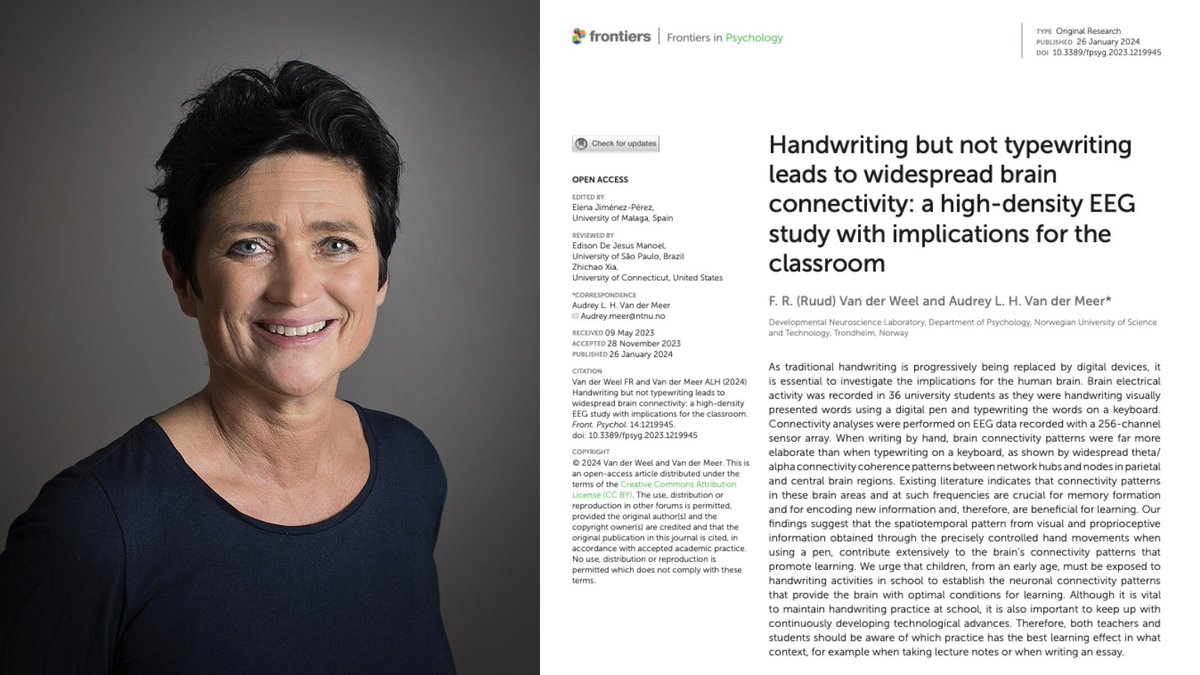
A Norwegian neuroscientist spent 20 years proving that the act of writing by hand changes the human brain in ways typing physically cannot, and almost nobody outside her field has read the paper.
Her name is Audrey van der Meer.
She runs a brain research lab in Trondheim, and the paper that closed the argument was published in 2024 in a journal called Frontiers in Psychology. The finding is brutal enough that it should have changed every classroom on Earth.
The experiment was simple. She recruited 36 university students and put each one in a cap with 256 sensors pressed against their scalp to record brain activity. Words flashed on a screen one at a time.
Sometimes the students wrote the word by hand on a touchscreen using a digital pen, and sometimes they typed the same word on a keyboard. Every neural response was recorded for the full five seconds the word stayed on screen.
Then her team looked at the part of the data most researchers had ignored for years, which is how different parts of the brain were communicating with each other during the task.
When the students wrote by hand, the brain lit up everywhere at once.
The regions responsible for memory, sensory integration, and the encoding of new information were all firing together in a coordinated pattern that spread across the entire cortex. The whole network was awake and connected.
When the same students typed the same word, that pattern collapsed almost completely.
Most of the brain went quiet, and the connections between regions that had been alive seconds earlier were nowhere to be found on the EEG.
Same word, same brain, same person, and two completely different neurological events.
The reason turned out to be something nobody had really paid attention to before her work. Writing by hand is not one motion but a sequence of thousands of tiny micro-movements coordinated with your eyes in real time, where each letter is a different shape that requires the brain to solve a slightly different spatial problem.
Your fingers, wrist, vision, and the parts of your brain that track position in space are all working together to produce one letter, then the next, then the next.
Typing throws all of that away. Every key on a keyboard requires the exact same finger motion regardless of which letter you are pressing, which means the brain has almost nothing to integrate and almost no problem to solve.
Van der Meer said it plainly in her interviews.
Pressing the same key with the same finger over and over does not stimulate the brain in any meaningful way, and she pointed out something that should scare every parent who handed their kid an iPad.
Children who learn to read and write on tablets often cannot tell letters like b and d apart, because they have never physically felt with their bodies what it takes to actually produce those letters on a page.
A decade before her, two researchers at Princeton ran the same fight using a completely different method and ended up at the same answer. Pam Mueller and Daniel Oppenheimer tested 327 students across three experiments, where half took notes on laptops with the internet disabled and half took notes by hand, before testing everyone on what they actually understood from the lectures they had watched.
The handwriting group won by a wide margin on every question that required real understanding rather than surface recall.
The reason was hiding in the transcripts of what the two groups had actually written down.
The laptop students typed almost word for word, capturing more total content but processing almost none of it as they went, while the handwriting students physically could not write fast enough to transcribe a lecture in real time, which forced them to listen carefully, decide what actually mattered, and put it in their own words on the page.
That single act of choosing what to keep was the learning itself, and the keyboard had quietly skipped the choosing and skipped the learning along with it.
Two studies. Two countries. Same answer.
Handwriting makes the brain work. Typing lets it coast.
Every note you have ever typed instead of written went into your brain through a thinner pipe. Every meeting, every book highlight, every idea you captured on your phone instead of on paper was processed at half depth.
You did not forget those things because your memory is bad. You forgot them because typing never woke the part of the brain that would have made them stick.
The fix is the thing your grandmother already knew.
Pick up a pen. Write the thing down. The slower road is the faster one.
Si els nostres fills no poden anar a l'escola pública, si els nostres pares necessiten contractar una mutua, si els nostres avis no reben l'ajuda de dependència fins que ja són morts, millor liquidem-ho tot ja, abaixem impostos i que cadascú es pagui lo seu com feiem abans
I have a medical appointment at 9 a.m. on the south side of Dublin this morning. I had one yesterday. Plan ahead, and you will make all your appointments.
#NeverForget In June 2020, Ireland was in full lockdown. Fear porn was everywhere; only 10 people were allowed at funerals; emergency rooms were empty; hospital staff were dancing in corridors; and you were told to stay within 5 km of your home. Yet these protests took place.
The people of Ireland need to stand with hauliers, farmers, bus companies, and taxi drivers. This government have prepared the nation well, we are built resilient.
Some of these representative organisations need to take a hard look at whom they represent, as they appear to be government puppets at this time. #StandUpIreland #FuelProtests
*On a side note, €866.4 million for 2026 has been set aside for overseas development aid.
https://t.co/lvetMc5ozd
The biggest threat to civilization is not climate change or war
It is the collapsing birth rate.....It's hitting record lows and consistently accelerating downward
If we don’t have enough people to sustain the light of consciousness on Earth, we’ll never make it to the stars. Mars will stay empty. Earth will become a graveyard
Population collapse is a choice. We need to stop making it
@santicalvicidad No veo clara la relacion Luna-Iran. El helio comun (helio-4) que se usa en la refrigeracion para la fabricacion de chips si se obtiene de gas natural. Helio-3 se obtiene de la desintegracion del tritio y se usa en aplicaciones criogenicas muy especificas (computacion cuantica)
Europe's official grid authority has released its report on the nationwide blackout that hit Spain last year. And while the report treads carefully politically, its data make the cause clear.
Wind and solar triggered the collapse.
Within the first 80 seconds, Spain lost 2.5 GW of generation, around 10% of its national supply, with every MW of that early loss coming from renewables.
Gas and hydro remained stable until the cascade was already underway.
The report calls it an unprecedented speed of blackout. This was a textbook inverter chain failure, with renewables dropping so fast that the grid's stabilizers never had time to react.
By midday, Spain's grid had virtually no inertia, nothing spinning fast enough to hold frequency steady.
But to admit that outright would mean questioning Europe's green transition itself, something the report appears unable to do. So the event is officially described as "a rare local disturbance," rather than what it actually was...
A systemic failure of weather-dependent power.
@Soy_Politicon@VirtudMental@MalakarasP El gliofosato si es un HERBICIDA. Uno de los mas estudiados de hecho. Tiene una accion sistemica e irreversible sobre la enzima EPSP sintasa, desencadenando un desequilibrio metabolico y la muerte de la planta. Muy efectivo excepto en GMOs diseñados con genes de resistencia.
@avidseries See also this Science paper showing that the Genotype-Tissue Expression project documents that 1/3 of our 23,000 genes are expressed differently according to sex in 44 different tissues, including 11 brain regions:
https://t.co/Y2VSgCNxyO
Spent my last 20 years in consulting.
Made Partner in my 30s.
Led teams of 100+ people.
Run 9-figure client portfolios.
Lived and worked in 4 continents.
Hired ~200 employees in multiple geos.
The hardest lesson I had to learn, at a real crossroads in my career, is a cliché everyone agrees with, but almost nobody truly understands:
"What got me here won't get me there."
Early on, progress rewards competence: you grind, you solve, you deliver.
YOU become the person.
Then you climb... and, basically without warning, the entire game changes.
At senior levels, being a brilliant problem-solver is no longer enough. In fact, it *can* become a liability.
The work that used to be all about answers, now starts being about implementing common sense at bigger scale.
The work now becomes about making ambiguous, high-stakes decisions with incomplete and/or conflicting information, and about building people who can succeed *without* you sitting next to them.
I'm telling you: if you still need to be in the weeds, you are already behind!
Real leadership (I know... the infamous L word...) requires something deeply uncomfortable for most human beings in corporate:
You gotta make yourself redundant.
Most people resist this. I did too.
When a team member brings you a problem, your instinct is to fix it in 30 seconds.
Don't.
Sit on your hands.
Ask a question and walk away.
If you keep fixing things, your team stays weak and you stay overworked.
Think back to a moment when you felt indispensable on a project or to a team: chances are that feeling (which you likely thought was a strength) was your ceiling.
If a deck is 80% as good as you would make it, leave it alone. If you spend your Sunday night polishing someone else's slides, what are you really?! A proofreader?!
You have to let people fail small so the organization doesn't fail big.
The shift from "doer" to "enabler" forces you to unlearn habits that once had made you successful; it can be ego-bruising and perhaps boring, but it is the only way to scale.
That shedding is the price of playing the long game - the only one worth playing.
All the best.
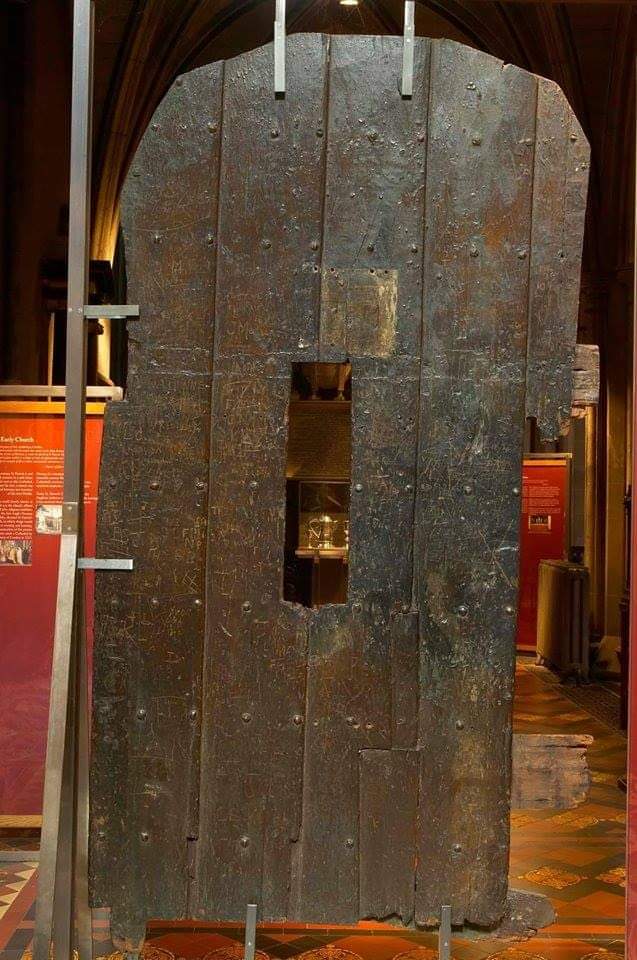
The legendary origin of the phrase "Chancing your arm" came from Dublin in 1492. The Butlers of Ormonde and the FitzGeralds of Kildare were fighting a bloody violent feud. The Butlers retreated to the sanctuary of St. Patrick's Cathedral, with the FitzGeralds in hot pursuit.
A deadly standoff took place, the Fitzgeralds refusing to leave till the Butlers surrendered. However, the Butlers feared they'd be massacred by their sworn enemies if they left the sanctuary.
To break the stalemate, Gearóid Mór FitzGerald came up with a genius idea. To show his sincerity to let the Butlers surrender peacefully, he cut a hole in the Chapterhouse door and put his empty sword arm through, as a gesture of peace.
The Butlers recognised the honour of the act of Fitzgerald "chancing his arm". Their leader shook Fitzgerald's hand. Both families left the cathedral in peace, and in one piece! The "Door of Reconciliation" is still on display in St Pat's Cathedral this day. Maybe there's someone in your life you should chance your arm with?
Rojo Rójez protestando por la detención de Maduro y Twitter Venezuela lo único que protesta es por qué lo han dejado vivo. Hay que ver lo lejos que se puede vivir de la realidad por unas ideas de mierda.
Sometimes we are tired.
Sometimes the baby messes up our whole schedule like when she got sick during our little vacation.
Or like the week before Christmas when she was sick with everyone else.
Or like right now on NYE where I’m at home with her and told my wife to take the boys to her moms to hang out with family because she’s either teething or has an ear infection (likely since she recently had a cold).
It’s all very inconvenient and trying at times. Our breaks come when she’s asleep.
I forget it all when she wakes up and gives me an ear to ear smile.
You can’t explain that love to people. It’s not possible. They have to receive it.
Love is risky. It’s rarely full of sunshine, it comes with all sorts of other things like the possibility of heartbreak.
But it’s love. What else is there.
God is love. We live for Him. He’s our entire purpose.
And with those little signs of pure love from your children, you get a taste of Gods love. A little bit a heaven if you will.
It’s worth it.