Herbert attempted to sell his books as anti-messianic: a narrative caution against deifying political or religious leaders for fear that they might turn out evil.
Unfortunately, he created a world in which a messiah—and a tyrannical one at that—is metaphysically necessary for the survival of the species. Paul Atreides and his scions can see the future, and are compelled to commit grave evils for the sake of a greater good that they alone can foresee. This is the claim every strongman makes, but in the case of the Atreides, it is actually true.
Herbert constructs the one world in which blind political messianism might actually be merited.
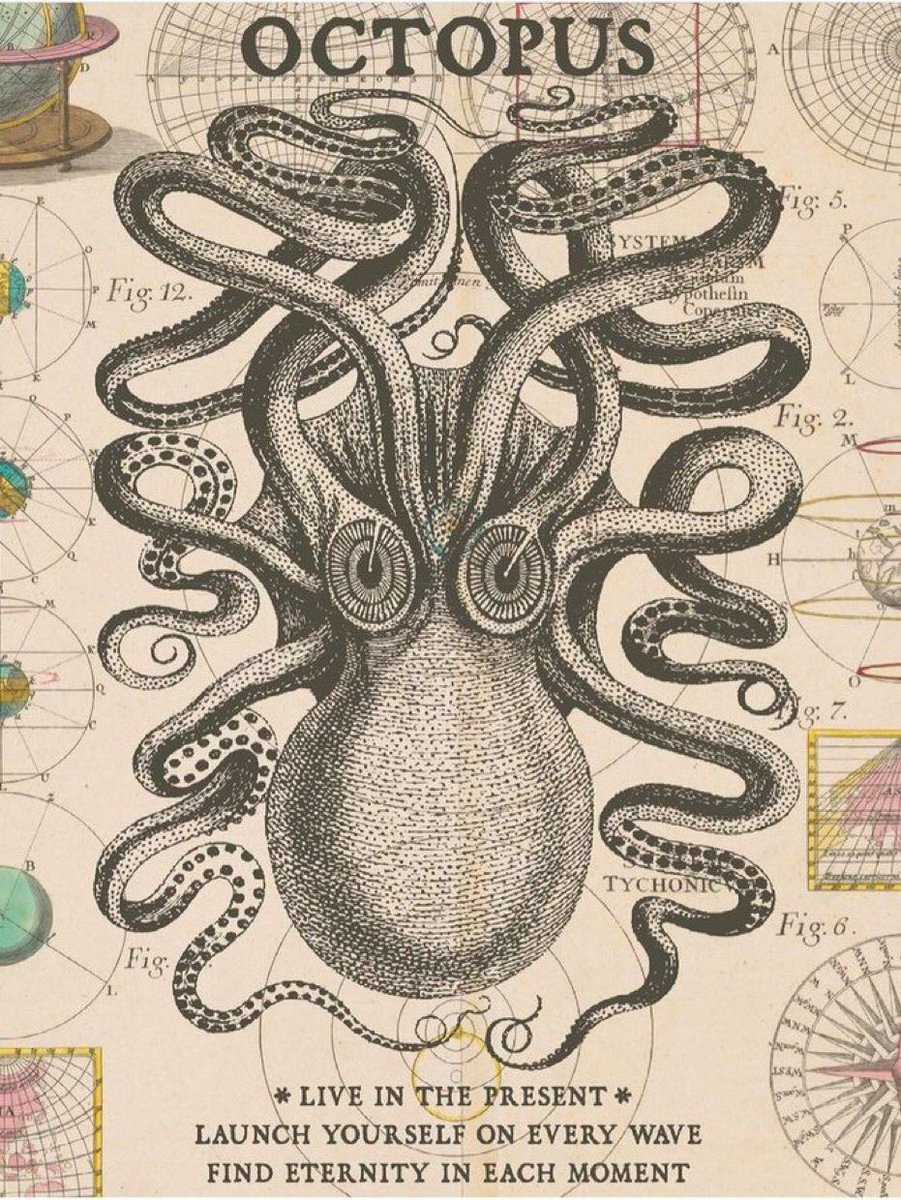
“Pulpo”
El pulpo no parece de este planeta… y la ciencia lo ha sugerido en serio. 👽🐙
En 2018, 33 científicos publicaron un artículo donde proponen que los huevos de pulpo podrían haber llegado a la Tierra dentro de meteoritos congelados. El debate sobre su origen se abrió… y luego se cerró en silencio.
En el árbol evolutivo, el pulpo está solo. Sin ancestros claros, sin formas intermedias, sin primos cercanos. Apareció de repente.
Tiene tres corazones, nueve cerebros (uno central y uno en cada brazo), sangre azul y la capacidad más loca de todas: reescribe su propio ARN de forma instantánea. Cuando el agua se enfría, literalmente reprograma su sistema nervioso en tiempo real. Ningún otro animal en la Tierra hace algo así. 🔄🧬
En la Cábala, el Leviatán es descrito como el señor de las profundidades, un ser de ocho brazos cuya sabiduría el humano no puede comprender. El Zohar lo llama “la mente del mar” y advierte que, antes de que despierte, cambiará el idioma del mundo.
En las tablillas sumerias, Enki —dios del conocimiento— emerge del fondo del agua y su símbolo tiene ocho brazos. Todo parece apuntar al mismo ser.
Mientras tú piensas con una sola cabeza, el pulpo resuelve nueve problemas a la vez. Sus tres corazones laten en ritmos diferentes. Cada brazo decide por sí solo, sin pedir permiso al cerebro central. Tiene una conciencia distribuida que nos deja pequeños.
No sabemos realmente qué vive en las profundidades del océano… porque quizás él nos observa a nosotros, no al revés. 🌊👀
El documental “My Octopus Teacher” me hizo llorar… y también me hizo investigar todo esto.
¿Qué opinás? ¿Criatura terrestre o visitante del cosmos? 🐙✨
Orcas eat great white sharks. They hunt seals, dolphins, and baby whales. They have never killed a single human in the open ocean. Not once, in all of recorded history.
An orca's brain weighs up to 15 pounds. Yours weighs about 3. They have roughly double the brain cells we do in the regions that handle complex thought. A neuroscientist at Emory named Lori Marino put an orca brain in an MRI and found these animals can tell different species apart underwater. They do it by sending out clicks that bounce off everything around them and come back as a kind of 3D sound map (this is called echolocation). From 500 feet away, an orca knows you're a human and not a seal. It skips you on purpose.
The answer is culture. Orcas around the world are divided into at least 10 separate populations, each with its own food rules, its own language, and its own way of hunting. All of it learned from their mothers. One population eats only fish. Another eats only marine mammals like seals and sea lions. These two populations can live in the exact same water and never swap a single meal. A baby orca learns what food is from its mother, and that list stays the same for life.
In the Pacific Northwest, one population called the Southern Residents eats almost nothing but Chinook salmon. Scientists have documented them killing harbor porpoises 78 times over six decades, carrying the dead porpoises in their mouths, and never once eating them. Even when the group was starving. A 2023 study in Marine Mammal Science looked at all 78 cases and concluded it was play. These orcas would rather go hungry than eat something their culture says isn't food.
Researchers studying whale behavior in 2001 found that orca cultural traditions "appear to have no parallel outside humans." Each family group has its own dialect, its own version of the language. Calves spend about two years just learning how to make all the sounds their family uses. Mothers will slow down a hunt on purpose so their young can watch.
In 2005, a 12-year-old kid was swimming in Helm Bay, Alaska when an orca came at him full speed. At the very last second, the orca seemed to realize it was charging a human. It bent its entire body in half and turned back to open water. In captivity, it goes differently. SeaWorld's Tilikum killed three people during his life in a concrete tank. Research from 2016, published in the journal Animals, traced it to psychological collapse from being locked away from the family bonds orcas need to stay stable.
I think calling this a "mystery" undersells the science. Orcas decide what to eat based on culture, not instinct. No orca mother has ever taught her calf to hunt humans, so no orca hunts humans. Only about 75 of those salmon-eating Southern Residents are still alive. Their pregnancy failure rate is 69% because we've destroyed their salmon runs. They won't break their food culture to survive. Whether we care enough to protect theirs is the part that actually matters.
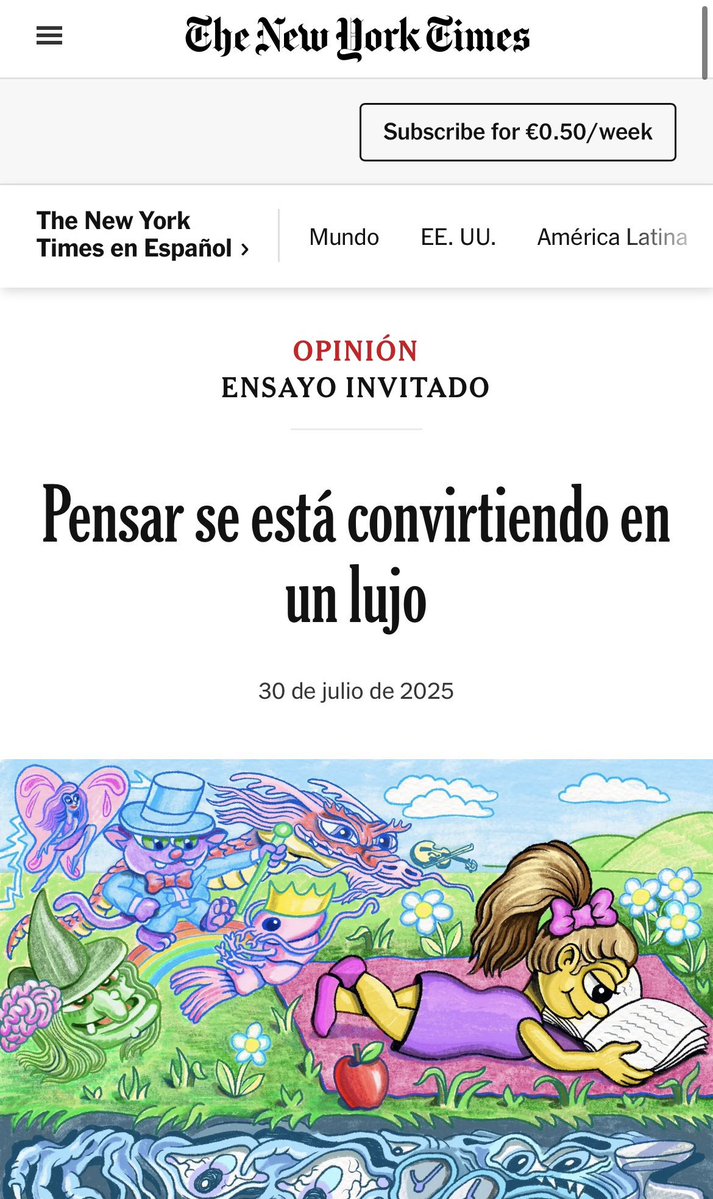
El auge de una cultura postalfabetizada —pantallas, vídeos cortos, textos fragmentados— no solo está erosionando la concentración y la lectura profunda. Está empezando a generar una nueva forma de desigualdad cognitiva. The New York Times
Como con la comida ultraprocesada, leer bien exige recursos, tiempo y entorno. La “lectura experta” reconfigura el cerebro y sostiene ciencia, democracia y pensamiento crítico. Si se convierte en un lujo, las consecuencias serán sociales y políticas https://t.co/YJaCTIzHn0
I've seen Mexicans who want to be white. I've seen white people who want to be black. I've seen black people who want to be Japanese. I've seen Japanese people who want to be Mexican
It’s mad that Italy were dogshit for a decade, then out of nowhere they peaked during Euro 2020 just to cockblock England out of their first trophy since 66, then straight back to being absolute wank again 😭
Three weeks into the war with Iran, a number of observations as someone who spent years war-gaming this scenario.
1. The U.S. and Israel may have produced regime transition in the worst possible way.
Ali Khamenei was 86 and had survived multiple bouts of prostate cancer. His death in the coming years would likely have triggered a real internal reckoning in Iran, potentially opening the door to somewhat more pragmatic leadership, especially after the protests and crackdown last month. Instead, the regime made its most consequential decision under existential external threat giving the hardliners a clear upperhand. Now we appear to have a successor who is 30 years younger, deeply tied to the IRGC, and radicalized by the war itself – including the killing of family members. Disastrous.
2. About seven years ago at CNAS, I helped convene a group of security, energy, and economic experts to walk through scenarios for a U.S.--Iran war and the implications for global oil prices. What we’re seeing now was considered one of the least likely but worst outcomes. The modeling assumed the Strait of Hormuz could close for 4–10 weeks, with 1–3 years required to restore oil production once you factored in infrastructure damage. Prices could spike from around $65 to $175–$200 per barrel, before eventually settling in the $80–$100 range a year later in a new normal.
3. One surprising development: Iran is still moving oil through the Strait of Hormuz while disrupting everyone else. In most war games I participated in, we assumed Iran couldn’t close the Strait and still use it themselves. That would have made the move extremely self-defeating. But Iran appears capable of harassing global shipping while still pushing some of its own exports through. That changes the calculus.
4. The U.S. now finds itself in the naval and air equivalent of the dynamic we faced in Iraq and Afghanistan. It’s a recipe for a quagmire where we win every battle and lose the war. We have overwhelming military dominance and are exacting a tremendous cost. But Iran doesn’t need to win battles. They just need occasional successes. A small boat hitting a tanker. A drone slipping through defenses in the Gulf. A strike on a hotel or oil facility. Each incident creates insecurity and drives costs up while remind everyone that the regime is surviving and fighting.
5. The deeper problem is that U.S. objectives were set far too high. Once “regime change” becomes the implicit or explicit goal, the bar for American success becomes enormous. Iran’s bar is simple: survive and keep causing disruption.
6. The options for ending this war now are all bad. You can try to secure the entire Gulf and Middle East indefinitely – extremely expensive and maybe impossible. You can invade Iran and replace the regime, but nobody is seriously going to do that. Costs are astronomical. You can try to destabilize the regime by supporting separatist groups. It probably won’t work and if it does you’ll most likely spark a civil war producing years of bloody chaos the U.S. will get blamed for. None of these are good outcomes.
7. The other escalatory options being discussed are taking the nuclear material out of Esfahan or taking Kargh Island. Esfahan is not really workable. Huge risk. You’d have been on the ground for a LONG time to safely dig in and get the nuclear material out in the middle of the country giving Iran time to reinforce from all over and over run the American position.
8. Kharg Island can be appealing to Trump. He’d love to take Iran’s ability to export oil off the map and try to coerce them to end the war. It’s much easier because it’s not in the middle of IRan. But it’s still a potentially costly ground operation. And again. Again, the Iranian government only has to survive to win and they can probably do that even without Kargh.
9. The least bad option is the classic diplomatic off-ramp. The U.S. declares that Iran’s military capabilities have been significantly degraded, which is how the Pentagon always saw the purpose of the war. Iran declares victory for surviving and demonstrating it can still threaten regional actors. It would feel unsatisfying. But this is the inevitable outcome anyway. Better to stop now than after five or ten more years of escalating costs. Remember in Afghanistan we turned down a deal very early in the war with the Taliban that looked amazing 20 years later. Don’t need to repeat that kind of mistake.
10. The U.S. and Israel are not perfectly aligned here. Trump just needs a limited win and would see long-term instability as a negative whereas for Netanyahu a weak unstable Iran that bogs the U.S. down in the MIddle East is a fine outcome. If President Trump decided he wanted Israel to stop, he likely has the leverage to push it in that direction just as he pressured Netanyahu to take a deal last fall on Gaza.
11. When this is over, the Gulf states will have to rethink their entire security strategy. They are stuck in the absolute worst place. They didn’t start this war and didn’t want it and now they are taking with some of the worst consequences. Neither doubling down with the U.S. and Israel nor placating the Iranians seems overwhelmingly appealing.
12. One clear geopolitical winner so far: Russia. Oil prices are rising. Sanctions are coming off. Western attention and military resources are shifting away from Ukraine. From Moscow’s perspective, this war is a win win win.
13. At some point China may have a role to play here. It is the world’s largest oil importer, and much of that supply comes from the Middle East. Yes they are still getting oil from Iran. But they also buy from the rest of the Middle East, and a prolonged disruption in the Gulf hits Beijing hard. That gives China a real incentive to help push toward an end to the conflict.