Using machine learning-based indices of gendered consumption to show that labor demand shocks reshape household spending in gendered ways, from Rania Gihleb, @osea82, and Dor Morag https://t.co/2m4MdjiXDx
🎉Congratulation! The JHR 2025 Highly Cited Paper goes to @massimo_anelli , @Osea82 & @Lucastella28 for "Robots, Marriageable Men, Family, and Fertility."
https://t.co/wWMKJJ5qHV
The obsession with getting your kids into an Ivy+ college is overrated.
The same kids who are able to get into an elite school will earn just as much money if they get into a good public school. The income gain is literally 0%
Why are people obsessed with it then?
Because those schools offer access to the *most prestigious* jobs, like elite law firms and grad schools. https://t.co/yI3gh2w8Al
Make sure to check Patrick's work. Labor & health economist, with great data skills: large data, spatial data, historical and current data on relevant topics: migration & health, migration & fertility, senior internal migrations and labor markets, noise https://t.co/rumk44CthN
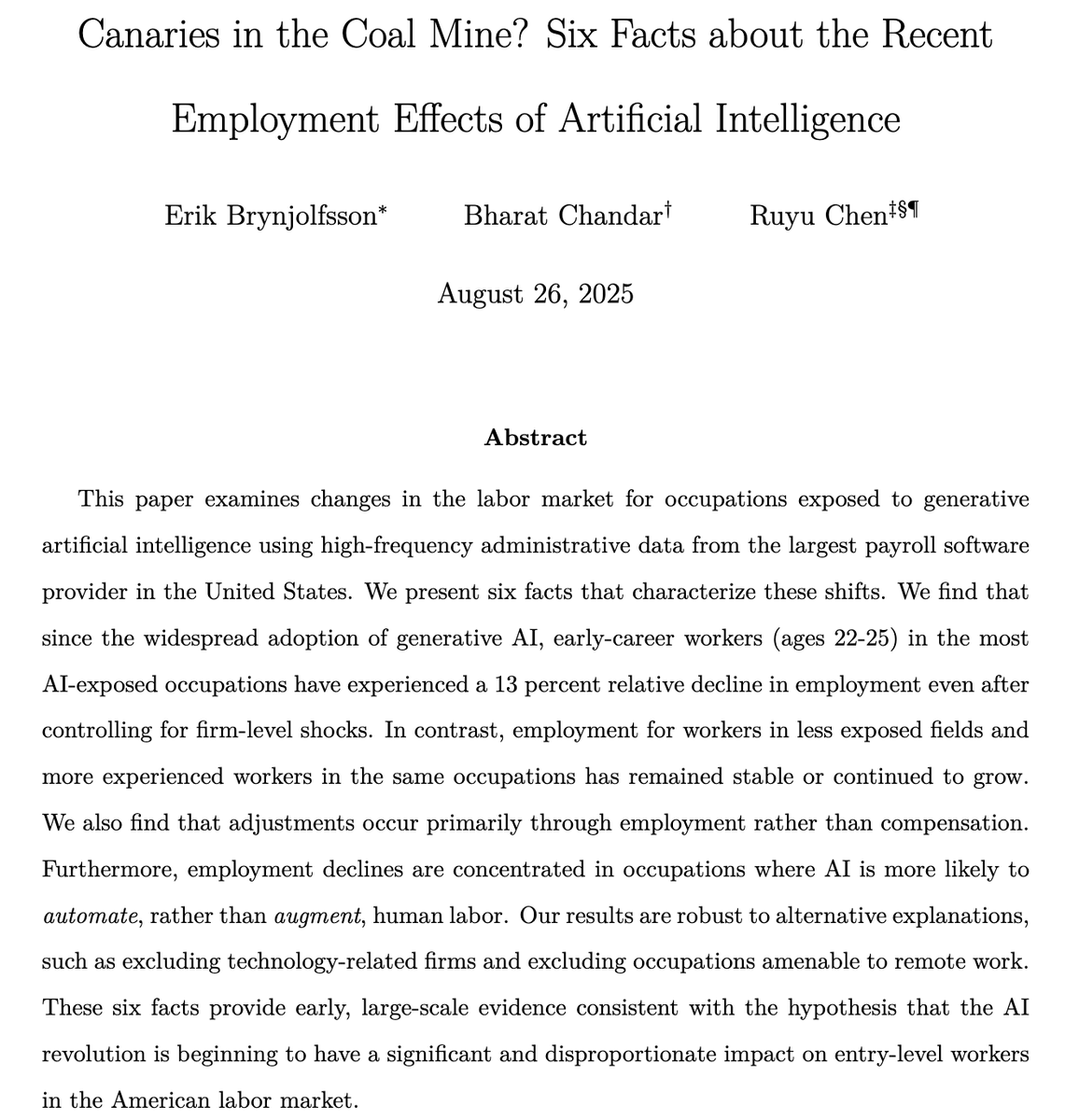
Is AI already impacting the job market?
A new paper from me, @erikbryn, and @RuyuChen at @DigEconLab digs into data from ADP.
We find some of the ***first large-scale evidence of employment declines for entry-level workers in AI-exposed jobs.***
A thread on our paper:
Are #smartphones and #socialmedia harming a generation?
This is a hotly debated and often polarizing debate. So we surveyed over 120 experts on the topic to see where there was genuine consensus (or not), like experts have previous done for climate change.
92–97% of experts agreed with the following statements:
1) Adolescent mental health has declined in several Western countries over the past 20 years.
2) Heavy smartphone and social media use can cause sleep problems.
3) Smartphone and social media use correlate with attention problems and behavioural addiction.
4) Among girls, social media use may be associated with body dissatisfaction, perfectionism, exposure to mental disorders, and risk of sexual harassment and predation.
5) Evidence on social deprivation and relational aggression is limited.
6) The evidence for policies like age restrictions and school bans is still preliminary.
These results can help guide future research (e.g., on policies) and informed policy on adolescent technology use.
This was led by @ValerioCapraro@laura_k_globig@steverathje2 and @ZachMRausch and numerous other authors!
🔥🔥🔥 It is with great excitement that I share our new paper
A consensus statement on potential negative impacts of smartphone and social media use on adolescent mental health
🧵 below
A little over 2 weeks to submit your papers to the 9th Workshop on the Economics of Organised Crime (Edinburgh, 19-20 June, 2025). Papers in related fields also welcome!👇
CALL FOR PAPERS: 9th Workshop on the Economics of Organised Crime, 19-20 June 2025 (Edinburgh, UK). Please, email full papers by 15 April 2025 to: [email protected]
Both theoretical and empirical studies, as well as papers in related fields welcome!
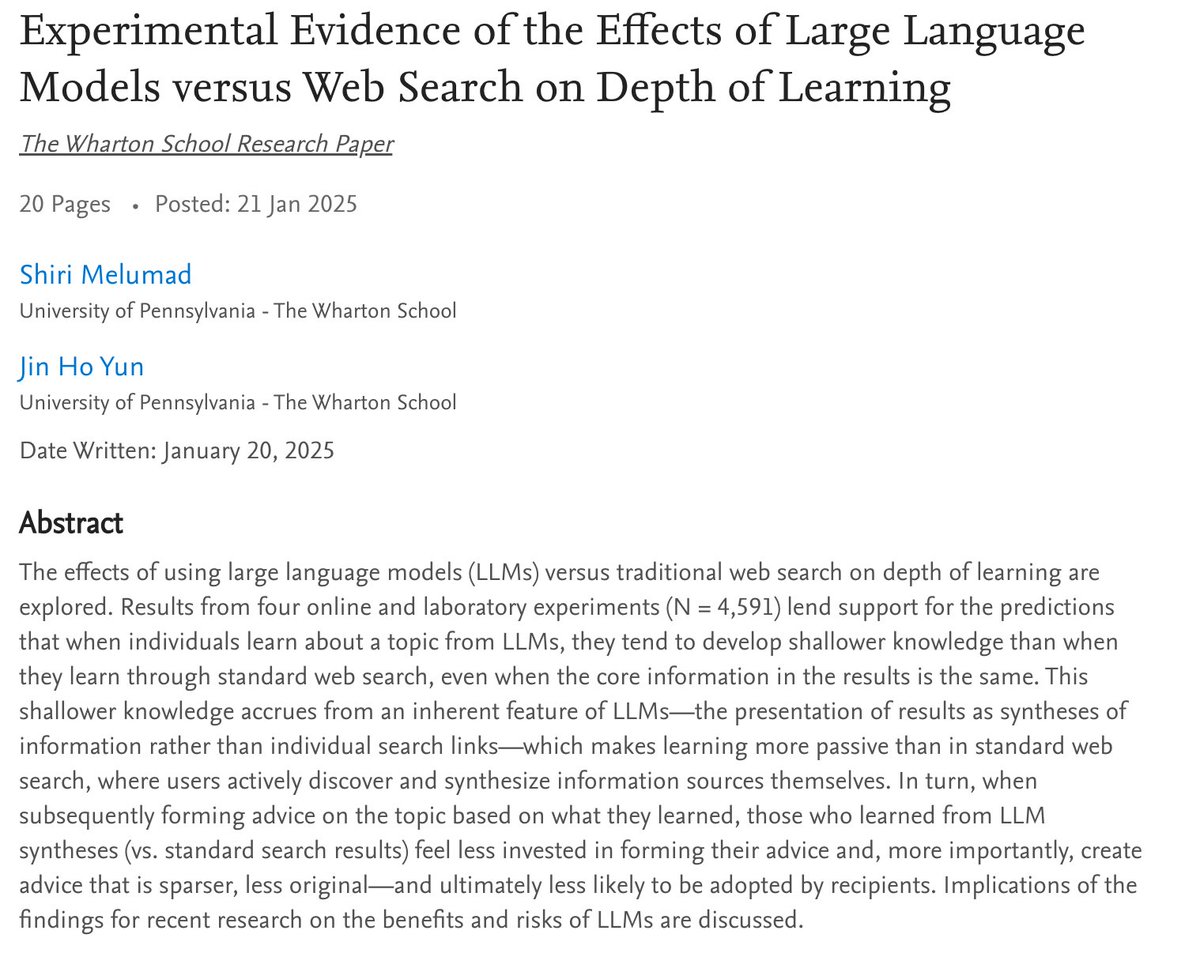
Excellent new paper on depth of learning from LLMs. Studies using large samples show LLMs like ChatGPT leads to shallower learning compared to using more traditional means like web search. When people rely on AI-synthesized answers, they develop less knowledge depth.🧵
Are you PhD student interested in AI/ML & economics?
Apply to the Machine Learning in Economics Summer Institute at Chicago Booth, Aug 7-13. Two-part program includes lectures from experts + 2-day conference on cutting-edge research.
Deadline March 28, plz RT. Link in reply.
A stunning essay in the FT on the international decline in the ability to read, reason, focus, and learn new things.
It began or accelerated in the early 2010s.
It's hitting teens AND adults.
Self-report and objective scores.
by @jburnmurdoch
https://t.co/gPGrShE2dk
If you are looking for a great data-scientist don't miss on Guillermo. Check his research and coding portfolio here: https://t.co/vgJeGdXmYB If you are looking for an expert in text -learning , web-scraping, and data visualization don't miss on him!
Stunning new findings on device use by young children: 40% of two-year-olds now have their own tablet. From @CommonSense.
We have to roll back the phone-based childhood now. An iPad is not a babysitter, it is an experience blocker.
https://t.co/QpAApoWM91
this is very sad. but will always be grateful for the opportunity IZA created for many of us over the years. A fantastic intuition, an incredible network and legacy which I hope will survive in other forms!