1. In all countries, the inflation burst was primarily the result of a series of supply disruptions and increases in the relative price of energy and food. In sharp contrast to the 1970s, this did not trigger a wage price spiral, and the inflationary effects of each these price shocks were not persistent. This was largely due to a strong anchoring of inflation expectations, itself likely reflecting increased credibility of central banks’ inflation targets.
The trend in global core inflation is almost back to normal (chart above)
And when you look at China, you think; should we not worry about deflation?
Headline CPI is as negative as in the covid shock, and almost as negative as in the CFC shock
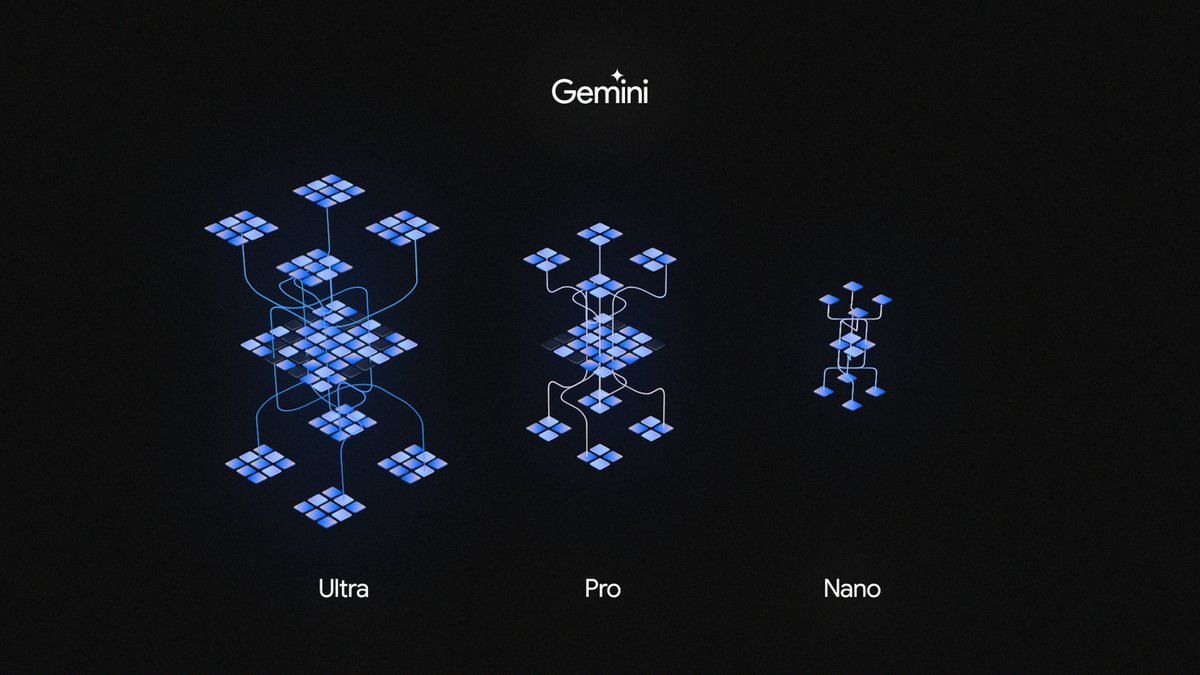
We’re excited to announce 𝗚𝗲𝗺𝗶𝗻𝗶: @Google’s largest and most capable AI model.
Built to be natively multimodal, it can understand and operate across text, code, audio, image and video - and achieves state-of-the-art performance across many tasks. 🧵 https://t.co/mwHZTDTBuG
Google just revealed Gemini and will directly integrate the AI into Google apps.
The GPT-4 competitor comes in 3 models — Ultra, Pro, and Nano.
Here's a thread of EVERYTHING you need to know:
Man hör inte så mycket paralleller till 70-talet längre, ej heller deglobalisation, ryskt gaskrig, eller pris/lönespiraler som spårar ur. Var är alla som sa att det var sticky nu? 🫢
🇪🇺 Inflation in the euro-area is now back to normal. The flash-estimate for November (0.1% m/m) was the lowest reading since April 2021 (own seasonal adjustment). No one will talk about inflation in 2024
@AFendert ”Vi vill inte lägga pengar på att försöka få tillbaka resenärer i Stockholms innerstad”
Dummaste jag hört! Vi bor ju nära stan av en anledning. 1:an är fullproppad redan idag, ni vill göra det värre.
Här är busslinjerna som läggs ner | Mitt i https://t.co/9t1AfGZ3Ei
So in the 1970s:
- Labor >>> capital: it took 8x the employees needed today for a US company to generate the same $1 million of sales, labor unions dominated and demographics was much better;
- Oil prices went ballistic;
- Credit growth booming
Exactly like now, right?
:)
@KlasEklund@dagensindustri Tack! Äntligen någon sans i flödet. Lägg därtill implosion i Kina och kreditkontraktion i USA och det är mer sannolikt att vi går in i deflationsspiral än tvärtom.
The Fed doesn't expand the money supply. Banks do that, and they don't do it when they're feeling insecure.
All previous incidents of hyperinflation that I'm familiar with occurred through helicopter drops, not endogenous loan growth (if I'm wrong, point me to it).
I dag skriver jag på @DNDebatt om lärdomar av de senaste årens #räntepolitik - och om den #bankkris som kan bli följden. Slutsats: finansiell stabilitet måste prioriteras högre. En enögd fixering vid #inflationsmålet ger för stora negativa bieffekter.
https://t.co/En0QsxNJVm
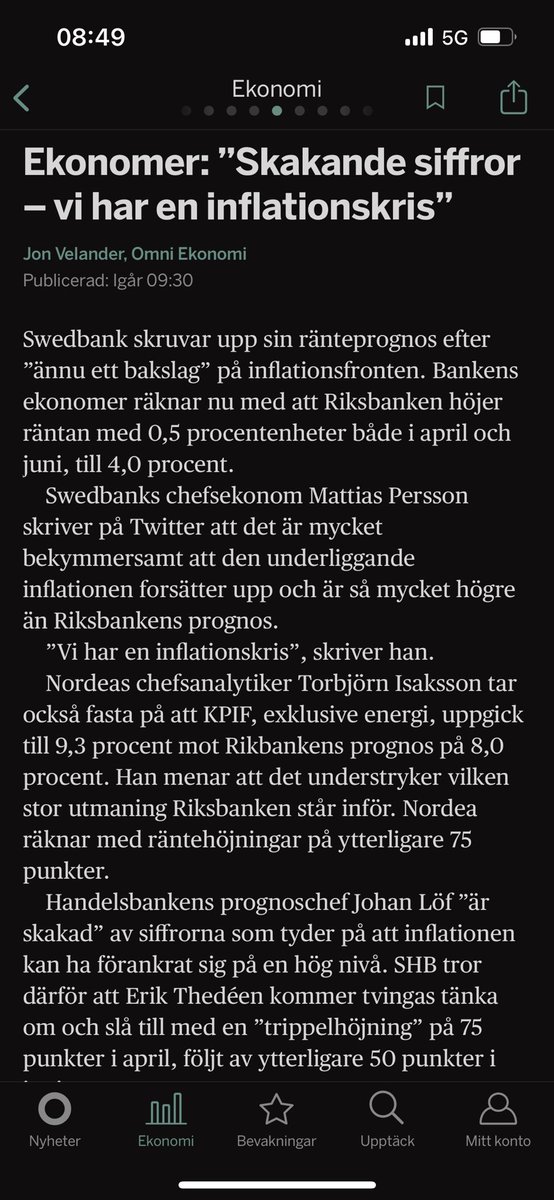
Ändå är det enda det pratas om att inflationen i Sverige nu är utom kontroll. Inom kommande månader kommer baseffekterna kicka in. Lägg till Ev. bankkris, hedgefonder som bettat på räntehöjningar sprängs. Knappast en miljö som driver inflation och räntor ytterligare. Vi får se 🫣
Många närsynta Sverige-takes från veckan som inte kommer åldras väl. Spelar inte så stor roll vad RB gör eller vad inflationen i Sverige ligger på. Global åtstramning har varit för snabb och satt banker/hedgefonder i skiten. Enda sättet att lösa detta är QE och räntesänkningar.