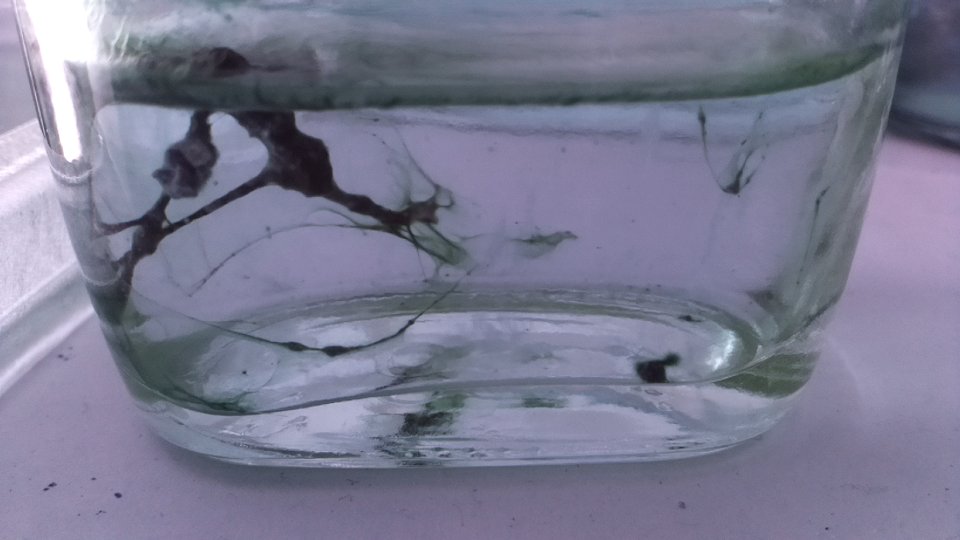
Cyanobacteria are never alone in Nature. Which bacteria do they interact with and how? We describe a stable cyanobacterial community reproducibly forming spatial structure and document metabolic interactions/processes within. Read here to learn more: https://t.co/TVm3Xe6sLZ
Cells in a filamenteous Cyanobacteria - how do they glide together? Cells are coordinated - until not! Cells rotate during gliding, and when they de-coordinate, the filament twists and form plectonemes! @PolinMarco @chavaleriani @elocatelli86
https://t.co/WVlb4AQPx3
How do microbial interactions emerge?
In the following, we show that ammonia leakage can underpin a nitrogen-sharing interaction among soil bacteria and fungi.
To be tested: Leakage-based N-acquisition could form the basis of loss of nitrate utilisation
https://t.co/Sbco6LpKxJ
How do cells on a filament coordinate their gliding motility to achieve back-and-forth movement? Our ongoing efforts in collaboration with @PolinMarco, @chavaleriani and @elocatelli86
https://t.co/c5bffGRjeO
Congrats to Emily Skates, @Munelectro and @zoe_banana and all others involved in the related work - It is online now - our first cover image!
https://t.co/wBGBHFJJ4i
VACANCY:
Interested in biophysics? @osslab are looking for a #postdoc to investigate spatial organization and metabolic interactions within a cyanobacterial, structurally organised community. Apply by 2 Jan 2024!
https://t.co/jQ72R0ruEy
Funded by @moorefound
ThT - a dye used for analysing protein aggregation, can also act as an indicator of mitochondrial membrane potential (MMP). It needs to be used at low concentration though. At high concentration and with high light exposure, it collapses MMP:
https://t.co/qjIoF8Xsdd
Can single cell respiration rate be measured? We think that it is theoretically possible but very hard in practice. If you are intrigued, please read our work with @Gabrielnegrao_ and @Patrick_Unwin using electrochemical probes on bioxriv just out now:
https://t.co/xybjqhEpCk
A big congrats to our Emily Skates (happiest one in the middle) for her viva success!!
Dr. Skates is off to the west coast and looking for postdocs if you are in need of an excellent scientist!
Thanks goes to co-supervisor @Munelectro as well as her viva examiners.
What controls metabolic fluxes? Our latest work highlights the relevance of co-substrate cycles as a distinct alternative to enzyme levels: https://t.co/gaaYOrtFuM
Spatial organisation in microbial communities. Two recent review/opinion pieces from @osslab and @MicSysEcoLab that might be of interest:
https://t.co/HpRWJYEhmM
https://t.co/fKj4OUTWwn
If you are interested in #microbiomes for engineering or understanding, you might like these two series of "voices", a CellSystems initiative thanks to @GaalBernadett...
Engineering 'voices': https://t.co/Wc5zC3QjV6
and understanding 'voices': https://t.co/Trdq9cTrfE
Working on host-microbe/iome interactions? Looking for your next step after postdoc? Come work with us at UoW based in UK - excellent facilities, good colleagues, and good student base:
https://t.co/ZLhVEvt7eQ
@Cyanotrans @MooreFound@CyanoWorld1 Cyanosphere, aka cyanobacterial granules - cultured in the lab for a longitudinal study to reveal their stable communities and metabolic interactions within:
https://t.co/1tLxyvUvi5
Formation dynamics and microbial symbioses in cyanobacteria granules - if that summary makes you curious and if you are looking for a postdoc get in touch to join our @MooreFound project, -@Cyanotrans . https://t.co/aKoJ52KNKF
Formation dynamics and microbial symbioses in cyanobacteria granules - if that summary makes you curious and if you are looking for a postdoc get in touch to join our @MooreFound project, -@Cyanotrans . https://t.co/aKoJ52KNKF