A king was asked to sign away his kingdom.
He refused.
He said: Treaties are necessary between equals. I am in no position to fight. But I will not sign.
Nawab Wajid Ali Shah. Lucknow. February 7, 1856.
The British took Awadh anyway.
They called it misgovernance.
They exiled the Nawab to Calcutta.
They cancelled the pensions of 60,000 soldiers.
They closed the royal courts.
They stripped the landed families of 45% of their ancestral villages.
They increased land taxes on peasants by 20 to 30%.
They shut down the city's entire economy overnight.
Every social class in Awadh was dispossessed in the same year.
They thought it would be quiet.
It was not.
May 30, 1857.
Lucknow Cantonment.
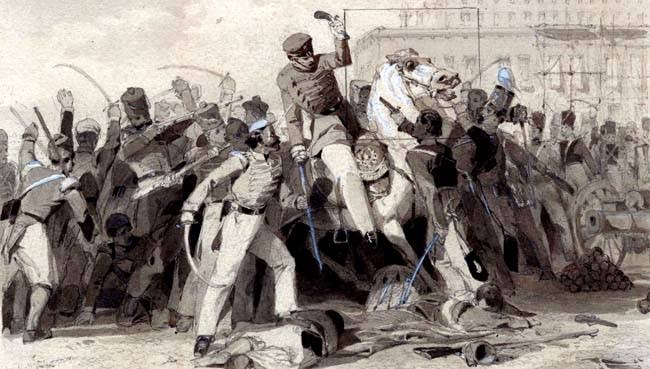
The sepoys rose up.
June 30, 1857.
The Battle of Chinhat.
Maulvi Ahmadullah Shah and freedom fighter commanders routed Henry Lawrence's force of 700 men.
300 British soldiers killed.
One third of the entire column.
Lawrence retreated into the Residency complex.
The Siege of Lucknow had begun.
33 acres.
A ridge above the Gumti River.
Roughly 1,700 soldiers. Hundreds of civilians.
Women and children sheltering in underground cellars. Surrounded on every side by a city in open revolt.
What followed was 87 days of the most brutal urban warfare in the history of the subcontinent.
Recommissioned Nawabi artillery pounding the perimeter day and night.
Freedom fighter tunnellers digging beneath the British walls to place gunpowder mines under their gun positions.
British engineers counter-tunnelling in darkness, listening underground for the sound of rebel picks.
Snipers in windows 30 yards from British positions. Firing continuously.
On July 4, Henry Lawrence himself was killed by a freedom fighter's shell inside the Residency.
He told those around him: Do not waste time on me.
The garrison buried their dead in the night so the rebels could not count the losses.
Begum Hazrat Mahal governed Awadh from the city while the siege held.
She had crowned her 12-year-old son Birjis Qadr as Nawab and organized the province-wide resistance.
She issued her own proclamation countering Queen Victoria's promises.
She told her people not to trust what the British were offering.
Maulvi Ahmadullah Shah commanded the military pressure on the Residency alongside rebel forces that numbered in the tens of thousands.
General Havelock fought his way toward Lucknow from Kanpur through the monsoon.
His column was decimated by heat, cholera, and rebel ambushes.
He reached the Residency on September 25, 1857. He entered the perimeter.
But he could not evacuate the garrison.
His own force was too weak.
The siege continued.
November 22, 1857.
Commander-in-Chief Colin Campbell finally evacuated the Residency with Nepalese Gurkha reinforcements.
By then Awadh had been fighting for six months.
Every taluqdar.
Every sepoy.
Every peasant who had been stripped of land, pension and livelihood.
They fought for six months to hold a province that a king had refused to surrender with a pen.
Wajid Ali Shah never came back to Lucknow.
He died in Calcutta in 1887.
He spent 31 years in exile.
His people gave everything to bring him home.
This August as Pakistan turns 79, remember the kingdom that refused to bow. The city that held a siege for 87 days. The king who would not sign.
Awadh. Lucknow. 1857.
Azadi Zindabad. 🇵🇰
Germany’s Deutsche Welle has released a documentary repeating tired allegations about Pakistan's nuclear program. Whenever you see the nuclear blackmail trope, it usually means Pakistan did something right.
The documentary paints Pakistan's program as illegal while ignoring history. Pakistan only built its deterrent after India detonated a device in 1974 using a Canadian CIRUS reactor meant for peaceful use. India pioneered regional proliferation, which led directly to the creation of the Nuclear Suppliers Group.
While DW claims Pakistan’s defensive weapons threaten global peace, facts tell a different story. The IAEA regularly praises Pakistan's nuclear security. Meanwhile, DW ignores India’s documented nuclear black market, including the 2021 seizure of over 7 kg of smuggled uranium in Maharashtra.
The film also frames Kashmir through the Western media template used for Palestine: treating resistance as the cause rather than the decades-long military occupation. It also ignores India's history of false flag operations, which former officials like Satya Pal Malik have openly exposed.
On militancy, DW weaponizes the radical Islam label. Yet Pakistan has fought terrorism harder than any nation, sacrificing over 80,000 lives and clearing groups through operations like Zarb-e-Azb. On law and order, the state aggressively prosecutes mob violence, as seen in the Sialkot case where 88 people were convicted, unlike India where mob violence is often protected.
DW should drop the double standards and instead document how Germany's current leadership enables the ongoing crisis in Gaza.
@PoltclCassandra Have used audionic personally and they are good. Not super great but also not bad. Haven't personally used zero but have heard awful reviews from friends who used them. Also ronin is good option too
@ibrahimbanglani The project is built so elites can get a faster way out either to dha/bahria or onwards to interior sindh and don't have to go through the hellhole ppp has made out of the whole city
@ibrahimbanglani Firstly infrastructure development is job of the govt, and after completing a small project in decades of rule you want us to give them some medal? Secondly the areas mentioned have most commuters who use either bikes or public transport niether of which use shahrah e bhutto