I first read Boethius’s Consolation as a teenager, and I’ve re-read it a couple of times since then. I revisit its poems more often.
“Almost no one” is a tad hyperbolic, but the message is clear: read Boethius. I concur: read Boethius.
@CatholicClod I think a few decades before Einstein, Bergson comes up with time as a dimension of space and critiques it! 10/10
Matter and Memory is at least as good.
Having encountered many people using parts of Epictetus’ hypothetical argument this responds to, it’s nice to have an unequivocal reply. Will use this one going forward.
but for the present be content to dwell in this country wherein He appointed you to dwell. Short is the time of your dwelling here, and easy for them whose spirit is thus disposed.
What manner of tyrant or what thief or what law-courts have any fears for those who have thus set at nought the body and its possessions? Stay where you are, and depart not without reason.”
Epictetus 1.9 has a longer take on the “open door” thing he mentions here and there (and is basically what I think he’d say to a depressed Porphyry):
“Men as you are, wait upon God. When He gives the signal and releases you from this service, then you shall depart to Him;
If you pray to the gods, give incense, libations, or cakes as offerings, and make an effort to live by basic cardinal virtues and connect with people trying to do the same - congrats! You have successfully reconstructed paganism.
Anything extra, if it is truly necessary, will be revealed through signs.
The idea that we need to have a feature-complete institution for exactly reinstituting the Eleusinian mysteries airdropped to us before we even have communities asking for it is ridiculous, and it comes from a combination of our adversaries making facetious demands and tepid or timid potential converts latching onto a reason to dither and delay.
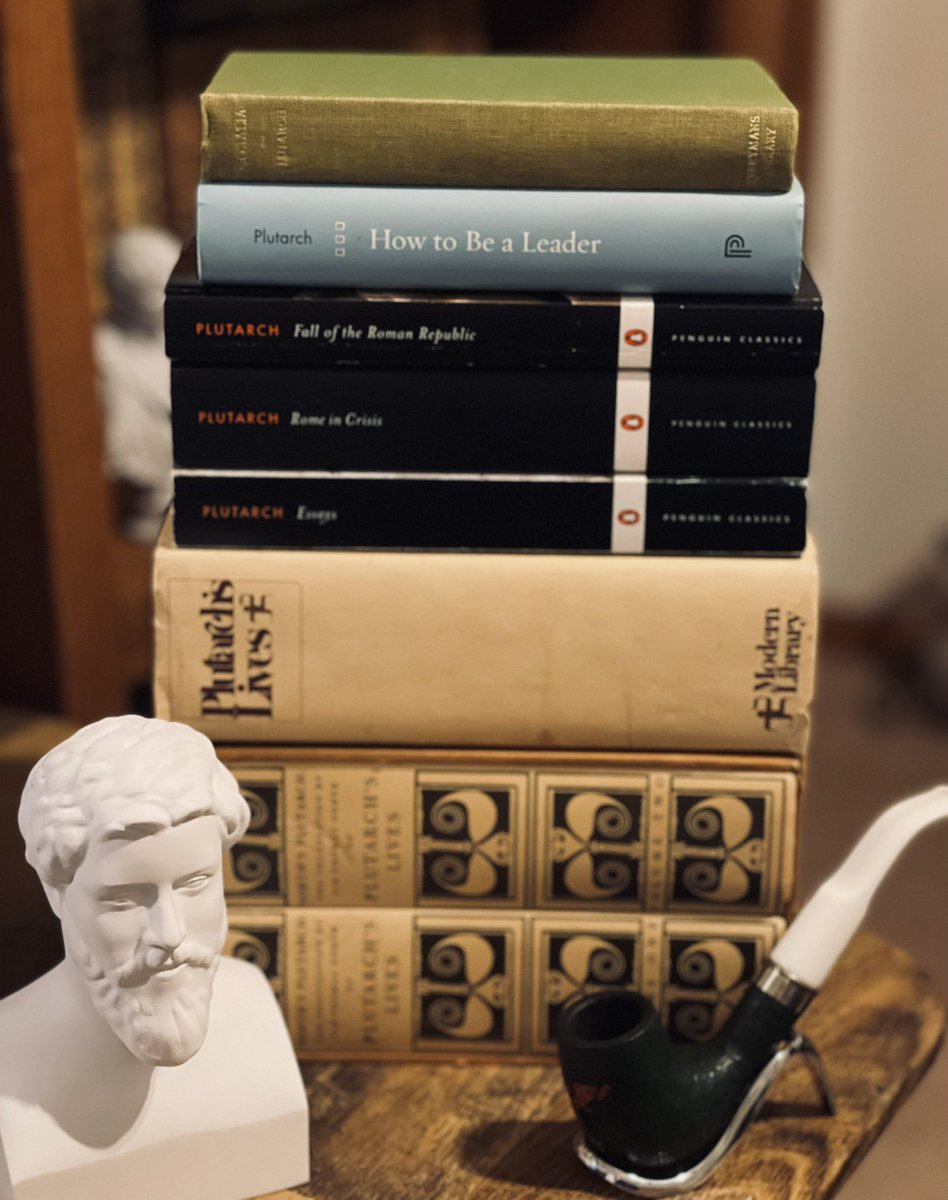
Don’t stop with Lives.
Plutarch’s Moralia is filled with brilliant essays on virtue, leadership, friendship, education, and the human condition.
If you’ve only read Lives, you’re missing an entire side of one of antiquity’s greatest minds.
in the Discourses he tends to attack with simple “you say you can’t be sure which is which but yet you never drink your shampoo or wash with honey” the use and manifestation is enough sometimes (though having more rigorous refutations is also good and important imo)
While I don’t like Wittgenstein’s image of letting the fly out of the fly bottle, I do like his earlier goal of philosophy- “to allow one to stop”. I sometimes over systematize to kind of distract myself from things I don’t like or feel like doing
Taken as one mode rather than one’s entire method, it reminds me of Epictetus arguing with the Skeptics. Epictetus no doubt studied the more comprehensive refutations of Chrysippus and Antipater, but
So the primary notions and roles are two angles we attack mistaken judgements from, along with logical reasoning.
On Duties pairs really well with Epictetus- lots of mutually reinforcing overlapping themes between them.
Epictetus’ philostorgia one is great to come back to. He really is nice to the guy actually; and he lays out again the process of practical reasoning pretty clearly.
We get an impulse to do something (he ties it directly to judgement here) then we should check it
Unlike the stubborn friend, this guy appears to have done so, but not satisfactorily, so Epictetus guides him through it (relating the appropriate actions of many roles based around care for the man’s sick daughter) again quite amicably, I think.