For sure, fair point. I rarely use twitter, just upgraded so I can elaborate a bit...
Per the Brattle study: "Half of the new transmission-level load is assumed to connect without imposing material new capacity costs on the system (e.g., through load flexibility during peak hours and/or self-supply from on-site generation). Additionally, a 500 MW portfolio of distributed energy resources (demand flexibility, batteries, energy efficiency, EV managed charging, etc.) is developed at an average net cost of $50/kW-yr." (https://t.co/IdrdZ8pwhu)
It's possible I'm missing something, but my understanding of the basic setup is:
> A 3000 MW utility that adds 1000 MW new load (+33%)
> The baseline case is all of this needs to be supplied by new infra investment
> The "utilization case" assumes 250 MW can be added to the transmission system with no capex impact, with an additional 500 MW added to the distribution system at $50/kW/yr, which feels pretty optimistic to me - what I referred to as "free or cheap"
More broadly, there are statements like this one from the Utilize Coalition: "Electricity costs are driven by a simple equation: the cost of the grid divided by how much electricity we sell over it. Providing more power through the grid we have lowers costs for everyone." (https://t.co/NLfcKrCU3s)
Personally, I find that a bit misleading. If you increase the denominator by adding load, which you also assume doesn't materially impact the cost of the grid (capex or opex) then sure, any new load you add will by definition result in lower rates. That's why the Brattle Study shows lower rates in all it's scenarios except the status quo. But I think the numerator impact is being underestimated. It might well be lower than the alternative of building new infra, but I don't think it's self-evident. As a result, you get the proverbial free lunch of increased load *and* lower bills.
@ArushiSF@JigarShahDC Ultimately I think we both agree on the potential for avoiding unnecessary capex spend. Is it necessary to overstate the benefits based with weak analysis? I'd be interested to do a more robust study to quantify the potential accounting for real world constraints.
@ArushiSF@JigarShahDC I don't think the Brattle study convincingly demonstrated that at all: 1) assumes away any wholesale price impact (still relevant for retail rates) 2) extrapolates results from a hypothetical 3 GW system to the whole US 4) assumes a bunch of cheap or free flex
@ArushiSF@JigarShahDC And yes, of course higher prices should incentivize new entry (absent price caps like pjm). But there's a time lag. Jigar and others have argued there are 100gw+ spare capacity that would have no price impact, which was the main thing I was addressing w the case study.
@JigarShahDC And that I'd rather spend time focusing on the underlying issue of a regulatory model that rewards utilities for capital spend rather than outcomes, which is ultimately what makes efficient use of existing infrastructure challenging. A utilization metric won't shift incentives.
@JigarShahDC My point is that higher grid utilization isn't a free lunch, that there are potential unintended consequences of a poorly designed utilization metric, and that there are more direct ways to achieve the same outcomes.
The fastest way to get new generation online to serve load is to let generators connect without waiting for completion of the comprehensive grid upgrades needed for their full deliverability under severely stressed system conditions.
Such generators become designated as “energy-only” per administrative definition, but they can supply capacity to electrically proximate load, put downward pressure on real-time energy prices, and provide supply ready to upgrade immediately to full capacity status upon completion of comprehensive grid upgrades.
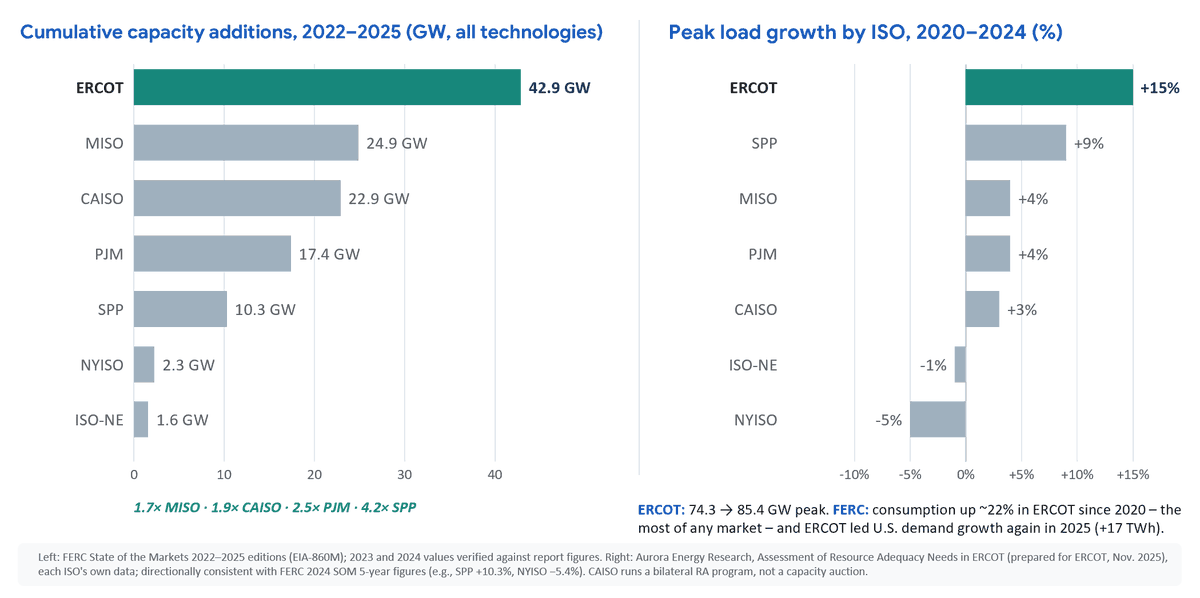
This is what Texas does (ERCOT), which is partly why its generator interconnection processing is ~2X faster than national average and how it has added 2.5X more generation than PJM in recent years.
FERC tried to provide such a pathway in the early 2000s, but in a recent study of >36,000 interconnection requests and 4,500 cost studies, we found that this option (called "ERIS," Energy Resource Interconnection Service) offers neither cheaper nor faster interconnection today.
This is what @SenatorHeinrich's (Ranking Member of Senate ENR) new bill seeks to fix by creating a Texas-style interconnection service option called Basic Access Service for Energy-only Delivery (BASED).
@JigarShahDC@gridcare@CamusEnergy I'm a big fan of the work @gridcare , @CamusEnergy and others are doing in this space. But I think the evidence base for the "100 GW" claim is weak. Why not seriously engage with the more substantive argument about costs?
@JigarShahDC Again I think you are very deliberately misrepresenting what I wrote. I was very explicit about how important it is *not* to leave that capacity on the table. My disagreement is about whether utilization is a useful metric to achieve the goals I think we both share.
In this piece, I argue grid utilization distracts attention from a more pressing debate about a utility regulatory structure that rewards capital spend rather than outcomes.
I welcome thoughts and feedback!
https://t.co/XlQZedI70A via @LinkedIn
LCOE is such a flawed metric, its use probably does more harm than good. Whatever small marginal value it provides as a simple way to compare resources is more than wiped out by the confusion it creates from being completely disconnected with how power markets actually work.
Out today: My @AmericanAffrs essay trying to reset the often-fever-pitched conversation about data centers & energy, with concrete ideas for how growth can be accelerated and legacy consumers can be protected -->
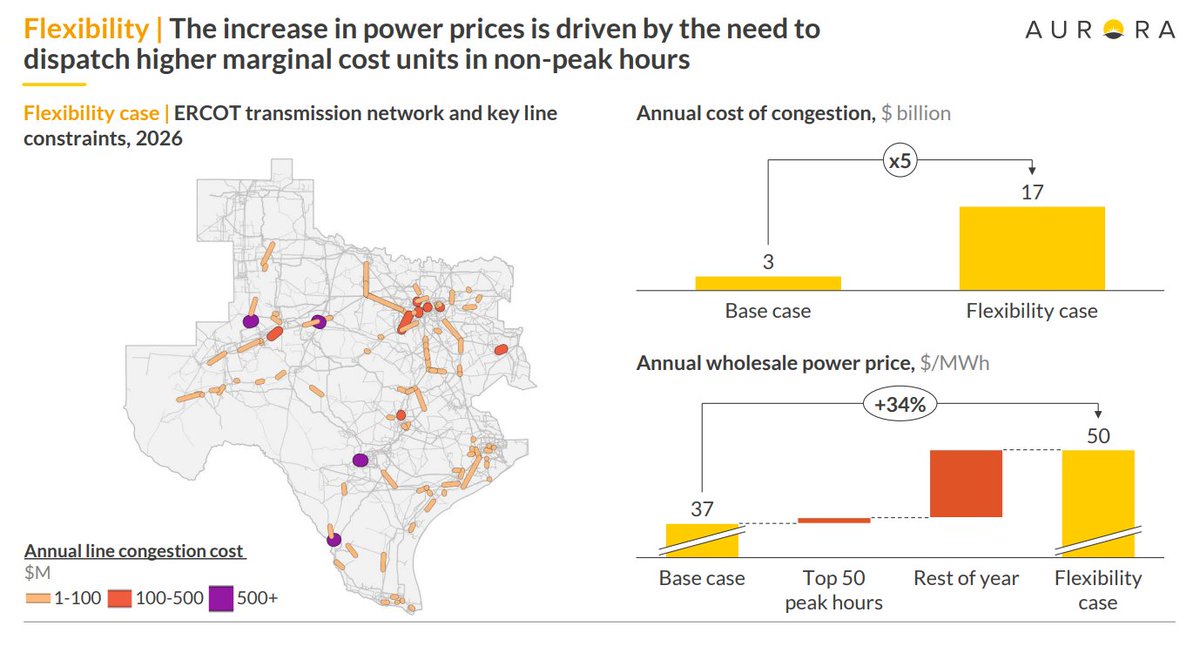
@JigarShahDC Even if you curtail load to avoid increasing the system peak (as in this scenario where we added 10 GW of fully curtailable data centers), better "grid utilization" is just another way of saying running less efficient gas more of the time, with less slack for extreme weather
@JigarShahDC System flexibility (demand response, VPPs, GETs etc) is super important and regulation needs to catch up (esp tariffs, conditional-firm interconnection). But "grid utilization" (system-wide load factor) is hard to take seriously as a relevant metric - how do you define 'good'?
The idea that AI is going to more "efficiently" give projects an answer about timing & cost (1-2 years!) in no way, shape, or form means that it will give answers on an economically efficient combination of projects