Rather than racing to replace people, we should build AI tools that amplify human expertise and expand opportunity, says Daron Acemoglu
https://t.co/RBH9QkaKbV
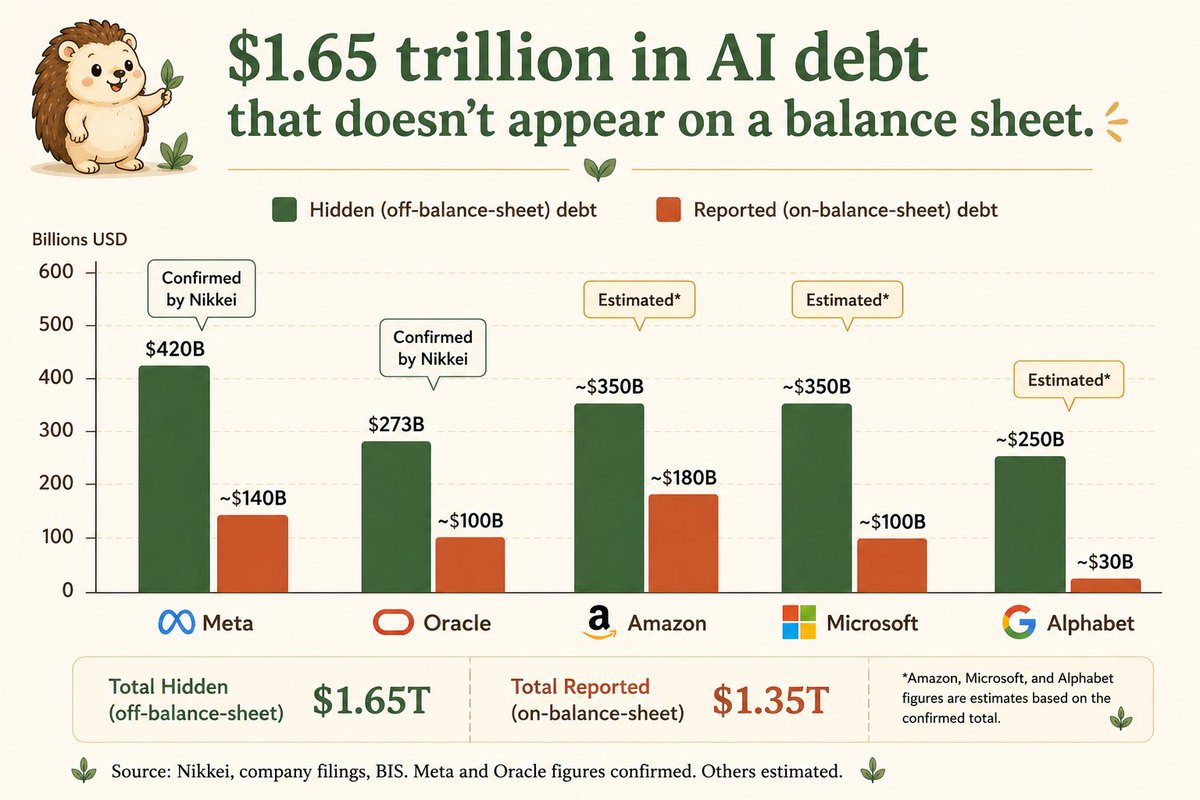
🦔A Nikkei investigation found that Alphabet, Microsoft, Amazon, Meta, and Oracle have $1.65 trillion in debt that doesn't appear on their balance sheets, more than the $1.35 trillion they officially report. These are GPU contracts, data center leases, and joint ventures that don't count as debt under accounting rules until the facilities go live. Meta's hidden debt is $420 billion, triple its reported debt. Oracle's grew 30-fold in four years. All five declined to comment.
My Take
Nikkei examined the actual filings and put a number on something the BIS already flagged as "shadow borrowing" back in March. These companies owe more off their balance sheets than on them, and the accounting rules let them keep it that way until the data centers go live. That's legal, but it means investors looking at quarterly earnings this week are seeing less than half the picture.
Four of these five report earnings in the next two weeks. The reported debt will look manageable. The $1.65 trillion in footnotes won't make the headlines. But when those data centers start operating, the leases hit the books all at once. If AI demand comes in below projections, those facilities get marked down and the losses land on the investors and insurance policyholders who funded the construction through private credit and project bonds without realizing how much total exposure they were carrying.
Hedgie🤗
@Fernand56602179@MendoncaRF and I have a new article that may be of interest to some of you. What is impact of AI agents on public services? - Governing the Ungoverned: AI Agents and the Future of Democratic Governance, IEEE Internet Computing, May-June 2026
Roughly 300 programs across Netflix's library have used generative AI across their production process this year, the company revealed.
“We are increasingly leveraging these tools to deliver higher quality output more quickly and at a lower cost than traditional methods,” the company said. “In some cases, productions would have had to leave out key shots and sequences in the absence of GenAI technology.”
https://t.co/92Yjt6PrV2
Dear followers, see this Substack from @MITshapingwork on my recent paper “AI, Human Cognition and Knowledge Collapse.”
Will AI lead to the collapse of collective knowledge?
https://t.co/3tEWfjsIdI
‘A very, very unpleasant surprise’: Meta forced to halt data center water discharges after polluting city's water reclamation system with resistant bacterium — shutdown and cleaning of two water reclamation plants expected lasted months https://t.co/K1yRinfJKS
We may be the last generation able to set the terms on which humanity and machines coexist.
If AI is to be powerful, it must be governed.
If AI is to be trusted, those who build it must be accountable.
If AI is to be global, it must be fair.
And if AI is to serve the future, it must not consume the future.
Let’s build a future of AI by humanity, with humanity, for all humanity.
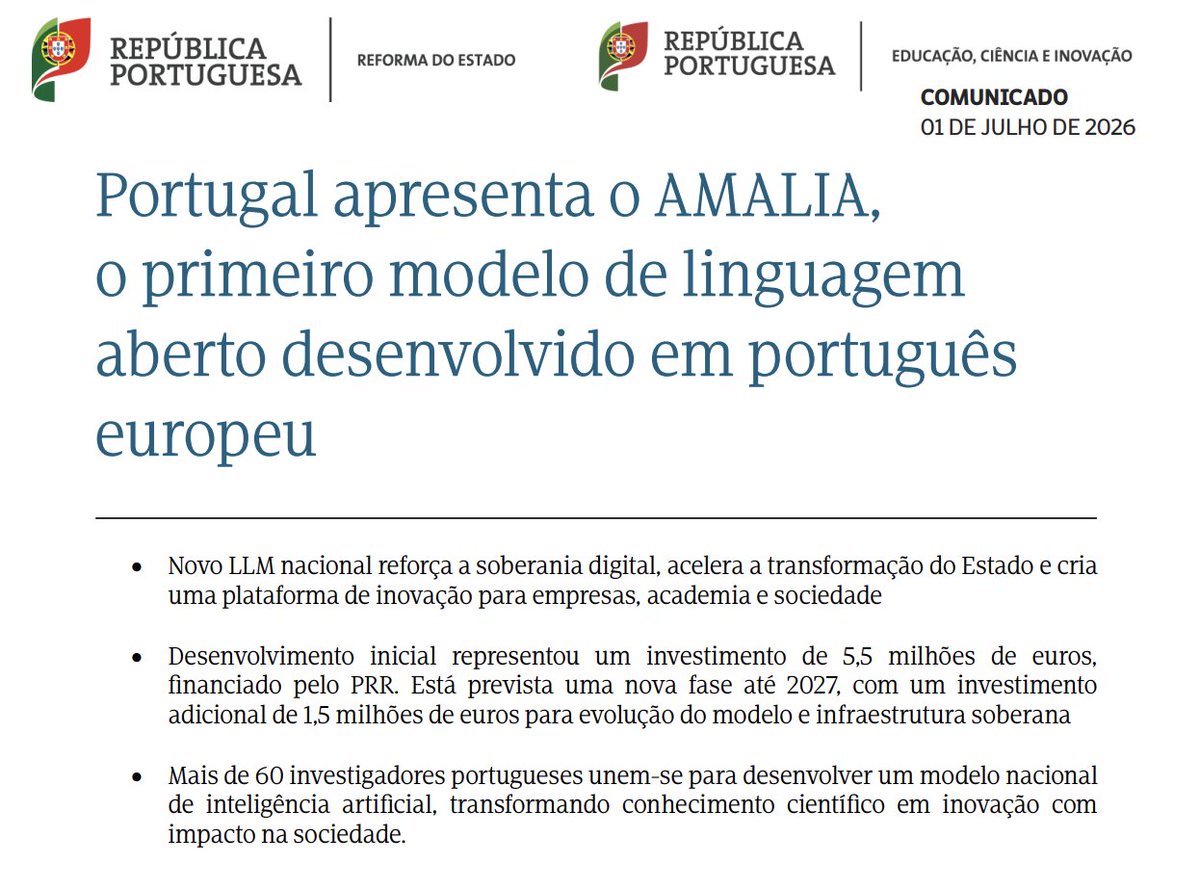
🚨 Portugal launches AMALIA, the first open-source model developed in European Portuguese. Interesting legal features:
- From an intellectual property perspective, the model was trained using publicly available and legally accessible data, framed within EU law applicable to scientific research.
- The model will be made available under the Apache 2.0 license, and there is a mechanism to report concerns, including intellectual property ones.
- Under the EU AI Act, AMALIA is classified as a General-Purpose AI model, without systemic risk.
- According to the official press release, it was developed following "high standards of security, transparency, and regulatory compliance."
- Portugal aims to strengthen the national AI ecosystem, providing an open model that can be used by everyone, including the public administration, to develop solutions in European Portuguese.
-
AMALIA is similar to Apertus, the Swiss AI model built around the idea of national AI development and prioritizing local languages, transparency, and legal compliance.
The new AI nationalism I've been writing about since last year is spreading, and it's great to see Portugal prioritizing its language and national development.
We'll likely see more countries following suit. I'll keep you posted.
-
👉 To stay up to date, join my newsletter's 97,600+ subscribers (link below).
As we discuss Mythos-level models, recursive self-improvement, and agentic systems taking over power grids, the paper
"Fully Autonomous AI Agents Should Not be Developed"
remains more relevant than ever.
By @mmitchell_ai, @evijit, @SashaMTL & @GiadaPistilli.
Link below.