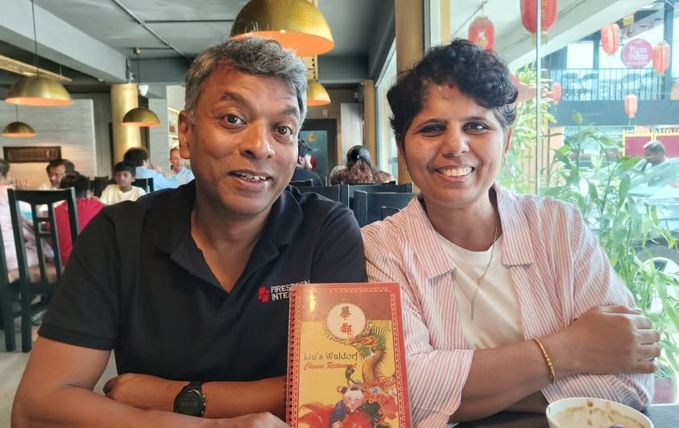
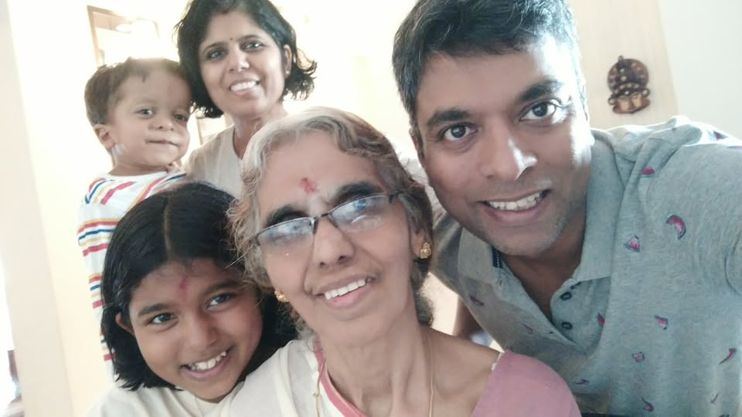
Till now I used to think that my wife and I had built a fantastic family of four, but thanks to @RahulGandhi, India’s leader of the Opposition…I realized that I have been living a lie.
Let me explain.
My wife and I have morning tea, breakfast and lunch at our dining table.
Fierce family discussions, WhatsApp calls with relatives and office Zoom meetings also happen at the same dining table.
Till two days ago, the innocent and ignorant me had no complaints about where my wife sat during meals.
She would sit opposite me and it was convenient because we could look at each other, and if either of us got tired of doing that, there was always The Hindu newspaper.
Then Rahul Gandhi, shared how his parents sat during meals and everything changed in our house.
At the launch of his mother Sonia Gandhi’s memoir, Belonging: A Journey of Love, Rahul recalled that when he was growing up, his mother used to sit on his father Rajiv Gandhi’s lap during meals.
Apparently, he thought this was how all parents ate, and when he visited a friend’s house, he wanted to know why the boy’s mother wasn’t sitting on his father’s lap.
I thought it was a lovely memory of his parents.
After watching him speak, I could have just closed Instagram, smiled at myself and gone back to my dosa while it was still hot.
Instead, I looked across the dining table at Rekha. I didn’t see my wife Rekha…I saw a woman who, for twenty-two years, had neglected her husband.
“Rekha, how come you have never sat on my lap?” I asked.
She looked under the table.
“What are you looking for?”
“Your brain! Just seeing if it dropped onto your lap.”
“Come on, I am serious…why have you never sat on my lap?” I asked.
Of course, my voice wasn’t stern. Over the last 22 years, I have learnt that any request for intimacy with Rekha has to be made in a meek voice, as if one were seeking alms.
So much so that there have been times when I have wanted to enter the bedroom shouting, “Bhavati bhiksham dehi!”
When translated into English, it means “O noble lady, please give me alms!”
But we Rajans also have dignity, so I have never done that. Also I don’t want my wife to hear this and get angry, and refuse to allow me inside the bedroom.
“Where is this coming from, Rajan?” my wife asked taking a bite of dosa with sambar.
Thankfully, I hadn’t closed the Instagram app, so I could reopen it and show her Rahul Gandhi’s video of him describing how his mother sat on his father’s lap during meals.
Rekha saw the whole video, said, “That’s nice,” and then dipped her dosa in the chutney and took a another bite.
Just nice? A former Prime Minister had found time to provide his lap for his wife while running a country, and now the CEO of a startup (that’s me!) was also offering to do the same…but all that his wife could come up with was ‘That’s nice’?
We Rajans may be meek while seeking intimacy from our wives, but we don’t give up easily.
“Doesn’t it bother you that in twenty-two years of marriage, you haven’t sat on my lap even once?”
“Does it bother you?” Rekha turned the question around.
“Of course it does.”
“Since when?” she persisted.
“Does that really matter?” I asked.
Rekha didn’t answer. My wife has this annoying habit of filling the room with silence, especially when I am about to win the argument. And I have realised that by not answering once, she immediately regains the upper hand in the argument.
Neither my wife nor I am religious, but we think of God whenever we need him.
So I decided to bring in a witness with slightly more authority than Rahul Gandhi.
I googled and found a photograph of a twelfth-century bronze of Shiva and Parvati in which the goddess was seated on the lap of Lord Shiva.
I enlarged the photograph and handed Rekha my phone.
“See? Even Parvati sat on Shiva’s lap.”
Even as Rekha studied the photograph, I was pleased with myself.
After what seemed like an eternity, my wife looked up and asked, “How many hands does Shiva have in this one?”
I took the phone back and counted. “Six.”
“Good. Two to hold Parvati so she doesn’t fall off, two to eat his breakfast, and he still has two left to handle the rest of the world. How many hands do you have?”
I put the phone down.
Seeing that I was losing the argument, my wife went into overdrive.
She said, “And how do you know that five minutes after the sculptor left, Shiva didn’t say, ‘Parvati, my left leg has gone to sleep. Can you get off, please?’”
Rekha was making fun of my problem statement, and I didn’t like it.
So I dug deep and threw in one more allegation.
“During most South Indian weddings, the girl sits on the groom’s lap…but your father never made you sit on my lap,” I continued complaining.
Over the next two minutes, Rekha explained how it was a practice followed only by Tamil Brahmins and by some Telugu and Kannada families, and not by Malayalis.
Once Rekha had explained why, I was at ease. So her father hadn’t robbed me of an opportunity on my wedding day itself.
If she had left it at that, I wouldn’t have been pissed. But knowing fullly well that I am proud of my physical fitness, Rekha decided to hit me where it hurt.
She said, “Even if I had sat on your thigh, could you have survived a 6-meter long Kanjeevaram saree, 300 grams of gold, three kilograms of jasmine flowers and a 48-kg me…without going completely numb?”
I tried to remain silent and gain the upper hand in the conversation – a trick Rekha uses often. But somehow, this trick works only for her. When I remain silent in an argument, I only end up losing more ground.
Rekha continued, “If I had sat on your lap for even ten minutes, you wouldn’t have been able to walk the three rounds around the fire.”
Again, I remained silent.
I didn’t understand where I had gone wrong. I hadn’t said that I wanted to be the Prime Minister of India, I hadn’t said that I wanted to marry an Italian lady….all I wanted was for my wife to sit on my lap once in a while.
Was that too much to ask?
As I was lost in my thoughts, Rekha pushed her plate away and moved closer to me. I am not sure if it was because she could spot a little tear forming in my eye or because of the little bit of a choke in my voice when I had complained that her dad hadn’t made her sit on my lap.
“Rajan, if you want me to sit on your lap, just tell me. OK?”
It was irritating how good that sounded.
Had I smiled at that moment, my wife and I could have had lunch sitting on the same chair that day. But you know us Rajans – we don’t tell boring stories.
So I said, “That isn’t quite the same thing, Rekha. If I have to ask you to come and sit on my lap, where is the romance?”
And since, at that moment, it seemed as if I was on a roll, I continued: “Also, I have decided that my first book won’t be fiction.”
“Then?” my wife of 22 years asked.
“It will be my autobiography, titled Sitting Apart: A Journey of Twenty-Two Years.”
Rekha smiled. If you have been married long enough, you know that it is irritating to see your wife smile when you are having a serious argument.
I hadn’t yet recovered from her smile when she said, “Lovely title. Send me the draft. I’ll correct the spellings and fix all the grammar mistakes.”
We Rajans are like cockroaches and we can take all kinds of insults sitting down, but one thing we can’t take is an insult to our English.
Here I was, threatening to expose the cracks in our marriage, and my wife was offering editorial support.
At that moment, I decided that enough was enough.
“Rekha, some men would consider this grounds for divorce.”
She stopped gathering the plates.
“Divorce?”
Now, when a man introduces divorce into a conversation, he has a particular response in mind.
I expected my wife to put down the plates, sit beside me and say, “Rajan, don’t talk like that. Come, let me make some tea and we will talk it over.”
My wife did put down the plates, and for a brief moment, things were going according to my plan.
But then she said, “Okay, let’s work out who gets what.”
“Why are you in such a hurry?” I protested.
I wanted to ask her if there was already a man in her life, but better sense prevailed and I kept mum.
Thankfully, Rekha filled the silence: “You brought it up. I have a call with the NIIT team at ten.”
It was 9:42 am. After twenty-two years together, my wife had allocated eighteen minutes for our separation.
Sixteen, actually, because she likes to log in two minutes early.
“You can keep one of the double beds…you will need that to sleep with your new wife. Take the sofa as well, and the dining table with one chair,” she said.
“That’s very generous…but why only one dining chair?”
“Why do you need two, Rajan? Isn’t that what this whole fight is about?”
I sat there looking at my wife. I could only admire the woman sitting in front of me – she had listened carefully to my needs and used that information to reduce my share in the divorce.
On the back of an envelope, she wrote ‘1 double bed, 1 sofa, 1 dining chair’ and then asked, “Is there anything else that you want?”
“Yes. Before we go our different ways, I just want to know when you stopped loving me. Is there another man?”
“I haven’t stopped loving you, you idiot. I got up at three this morning because I heard you cough from the other room.”
“You did?” I asked, surprised.
“Yes, I brought you warm water, waited till you drank it and then lay awake listening to you snore. Where do you think I was sitting then?”
That’s when it all came back…I remembered the warm glass against my hand in the dark. I also remembered making room for her on the edge of the bed without quite opening my eyes.
“Next to me,” I said.
“Yes, Rajan. I generally am next to you…always.”
Then she picked up her cup of tea and came round to my side of the table.
I shifted my chair back and, I don’t mind admitting, it felt good as Rekha came in between the dining table and the chair to sit on my lap.
But just before she could sit down, I stopped her.
“Rekha, the left knee, please…remember the surgery?”
I’d had ACL surgery on my right knee a few years back.
Rekha walked around me and tried to slowly sit down on my left knee…midway through, I stopped her.
That was all – I didn’t say why I stopped her, and she didn’t ask either. She understood.
But as a reader you may not know…so let me give you a hint – she is no longer the 50Kg Taj Mahal she used to be when we got married. But she is Taj Mahal, nevertheless.
We both started laughing…and in the process, she even spilled her tea. But since it was she who spilled it, it wasn’t a big issue.
Then she pulled up the spare chair, sat down beside me and we laughed more.
For now, we have decided to stay married. We have also decided that where my wife sits is largely up to her.
When I read the news that a Chinese spy had tried to honey-trap @JensenHuang Jensen Huang, the CEO of Nvidia, I had no idea I was next.
In hindsight, it makes sense - while Jensen had the AI chips...I had the A1 jokes.
Don't worry...I am safe. But you need to know the full story.
A few days ago, a Chinese woman began replying to my posts on Twitter.
Initially, I didn’t suspect anything because women have been appreciating my writing for years.
Some even say that Rekha is lucky to have an adorable pushover like me for a husband.
But this Chinese woman was different…she would read my long posts till the end. I know because she would reference the last paragraphs in her replies.
Those of you who have been following me for a while know that very often, someone or the other leaves a reply that reads: “It was funny, Rajan…but it was too long…so I didn’t finish it.”
This Chinese woman would reply to older posts as well.
“You have such a wonderful sense of humour.”
“Your wife must laugh all day. She is so lucky!”
“I wish I knew someone like you.”
I liked the third reply immediately. The lady had identified a gap in her life and wasn’t afraid to discuss it with me. She probably also wanted me to fill this gap…but of course, I couldn’t leave Rekha for a Chinese woman I had just met online.
A few days later, she sent me a DM on Twitter.
“Hello, R. I hope you don’t mind me messaging you.”
I didn’t mind. But then we Rajans don’t like to give the impression that we are available all the time, so I waited for three full minutes before replying.
“Hello, J. I don’t mind at all. How are you doing?”
I am sure that, as she waited a full three minutes for my reply, she would have figured that I was a tough nut to crack.
You probably already know by now that we Rajans are smart people. So I started connecting the dots.
And then it struck me - China may have wanted Nvidia chips from Jensen, but from me they wanted ‘my jokes’.
My respect for the Chinese went up immediately. We Indians don’t understand the importance of jokes. In fact, “He is a joker!” is how we admonish others.
But the Chinese seem to have understood that while they needed AI chips for technological progress, they also needed A1 humour to make the people using them laugh.
Not AI jokes. A1 jokes.
My jokes had the hallmarks of a man who had spent years observing middle-class Indian life, irritating his wife and surviving the consequences.
But there was no way I could hand over that kind of intellectual property to China.
My father had joined the Indian Army in 1964 after India lost the 1962 war to China. So China and later Pakistan were discussed a lot in our home. We learnt early that they were India’s archenemies.
The way I think now has changed. Now I know that the three countries can peacefully coexist, but then, I also know that our politicians can’t win every election on cows, temples and religion alone.
Anyway, my father’s soul would continue to haunt me if he came to know that his own blood had sold his A1 jokes to China.
Even if I managed to convince my dad (who is no more), there is no way I could backstab my Prime Minister, who has shown his ‘laal aankh’ to China so many times.
Despite all these reservations, I didn’t block the Chinese woman. It takes a certain courage to block a pretty lady, and I will be honest…I don’t have that.
So I decided to chat with her and understand what my country’s enemy wanted.
The lady asked about my childhood, my marriage and how I came up with my funny stories.
I answered carefully.
Then she asked, “Do you have any funny stories you haven’t published yet?”
I sat up. There it was - they already had access to my publicly available A1 jokes, but now they wanted what I hadn’t published yet.
“I have a few,” I replied cautiously.
“Could you share one?”
I decided to challenge her. I asked, “Why are you so interested in me?”
Her reply arrived a few minutes later.
“I’m doing a college assignment about humour on social media. Your funny posts are very useful for this assignment, Uncle.”
I stared at the last word. I didn’t particularly like the word “uncle”, but ever since I came to know that Gen Zs use the phrase ‘Unc got no chill’ to describe a man who is uncool, I have started hating the word.
Here I was preparing to defend India’s humour reserves, while the lady was only trying to collect funny material for a college assignment.
I went through her earlier replies again. She had mentioned, “I wish I knew someone like you.”
And then it occurred to me…maybe she had meant she needed someone who could help her with her assignment.
We Rajans are like cockroaches and can survive all kinds of situations, but I will be honest - it was demotivating to know that I wasn’t the target of a Chinese woman spy.
---X---X---
The next morning, I didn’t go to the office.
“What happened?” Rekha asked.
“Nothing. I’ll work from home today.”
She looked at me carefully.
“Are you unwell?”
“No. I just don’t feel like going.”
I opened my laptop, but every few minutes, I checked Twitter.
There were no new DMs, no suspicious spy-level replies…not a single foreign government was interested in me.
By lunchtime, I began questioning my life’s achievements.
Rekha was working at the dining table. I sat opposite her and asked, “Do you think I am still funny?”
She pointed to her earphones.
“Rajan, I am in a meeting.”
I nodded and waited.
After a few minutes, I wrote the question on a piece of paper and pushed it towards her.
She read it, looked at me angrily and pushed it back but didn’t answer.
I didn’t know whether that meant I wasn’t funny, that she was still in the meeting or that she needed more time to evaluate me and give her response.
For the whole of the next week, I felt low, so I continued to work from home.
Unfortunately, whenever my heart isn’t in something, I prefer to be close to Rekha. I followed her around the house, asking questions.
“Do you think people genuinely like my writing?”
“Yes.”
“Then why don’t more people reply?”
“Maybe they are busy.”
“But they have time to read.”
“Rajan, I am also busy.”
My wife wasn’t lying, so I went to another room for half an hour. At 4:40 p.m., I took a cup of tea to her, sat beside her and began reading my latest article.
“Just tell me whether this opening works,” I asked.
She removed her earphones.
“Can this wait?”
“Of course,” I replied.
I waited until she put her earphones back on.
“How long?”
By the fourth day, Rekha began closing the bedroom door during meetings.
By the end of the week, Rekha sat me down and asked, “Rajan, what is bothering you? You aren’t yourself.”
Initially, I was reluctant, but when Rekha persisted, I told her about the Chinese woman and her assignment.
Rekha listened quietly and asked, “So you’re upset because she wasn’t trying to honey-trap you?”
I nodded and looked down.
“Really?” I could tell Rekha was surprised.
Without looking up, I explained that I might not have the $141 billion that Jensen Huang is worth, but I like feeling valued.
Even though I was still looking at the floor tile in front of me through my moist eyes, I could tell that Rekha was looking at me.
“Don’t worry, Rajan…things will get better,” she said and went back to the bedroom.
---X---X---
As luck would have it, the next day, another Chinese woman replied to my post on Twitter.
“This made me laugh so much. You must be wonderful company.”
I hadn’t even finished reading the reply when she followed me.
I checked her profile. She was a Chinese woman living in Chennai and running a baking business.
After following her back, I waited for her to message me.
If somebody wanted to honey-trap me, I wanted them to put in some effort first.
She messaged the same night at 8:30 p.m. The timing seemed convenient because all my readers know that Rekha goes to sleep by then.
We spoke about my posts, and she asked how much of what I wrote about Rekha was true.
For every message of mine, this Chinese woman was sending two to three laughing emojis.
My wife hadn’t laughed at anything I had said for a week, and here was a woman who found every message of mine funny.
Immediately, my self-worth shot up, and the next morning, I went to the office.
Rekha seemed delighted and asked me if I was feeling better now.
“Yes, Rekha, much better,” I said, smiling.
---X---X---
A few days later, the Chinese woman suggested we have coffee together.
I agreed, but selected a café near my office. To be extra careful, I had selected a café which was bound to be crowded all through the day and had easy access to the main road.
We Rajans may enjoy female attention, but we don’t ignore basic security.
She was pleasant and easy to talk to. She asked about my childhood, my writing and whether I had always been funny.
I told her a few stories, and she laughed all through without even checking her mobile once.
That was when I knew something was different about this woman - even Rekha checks her phone when I tell a story.
Then she told me about her baking business.
Apparently, she also made cakes to order, which I thought was a great cover for a spy.
Nobody would question a woman carrying a large cake box anywhere. She could keep anything inside - a cake, an AK-47 or a vial of cyanide.
You know us Rajans…we love risk. So over the next few days, my mood improved considerably.
A few days later, we met for coffee again, and this time she sat on my side of the table.
She complimented my shirt, touched my arm while laughing and said that she enjoyed spending time with me.
I remember blushing. After all, how often does a married man hear a woman other than his wife say that she loves spending time with him?
But then she moved closer still and leaned towards me as if she was going to kiss me.
I immediately pulled back.
“Sorry…I am married.”
“We know,” she said.
“We know? So it is true?” I asked.
She stared at me as if she didn’t know what I was talking about and then asked, “What is true?”
“Aren’t you a Chinese spy trying to honey-trap me? Didn’t the Chinese Intelligence Agency send you?”
But before she could answer, I stood up and rushed out of the café.
Until that moment, I had enjoyed the idea that somebody might be interested in me - that a foreign government might have a file on me and send a highly trained spy to honey-trap me.
But I hadn’t thought beyond that.
Now that the spy had come close to kissing me, I couldn’t think beyond Rekha.
I rushed out of the café, went to the office, picked up my laptop and headed home.
---X---X---
Rekha was at the dining table when I walked in.
“You’re early,” she said.
“I need to tell you something.”
She looked at my face and closed her laptop.
I sat down and told her everything - the Twitter replies, the DMs, the coffee meetings and how I finally found out that it was the Chinese Intelligence Agency’s attempt to honey-trap me.
Rekha smiled.
“I know.”
I stared at her.
“What do you know?”
“I asked her to message you.”
For a few seconds, I couldn’t speak.
“You?”
“Yes, Rajan. You were sitting at home, getting on my nerves and not letting me work. I had to bring you back to your senses.”
“But how do you know her?”
“She’s the only Chinese woman I know. She owns Gaylord Laundry Services, which is where I give my silk sarees for dry-cleaning.”
I looked at my wife.
“But Rekha, that lady told me she runs a baking business.”
“Yes, Rajan, I told her to say that. If she had mentioned laundry, you might have recognised her.”
I didn’t believe my wife.
“But she said she loved my writing and found it really funny.”
“Yes, I told her to say that…I knew that it would make you feel valued.”
I sat back. For a moment, I wondered if Rekha was also a Chinese spy. Maybe a sleeper agent who had taken her job seriously and started sleeping with me.
“And that kiss…that woman tried to kiss me, you know?” I asked.
“I asked her to go for it. I wasn’t sure how you would react, but it was worth knowing.”
I didn’t know what to say, but I felt Rekha’s hand on mine.
“And I am glad you are back home with me,” Rekha said, squeezing my hand.
For a moment, I felt better, but before I could say anything, she looked at my laptop bag beside me and asked, “But you are still going to the office tomorrow, right?”
Every WhatsApp group has two kinds of people - those who type and those who live by the emojis.
And please don’t underestimate WhatsApp emojis for they represent ‘full sentences’ typed by people who either love you, judge you, hate you, or simply don’t care about you.
A few decades from now, anthropologists who study cave paintings, ancient inscriptions, architecture, etc., to understand a civilisation will want to study WhatsApp emojis.
Because WhatsApp is to today’s people what the Roman Forum was to Romans and the Athenian Agora was to the citizens of Athens.
Because that’s where people meet daily, exchange pleasantries, do business, fight, bless, judge, and ignore.
And inside WhatsApp, nothing is more important than emojis.
For instance, a single folded-hands emoji can mean thank you, sorry, namaste, please stop, I disagree but don’t want to fight, I don’t know what to say, and I don’t want to be rude.
That’s why I thought maybe it is not a bad idea to write about my favourite emojis and how we all use them.
If you are in a group chat with me on WhatsApp, at the end of this article, you will know my secret to good communication. So please just keep it to yourself.
----X----X----
🙏 – the folded hands emoji
This is the Amitabh Bachchan of WhatsApp emojis because it can be used in all situations.
You can use it if someone sends birthday wishes, if someone sends condolences, if someone shares photos of a temple, or if someone says “I am leaving the group because nobody respects my opinion.”
This emoji is so flexible that many people who don’t understand the context can also use it.
If someone writes, “I wish I could come and visit you in the hospital …but I was stuck in a meeting” the patient would reply with the folded hands emoji.
And two days later when the patient would die, and the same person messages, “I am sorry I couldn’t come and meet your dad before his untimely death. Will come over later” the patient’s son could use the same folded hands emoji.
So, it cuts across situations and generations.
👍 – the thumbs up emoji
If you are married, this is one of the most dangerous emoji for you.
Among men, thumbs up means approval but among women it can mean many things.
When I message Rekha saying, “I will be late,” and she replies with a thumbs up it doesn’t mean that she is OK with it.
It means, “I have received your update. Further action will be taken after you return home.”
In WhatsApp groups, thumbs up is also used to stop the conversation from going further.
But many people don’t know how to use it.
We were recently planning a massive group trip to Pollachi in Tamil Nadu, and one of the organizers asked, “Please confirm your availability for 14, 15 and 16 August, mention the number of adults and children, and what you would prefer – vegetarian or non-vegetarian?”
One of the travellers responded with thumbs up emoji.
Now we don’t know if he is available on those days, how many of his family members are coming along and what his food preferences are.
But in his mind, he has responded.
😂 – the laughing emoji
I use the laughing emoji even when the sentence is not funny…even when I didn’t even smile.
And I am sure there are many other there just like me.
Let us be honest….if you are really laughing like that will you be able to hold your mobile properly, select that emoji and then tap on the ‘send’ button?
At best, they would have a hearty laugh, then wipe their eyes, hold their stomach, and maybe type “hahahaha.”
I think the laughing emoji is used when someone has made a joke and you don’t want them to feel bad.
This emoji is closest to social service – makes both you and the receiver feel good.
The laughing emojis have a super power…when one user uses it, others are forced to use it.
The moment you send three laughing emojis…5-6 more people will also send them.
Not because they also laughed…but because otherwise it would seem as if they didn’t get the joke.
🤣 – the slanting laughing emoji
This is used by people who want you to know that they are more amused than normal people.
While the normal laughing emoji conveys that it was a nice joke, the slanting laughing emoji means “I am rolling on the floor laughing.”
But honestly, think about it…how many of you have actually rolled on the floor and laughed at something you read on WhatsApp?
Also, if like me you are a middle-aged man and you roll on the floor laughing, your family will first check whether you are having a stroke.
❤️– the heart emoji
Many Indian men have a problem with the heart emoji because they consider it public display of affection.
In sharp contrast, Indian women use the heart emoji easily.
A group full of women usually has more hearts than words.
Maybe because they are emotionally literate.
Men are different.
If a male friend sends another male a heart emoji, the receiver won’t sleep the whole night.
He will wonder what happened…why did he send me a red heart.
Is he okay? Is he drunk? Should I reply a heart emoji or a folding hands emoji?
If I reply a heart emoji, will it end there? Or will he send something more provocative?
Men prefer thumbs up emoji because that is like a handshake, while a heart emoji feels more like a hug.
But send a WhatsApp uncle the Indian National Flag, and he will heart it twice (thankfully WhatsApp doesn’t have that feature).
😢– the sad emoji
For a long time I didn’t realize this was the sad emoji.
I thought this was to be used when we have cold, and have to convey that we have a runny nose.
People use it to express sadness, but when words are risky.
For example when someone sends in, “I am sorry to say that Mr Muralidharan passed away this morning while lifting weights at the gym,” you can’t type back, “I am sad, but I don’t know the deceased well enough to write three lines.”
And that’s why this sad emoji exists…to rescue you from such situations.
But I hate it when some people overdo sadness.
Like that instance, when someone’s scooter got stolen from our block, a resident sent six sad emojis.
For a moment I thought he was the thief, trying to cover up.
👏– the clap emoji
The clap emoji is used to play social debt.
If you clapped when someone sent in the group their or their child’s achievement, then they must clap back when you send in your family’s achievement.
Both Rekha and I indulge in these clap exchanges often.
The moment our daughter bakes something Rekha will send in a few pics, and get many claps.
Since I don’t like to be in debt, I tell her not to do this.
Because now I have to keep waiting for something their kid did. But Rekha doesn’t listen.
Here are a few examples of messages that seem to get the clap emoji:
“Proud to share that Ananya has won second prize in inter-school colouring competition.”
“We are happy to share that Sahil is now a Karate yellow belt.”
These clap emojis are usually followed by short messages such as, “Wonderful,” “Great achievement,” and “Blessings.”
🔥– the fire emoji
The fire emoji represents ‘amazing’ and the younger generation uses it a lot while the older people don’t fully understand it.
If Rhea posts a photo of hers and someone uses a Fire emoji, I understand it means “looking great.”
But some elderly relative may see it and get worried.
They may ask, “Why fire? Is everything alright?”
That’s why ladies and gentlemen, if a WhatsApp uncle sends a Fire emoji in a group please check context…it may be his last cry for help from a building on fire.
😍 – the heart eyes emoji
The heart eyes emoji is a diluted version of the red heart emoji and is mostly used on photos of babies, food, sarees, vacations, etc.
I use them often, but most men shy away from using the heart eyes emoji because it shows them as weak. “Emotions? Eww!”
Usually a married man has to be careful before using a heart eye emoji under another woman’s photo.
That’s why, a married man is forced to use a thumbs up emoji or a clap emoji if they receive another woman’s photo.
🙄– the eye roll emoji
The eye-roll emoji is mostly used by women and teenagers.
I am yet to see a man use this.
Maybe because they don’t do a real-life eye roll or they are scared of the consequences.
When someone uses this on you, the meaning varies based on the person.
For instance, if Rekha sends me an eye roll emoji, I know she has judged something I have said and there are going to be consequences later in the evening.
And if my daughter Rhea has used it…she didn’t like the ‘dad joke’.
Sometimes this emoji is followed by single word messages such as: “Really?” “Again?” “Please stop.”
🤔– the thinking face emoji
The thinking face emoji is often used by people who want to appear smarter than they actually are.
In apartment groups, this emoji is very common.
The Association President will say, “Maintenance will increase by ₹500 from next month,” and immediately one resident will reply with the thinking face emoji.
They may not even know how much they are paying per month currently, but this one thinking face emoji may make another group member believe that a revolution has started and they will send a “Why?”
The thinking face emoji is often the first stone thrown before a digital riot on WhatsApp.
For the lack of time, I will now only mention some of the other honourable emojis:
- the smiling face emoji
- the anger emoji
- the bouquet emoji
- the cake emoji
- the hugging face
----X----X----
Over the years, I have realised that each person has an emoji personality.
Some are folded-hands people, some are thumbs-up people, some are heart people and some are laughing emoji people.
You just need to identify them, and understand their game.
Just be careful, because in this cruel world, sometimes one emoji is enough to start a riot.
Note: If you liked this article, send 😂. If you felt seen, send 🙏. If you are angry, send 😊so I know the matter is serious.
If you have read me enough, you will know that before meeting me, Rekha’s dream was to marry a tall Malayali man with a thick moustache and a Royal Enfield.
Basically, she wanted a man who could ride through the Western Ghats, stop near a tea shop in Wayanad, remove his helmet in slow motion, and make three women forget their husbands’ names.
And then she married me.
By marrying me, Rekha fulfilled exactly 0% of her wishes - I am not tall, I am not Malayali, I have never had a thick moustache and I have never owned a Royal Enfield.
But is Rekha happy? Yes. I think so.
So the real question is: how did a woman who wanted a tall Malayali with a thick moustache and Royal Enfield end up being happy with me?
The answer, ladies and gentlemen, is simple - we Rajans are wife-friendly men.
And there are two main reasons for this:
1) We are conversationalists
2)We keep changing our goalposts (I will explain)
Both qualities are very important for a happy marriage.
The first trait helps you talk your way into the woman’s heart and the second trait helps you stay happy so you don’t mess up the woman’s life.
----X----X----
Let us first discuss the conversationalist part.
There are broadly three kinds of men in this world.
//Type of men who can’t converse//
They will sit in the house like furniture.
Their wife may tell them about office, children, maid, mother, school, neighbour, plumber, milkman, gas cylinder, etc…but the man will keep looking into his mobile and say, “Hmm.”
That’s all. This is the worst kind of husband to have.
//Type of men who listen//
These men are slightly better.
They will make eye contact, nod at the right places, and occasionally say things like, “Oh,” “Really?” and “Then what happened?”
If you are a woman and your man falls into this category, please don’t complain too much.
You may not have got the Husband Pro Max model, but at least the basic functions are working.
//Type of men who also ask questions//
Men who not only listen, but also ask questions in between are rare.
I suggest you guard him with your life.
Even within the men who ask questions, there are a few types –
For a moment let’s suppose the wife is telling her husband about a fight she had with a colleague.
A normal man will say, “Why don’t you ignore her?”
A better man will say, “What happened…is she like this only with you?”
A super conversationalist will ask, “But why did she say that after you had already sent the mail and also gone up to her desk and reminded her in person?”
Such men don’t just listen to the words coming out of your mouth but are also following the plots and sub-plots in your story.
Women love men who follow the plot.
This is why over the years, whenever I have worked with unmarried women, I have often advised (mostly unsolicited!) them to opt for a conversationalist over the handsome hunk.
The handsome hunk may look good in photos, and make other women jealous of you…but that’s about it.
After ten years of marriage, what will you do with a man with a good jawline? You need a man who can sit, listen, and ask, “But why did she say that?”
----X----X----
Now let us come to the second quality that makes Rajans wife-friendly….the ability to keep changing our goalposts.
My advice to women: please stay away from men who have fixed goalposts in life.
They will say, “By 35 I must become vice president.”
“By 40 I must own a villa.”
“By 45 I must retire.”
The poor wife has to live according to his timetable.
Worst is if the man does not reach these goals, he will become upset, bitter, and angry and start blaming everyone except himself.
But if you are a man who keeps changing goalposts according to changing conditions, then life becomes beautiful.
That’s why we Rajans can never fully fail.
Let me explain with a recent badminton tournament.
On 25 July, I participated in a doubles badminton tournament at our club.
There were ten teams, five teams in Group A, five teams in Group B (my group).
My original partner was Janani, a fellow shuttler from my club.
She has super-fast reflexes, because of which I gave her the nickname “Cat Woman.”
Janani and I practised together for three weeks.
And being the dreamer that I am, I started openly announcing that we were targeting the finals.
I didn’t want to win the cup…I just wanted to reach the finals.
Many of my fellow shuttlers laughed…but without dreams, what is life?
Then fate entered….and a few days before the tournament, Janani told me she had to go to Namakkal on an urgent visit and would not be able to play.
Just like that, my Cat Woman disappeared.
But as they say, luck favours the brave.
Thamizh, another lady shuttler from our club, who was not available earlier, agreed to become my partner.
Now, Thamizh is a super fit, strong and disciplined gym trainer.
For a day-long tournament where we may have to play six or seven matches if we progress, she was ideal.
But she did not have Janani’s super-fast reflexes.
So being a sensible man, I immediately changed the goalpost.
With Thamizh, the new goal became: topping the group and entering semi-finals.
Some men would have remained stuck to the old goal….but not me.
I am flexible.
On the day of the tournament, we had to play four group matches.
The top two teams from each group would qualify for the semi-finals.
As planned, we won our first match and our plan to top the group was intact.
Then we played the second match and lost.
This was unfortunate….but did I panic?
No…I didn’t…because I am a Rajan. I immediately changed the goalpost.
Now the goal was no longer topping the group – it was to at least come second and qualify for the semis.
Then we played the third match….and unfortunately lost that as well.
Now the semi-final dream had started packing its bags to leave.
But did we collapse? No, we didn’t. Instead, I changed the goalpost again.
Now the goal was: can we at least not finish last in the group?
Then came the fourth match…which we started losing from the first point of the first set itself.
We were three points away from losing our third consecutive match when while trying to retrieve the shuttle Thamizh fractured a bone in her leg.
She was in terrible pain, and we had to give a walkover.
And with that, Thamizh and I became the last team in Group B.
If this had happened to a fixed-goalpost man, he would have gone home sad, sat in silence, and maybe blamed his partner, and the unfairness of life.
And by doing all that, the man would have made his wife’s life sad.
But I didn’t do all that.
As soon as we came last in the group in this tournament, I moved my goal post – now I want to reach the finals of the next tournament.
A man who moves goal posts may not win many tournaments, but he will remain happy after losing them.
In pic: Thamizh is sitting after her injury while I am helping her with a cold pack. To be honest, as soon as the photo was taken, I got up and left.
You probably know the right meaning of WTF. For Rekha and me, it is “Where’s The Food?”…and that is the underlying problem of our house.
We talk about health, fitness and about weight.
We talk about sugar, cholesterol, protein, workout, badminton, core strength, ageing, discipline, and yet we eat like a college student who has just discovered unlimited Tamil Nadu meals.
And that’s why in our house, the weighing machine has a very important role.
It is hidden under the bed in our master bedroom – the one in which Rekha sleeps with her AC at 18 degrees.
I don’t know if we put the weighing machine there, or it hides there by itself after ruining our day.
Rekha and I both watch our weight, but there is a difference.
Whenever I stand on the circle of shame (the shape of our weighing machine), I tell Rekha my weight.
But she never tells me hers.
She says, “I have lost 400 grams in last one week,” but never gives away the absolute number.
This hurts more because when we got married in 2004, she was 49 Kgs.
And by a stretch, she was my 50 kg Taj Mahal…if you know Tamil and have heard the song ‘Fifty kg Taj-u Mahal enakae enaka’ from the 1998 movie Jeans starring Aishwarya Rai, you will know what I mean.
For those who don’t know Tamil the song’s lyrics means, ‘The 50 Kg Taj Mahal for me…”
Her current weight has been one of the great unsolved mysteries of our marriage.
I have known Rekha for more than twenty-five years.
I know her moods, when she is angry, the moment she is going to say ‘fine!’ and when she is going to say ‘nothing.’
I know which sarees she likes, which handbags she likes, which shops she trusts, which of her friends she doesn’t trust, and which restaurants she thinks are overrated.
But I do not know her weight.
Finding out Rekha’s actual weight is like finding out how much money the British took out of India.
I have an estimated number, but if you asked me how I arrived at that number, I can’t explain.
----X----X----
I don’t check my weight daily because I am not disciplined. I do so only on special occasions.
For example, if I have played badminton for a long time and sweated a lot, I will come back home with the confidence of a man who has burnt at least 7,000 calories, and stand on the weighing machine.
But the weighing machine is very disciplined.
It disappoints me every time.
I go there thinking, “Today surely I must have lost at least 500 grams.”
But no, the machine will show me the same weight I had a few days back.
Sometimes, after a heavy workout, I stand on it… only to see the same number.
Then I will remove my watch, hoping against hope and yet it again it will be the same number.
They say air is weightless, but why take a chance.
So I breathe out and then stand on the scale….but see the same number.
Then, like all desperate men, I suck in my stomach.
And since I haven’t come out of the master bedroom for five minutes, like all dutiful wife Rekha will walk in to check if everything is alright.
She will see me sucking my stomach while standing on the scale and say, “I don’t think that helps.”
Of course it helps, because when I suck in my stomach I don’t have to crane my neck to see the numbers.
But I won’t explain it all to her.
I will quickly get off the scale and slide it under the bed, because I don’t want my wife to see the number on the scale.
I like telling my weight to her myself…because that helps me make morally justifiable adjustments.
Basically small adjustments that don’t harm her, but show me in better light in her eyes.
For example, if I have lost only 100 grams, I may end up saying “Rekha…lost 300 grams.”
She would smile, and say, “Rajan….that’s good. No?”
I will nod, and my life would start feeling fine all over again.
In 2016, when I gave up corporate life, and started my own business, I was 78 kilos.
Today, without any dieting, but with three days of heavy workout and three days of heavy badminton almost every week, I am usually between 70 and 71 kilos.
Effectively, I have lost 7 to 8 kilos over the years.
The problem is that I have never been able to go below 70.
That number is like my Wagah border…I can go near it….look across it…but I can’t cross it.
No matter what I do, the weighing machine stops me at 70.
It is as if Rekha has had a private conversation with the weighing scale: “Whatever happens, don’t let him become too happy.”
----X----X----
The funny thing is, whenever I weigh myself, I tell Rekha.
But if I ask her, “What is your weight?” She won’t reply.
She will pretend as if she hasn’t heard it.
Worse still, she will bring up some task that’s still pending and ask for its status.
I have even tried indirect approaches.
“Rekha, as we grow older BMI is important. Shall we calculate ours?”
She didn’t fall for it.
Then one day, as I lay next to her, and she seemed vulnerable, I asked her, “After all these years, we don’t have any secrets between us…right?”
She didn’t even turn towards me…she continued to look at the ceiling fan and said, “Many.”
That one word was enough to freeze me in my place because marriage is not about knowing everything…it is about knowing when to stop asking.
If there are a few things Rekha is keeping a secret from me, then I sure as hell don’t want to know.
She is doing that because I may get hurt if I know.
That works for me too, which is why I don’t tell her about my girlfriends.
But however hard she may try to hide it, I know when she has had a bad day on the weighing scale.
The weighing machine may have given her the number, but it is me who faces the consequences.
Some days she will come out of the master bedroom and suddenly I will be responsible for everything wrong in the house.
“Why is this towel here?”
“Why are the lights on?”
“Why is this charger lying here?”
“Why are you sitting like you have lost something?”
I know the pattern so when something like this happens, I keep a low profile.
I avoid talking, burping, and farting.
On an average I breath about 14 to 16 times per minute, and on days when the weighing machine has shown her a number she is not happy with, I bring it down to 12 to 13 times so as to not disturb her.
But a husband can’t always be careful enough.
In marriage, many disasters begin with the husband trying to help.
So one day when Rekha was not happy with the weighing machine, I told her that I had an idea.
She looked at me with suspicion.
Because she has lived with me long enough to know that my ideas come in two categories: useless and dangerous.
I said, “Why don’t you lie down on the floor, lift both your legs up at 90 degrees to your body, and I will place the weighing scale on your feet?”
She stared at me. I continued, because men never know when to stop.
“That way the scale will show a lower number.”
Technically, I am not even sure whether this is true.
But Rekha did not reply.
Neither did she laugh….which meant, it wasn’t funny as well.
That day I realised that women do not appreciate scientific innovation when they are upset with their weight.
After a few hours she asked, “Do you think I am overweight?”
Before I tell you what I responded with, you need to know that we Rajans are lovable creatures.
For us, one only needs to be a woman to fall in love.
Tall or short, fat or thin, fair or dark, rich or poor…doesn’t matter.
All that we need is for you to be a woman.
Now, I can’t go back to Rekha with that reply, can I? So I said, “Of course not. And even if you were, that’s just more of you to love.”
There was silence from the other end.
Now when your wife is silent, it augurs well for the husband to also remain silent.
Later that night Rekha asked, “Do you want to start dieting?”
I don’t remember what happened over the next half hour…I have faint memory of not wanting to diet…but I also remember saying, “Ok, let’s do it together!”
And the next day we skipped our regular tea and had green tea.
And we reduced the quantity of rice intake, and we stuck to a lot of greens.
The whole day, looked at each other with respect.
The next day we went for the core workout, which we have been paying for the last one year, but skipping more times that attending.
During the first week of green tea, and core workouts, we would check weight often – as soon as we got up, after a bath when still in a towel, before going to bed, etc – but we didn’t notice anything.
I usually don’t care but Rekha takes dieting seriously and loves to see results.
After a week she sprung a surprise, “What is this Rajan…is it even worth it?”
I would have given up right then, but then I knew Rekha wanted to try this out, for the 100th time, once again. So didn’t give up.
“Yes Rekha…let’s keep at it for two weeks and then take a call,” I said and gave her hope.
So we continued to consume only green tea, and maintain the rest of the drama.
One day I came back home slightly early, and saw Rekha watching ‘Pritam and Pedro’ on Netflix.
Right next to her was a Tupperware with her favourite snack – Madras Mixture.
The biggest enemy of weight loss in our house is not rice but Tupperware containers, which in our house are available in three sizes.
In these containers, we store dry fruits, different kinds of biscuits, snacks, mixtures, murukku, and many other items that are not technically meals but can quietly become one.
There are at least ten to twelve such containers in the house at any given time.
Which means that in our house, food is always available. This is where WTF becomes our family motto.
When Rekha sits in front of the TV, she will sometimes take two-three such containers.
This is normal, and all of us do that.
But my problem is, when one of them gets over, and my daughter and I look for it, Rekha will refuse that she had anything to do with its disappearance.
“No, no. It was almost over when I took it from the kitchen shelf,” is her standard line and she doesn’t budge
Rhea and I don’t believe her. We have seen patterns repeating…just that we don’t have it documented.
Now we are wondering whether we should install CCTV in the hall, not for security, but to find out who is finishing the snacks.
I cannot make too much fun of Rekha and her love for snacks because I have my own weakness - peanuts.
I am a huge fan of peanuts and have it at all occasions.
I love them because they come in many forms - salted peanuts, masala peanuts, fried peanuts, boiled peanuts…kind of like the rats in Pied Piper of Hamelin.
I can have peanuts with Old Monk, without Old Monk…I can have them when I am happy, when I am sad or when I am writing.
If there is one food item that has stood by me through good times and bad times, it is peanuts.
Unfortunately, my body has not handled this relationship well because now I have high cholesterol.
When I was young, my mother used to say cholesterol is a rich man’s disease.
This made sense then because only the rich ate butter, cheese, meat, sweets, cashews, and things we saw only on Doordarshan.
So if cholesterol is a rich man’s disease and I now have it, I can only conclude one thing – I am going to be rich soon.
And when that happens I plan to hire a weighing machine operator.
His job will be like that of a lift operator…he will be next to the weighing machine…and once you stand on it…he will speak out the number.
But the best part is, he will also motivate us when we feel let down.
“Ma’am, it could be because of the weight of your jeans!”
“Sir, remember last night you had a drinks party…must be all that food.”
Just that, we may have to move the weighing machine to the living room…because I can’t have another man standing inside our master bedroom.
I believe a weighing machine doesn’t just weigh us…it also measures our hope….our confidence.
Every time we stand on it, we are not just checking kilos but also seeing if yesterday’s sacrifice mattered.
And that’s why we need a “confidence booster” right next to the weighing machine.
And my idea may work, because hope and confidence are just like weight – they keep returning.
After my article on ‘why men should never be asked to find things’, a reader called Deep Rastogi asked a very deep question in the comments.
She wrote: “So, for the women who are juggling home, work and families, what is the solution for delegating the cognitive load to husbands?”
What she indirectly meant was, “if men are so stupid…will we ever be able to delegate our tasks to them and relax?”
Dear Deep, this is not an easy question.
Which is not a surprise because women ask all the tough questions, while men opt for the easy ones.
Men ask, “Where is the fridge in the house?” “Where in the fridge is the sambar?” “How do I heat sambar in a Microwave?”
Women ask questions that deserve a separate article.
So, let’s try – no promises though.
This is not a definitive guide and before I even start, let me tell you that you are most likely to fail.
Because teaching men is like trying to teach a pressure cooker to understand poetry.
Like a man, the cooker will occasionally give some sound, and some steam…but that’s about it.
As for its depth…about half a feet.
First, let us understand what cognitive load in a marriage is.
When Deep mentioned cognitive load, she wasn’t talking about washing the clothes.
She was talking about remembering to wash clothes.
Cognitive load is remembering that the work exists, and remembering all the aspects of the work before it can be done.
Let’s take the example of washing clothes.
When a wife tells her husband, “please put the clothes in the washing machine,” and he puts the clothes in the washing machine….it is an easy task.
But who remembered that clothes had to be washed?
Who remembered that one of their son’s two pants had gone to the tailor, so the one he had worn to school today needs to be washed and dried?
Who remembered that the daughter’s new red T-shirt bleeds like a villain in a Telugu movie?
Who knew that all the towels are dirty because the previous day the whole family had gone to the beach?
That, ladies and gentlemen, is cognitive load.
Pressing the washing machine’s button and then drying the clothes in the balcony is plain work.
Knowing what to wash, and which ones need to dry soon, and what to give for ironing…now that’s cognitive load.
----X----X----
Most men think they are helpful because they say, “Just tell me what to do.”
This sounds like the man is trying to be supportive, but it hardly is.
As long as the man depends on the woman to tell him what to do around the house, she is still the Project Manager and he is a glorified labourer (a highly educated daily-wage worker in shorts).
And we all know…the cognitive load is most on a Project Manager.
The wife has to remember the task, break it into steps, assign it, follow up, and finally check how it was completed.
If there were mistakes, she has to gently let the man down, and then once the task is over…thank him, so that he is happy.
As I am writing this now, I am realizing that I am also like most men.
If Rekha tells me, “Rajan, please order groceries on Zepto,” I may order groceries.
But since she is the one who tells me what to order – she says that rice is getting over, coconut oil is low, Ritwik needs cornflakes, Rhea wants Jim Jam biscuits, and get Milky Mist curd and not the one we got last time, then I have not taken cognitive load.
I have only operated the app and placed an order.
If you have seen a circus you know that even a monkey with a password can operate an app.
The question is: did I know groceries had to be ordered before Rekha said it?
Usually, no. That is why she carries the load.
----X----X----
Now let’s break down how women can delegate cognitive load to husbands.
I can see five rules emerging…let’s tackle them one by one:
//First rule: delegate the whole department//
Most wives don’t trust their husbands, so they only delegate tasks.
Instead, I suggest you delegate the whole departments, however big or small it is.
Instead of telling your man to “buy milk” tell him that going forward milk would be his department.
Also explain what all it entails – milk for tea & coffee, milk for cereals, curd, paneer and any other milk derivative your family consumes.
And please don’t expect miracles. The first week he may buy milk only after everyone has already had black tea.
In the second week he may buy milk but forget curd, but don’t take him off the hook.
If you want to reduce your cognitive overload, you have to suppress what you were born with – the eternal urge to correct/fix a man.
Let him stumble and figure his way out.
If your man is smarter than a snail, by the fourth week he will understand that milk is not a single item….but an integral part of every Indian household.
You can offer him any department…but let it be the complete department. Anything from groceries, medicines, school communication, utility bills, etc.
If you give your boyfriend/husband more than one department, expect him to lag as a Windows laptop would when you open too many tabs in the browser.
Start with one, and let him fail.
When he fails, you will also suffer…but in the long run, you will be the winner.
As my son Ritwik says when I ask him to study, “Appa…it is short term pain for long term gain!”
//Second rule: don’t rescue your man too quickly//
I know this is going to be very difficult for the women, but if your man is failing, hold the urge to correct him.
I remember the time I was asked to help in Ritwik’s school project.
He was to submit it on Monday, and till Thursday evening I had not yet bought chart paper.
On Friday at about 7 am, Rekha asked, “Rajan, is Ritwik’s project on Mughal architecture done?”
I should have known it was a trap. I said, “yes…almost.”
She gave me a stare and said, “Rajan…it is not on Mughal architecture…it is on renewable energy. I was just testing you!”
But after saying that she backed off.
The topic once again came back to haunt us when on Friday night I asked her, “Rekha, where is the Fevicol?”
I could see that her whole body wanted to intervene….push me aside and do the project herself.
But she didn’t.
She just handed me the Fevicol, and moved on with her life.
To cut the long story short, on Monday morning, my son and I were rushing to make a patch-work of a windmill just before he went off to take bath and get ready.
Even though we had started late, we had caught up.
Everything was on track as Ritwik said his byes and walked into the lift holding his windmill project in front of him.
I turned towards Rekha, who was standing beside me, and said, “See, we Rajans never disappoint.”
She smiled, but didn’t say anything.
Two minutes later, Ritwik walked back into the house crying.
Apparently, as soon as he reached the ground floor, his windmill had fallen down, and its blades had also come off.
Rekha turned towards me and gave me her “I knew it” look.
I hate it, but can’t do anything about it.
Then she turned towards him and said, “That’s a lesson Ritwik…don’t do things at the last minute. It came off because the Fevicol was still wet.”
That day, by not interfering Rekha taught a lesson to both the men in the house.
//Third rule: stop giving instructions like mothers//
You know that all computers and mobiles have RAM…similarly we men also come with RAM…just that it’s very limited.
Many wives delegate to husbands the way mothers delegate to small boys.
Sometimes Rekha also does that, and I don’t like it either.
“Go to the shop, buy lady’s finger, cucumber, potatoes, tomatoes, onions, and coriander leaves. Please remember coriander leaves means coriander leaves, not mint, not curry leaves, and not some green thing that looked fresh. Check that the lady’s finger is tender, don’t buy cucumber that looks like it has given up on life, don’t buy potatoes with roots coming out like they are trying to escape, don’t buy tomatoes that will become chutney before reaching home, and finally don’t get distracted and end up buying Lays Chips and Maggi…we have enough of both at home. If confused, call me.”
By the time I reach the lift, I forget where I am going.
My recommendation is, if you want him to own something, don’t tell him all the micro-steps.
Tell him the outcome: “We need vegetables for three days. You handle it.”
He may make mistakes in the first week, let him know what he did.
I am sure some of the men may get excited by the colours at the vegetable shop and throw in purple cabbage, zucchini, yellow and red peppers, Broccoli, etc.
Next week he will improve….or at least he will start thinking on his own.
If you give your husband ownership, there is a chance he may grow a brain in that department.
Not sure, girls, but worth a try.
//Fourth rule: don’t expect him to do it your way//
This is something I learnt working for 15+ years in various companies and then 10 years of running my own startup – don’t expect anyone else to work like you.
When we delegate we all make the mistake of expecting similar quality of work.
We forget that those who report into us have far less experience on the subject, and their output is going to be different from what we may have delivered.
The same rules apply at home as well.
Women say they want their husbands to take responsibility, but when they do, and deliver results that’s different from what the lady wanted, she goes, “Not like that.”
Now, sometimes “not like that” is a correct response.
But not always.
If your husband puts in white clothes with your blue salwar which you know will bleed blue, please intervene.
If he gets lazy and gives your son Maggi for breakfast, please intervene.
But if he folds clothes differently, let it go.
If he arranges vegetables in fridge differently, breathe easy.
No harm is done.
If he buys a different brand of dishwash liquid that still washes dishes, allow him to experiment.
Giving away ownership of the department means accepting that the other person’s method may not match yours.
I know this can be painful for women who have run homes with precision for years.
But if you keep correcting the man, you are offering him an escape route.
He will say, “You can only do it…you know it so well.”
So choose the battles you want to win – don’t let the cognitive load return.
//Fifth rule: Stop reminding your husbands//
Even after assigning the task, if you have to keep reminding your husband, that means the cognitive load has not shifted.
I myself have told Rekha many times, “During the day can you remind me about paying the school fee?”
This just means that now the wife has one more task: remembering to remind the husband to remember his task.
If your man says “remind me,” then you should say, “Put reminder on your phone.”
We live in a world where phones remind us to stand up from our chairs every half hour, drink water even before we get thirsty, pack a sanitary pad because the day has neared, and yet husbands still need wives to remind them to call the plumber.
----X----X----
Now, men reading this may say, “Why are you blaming only us?”
I am not. Remember…I am also one of you.
Only a man who cannot find sambar in his own fridge has the moral right to make fun of other men who cannot find sambar in their own fridge.
We men have probably helped in transforming our women into control rooms.
Ideally, women alone should not have to be responsible for their career, and then also handle most of parenting, caring for elders, planning meals, tracking school notices, remembering birthdays, managing helpers, etc.
While I agree many of the men work hard (I know I do!), many of us are good fathers (I am!) and decent husbands (I am not so sure!), but cognitive load inside the house is often still carried by women.
And if you think we will be less of a man if we help the woman in the house, you couldn’t be further from the truth.
A woman, who is well rested and is not thinking of pending things to do, is more likely to make you feel like a m...a…n.
I rest my case, my Lord!
Men should never be asked to find things.
It is not that we are lazy.
Especially when it comes to finding things that matter to us….we are definitely not lazy.
If there is one last piece of fried chicken hidden under three layers of biryani rice, we will find it.
If the TV remote is stuck between sofa cushions (God knows why women love them!), we will find it.
But God forbid, Rekha ends up saying, “Rajan, can you get the sambar from the fridge and warm it up for Ritwik?”
We suddenly we become blind.
This is a very special type of blindness that affects married men only when the object is needed by the wife, or her mother.
And in such a situation different kinds of men will emerge.
Type 1: As they get up from the sofa, they will ask “where is the fridge?”
Type 2: They will know where the fridge is, but as soon as they open the door, they will ask, “where is the sambar? I don’t see it.”
Type 3: They will get to the sambar, but will end up asking, “I got the sambar, but where is the microwave to heat it?”
And then there are the Type 4 men – the worst kind - who will end up asking, “Ritwik? Who is he?” In this case it happens to be my 12 year old son.
I don’t know what kind of a husband you have got, but whichever type he is, please don’t ask him to find things.
Let me bring you in on a secret…men don’t search.
We men scan. Searching burns calories…scanning doesn’t.
Searching means you open the fridge, move the half-cut water melon, lift a steel dabba, check behind the dosa batter, bend slightly, look at the second shelf, and then find the microwave-
friendly bowl that has the sambar.
Scanning means you open the fridge door, stand like the President of India inspecting the Republic Day parade on Kartavya Path.
Like the President you will only move your eyes for three seconds, and shout out loud, “Rekha I can’t find the sambar …are you sure it is here?”
This is the male method – we try to find things without disturbing other things.
We try not to interfere in our wife’s arrangements.
That’s when Rekha will get up from the sofa with a sigh, which I am used to now, and open the fridge with the confidence rarely seen in a man.
She will just move one bowl, and there it will be in a medium-sized bowl – the same sambar which I had failed to detect.
At that moment, the husband will say one of three things.
“Oh, this is sambar?”
“Why did you keep it behind.”
“I didn’t see because it was covered with a lid.”
All three are wrong answers….but since when have we started expecting correct answers from men?
----X----X----
You know who I blame for men being like this? You women!
As boys, we were trained by mothers to not find things.
Every Indian boy has stood in front of an open cupboard and shouted, “Amma, where is my uniform belt?”
And from the kitchen, while frying vegetables or cutting fruits, or washing dirty dishes, the mother will say, “it is hanging on one of the dining chairs.”
The boy will walk slowly to the dining table…scan it…and then shout back, “It is not there!”
Mother will say, “It is there.”
Boy will say, “No, Amma, I checked.”
Mother will come, pick up the belt which would have just fallen down on the floor from one of the dining chairs, and say: “It is right in front of your eyes.”
This sentence has followed men from childhood to marriage.
First we have heard our mother say it and then we hear our wife say it.
And if we are lucky, and our daughter decides to stay with us (or decides to take care of us), we will also hear the same sentence from her.
Every mother has had a chance to fix this, but she didn’t.
She played on, because it made her feel wanted…even after her son became a teenager.
The worst part is that women expect men to find things using logic.
But women forget that we men are liner beings…we only think straight.
Expect when the blood rushes elsewhere and we can’t think straight.
Anyway, getting back to the topic…if I am looking for my grey socks which we bought from Decathlon, I will look in the sock drawer.
If my socks are not there, I will shout, “Rekha, where are my socks?”
Rekha will calmly reply, “Check the chair.”
In case you are wondering we have a chair in our bedroom – so that if one of us has some work to do, we can use it.
“Why would socks be on the chair?” I will wonder.
I won’t say it because remember we Rajans are cockroaches…real survivors…so we won’t risk a fight with Rekha.
But not all cockroaches are scared of a good fight – you don’t need to look beyond what’s happening at Jantar Mantar for that.
Anyway, coming back to Rekha... even though she would be in the kitchen, she would be able to read my mind.
So she will shout again, “I folded clothes yesterday and kept them there.”
By now I am angry and I want to ask her, “Why did you not keep the socks where it belongs?” but I don’t.
After all I am a survivor.
But Rekha knows what’s going on in my mind, so she once again shouts back, “I was going to keep them inside later….but forgot.”
Now, how is a man supposed to know this? And then we are asked to look properly!
For women, looking properly means thinking like the person who last handled the object.
For men, looking properly means looking where the object is supposed to be.
Even my son is like me.
Ritwik will stand in front of his school bag and say, “I can’t find my French notebook.”
Rekha will say, “Check properly again.”
He will look into the bag, move a few books here and there and then shout back, “It is not there Amma.”
She will say, “Remove the books from the bag and try.”
He being an early teenager will remove only two books and say, “Not there!”
Rekha will say, “Remove everything.”
Even though he doesn’t want to, Ritwik will still remove everything with great sadness, and there, at the bottom, will be the notebook.
Then Rekha will say, “See?”
If there is one word that can demolish a man’s confidence it is the word ‘see’ followed by a question mark.
I would be watching all this unfolding in front of me, but won’t jump in to his rescue.
Sometimes I feel bad for him because I know his future – today it is a notebook and tomorrow it will be sambar in the fridge.
----X----X----
Let me tell you one more secret – we men give up too early.
I know it is surprising…I mean, aren’t we supposed to be the hunters? Aren’t we supposed to look around till we found something we could take home? But still, we do not have stamina for searching.
I can almost imagine, what would have happened back in the cave man (and women!) days.
After waiting in the cave for couple of days with nothing to eat, the women would form a group and step out.
They will track their husbands out into the forest, and tell them, “Listen…just move aside for a moment…let us try searching for a prey.”
Having been unsuccessful for the last two days, the men would happily oblige.
And lo and behold, the women would spot a deer, shoot an arrow and kill it.
The men who are tired by now, would be more than happy that they were finally getting something to eat.
And that is how ladies and gentlemen, slowly women took over and we men from the hunter became the hunted.
All because of our lack of stamina for search.
But don’t take us for granted…for we have stamina for other things.
A five-day Test match, for instance. Or looking through a thousand car reviews for a car we don’t have the money to buy.
The other day both Rekha and I were at the dining table.
She was packing a birthday gift for one of Ritwik’s friends, while I was writing yet another story.
“Rajan, can you get me the scissors from the kitchen?” She asked.
I got up, stood in the middle of the kitchen and did a slow 360 degree turn lasting 4-5 seconds and replied, “it is not here, Rekha.”
Without looking up, she said, “It is in the container in which we keep the tongs, grater, can opener and the whisk.”
For a moment, I did admire her – she didn’t just know where the scissors were…but she also where the tongs, grater, can opener and the whisk were in this house.
I stood there in the middle of the kitchen, not knowing where this container was.
But that’s the beauty of wives - they know when their husband is in trouble.
Without looking up, Rekha said, “It is next to the water filter.”
Now, I am not that bad a man…I know where the water filter was in my kitchen.
But as luck would have it, the scissors wasn’t there in the container along with its siblings.
“Rekha…” I had only started my sentence when yet again without looking up Rekha said, “Aarthi may have kept it in the drawer along with the spoons.”
In case I haven’t already shared with you, Aarthi is our cook – she comes in at 7 am and helps us in the kitchen.
Now I know where the spoons were because when I pour my drink, and take a bowl of peanuts to go with it…I always open that drawer.
That day, I found the scissors…but it was humiliating.
For a man, the greatest humiliation is when one tries to look for an item and fails but the object is exactly where the wife said it would be.
When I was growing up, my mother was also like this.
She could find anything without moving an inch.
In our Ambattur house, if something went missing, my mother would know where it was, where it had been, and even who had taken it.
If I said, “Amma, where is my geometry box?” she would say, “Under the cot, near the wall.”
“How did you know Amma?” I would ask.
She would say, “Don’t you know…I have eyes even on the back of my head. So, never lie to me.”
That’s how she would bring in life lessons even while searching for a geometry box.
----X----X----
I think I know why we men can never find anything.
The reason is probably the same reason why men can’t be as emotional as women.
I think we men are superficial beings, with no depth.
We only scan.
We scan the fridge, the cupboard, the drawer, and even our wives and girlfriends.
We scan our wives’ faces after saying something stupid, and only notice surface-level things like, “Ohh…she is not smiling.”
If another woman had seen the same face, she would have identified hurt, disappointment, and anger.
And that ladies and gentlemen, is the problem.
To find something, you need depth, patience and belief that what you are looking for is there…one just needs to keep looking.
Women do this naturally.
That is why they can find sambar in the fridge, safety pin in a box, pain in a sentence, and insult in a tone.
We men cannot.
If a child says, “Nothing,” the mother knows something is wrong and holds the kids hands and talks to them.
The father would just say, “Okay,” and go back to his cricket highlights.
And this is because the father ‘scanned’ the kid while the mother ‘searched’ the child.
And now for the question – do all women hate this incompetence of their husbands/boyfriends? I am not sure.
I think some women may enjoy this power.
There is a small satisfaction wives get when husbands fail to find things.
They may act irritated, but somewhere inside they are happy and thinking, “Without me, this man is as useful as a paper umbrella during a strong downpour.”
And they are not wrong.
There has always been a huge communication problem between men and women in India.
This is not new.
This has existed from the time the first man came home late and said, “crazy traffic.”
But this communication problem becomes even more serious when the man and woman involved own trucks.
You may think truck ownership has nothing to do with marital communication.
In Jammy’s world everything has something to do with marriage.
Even the back of a truck.
Usually, in a marriage, women don’t feel the need to stop talking, and men don’t feel the need to start talking.
That is the basic problem.
While a woman will want to discuss the issue, a man will think it will dissolve naturally, like Eno in water.
But over the last fifty years or so, this inability to communicate has taken a totally different dimension.
Let me not keep the suspense any longer.
Yesterday, by a combination of charm, foolishness, and standing near the right tea shop at the right time, I broke into the trusted inner circle of women truck owners.
They are a very powerful group, and only mentally strong people like the Rajans can enter.
They don’t allow ordinary men inside.
And there, over tea strong enough to wake up a dead man, I was told a fifty-year-old secret.
Men and women who owned trucks have not been fighting openly all these years.
They have been communicating with each other through messages painted on the back of their trucks.
What we thought were traffic instructions were actually marital messages.
What we thought was road safety was actually husband and wife trying to discuss what they couldn’t discuss in person.
I asked the lady truck owner who had let me in on the secret, “How did all this begin?”
She looked around carefully, as if the other not-so-smart-men were listening, and then said, “It started sometime around 1960.”
“1960?” I asked.
“Yes,” she said. “Back then, Indian women were traditional, shy, and not very open about certain matters. And our truck-owning husbands had one major complaint.”
“What complaint?” I asked innocently, because in such situations one must pretend innocence.
She leaned forward and said, “They felt they were not getting enough…attention.”
Now, when a woman pauses before the word attention, you must understand that the matter is not about emotional attention.
It is about married life after the children have slept.
I said, “And then?”
“That is when the Truck Owners Association of Men held a secret meeting.”
“Where?”
“Obviously, near a mechanic shop. Where else will Indian men discuss romance?”
Fair point.
She continued, “The men decided that since they could not directly tell their wives what they wanted, they would write it on the back of their trucks.”
“What did they write?”
She looked at me and said, “Blow Horn.”
I sat silently for a few seconds.
I knew exactly what the husbands had been missing.
A terrorist can blow a car, but to blow a horn, you need a girlfriend or a wife.
Suddenly my entire childhood changed.
All these years, whenever I saw “Blow Horn” written behind a truck, I thought it was a traffic instruction.
I thought the driver was asking the vehicle behind him to honk.
I did not know I was witnessing a coded message from one lonely husband to his wife.
I asked, “But how did that help?”
She said, “Back then, the trucks used to be parked in front of the house. Every morning, the wife would come out, draw kolam, sweep the front yard, look up, and see the message.”
Absolutely brilliant.
Indian men may not know how to express feelings, but give them a lorry and two tins of paint, and suddenly they become John Keats.
I asked her, “So how did the women respond?”
She smiled.
“We also had an association,” she said.
“Women Truck Owners Association?”
“Yes. We met quietly and decided to respond appropriately.”
“What did you write?”
“We wrote, ‘Keep Distance.’”
I almost clapped.
Women…they are smarter, I thought. But didn’t say.
This is how most Indian marriages function…the husband makes a request, while the wife dismisses it.
And yet then both continue living together.
The message spread quickly.
Soon, women-owned trucks everywhere started carrying “Keep Distance” behind them.
Apparently the men were shocked.
They hadn’t expected the women to revolt.
I asked, “What happened next?”
The lady’s face changed. “The men became obnoxious,” she said.
I stayed silent.
When your whole gender is being nailed to the cross it is better not to defend them.
She said, “They responded with a new message.”
“What message?”
“Use Dipper at Night.”
At this point I realised that the truck communication war had become serious.
This was no longer simple husband-wife misunderstanding.
I asked carefully, “Did the women understand what the men meant by ‘Use Dipper at Night’?”
She looked at me as if I had asked whether women understand sarcasm.
“Of course we understood,” she said. “But it made things worse.”
“Worse?”
“Yes. We decided that if men wanted to communicate like this, we would not cooperate for months.”
Now, this is where men always underestimate women.
“What did the men do then?” I asked.
“Nothing,” she said.
“Nothing?”
“Nothing. For six months.”
This is very believable.
If there is one thing Indian men are capable of doing during an emotional crisis, it is nothing.
We can sit with the problem, avoid the problem, discuss cricket near the problem, drink tea beside the problem, and still not solve the problem.
So the women waited for a bloody long time.
Finally, when they realised the men were not replying, they decided to escalate.
“What did you write?” I asked.
She said, “Horn OK Please.”
I nearly fell off my chair.
All these years, I thought “Horn OK Please” was a message for someone following a truck to honk.
But apparently no….it was a question from a wife to her husband.
“Horn OK Please” was the women asking the men, “Your so-called horn…is it okay?”
This was a surgical strike.
I asked, “Did the men get angry?”
She said, “Angry? They came back to us.”
“On all fours?”
“Not exactly all fours,” she said. “But close.”
I believed her.
Every married man has at some point returned not exactly on all fours, but close.
“What did they do as apology?” I asked.
She said, “They painted ‘We Two, Ours Two’ on their trucks.”
So after months of coded romance, protest, counter-protest, the men had finally surrendered.
Their message indirectly said, “Let us stop all this nonsense and raise two lovely children.”
The husbands were back on track, and it didn’t matter to them if the horn was not blown or if the dipper was forgotten.
And everybody lived happily ever after.
Today let me tell you how Rekha helps me drive the car safely.
The moment the whole family gets into the car - or, to be more accurate, while the whole family is still in the process of getting into the car - Rekha will say, “Rajan…lock it.”
I will look at her and say, “At least let Ritwik get inside and close the door first.”
Ritwik usually gets in slowly and settles down, while I put on my seat belt, and check the mirrors.
Before I can even start the car, Rekha will ask again, “Did you lock it?”
I will say, “Don’t worry, Rekha. The moment the car goes above ten kilometres per hour, the doors lock automatically.”
This explanation does convince her, but gives her one more responsibility – to stare at the speedometer and wait for it to cross ten kilometres.
The moment it does, she will turn towards me and ask, “Did it?”
I will give her a look and say, “Didn’t you hear the click?”
She will say, “I heard the click. But what if it only clicked and didn’t lock?”
This is why I think the car manufacturers must introduce a new feature – as soon as the doors are locked, the speaker should announce it, “Doors of this car are now locked! You may now relax.”
You have known us Rajans for a while now and know that we are patient.
Any more patient, and we would have been admitted in a hospital.
So I patiently assure her that, yes, the doors are locked.
“Even the two doors at the back?” she will ask.
By now, I will be on the verge of losing whatever little peace I had when I woke up that morning, but I will clench my teeth, breathe slowly and say, “Yes, Rekha. The back doors are also locked.”
My friends and colleagues often ask me how I manage to remain so calm, why I rarely lose my temper and how I have developed such tremendous patience.
They don’t know that Rekha makes sure I practice every single day.
Once the locking ceremony has been completed and certified by all authorities concerned, I will start driving.
After a few minutes, I will glance towards Rekha and notice that her left hand is gripping the side rail on the passenger door with all the strength available in her body.
She holds it as if the car is not travelling on a normal city road but is hanging from the side of a mountain, and if she loosens her grip even slightly, the entire vehicle, the passengers, and 100 members of her side of the family will fall into the valley.
I have tried explaining to her that the passenger side of the car has three airbags: a dual-stage front airbag in the dashboard, a side thorax-pelvis airbag in the seat, and a side-curtain airbag covering the passenger window area.
God forbid we are involved in an accident, these airbags are designed to activate and protect her, which means she does not need to hold the railing of the door as though she is single-handedly preventing the car from breaking apart.
But will she listen? Of course not - she is a lady out to protect her family.
So, from the corner of my eye, I will watch her hand slowly turning pale because of the pressure of her grip.
But I will remain silent because, after several years of marriage, a man learns that not every observation needs to become a conversation.
Having said that, you must remember that we are Rajans and we don’t let a family member down.
So, after some time, I will say, “Rekha, if your left hand is hurting, there is another grip near the bottom of your seat on the right side. You can hold that instead.”
She will smile, release her left hand and immediately grip the other handle with her right hand.
She is happy that because of her the car remains safe.
Now, an average car contains somewhere between thirty thousand and forty thousand individual parts, including the engine, transmission, body, suspension, braking system, sensors, electronics and several computers that are constantly checking whether everything is functioning correctly.
In addition to all this advanced machinery, my particular car also has, behind the steering wheel, a fifty-year-old man who has been driving for decades, and has reasonably good eyesight.
Yet Rekha firmly believes that the car reaches its destination safely only because, once every five minutes, she says, “Paathu po, Rajan.”
In English, this roughly translates to, “Go carefully, Rajan.”
But the English translation does not fully capture the meaning.
Depending on her tone, it can also mean, “You are going too fast,” “There is a vehicle close to us on the left,” “I don’t trust that man on the motorcycle,” “There may be a speed breaker within the next five kilometres,” or simply, “I have not given you a driving instruction for several minutes and I am beginning to feel irresponsible.”
And so, every few minutes, regardless of whether I am driving at eighty kilometres per hour on the highway or crawling at eight kilometres per hour behind an auto-rickshaw, she will say, “Paathu po, Rajan.”
I will say, “I am going carefully.” I emphasis on ‘am’.
She will reply, “I am only telling you.” She will emphasis on ‘only’.
There is no answer to this.
Then, every ten minutes, she will turn around and check on the children.
“Rhea, are you okay?”
“Ritwik, are you okay?”
And it is not as though, if something were suddenly wrong, like Jackie Chan she would squeeze between the driver’s and passenger seat in the front to the back seat and personally resolve the emergency.
A few months ago, while we were driving to Pondicherry, Rekha turned around and asked Ritwik, “Are you okay in the back seat?”
Ritwik replied, “Amma…I feel like puking.”
Now, I had heard Ritwik. He was sitting barely three feet behind me. But Rekha didn’t give me any chance to react.
She Rekha looked at me with urgency and said, “Rajan…Ritwik feels like puking. Do something!”
I pulled the car over to the side of the road, found a reasonably safe place to stop, switched on the hazard lights, got out, walked around the car, opened Ritwik’s door, helped him out and guided him towards a patch of grass, where he vomited his heart out.
All this time, Rekha remained seated inside the car, holding the side rail on the passenger door and making sure the situation did not go out of control.
To her credit, once Ritwik finished, she handed me a bottle of water through the window, which I then gave him so that he could rinse his mouth.
While I was still standing on the roadside, one hand holding Ritwik, the other hand holding the water bottle, and keep an eye on speeding buses, Rekha lowered the window by approximately three inches and asked for a status report, “Rajan, is everything okay?”
I said, “Yes, Rekha. Everything is under control. Thank you!”
But she did not appreciate the sarcasm.
We got back into the car, I checked the mirrors, put on the indicator, waited for a safe gap in the traffic, and slowly merged back onto the road.
The car had barely moved twenty metres when Rekha asked, “Did you lock the doors?”
I looked at her. She looked at me.
There are certain moments in marriage when words become unnecessary, because twenty years of living together allows two people to communicate through the eyes.
But this was not such a moment, so I replied patiently, “Yes, Rekha. The doors are locked.”
“Even Ritwik’s door? Because you opened it just now.”
“Yes, Rekha. Even Ritwik’s door.”
After five minutes, Rekha said, “Drive slowly.”
At that moment I was driving at forty-eight and the speed limit was eighty.
And a weekend cyclist had just overtaken us.
I said, “Rekha, I am already driving slowly.”
She said, “Not now. I am telling you in advance.”
This is one of Rekha’s special abilities.
She can issue warnings for mistakes I have not yet made, thereby saving time later.
Most wives will wait for something to happen before blaming their husbands, but Rekha is a better wife – she blames him/corrects him even before it happens.
Over the years, I have realised that there are three navigation systems inside our car: Google Maps, the road signs, and Rekha.
Of these, only one has no access to satellites, traffic data or updated maps, but it speaks with such confidence that the other two begin to look unreliable.
Then there is the question of braking.
Whenever a vehicle in front of us slows down, Rekha presses an imaginary brake with her right foot.
Sometimes she presses it so hard that her entire body moves forward and she produces a small sound like “Aiyyo!”
I once told her, “Rekha, there is no brake on your side.”
She said, “I know.”
“Then why are you pressing your foot?”
“I am helping you.”
Even though my kids sit through all of this peacefully, once in a while they come to my rescue.
Rhea will say, “Amma, Appa knows how to drive.”
Rekha will reply, “I know he knows how to drive. That is why I am telling him to drive carefully.”
Rekha also helps me find parking spots.
I don’t want her to help me with parking, but she does.
At this point it is important to note that she doesn’t know how to drive.
“There is space there,” she will say, pointing at a narrow space in between two cars.
I will say, “The car won’t fit there.”
“It will fit. You don’t know until you try.”
I so want to tell Rekha that I love her positive attitude that everything is possible, but in this case parking a car in that space won’t be possible.
But that would be like insulting a woman for taking initiative so I remain silent.
I find another parking spot and begin reversing into it.
Immediately she will turn around, look through the rear window and say, “Come, come, come…slowly…come…come…STOP!”
“Thank you Rekha,” I will say but continue relying on the reversing camera, parking sensors, rear view mirrors and my own 25 years of driving experience for parking my car.
Finally, I will switch off the engine, and sit silently for a few seconds, enjoying the unfamiliar sensation of the car not moving.
Rekha will release her grip on the side rail, inspect the position of the car through the window and say, “You could have parked a little more to the left.”
I will smile because that’s the only thing I can do.
Besides, smiling uses up fewer calories than arguing, and I need to conserve my energy for the return journey.
Then she will open the door, step out, and before walking away she will turn back and ask, “Did you lock the car?”
I will press the remote. The car will make a loud locking sound and flash its lights.
She will wait for a second and ask, “Did it?”
And I will say, “Yes, Rekha. It locked.”
The best part is, as we are walking towards the hotel, Rekha will look at Rhea and say, “You know Rhea, appa couldn’t even park properly…I had to crane my neck back and guide him.”
Rhea knows, but she is also a Rajan…so knows when to speak up and when to remain silent.
So she smiles at her mother, but winks at me. I wink back.
All is well in the Rajans family.
When I wrote that men don’t apologise properly, I knew that there will be at least five men who will come in the comments section wearing the badge of justice, holding the torch of truth, and shouting, “What about women? Do they ever apologize?”
And just as expected, my friend Sanjay Sethi commented:
// “And here I was convinced that it’s WOMEN who can never bring themselves to apologize for their errors and omissions!!! Now, that’s not only Yours Truly’s experience … Men who have any Testosterone left all agree with me!! Wonder what that makes YOU, O Admirer of Thy Wife, Jnani Jamshed V Rajan Ji?!?” //
Now, “Jnani,” as far as I understand, is a Punjabi slang word used to refer to women or men with feminine qualities.
So basically, because I said men should apologise better, Sanjay promoted me to a ‘Jnani.’
This is the beauty of social media. You write one humour article on apology, and by evening people start questioning your testosterone level.
Dear Mr Sethi, you need not worry – for the last 18 months I have been having Kapiva Original Himalayan Shilajit.
I think I am on my 5th 20 ml bottle…so you can rest easy.
I assure you that testosterone levels is not the problem here.
But to be honest, I must say that Sanjay is not completely wrong.
Please don’t get excited, Sanjay. I am not saying you are fully right.
I am only saying that all of us are a result of our experiences.
Sanjay’s experience has taught him that women don’t apologise.
My experience has taught me that my wife doesn’t apologize, and men like me apologise but don’t do it properly.
Both experiences can be true…and that is the tragedy of marriage.
----X----X----
But Mr Sanjay’s comment reminded me of my early teenage days, when we had just moved back to Madurai from Kolkata.
In the evening my mother would make very simple snacks, and tea and neighbouring women would come over for a session of gossip.
I loved sitting next to them with a book, pretending to study.
I would listen to every word, every tone, and analyse every expression.
Soon enough I had my own image of each lady’s family, their problems, and what was going on in the lady’s mind.
Many a times my mother would scold me – she would ask me to go to the only bedroom we had and study, but I would refuse.
She would ask, “Why do you want to sit among the women and listen to their stories?”
I didn’t have answer then.
Back then I thought I loved the gossip…but no…looks like I had loved the stories.
To me, they seemed like story sessions, where parts of it were told and rest I was left to imagine.
Since I was a fairly decent student, my mother didn’t really force me away.
So, for about three years…if I didn’t go out to play…this used to be my routine.
To cut the long story short, when my body was maxing out on testosterone, I was spending time listening to women.
Maybe that’s why I love women and their issues so much.
----X----X----
So today, in the interest of balance, fairness, and because Mr Sanjay has publicly raised the testosterone flag, let us discuss why women should also be taught to apologise better.
Before any woman gets angry, please understand that I am not saying women don’t apologise.
They do. But sometimes, they apologise in such advanced ways that ordinary men like us cannot identify the apology.
Like a man’s apology, women don’t apologize in simple terms.
A man’s apology, even if bad, at least has the word ‘sorry’ in it.
Here are a few phrases we men use to apologize:
“Sorry.”
“Okay sorry.”
“Sorry but….”
“Sorry if you felt bad.”
Here are some ways a woman may apologize:
“Fine, leave it.”
“I didn’t mean it that way.”
“I was angry, that’s why I said it.”
“You know how I am.”
Not once will you hear her use the word ‘sorry’.
No wait…sometimes when pushed to the edge a lady may apologize…but the sentence would be framed as if she has already said sorry, even when it is the first time.
She would say, “Okay, I said sorry no?”
Now let us look at some of the different types of ‘sorrys’ a lady is capable of.
+++Indirect Apology+++
Sometimes a woman may not say anything related to the incident, but will try to apologize with her actions.
For instance, sometimes after the emotions have died down, and Rekha has realized that she was wrong, she would use ice breakers such as:
“Is it ok if I play some songs?”
“Want me to open the door…looks like there is a good breeze.”
“I am planning to go for a walk in the evening. Want to come?”
Now, this is confusing for men because we are simple people.
We need clear communication…if you are sorry, say sorry and be done with it.
+++Counter Apology +++
Exactly as the men do, even the women offer what I call the counter-apology.
This is when a woman says sorry and immediately adds your bigger mistake to the sentence.
“Okay, sorry I shouted, but you only made me shout.”
This is like borrowing a vessel to make biryani because you were going to have many guests, and then returning it with a scratch saying…“Sorry, but your vessel was too delicate.”
If you have been married to a lady for a while, you must have heard these sentences:
“Sorry I said that, but you pushed me to it.”
“Sorry I got angry, but you know I don’t like it when you do that.”
Most often these sentences are accompanied by opening of the Dam of Eves, so there is moistness on the cheeks, sniffling etc…which weakens the man.
This happens even to those with high testosterone levels, Mr Sanjay.
At this moment the man is confused.
He has received his sorry, but somehow he is still the accused.
He tries to unravel the mystery but looking at his woman crying, he buckles and holds the woman and says, “It is ok…I am sorry. It is all my fault.
That’s the complexity of women – they can apologise to you and prosecute you in the same sentence.
And you know us… we Rajans love complexity.
Maybe that’s why we love women.
+++Historical Apology +++
How often has the lady in your life apologized, but in the same sentence brought up your mistake from ten years ago for context?
“Okay, I am sorry I said that yesterday, but remember in 2015 when your cousin came home you said the same thing to me?”
We men don’t remember where we kept our car keys last night…how are we expected to remember what happened 10 years back?
But women remember because their memory is frightening.
I think every time a man makes a mistake a quick reel gets made in a woman’s mind.
The reel has the information on who said what, what was the tone used, who was sitting nearby, who was standing nearby, who smiled, who smirked, and who looked away.
And when the time comes, they play this reel in 30 seconds and become fully updated on what happened ‘that’ day.
As for the men, we can’t even take a selfie…leave alone a reel.
+++Aggressive Apology+++
Some women apologize aggressively – I call it the apology with Service Charge.
On the surface, the apology looks ok…but if you look closely a ‘Service Charge’ is applied in the bill.
“I am sorry. Are you happy now?”
“I am sorry. What else do you want?”
Being the simple minds that we are when women say sorry like this, we don’t know whether to accept or apologise back.
Most experienced husbands who want peace in their lives will apologise back.
Young husbands may ask, “Why are you saying sorry like that?”
Poor fellows…they are still new to the forest….and don’t know who is the King of the jungle.
Men who have spent enough time with their women know not to disturb wildlife.
----X----X----
I am not a relationship guru, but I think a relationship becomes healthier when both people can say, “I was wrong.”
In fact, it is a vicious cycle…one can freely say “I was wrong” only in a healthier relationship.
Apology is not surrender, but it is actually a repair.
Apologizing is the fine art of choosing the relationship over the argument.
Of course, this line sounds very wise when I write it…but do I practice it in real life.
Maybe…maybe not.
I am sure after reading it Rekha is going to ask me, “Then why don’t you follow it?”
And we will have a fight over it, and one of us will apologize to the other. Mostly me.
If you are a lady and like Mr Sanjay you are upset that I am blaming the women, please don’t misunderstand.
What I am saying is research.
It is unfunded research conducted over twenty-five years in one house, under difficult field conditions, with one wife, two children, and many fights.
Also, please note that I am taking great personal risk by writing this.
When I wrote about men apologising badly, it was easy for my wife to agree with it.
When I write about women apologising badly, Rekha may not like it as much.
So Mr Sanjay, if anything happens to me after this article, remember, your testosterone comment started it.
You lit the match and went away….and left me near the gas cylinder.
Men should be taught to apologise better.
After many fights, many silences, many “it’s okays,” and many apologies where I had no idea what crime I had committed, I have realised that the average Indian man does not know how to apologise.
We know how to say sorry.
So much so that now it is an automatic reflex.
For men, who are still-in-training it is an voluntary reflex, but for professional apologizers, its involuntary.
You see an occasion where there could be further damage to your body, mind or material, you immediately say ‘sorry!’.
But then even parrots can say sorry if you train them well.
Wife: “Why did you tell my mother that I am stubborn?”
Husband: “Sorry.”
Wife: “Why are you saying sorry like a recorded message?”
Husband: “Sorry.”
For us men, sorry is now like breathing.
We must continuously say it to survive.
In a way, a ‘sorry’ is like the whistle of a pressure cooker.
Can you imagine how much pressure would be inside it after just ten minutes on the gas stove?
There is a reason it is called pressure cooker.
And guess the saviour – the whistle.
Similarly our ‘sorry’ helps ease the tension in the room.
I say that men should be taught to apologize better because we think an apology is the end of a fight.
But women think apology is the beginning of the end of the fight.
While a man may want peace and say sorry, a woman wants that her man understand how he was wrong, so he doesn’t repeat it.
And this inability to understand each other’s position, undermines a lot of the relationships.
But having said that, I think it is unfair to men because most of the time we don’t even fully understand what happened.
We only know there was normal atmosphere till 7:20 p.m., then we said something, then the temperature dropped, then she became quiet, then the children also became quiet, then there was silence in the room for an extended period of time.
And you look up because the room has been silent for a long while, which is not normal in your house, and realize that some damage has taken place.
Now you don’t know what caused it.
Was it something you said?
You had scratched your butt…did that upset her? You had flipped the pages of PG Wodehouse Omnibus…was that too loud?
Since there was daal in the afternoon lunch, you had let out a small fart…could that have offended her?
Or maybe you switched on both the lights in the room…because you wanted to read?
Our situation is kind of like Iran’s.
It doesn’t know why Trump gets up angry one day, and seems completely content with life on other days.
Now since our brains are not smart enough to comprehend the situation, we fall back on ‘sorry!’ thinking that it will solve the issue.
In the world of relationships, a ‘sorry’ is like a paracetamol.
Got fever? Take paracetamol.
Tooth is hurting? Take paracetamol.
Got period pain? Take paracetamol.
Got a sore throat? Take paracetamol.
Your joints are hurting? Take paracetamol.
Dear women, you need to understand that man has been built for ‘fight or flight.’
The moment we smell danger, if the creature is bigger, heavier, more dangerous than us, we will obviously opt for flight.
But since we can’t run away – because we don’t want our kids to say to their friends, “you know…my dad went to buy milk, and never came back!”…we stay back and say sorry.
Not because we have understood the full architecture of the issue, but because we wanted to survive the situation.
----X----X----
Now let’s deconstruct how we men say sorry, and why it is wrong.
The first mistake men make is saying sorry too quickly.
A woman is explaining what hurt her, and before she finishes, the husband says, “Okay, sorry.”
This kind of sorry is like closing a laptop while Windows is still updating.
Remember the warning sign you get before an update begins – “plug this laptop to a charging point and ensure it is open till the update is over?”
That’s a serious warning…and not to be taken lightly.
And a man who has committed a mistake is like that laptop – you can’t close before receiving the full update from the wife on what went wrong.
When you close the laptop, you think all is well…but damage will happen in the background.
Similarly, when a man says sorry too quickly, he thinks he is being mature…but poor fellow doesn’t understand.
He does not know that the wife heard the speed of the apology, not the apology.
When you say sorry too fast, you are telling your woman: “Ok…now stop talking.”
Women have very advanced hearing during fights.
They will even hear things you haven’t said, so it is better to be careful.
Because if you aren’t careful, based on the sound of your breathing she will know that after saying ‘sorry’ you relaxed a bit.
She may not like it, and will want to push your heartbeat higher by saying, “Don’t just say sorry for the sake of saying sorry.”
And now you are trapped.
The second mistake we men do is adding a ‘but’ after the ‘sorry.’
“I am sorry, but you also…”
Never do that gentlemen.
If you don’t want your wife to add cyanide to your food, or worse to your aftershave…don’t make that mistake.
You may admire her butt, but she hates your but.
The moment you say “but,” the apology is cancelled.
Here are three sample sentences that can take you close to bankruptcy:
“I am sorry, but you also talk like that sometimes.”
“I am sorry, but I was tired.”
“I am sorry, but why are you making it such a big issue?”
Some of the still-in-training men use ‘sorry but’ because it allows them to apologise and defend themselves.
Women love men who multitask, but ‘apologizing and defending’ is one multitasking they hate.
So stay away.
The third mistake men make is saying, “I am sorry if you felt bad.”
Obviously she felt bad, there is no need to point it out.
When men say that, what they mean is: “I am not sure I did anything wrong, but since your feelings have been inconvenienced, I am ok with saying sorry.”
Dear men, this approach works with the customers of your company – you can send emails to them saying “We regret any inconvenience caused” but it won’t work in your house.
What is the ‘if’ doing there? Just remove ‘if’ from that sentence and it becomes a decent apology - “I am sorry you felt bad.”
This two-letter word is responsible for moving the goal posts of many fights – as soon as the man utters it, the fight moves from main issue to ‘how the apology was delivered.’
The fourth mistake is believing that the ‘sorry’ you just said is enough.
In the early years of our marriage, Rekha would be upset even after I said sorry.
I would think, “But I said sorry.”
Then I would make the mistake of saying what was in my mind out aloud, “What else do you want?”
It is a classic mistake most men make.
What sounds logical in your mind sounds stupid when it comes out.
Never ask a woman “What else do you want?” after a bad apology because she will give you a long list and the fight will get bigger.
----X----X----
In a way saying sorry is like maths.
You need to first read the question twice, understand it, then you have to follow all the steps correctly to arrive at the answer.
You miss one step, you won’t get full marks – even if you got the end answer correct, which in this case would be a simple ‘sorry!’.
That’s why I think men should be taught to apologize in school itself. Here are some lessons I suggest 8th class onwards.
Class 8: Difference between sorry and sorry-but
Class 9: Dangers of ‘if you felt bad’
Class 10: Practical exam - apologise without defending yourself
Class 11: Handling long periods of silence
Class 12: Decoding actual meaning of ‘fine’
These lessons will teach boys much early that men and women are different.
While men are more tuned for ‘action’ women are more tuned towards ‘emotion.’
That’s why while a man professes love by saying, “I will bring all the stars of the world and put them beneath your feet” while the woman expresses her love by saying, “I can sit beside you my whole life.”
And this is precisely why after upsetting a lady we spring to action by saying ‘sorry!’ while the lady in the conflict only wants you to sit there and accept that you caused hurt.
Children learn apologies from watching us, and that I think is the primary reason men must learn to apologize better.
Rhea and Ritwik have seen Rekha and me fight.
Of course, we try not to fight in front of them, but they are also not fools…they know when sparks are flying.
They may be in another room, but they can identify tension from the sound of vessels being kept on the kitchen counter.
They can tell when Amma is quiet and when Appa is compensating by being extra cheerful.
If sons see fathers apologising badly, they learn bad apology.
If daughters see fathers apologising badly, they will learn to tolerate bad apology. Both are dangerous.
Note: I am not saying women are good at apologizing. Women also say things that can hurt men. Someday, we will dig deep into how women can apologize better.
I am 165 centimetres in height.
Before you start feeling bad for me, please understand that 165 centimetres is not short.
It is average Indian male height.
In India, the national average adult height is approximately 5 feet 5 inches, or 165 centimetres, for men and around 5 feet, or 152 centimetres, for women, and these figures are based on the National Family Health Survey, which was conducted across the country between June 2019 and April 2021.
So technically, I am not short.
I am exactly where lack of protein in middle-class childhood would get you.
Even in northern states like Punjab and Haryana, where men are generally taller and frequently reach 5 feet 7 inches (170 cms), they are only around 5 centimetres taller than me.
That is hardly any difference – that’s literally the height of one idlee when it is placed on a plate.
And I gobble up four of them for breakfast on most days.
Yet, all my life, people have made me feel as if I am a bonsai version of a man.
The tragedy is that when I was in class 9, I was as tall as I am today.
After that I just stopped growing.
Back then, I was one of the last three boys in the assembly line of my class.
If my life had continued in that direction, I may have become one of those men who look over crowds, reach overhead shelves without a stool, and say irritating things like, “Legroom is a problem for me.”
Why, I may have even won an Olympic Gold for India in an athletic event.
But India’s bad luck…somewhere in the middle of 9th standard, I stopped growing.
It was almost as if my body told itself, “ We have reached national average.
Let us be modest…we Rajans don’t like to show off.”
By the time I reached class 12, I had moved from being one of the last three boys in the assembly line to the fourth from the front.
Boys who were puny in class 9 suddenly grew into monsters with moustaches.
My classmates who were once stopped from entering the Vijay Lakshmi theatre which used to show adult movies started walking around with deep voices, hairy arms, and could also lift a cycle with one hand.
Meanwhile, I remained 165 centimetres.
At this point it is important to note that I did have a moustache worth mentioning.
----X----X----
Despite my small build I was a decent kabaddi player in school.
In fact, I went to the Kendriya Vidyalaya kabaddi nationals three times – in 10th, 11th and 12th.
The last time, I captained the Tamil Nadu team and took them to Jaipur for the nationals.
That sounds impressive because it was impressive.
At the nationals, we would play against teams from Punjab, Haryana, Jammu and Kashmir, and other places where boys seemed to have been grown using fertiliser meant for sugarcane.
They were six-footers with massive muscles, and proper moustaches and beards.
And then there was me…Tamil Nadu’s captain…just 165 cms tall.
I was only a decent raider because of my small size.
A raider in kabaddi needs to enter enemy territory, touch someone, and come back alive while saying kabaddi-kabaddi-kabaddi without breathing.
As you may have guessed…for that, long arms, long legs, height etc help but I had none of these.
What I had was excellent reflex, which I for some reason still seem to have.
Even today, my reflexes help me on the badminton court, and when I play football with my kids’ friends.
But more on the football later.
In kabaddi, I was a very good right-in.
For those who don’t know, the right-in is one of those positions where you have to watch the opponent raider’s footwork when they come into your court, wait for the exact moment when they think they are safe, and then go for the kill.
It requires timing, sharpness, and courage.
I was good in that position.
So good that I was selected for SGFI — the School Games Federation of India.
But even this achievement has a humiliation attached to it.
At the kabaddi national meet where I was selected for SGFI, the six-footers from Punjab, Haryana, and Jammu and Kashmir gave me a nickname.
They called me ‘gilehri’…which means ‘squirrel’ in English.
Now, I am not against nicknames.
A good nickname can build an image, which I think is good for sportsmen.
A nickname such as Lion, Tiger, Rhino, Panther…why even a Cobra…would have been amazing.
These names mean power, danger, dependability.
Opponents will think twice before coming near you.
But squirrel? What image does squirrel create? A small nervous creature holding a nut.
And whenever my team lost the good raiders and I went for a raid, I would hear chants from the other side: “Gilehri! Gilehri! Gilehri!”
Imagine the emotional damage to a kabbadi player when you are representing Tamil Nadu and trying to look fierce…but then they end up calling you “cute.”
At that age, it hurt.
Today, of course, I have matured.
Today, I tell myself that they called me squirrel not because I was small, but because I had fast reflexes.
After all, a squirrel is one of the fastest and most agile animals on land.
So maybe it was not insult but a recognition.
But I was immature to misunderstand it.
Over the years, I have also realised that the world around me is actually built for people of my height.
When I sit in economy class on flights, I am comfortable.
I don’t have to pay ₹1000 extra for extra legroom like my taller friends do.
Even in buses - though it has been a while since I travelled by bus and I am not proud of it - I don’t have to crouch the way my taller friends do.
When I climb up to the upper berth in 2 AC, I have space to keep my laptop bag and also stretch my legs.
I can even walk under low doorways without hitting my head.
In short (pun intended!), I am the height India was built for.
So it is not that I am short…its just that those guys are taller.
----X----X----
I thought by fifty, either I would have forgotten about my height of 165 cms, or the world would have moved on.
But the curse of being considered short has not left me even at this age.
I used to think that by 50 people would stop discussing height and start discussing more mature things like cholesterol, retirement plans, and knee pain, but no.
For the last few years, I have been playing football regularly with my son Ritwik’s friends.
They are five-six of them, all between ten to twelve years old.
When I come back home around 6:30 p.m., they are already warmed up and ready.
Before I can park my car, I get waylaid and pulled straight into the small open area that serves as our football field.
Now, because these are children, I decide whether I want to win or not.
Sometimes, when I am in a generous mood, I let them win so that their childhood confidence remains intact.
Sometimes, when I have had a bad day, I beat them….and that’s usually the first win of my day.
Doesn’t go well with the kids, but it helps me sleep well.
Anyway, a few months back, I had had a bad day…so when I was dragged into football, I decided there would be no mercy.
I marshalled my team of three footballers and won the match 6-3.
After the match, as is tradition, the winning team started teasing the losing team.
There are very few moments in life when a fifty-year-old man feels like a champion….and beating his son’s friends at football is one of them.
That is when one ten-year-old boy from the losing side stepped forward and said, “Uncle, you should be the last person teasing us. You are the biggest loser.”
I was shocked.
“Bro, why would you say that? Your team just lost the match 6-3.”
He looked at me with the confidence of a child who has discovered his Brahmastra.
“I have seen your marriage photo in your house,” he said. “You are shorter than your wife.”
Now I am not the kind that brings personal matter into public space.
Ok, maybe I am wrong there…else I won’t be publishing this.
Let’s reword that.
Now I am not the kind that brings personal matter into the sports arena, but then, I was compelled to defend myself.
I said, “No, I am not.”
He said, “Yes, you are.”
I said, “No, really, we are the same height.”
He shouted, “No, you are shorter.”
And suddenly, all the kids joined hands. Even those who played in my team.
All of them started shouting, “Yes, you are! Yes, you are!”
I tried to defend myself but with each passing minute their shouts were getting louder.
I bet some adults were also looking down on me from their balconies.
Then the boy who started it all got wings.
He said, “And any man who is shorter than his wife is a loser.”
I wanted to tell him that the most handsome men in the world have had taller wives or girlfriends.
I wanted to tell him about Charlize Theron who is is taller than Sean Penn, about Cameron Diaz who is is taller than Benji Madden, and about Katie Holmes who guess what…is again taller than Tom Cruise.
I wanted to explain that height has nothing to do with masculinity, marriage, love, or confidence.
Wait…maybe we should erase confidence from that list.
But would they understand? They wouldn’t have because at that moment they had the energy that a mob from one religion has when it attacks innocents from the other religion.
Unfortunately, every time a few have to die before the stupidity of it all comes to an end.
In this case it was my confidence that died.
After I came back home, I did what any self-respecting husband would do.
I went straight to check the marriage photo and looked at it for more than a minute.
And I promise, Rekha and I are of the same height.
Maybe she is standing slightly straighter…having married a Rajan.
But I am not shorter - at least I don’t think so.
As cruel as kids can be, they can also be amazingly genuine.
The next day, as my car entered our apartment complex they stopped playing, surrounded me, and pulled me into the game.
I was still thinking of the previous evening, but they had forgotten and moved on.
There was no mention of the height.
But then, I don’t trust these kids….so haven’t won a match since then.
Why win and reopen old wounds?
In pic: That’s a silicone statue of Robert Pershing Wadlow, the tallest man who ever lived. The American was 8 ft 11.1 in (2.72 m) tall. The pic was taken at Live Art Museum in Pondicherry.
There are three types of men women should be careful about - men who play the guitar, men who sing, and men who write.
But unfortunately, these are exactly the kind of men around whom women let their guard down.
I know because I belong to the third category, which is the least powerful of the three categories.
A guitarist can sit under a tree, tune the guitar badly for ten minutes, strum three chords, look into the distance, and immediately a girl will walk in and say, “You play so well.”
A singer can go on stage, hold the mic, close his eyes, tilt his head slightly as if the whole world has conspired against him, and by the time he reaches the second stanza, some girl in the audience will whisper to the one nearby, “He has depth.”
Of all the three kinds of chick-magnets, we writers are the least effective.
First we have to write.
Then we have to hope the girl reads, and then hope that she understands.
Then we have to hope she realises it is about her.
And most important, he has to hope she does not show it to her friends and say, “See what that good-for-nothing has written about me.”
----X----X----
On 4th July we had a party in our house, and we had friends over.
Rhea’s classmates from IIHM Aurangabad, and their parents had come home.
I had borrowed a party speaker which came with a mike, and we tried out some karaoke.
Two of the friends, Ravi Shankar and Ramesh Vijayakumar sang brilliantly.
As they belted one song after the other, I was reminded of how when in college I used to hate guys like them.
It re-opened an old wound because Ravi and Ramesh were exactly the kind of boys who walked away with all the girls.
This was not the small jealousy.
It is definitely not the kind of jealousy you feel when you decide to share a chicken biryani, and the next guy ends up getting a much fleshier piece of chicken.
This is deep jealousy.
The kind that sits inside you and says, “Look at him. He goes to the same college, eats in the same canteen, has the same optional subjects, and yet has an unfair advantage that God has given him.”
My hatred for “good singing males” started when I was studying BA Economics in The American College in Madurai.
Our college had an annual cultural festival called Acacia, which was supposed to be a celebration of talent, youth, creativity, friendship, music, and all that nonsense.
For ordinary untalented boys like me, Acacia was an annual public reminder that life is unfair.
Because for two or three days, boys with talent came out from everywhere, and swayed the girls their way.
And most notorious among them were the guitarists and singers.
Till the previous week, you would have seen the same chap standing near the tea shop, wearing faded jeans, scratching his head, and asking someone, “Machan, do you have a rupee…got to buy a smoke.”
Suddenly during Acacia, the same fellow would climb on stage, hold a mic, and become Bryan Adams.
Sometimes before starting the song, these singers would say, “This song is dedicated to someone special,” and then smile randomly into the crowd.
If you have seen enough of life, “someone special” is one of the biggest scams in romance.
If you can’t name them out, they aren’t special.
The singer won’t take any name…he will just say ‘someone special’ and immediately twenty girls in the audience will think it is them.
One girl will think, “He means me because only last week he borrowed my pen.”
Another girl will think, “Maybe he means me because we made eye contact near the chapel last evening.”
A third girl will think, “It is definitely me…because his friend likes my friend.”
Just because a man can sing about love does not mean he understands love.
I myself have known singers who can sing Dolly Parton’s “I will always love you” and then not reply to your letter which was wrapped around a Dairy Milk chocolate.
If you are from the 90s, you will know that Dairy Milk was the ultimate gift for the ‘one you love.’
I remember standing among the crowd during Acacia and thinking, “What is this nonsense? Even I have feelings…doesn’t that count for anything?”
Guitar boys are even worse…because at least the singer had to sing. The guitar boys only have to hold the guitar correctly.
That itself was enough, to get the heart of the girls pounding.
I don’t blame them…if any girl sees a man with one foot slightly raised, a guitar resting on his thigh, hair falling on his forehead, and fingers moving over the strings…she is bound to fall head over heels in love.
If he knew how to strum “Hotel California,” 100 girls knocked down. And if he knew “Summer of ’69,” let’s make that 200 girls.
God forbid he could sing in three different languages…he could become what I would call a Multinational Romantic Corporation.
That is the power of props – they can get very powerful based on where they are used.
For instance, when in college, give a man a pressure cooker, and girls will say “Yikees!” and walk away.
Once out of college, they would want the same man to be able to handle the pressure cooker.
----X----X----
Then there are writers…men like me.
We are the least glamorous of the dangerous men out there.
A guitarist has his instrument, a singer has his voice, and a writer has his notebook….well, let’s correct that…a rough notebook.
There is nothing visually attractive about a boy sitting with a pen and looking into the sky trying to figure out the next word or sentence.
No girl has ever looked at a man holding a Reynolds pen and said, “My God, what a man!”
But writers have one dangerous advantage – we tackle girls one at a time.
A guitarist can be on stage and 100s of girls will be listening to his performance at the same time.
A singer can dedicate the same “someone special” song to all the girls standing below the stage.
But we writers, write for one girl at a time.
Because 100s of girls don’t come together below a stage and read together.
You read alone…so in your mind, it is just the two of us.
That’s why we are dangerous…we may not attract instantly, but we enter slowly.
A guitarist enters like breaking news on NDTV, a singer enters like a jingle on FM radio and we writers enter your life like how fungus takes over during the rainy season.
Once in, we are difficult to budge.
---x---x---
But I think I know why girls love artists.
The guitarist looks like he has pain in his soul, a singer sounds like he has ache in his heart, a writer writes like his fingers are hurting from holding a Rs 10 pen.
And girls, who are full of emotions and sensitivity, and most importantly poor romantic judgment, look at these boys and think, “He is different from the rest.”
The girls are wrong because we artists are no different.
We are just better at presentation.
A normal boy may hurt a girl and say sorry badly.
Or sometimes, not even say it.
But an artistic boy may hurt you and then write a poem about how hurting you hurt him more.
See the problem? You may be emotionally hurt but he has the vocabulary to make himself the victim.
This is why I say never fully trust men who can convert emotion into performance.
As a writer, I must confess something…we are the most dangerous of the lot.
Definitely not innocent.
We writers observe too much.
We may not remember our wives’ birthdays but we remember things we should not remember.
The way you smiled, the way you looked away, the way you said “nothing” when clearly something was wrong, the way you wanted to flirt, but were feeling shy.
Let me simplify - knowing a writer is like living with CCTV that also exaggerates.
I am definitely not saying that all writers are manipulators.
I am only saying don’t give them full marks immediately …because these men know how to create the mood.
A simple boy will say, “I like you” but a writer will say, “Some people enter your life quietly, like the first rain on a summer afternoon.”
But if you still have to choose one, I suggest you go for the writer.
What’s life without a bit of drama thrown in.
Choose a writer…not because he is safer, but because years later, when both of you are older, heavier, and tired, he may still sit down one night and write about how lucky he was that you chose him over the guitarist and the singer.
And if he is a decent writer, he will make it sound like humour.
Just like how I do.
In pic: That’s yours sincerely aged 19 years during an Indo-Canada youth Exchange program. I was trying on Jaron Samson Breland's guitar and failing. Somewhere in Perth, Ontario, Canada.
This is Part 2 of what I got Rekha for her 50th birthday (on 5 July).
If you haven’t read Part 1, please go to my profile and read it first.
But if you don’t want to do that, it is okay. Here is a quick flashback.
In Part 1, I had written about how, after giving the world free advice on how to buy gifts for the woman you love, I found myself standing exactly where most husbands stand before their wife’s birthday - confused, guilty, afraid.
Then I roped in Rhea and together we went to Marina Mall.
Even after two hours, and two Maharaja Macs we didn’t have a gift for my wife.
And that is when we decided to focus on sarees - the last item on our list.
Rekha loves to drape sarees, and I love to see her in sarees…so it’s a win-win.
A saree is one of those gifts that can be romantic, personal, and dangerous at the same time.
Dangerous because buying a saree for a woman is not like buying a shirt for a man.
If you gift a man a shirt, he will only ask only three things:
- Has anyone else worn it?
- Does it have buttons?
- How often do I have to wash it?
But saree? While buying a saree one has to consider fabric, comfort, drape, colour, border, pallu, blouse piece, transparency of the material, print quality, maintenance instructions, and whether the woman already has something similar.
And after all that, you also have to keep in mind lady’s personal taste and the exchange policy.
Because saree is romantic but if the lady doesn’t like it romance can take a backseat till it is exchanged.
In order to get Rekha a saree, Rhea and I first went to Soch.
We did not find anything that Rekha may like.
As we stepped out, Rhea said, “How long has it been since we had our burgers?”
I looked at my watch.
“Maybe one hour. Seventy, seventy-five minutes. Why?”
She said, “Funny, I feel hungry. Shall I get a few doughnuts from Krispy Kreme?”
I looked at her but she avoided eye contact.
I think inside every teenager there is a hungry wolf that takes its commission from everything they eat.
And then it occurred to me… my daughter was trying to milk the occasion.
But she had forgotten my grandfather was not just a shepherd…he had had twenty cows as well.
So milking runs in the genes. So I didn’t budge.
Finally, we walked into Avantra, which is Trends’ ethnic wear section.
The moment I entered, I remembered why men avoid buying sarees alone - there are too many choices.
I think attendants in saree shops behave differently based on who has come to buy the saree.
If a man comes alone, they know he wants to finish quickly and get out alive.
If a single woman comes, they know she may take time but will have clarity and end up buying.
If a group of women comes, they know the next two hours of their life are gone and still nobody may buy anything.
Women will ask to see one hundred and fifty sarees, reject one hundred and forty-eight, keep two aside, then say, “We will come back,” and leave.
Men will look at ten sarees, get tired, panic, and then buy one.
When the attendant approached us, both Rhea and I acted as if we had bought hundreds of sarees before.
Then he asked his first question and almost exposed my fake bravado.
He said, “Sir, what kind of saree are you looking for?”
We had no clue…but as you know, we Rajans don’t buckle easily.
When the going gets tough, we Rajans get going.
So I dug deep, put on my most confident expression, and said, “Show me what all you got.”
I may have stumped the attendant with my smart response, because the very next moment he waved to one side and said, “Sir, this side we have cotton sarees.”
Then he waved to another side and said, “And on this side, we have silk, linen, georgette, chiffon, and crepe sarees.”
That is when I made a note to myself.
If I ever open a saree shop and a man walks in, I will never tell him where which saree is on display.
I will let him roam around the whole shop, get tired, and lose interest in living, and that’s when I will show him a nice saree and quote the price…which he will immediately pay and go home to sleep.
Since we knew that we wanted a cotton saree for Rekha…we started walking towards that section.
The attendant pointed to one shelf and said, “Sir, this shelf has sarees on discount.”
Now, let me be very clear that Rajans love a good bargain but we are not cheap.
It is not that we don’t respect discounts…we do.
A discount is a businessman’s way of taking part of his customer’s pain, and making it their own.
But this was Rekha’s 50th birthday….so it couldn’t have been a discount.
Plus, I had my daughter with me….and we all know children have no filter.
Imagine me giving Rekha the saree and saying, “Happy birthday, Rekha,” and Rhea immediately jumping in and saying, “Amma, you won’t believe what a lovely deal we got.”
Romance would have died right there.
So, after making sure Rhea was listening, I asked the attendant, “Is there a shelf where the opposite of sale is going on?”
He looked confused. “I don’t understand, sir,” he said.
“This is for my wife,” I said. “The woman I have known for twenty-five years. Do you have a shelf of sarees where you are not reducing the price but charging more than what it actually costs?”
He smiled politely.
“Sir, such a concept doesn’t exist. We only have discounts.”
The poor fellow did not understand marriage.
Sometimes husbands don’t want discount….they want to pay extra and later claim, “I didn’t even look at the price while I was getting it for you.”
Once the attendant started showing us the sarees, I realized that every saree looked nice….but then every saree also looked risky.
I didn’t count, but the attendant must have shown us at least 100+ sarees.
At some point I felt as if I was playing Fruit Ninja.
The attendant would throw one saree on the table, and if I didn’t like it, I would mentally slash it and he would keep it aside.
If I liked it, I would pick it up and keep it on my right.
Rhea’s contribution during this phase was minimal.
In fact, I will be honest here - the only meaningful contribution my daughter made during this entire birthday shopping mission was the Maharaja Mac she had eaten.
Whenever I asked, “What do you think?”
She would say, “I don’t know. Not sure if Amma will like that. What do you think?”
After about twenty minutes of sorting, I had eight sarees on my right.
The problem with buying sarees for Rekha is that she looks pretty good in sarees.
This may sound like a husband praising his wife….yes it is…but it is also a practical problem.
Let me explain.
Now, if your wife looks good in some sarees and average in some sarees, your job is easier.
You buy one saree, and if she doesn’t look good …you can blame it on the saree.
But when your wife looks good in all sarees, and then she ends up looking average in the saree you got her…it can’t be the saree’s fault.
It becomes YOUR blunder.
And that’s the predicament I was in, as I looked at the eight shortlisted sarees.
Women may divide sarees into many categories: cotton, silk, linen, chiffon, georgette, office wear, festive wear, casual wear, occasion wear, day wear, evening wear, temple wear, “I bought this but haven’t found the right blouse yet” wear.
But when it comes to Rekha, I divide sarees into two categories - bright and vibrant & classic and elegant.
The bright ones make her look like a flower that has just bloomed, and the classic ones make her look like she owns the room, the building, the street, and also the poor husband standing beside her holding the handbag.
Among the eight sarees, five were vibrant and three were classic…but all eight were shouting “pick me!”
I looked at Rhea, but she was confused.
Probably still wondering if we will stop by at Krispy Kreme before we head home.
So I bought two sarees – one vibrant and one classic.
And that, my dear friends, was my gift to Rekha for her 50th birthday.
Don’t think it was just two sarees - it was love, folded, billed, packed, and carried home carefully.
Of course, it is possible that Rekha may exchange one or both of them.
And that’s why I have kept the bill intact.
We will know within the next 15 days.
Note: Rekha, if you are reading…you should know that the returns are possible only within 15 days of purchase and the bill is in the whiskey glass in the living room cupboard.
As most of you know by now, 5 July was my wife Rekha’s birthday.
And not just any birthday….it was her 50th birthday.
Fifty is the age where people start saying things like “health is wealth,” “job satisfaction is more important than money,” and “I think I will hit the bed early today.”
So naturally, because I am her husband, and because I had recently written an entire article about how to buy a gift for the woman you love, many people started asking me, “So Rajan, what are you buying Rekha?”
This is the problem with giving any kind of advice. When it is your turn, those who heard your advice end up asking, “Okay professor, now tell us what did you do?”
A psychologist may tell people, “Stay calm, breathe deeply, do not react emotionally,” and then shout at the Swiggy delivery boy because he didn’t bring the customary tomato sauce packets along with the pizza.
Similarly, I had written a full thesis on gifting your wife.
But when Rekha’s 50th birthday came, I was standing exactly where most husbands stand before a wife’s birthday – confused, guilty and afraid.
----X----X----
In the early days of marriage, I used to go to great lengths for Rekha’s birthdays and our wedding anniversaries.
Please don’t look shocked….I have always been a romantic partner.
Not efficient romantic like today’s boys who order flowers from Ferns and Petals or a chocolate cake from an app, write “Happy birthday babe,” and think they are Devdas Mukherjee.
I was old-school romantic.
For instance, one year, I came home early from office and tried to cook pasta for Rekha.
I say “tried” because it was not cooked properly. Only a man can mess up pasta.
I laid out the dining table, put flowers, switched off the lights….and waited for Rekha to come back from office.
Since Rekha had the keys, I decided I would hide behind a wall and record her reaction with a handycam.
For those born straight into Instagram reels, a handycam was a device people used to record videos before phones became custodians of our self-worth.
When at 7 pm, Rekha opened the door, I was hiding in the darkness with the handycam ready.
I wanted her to be stunned by my romantic effort.
She opened the door, and instead of gasping with love, she looked straight at the red recording light of the handycam and asked, “What are you doing in the dark with a handycam?”
One may think that just because Rekha spotted me before I could record her reaction, romance died. No sir!
The pasta may have been bad, the surprise may have been detected, but that day I scored points.
And in marriage, you must take points wherever and whenever you can get them.
Sometimes it comes from diamonds, but most times it comes from small efforts.
On yet another birthday, I recorded a fifteen-minute message for her on a CD.
Today’s kids send out voice notes on Whatsapp…but back then love required CDs – either to record your messages or to record your favourite songs and pass it on to the girl (or boy!).
A day before her birthday I sat down like a radio jockey, recorded my feelings, burnt them onto a CD, and then played it twice just to be sure it worked.
But because I am a Rajan, and you know that we Rajans are romantics…I made one small improvement.
I left fifteen minutes of silence at the beginning of the CD.
Why? Because we Rajans love suspense, drama and build-up.
So on her birthday, I told Rekha I would drop her at work and just before she got into the car, I played the CD.
But because the first fifteen minutes were silent, she had no idea anything was playing.
We drove quietly.
The weather was nice…and 15 minutes was just the time we needed to get out of the traffic and hit Old Mahabalipuram Road, which back then…was a road with no traffic.
Then, just as we had hit OMR and were on our way to Cognizant where she worked back then, the car stereo suddenly spoke.
“Hey Rekha, how are you today? Sitting next to the man you love…”
My dramatic dialogues went on.
I spoke about how we met.
How we started living together with just a mat, a table fan, a desktop, a tawa, a pan, and a single kadai.
How we had very little and how we were slowly building a life.
How we were a few years into marriage, but she had already become my home.
By the time the recording ended, Rekha was sobbing and I was choking.
It was a great start to her birthday.
Also a dangerous one because once you set such standards early in marriage, you create problems for your future self.
Now when I think of it, the young Rajan should have had some concern for old Rajan….and played it easy.
----X----X----
Over time, with work, children, two EMIs, school fees, etc things changed.
I stopped going to such dramatic lengths but it didn’t mean I loved Rekha any less.
It only means life became more practical.
Earlier, love was a fifteen-minute CD full of drama.
Now love is forwarding her screenshot of EB payment, the LIC premium payment receipt or the SMS I got from Revathy Gas Agency after booking the cylinder, before she even asks.
If you ask me, that’s how marriage changes…romance does not disappear….it just takes another form.
But this time because this was her 50th birthday, I knew I had to do something.
I had to do something that was thoughtful enough for a 50th birthday but safe enough for her to like.
It couldn’t have been a CD because I will be honest, now if you ask me to speak for 15 minutes into a mic about Rekha and me, I wouldn’t be able to.
If you make me sit next to her, and give me a mic, we both will be able to speak into the mic the whole night.
As I was struggling to figure out what to get her, my daughter Rhea asked me, “Appa, what are you getting for Amma?”
I said, “That’s what my readers have also been asking.”
She said, “Shut up and answer me.”
There is a certain pleasure in listening to your children boss over you.
I said, “I don’t know Rhea. I am thinking of getting her a saree.”
She looked at me with the expression one usually reserves for someone who still believes that the Earth is flat, “And you haven’t bought it yet? What are you waiting for - an auspicious day?”
Now, one does like one’s kids bossing over you but when they become sarcastic, it stops being cute.
I could see a second Rekha growing up.
Long story short, I roped in Rhea to help me find a gift for her mother.
This was part of the process I had myself recommended - consult other women who know your wife.
Because daughters know their mothers better than husbands do.
A husband may think he knows his wife after twenty-five years, but a daughter who has seen her mother’s Amazon and Myntra order history for five minutes can defeat him.
So the plan was made.
Rhea would tell Rekha that she was stepping out with Ishaan, a friend of hers who was also in Chennai for the summer vacation.
She would go to Marina Mall, and I was to leave office at noon and secretly meet her there.
Together, father and daughter would buy the perfect gift for the woman who was going to turn 50.
Now, one would imagine that a responsible child, someone in the second year of college, someone who knows the seriousness of a mother’s 50th birthday, would stay focused on the task.
But as soon as we got off the lift on the ground floor of Marina Mall, she spotted McDonald’s.
And she said, “You know how long it has been since I have had a Maharaja Mac?”
I said, “No.”
She asked, “Do you want to know?”
While I wanted to know how long it had been, she ended up saying something totally unrelated, “Suddenly I am feeling hungry. Are you okay if we have something before we select the gift for amma?”
Then we spent twenty minutes figuring out what to order, out of which I used exactly one minute to decide that I wanted a Maharaja Mac, fries, and Coke.
After the ordering, we spent forty minutes eating. While I finished my burger in ten minutes, Rhea said as an upcoming chef she was relishing hers.
By the time we came out of McDonald’s, it was almost 2 p.m. So much for focus.
After getting out of the World of junk food I asked, “So where do we go?”
“Miniso,” she said.
“Miniso? For your mother?”
I knew about Miniso. I knew it was popular with kids.
I knew it sold cute things, pink things, soft things, unnecessary things, and things that look inexpensive individually but together can quietly damage a father’s wallet.
But I had never gone there to buy a birthday gift for my wife.
Rhea said, “Yes Appa, we will find cute things we can gift Amma.”
I fell for it. Twenty minutes later, we stepped out of Miniso with a pink eyelash curler.
Not for my wife…she hardly wears make up.
But for Rhea….who apparently had wanted an eyelash curler for the last four years.
Next we went to Zouk. Rhea had inside information that Rekha wanted a black, medium-sized bag.
Apparently daughters have access to intelligence networks unavailable to husbands.
There were a few black, medium-sized bags in the store but when I picked one, Rhea said, “No, that’s not Amma’s style.”
I picked another.
“No Appa.”
I picked a third.
“Definitely not.”
At this point, I wanted to tell her that when her Amma came into this style bhai’s life, she had no style.
She had long hair full of coconut oil.
She wore a red T-shirt with a blue jeans…like Chunkey Pandey in the 1990s.
For Gen Z people, Chunky Pandey is Ananya Panday’s father, and in our times he was a man who proved that confidence was sometimes more important than acting.
You have probably seen him now a days in the Ninja Combi 14-in-1 Multicooker advertisement where he ‘acts’ with his daughter.
So technically, whatever style Rekha has today, I have contributed to it.
Therefore if I like a bag, she should like it. But I did not say this aloud…and we walked out of Zouk without a bag.
Then we went to Pantaloons and Lifestyle looking for a shawl for Rekha.
Rekha works for MetLife, and because she works from home most days, a few days a week she comes to my company’s office space and works from there.
At this point, you should know that I have a cabin in my office….something I have worked hard for.
But whenever Rekha comes to my office, she goes inside that cabin and sits….while I am forced to find a chair outside.
Since sometimes my cabin can get very cold, I thought of buying her a shawl.
At this juncture, I would like you to pause reading and appreciate my selflessness.
If I don’t buy her a shawl, she may find the cabin too cold and stop sitting there.
That would benefit me, but no…that won’t be an act this Rajan will be proud of.
We Rajans do not take shortcuts. If we win, we want to win with our dignity intact.
You may wonder how a lady who sleeps at 18 degrees at night struggles with office AC.
Please don’t ask such questions….we have already established that women are complicated beings.
Anyway, we searched for shawls….but couldn’t find any. And that’s when we decided to just focus on sarees – the last item on our list.
Note: Part 2 of this piece will be published tomorrow. It is all about what happened when we went out to get a saree for Rekha.
In the first part of this mother-in-law series, I had written about how, after one quiet peg of Old Monk, Satan danced in my mind and I decided to play a prank on my mother-in-law by telling her that I was no longer in love my wife, and that I was planning to convert to Islam so that I could marry another woman who would listen to me.
The prank was supposed to last five minutes. Unfortunately, like most things I start with confidence, I forgot to finish it.
So while I went back to my laptop and started watching The Intern, my mother-in-law stayed awake the whole night thinking her daughter’s marriage was collapsing, her son-in-law was converting, and one more woman was about to enter the house.
If you have not read that first part, you can visit my profile and read it.
It will help you understand two things – that unlike my wife, her mother is a good woman, and that when I have had a peg of Old Monk, I am Satan.
Anyway, that was not the only time I put her in trouble.
I once put her in the dock while in Gurgaon.
Back then, every year Rekha would take both our kids and go on what I call her South India tour.
For one month during the summer vacation, she would visit relatives and friends in multiple cities, with the kids in tow.
And during that one month, Rekha’s mother and I would be home alone in Gurgaon.
Now, even an arts student can tell you that usually there is no chemistry between a son-in-law and a mother-in-law.
But for some reason, we would get along well.
Maybe because we had a common enemy – Rekha.
If you think a daughter and her mother can’t be arch enemies you haven’t seen a daughter and a mother argue.
We both had our routines…for me work was worship, and for her worship was work.
Needless to say, my mother-in-law is dutifully religious.
So much so that she thinks that it is because of her prayers that my son passes in maths, my company manages to breakeven, and Rekha looks good in sarees.
Despite our busy schedules one weekend both of us were getting bored.
So I asked her, “Would you like to join me at a drinking place?”
She looked at me and said, “As long as you get me back alive.”
That was all the permission I needed from a sixty-seven-year-old woman.
Today she is seventy-four, but back then she was sixty-seven and clearly still open to painting the town red.
So we got ready and went to Open Tap, a brewery on Sohna Road in Gurgaon.
I ordered myself a glass of wheat beer, some potato wedges, and chicken popcorn.
Then I asked her, “Do you want to try the beer?”
She looked at me with pride and said, “Nobody in Cherukunnu could drink like my husband. Do you think I will shy away?”
Cherukunnu is a small town about half hour from Kannur in Kerala and that’s where Rekha’s family is from.
If my mother-in-law’s boast doesn’t impress you, you must know that in Kerala, out of ten people, eleven of them drink alcohol.
That’s right, my mother-in-law has a good sense of humour when she is in a good mood.
But when she is not in a good mood, Rekha looks like a movie trailer.
I placed the massive glass of wheat beer in front of her.
She immediately lifted it, took a sip, let out a huge after-drink sigh and then licked her lips.
We Rajans could very well have been the guys who invented documentation.
Because we love to document everything that’s happening in our lives…and this article is an ideal example.
So, I did what any smart Rajan would do when an event as big as ‘a mother-in-law and son-in-law sharing a beer’ was happening – I snapped a photo.
She warned me, “Don’t send this to anyone. This world is not ready for a sixty-seven-year-old woman drinking beer in a pub.”
But you know us Rajans…we dabble in risk.
What rusk is to milk, risk is to us.
So I sent the photo of my mother-in-law sipping on a massive glass of beer to the WhatsApp family group.
Now, this was not my Madurai-side of family WhatsApp group where she has a guest role.
I sent it to Rekha’s family WhatsApp group where she is the protagonist.
And as luck would have it, that day her brothers - and she has many - were leaving for Sabarimala temple.
For those who don’t know, Sabarimala is an Ayyappa temple, and before going there, devotees observe a strict 41-day fasting (vratham in Tamil).
They don’t have alcohol, they skip non-vegetarian good, they maintain celibacy, indulgence is strictly prohibited, and to top all of that there are the cold-water baths every day in the morning, prayers all through the day and austerity as well.
And at exactly that pious moment, their sister’s photo appeared in the family group, sitting in Open Tap, sipping the beer.
That was the first time I truly understood what people mean by “putting someone on the spot.”
If silence in a WhatsApp group could hurt, I would have been hospitalised that day.
Not one person liked or commented on my mother-in-law’s photo.
It is also possible that they were all in the puja that’s done before her brothers boarded the van to head towards Sabarimala.
We won’t know.
Yet again, I got scolded by both Rekha and her mother.
But we Rajans are resilient….we are cockroaches.
We may not float a party, but if we are ever shipwrecked, we would float in the tumultuous sea till help comes.
I am sure during the next few days Rekha’s mother would have wondered if marriage had a return policy like Amazon….so she could send me back and get a new bridegroom for her daughter.
But who cares about what the mother thinks when you have her daughter in your pocket.
----X----X----
Before we get to my mother-in-law’s next story, let’s spend some time on my father in law …Mr KP Chandrasekharan Nair.
He was honest, hardworking and loved his smokes and drinks – just the kind of father-in-law I prayed for whenever I visited temples.
Why you laughing? If women can pray for a good husband, what’s wrong in a man seeking a good father-in-law?
In the initial days of my marriage when we would be visiting Rekha’s home in Cherukunnu, I have even stolen his smokes.
That’s how close we were.
Or maybe we were close because he never found out how his cigarettes were vanishing.
But in 2010 he was diagnosed with oesophagus cancer.
Back in those days, he was a regular at Artemis Hospital in Gurgaon – for his chemotherapy etc.
Very often he would get overnight admission as well.
Since the hospital was in between our home and office, whenever he was admitted, I would visit him before going to work.
What I am going to tell you happened on one of the last times he was admitted…before he was brought to the same hospital in a condition he won’t be recovering from.
I don’t know why, but I remember that that day I was in formals and when I entered his room sometime after 8 am, he said, “Ah, nice shirt.”
He is not the kind to compliment you on trivial matters…because his standards were very high.
I said thank you and sat next to him.
He was still in his bed and having his breakfast.
He was struggling to swallow…and we both looked at each other, and knew that the situation wasn’t getting any better.
To break the awkward silence I asked, “So what did the doctor say when he came over last evening?”
My father-in-law was the most blunt man I have ever met. He said, “he said what I wanted to hear,” and then laughed.
As much as a tired cancer-ridden body would allow.
I didn’t respond. Sometimes, the best reply is not saying anything.
And knowing how strong my father-in-law was, it seemed futile to give him false hopes.
So I offered him the next best thing.
I don’t know why I said it…but at that moment I felt that instead of false hopes he would have wanted to know that his wife would be in good hands after he was no more.
I extended my hand and said, “But don’t worry…I will take care of your wife. Promise.”
It sounds very dramatic now.
But back then it was just two men, making a deal.
He extended his hand, and held mine.
I choked, while tears rolled down his cheeks.
That was the second time I was seeing him in tears.
First was while we were standing in front of the deity Annapoorneshwari, at the Annapoorneshwari temple in Cherruknnu, Kannur….and he held Rekha’s hand and gave it in mine.
The moment lasted just a few seconds, after which we pulled our hands apart.
I sat there silently for a few minutes…and after that bade him farewell.
That evening I saw him at home…because Rekha had brought him home again.
But we never spoke about the ‘gentleman’s agreement’ again. I am sure he didn’t tell his wife…and I didn’t tell mine.
After he passed away in 2011, I did mention about my gentleman’s agreement with her dad to Rekha.
She said, “You did the right thing. I am sure he would have been worried about her.”
My father-in-law would be slightly pissed if he ever read what I am going to write next about my mother-in-law.
But since he is no more, we both don’t have to worry.
My mother-in-law is like Poo in Kung Fu Panda…loveable, but dangerous.
When they are 65 plus many people get busy with bhajans, temple visits, and hospital’s OPD ward…but not my mother-in-law.
She is different.
For instance, around two years back she fell in love with Shah Rukh Khan.
Every evening, around 6 or 6:30, when Rekha, Rhea and I would go for a walk, she would ask us to play a Shah Rukh Khan movie for her before leaving.
We would search on Prime Video, Netflix, Hotstar, YouTube, wherever available, and play one.
This went on for more than three months, and she ended up seeing almost all of his movies.
She watched SRK smiling, crying, running, spreading his arms, loving women, loving mothers, and then in the climax hating the villains and kicking the shit out of them.
And slowly, she started falling for him – one movie at a time.
Like any teenager she didn’t tell us…we found out accidentally.
Every day, around 6 a.m. she lights the lamp and then till 6:30 a.m., she reads the Gita.
One morning, I was working from the dining table, from where I can see inside her room.
Since I was not able to concentrate on work, I walked up to her and said, “Reading Gita…nice.”
She replied in her characteristic style, “Yes, but I am not able to focus.”
I was surprised. “Why?” I asked.
She said, “When I open the page, all I can see is Shah Rukh in a black suit running….”
I was stunned. “What?” I asked. I thought I had heard it wrong.
She looked at me as if I was the foolish one and said, “Arre, I saw that movie yesterday …Kabhi Khushi Kabhie Gham. That’s why. Nothing else.”
Nothing else?
A seventy-plus woman was reading the Gita, but Shah Rukh Khan in a black suit was blocking her spiritual concentration, and she said “nothing else” as if this is a normal.
That is my mother-in-law. How can one not like her?
----X----X----
She has been alternating her time with us and Rekha’s elder sister ever since my father-in-law passed away due to cancer around 15 years back.
Now, it has been three months since she left Chennai and started staying in Kochi, Kerala with Rekha’s elder sister Rema and her husband Sudhir.
I miss her sometimes.
I miss making dosas for her because she loved the dosas I made. But I also love the fact that I now have her room.
This is the problem with love….it is never pure.
There are always riders attached.
But then human beings are complicated, and among them sons-in-law are the worst.
I think every mother-in-law and son-in-law relationship has a strange beauty.
It is not like mother and son, definitely not like father and son, but is it is like friendship, that develops because of a common friend.
It’s like one friend introducing you to a third friend, “Listen, we both are close…will be nice if you both can also hit it out. We three can then hang out together!”
And we did hit it out. After all, my mother-in-law loves Rekha as the child she raised, while I love Rekha as the woman I married. Effectively, we are on the same team.
My mother-in-law is nice to those who are nice.
This may sound like a simple sentence.
But if you are married you probably already know that simple sentences are usually the most dangerous ones because they look harmless from outside, but inside them there is both wisdom and warning.
I don’t know when I realized it, but I have almost always known that there are two ways to get to a woman’s heart - through her children and through her mother.
Please don’t tell me that the way to a woman’s heart is through her stomach….that is for men.
Or in some cases, a little lower than the stomach.
We men are simple creatures.
Give us good food, a little silence, and the remote control, and we will think life has reached its spiritual peak.
Women are more complicated.
A woman may enjoy the dosas you make, but she is also simultaneously observing whether you cleaned the kitchen afterwards, whether you fed the children first, and whether you spoke nicely to her mother.
So I decided very early in life that if I wanted Rekha land’s green card, I had to take both routes.
I had to treat her children and her mother well.
The first route was slightly easier because the children were also mine.
The second route required strategy because a mother-in-law is not just a senior citizen staying in your house. She is the original manufacturer of the woman you love.
She has seen first-hand who you are living with.
She knows your struggles, and understands them.
So if you are nice to your mother-in-law, you may have an ally on your side.
----X----X----
I have always liked my mother-in-law.
I am not saying this because Rekha may read this, though that is also one of the reasons, but because it is also true.
She has a good heart and a good sense of humour.
I think her motto is “Be nice to those who are nice.”
Kind of like Rajinikanth who even did a movie which means the same “Nallavanukku Nallavan” in 1984.
If you make her crispy dosas the way she likes, she will look at you with a softness that even your own wife may not have shown after the first year of marriage.
But if you irritate her, fool her, or disturb her peace during a Malayalam movie, then God help you.
Or wait…I doubt if even he will help.
He may instead just say, “You started this. You handle.”
Unfortunately, we Rajans are risk takers.
We love to take the bull by the horns.
Simply put, deep down we Rajans feel alive only when there is fire below our butt.
And that is why after one peg of Old Monk when Satan suggested I get naughty and play a prank on my mother-in-law, I didn’t delay any further.
----X----X----
One evening, Rekha had gone to sleep early and by early I mean 8.30 pm.
My mother-in-law was sitting in the hall and watching a Malayalam movie.
I am 50% sure it was a Mohanlal movie, because in a Malayali house, if the TV is on and one senior citizen is watching with full concentration, it can either be Mohanlal or Mammootty.
I was sitting at the dining table with my laptop, and since it was a Wednesday, as is my weekly ritual, I was having a quiet peg of Old Monk.
I used the phrase “quiet peg” because I don’t want you to think I am an alcoholic.
It is just weekly maintenance.
On that particular Wednesday, after the Old Monk had warmed my blood a bit and weakened the little common sense I have, Satan danced in my mind.
I looked at my mother-in-law watching the movie peacefully and thought, “Why not play a prank on her?”
Now, what you are going to read next will showcase the level of risk taking we Rajans indulge in in our everyday life.
A normal man, who is usually risk-averse, sees his mother-in-law watching a movie and leaves her alone.
A wise man, who may not be as risk-averse, may ask her, “Amma, do you want tea?”
A typical Rajan, or let’s say a foolish man, walks up to her and says, “I am done with your daughter.”
Now that I have your attention, let me explain in a little more detail what exactly happened.
As she was glued to the TV, I had to go and stand in between the TV and her chair to catch her attention.
She looked at me, slightly irritated because I had interrupted her daily dose of Mohanlal, but the risk-taking Rajan didn’t care.
Or maybe it was the Old Monk…I am not sure.
“Amma, I am done with your daughter,” I said.
She looked at me confused, but didn’t say anything.
“I don’t think I can love her anymore.
I have made enough compromises, and she just refuses to budge from her high pedestal.”
Now, the problem is, my mother-in-law believed me.
I doubt she believed me because I am a good actor, but because she knows her daughter.
Every mother knows that her daughter has issues.
Even though a mother will never allow others to complain about her kid, but deep down she knows the truth.
So when I said Rekha was refusing to budge from her high pedestal, my mother-in-law’s face had that look which said, “I know why you want to leave her, and I agree with your decision…but I will have to take my daughter’s side.”
She immediately became serious, and turned down the volume.
That itself was a big development because in a Malayali household, interrupting Mohanlal is not a small thing.
This would have been a great time to stop the prank. But you know us Rajans…the eternal risk takers.
She said, “You should talk and sort it out.”
I said, “No, Amma. Time to talk is over.”
Then, because one stupid sentence is never enough for me, I added more stupidity.
I said, “I am planning to convert to Islam, because then I can marry a second time, and this time I will marry a girl who listens to me.”
Even as I was saying it, I could see her expression changing.
She was probably thinking, ‘I know my daughter is difficult to deal with, but what kind of fellow has my daughter married?”
My original plan was simple – keep up the charade for about five minutes and then get back to her and shout, “Amma…it was a prank! Look camera!”
Of course there would be no camera, but you get the idea.
Then she would scold me, I would laugh, she would laugh, and the matter would end.
This was the plan.
But unfortunately, the moment I sat down at my laptop and started watching Hollywood movie ‘The Intern,’ starring Robert De Niro, Anne Hathaway, I forgot the prank.
Rekha always says that I am very good at creating problems but very poor at solving them.
Such instances prove that she is right.
Because that night, as I was one peg down and enjoying a movie, ten feet away from me a seventy-plus woman was sitting with the full belief that her daughter’s marriage was collapsing, her son-in-law was converting, and one more woman may soon enter the house.
I don’t remember it clearly but I doubt my mother-in-law watched the movie after that.
She sat there for some time and then decided to go to her room.
I remember that on the way to her room she stopped near the dining table, where I was sitting.
Maybe she expected me to say, “Amma, I was joking,” or maybe she wanted to advise me or maybe she wanted to plead for her daughter.
I wouldn’t know because I had forgotten about the prank, so just looked up from the laptop, smiled at her and said, “Good night, amma!”
She did not sleep the whole night.
Usually I wake up at 4 a.m. But that night, because one peg had become two, and because the universe wanted my punishment to have proper build-up, I woke up only at 6 a.m., which is one hour after Rekha gets up.
By then, my mother-in-law had told Rekha everything.
She had told Rekha to mend her ways….because if she didn’t either divorce was coming or one more woman was coming.
My mother-in-law had also informed Rekha that I was converting to Islam.
Rekha laughed.
Any other woman may have panicked, but not Rekha because she knows me.
She knows that I am capable of planning many things, but not capable of executing a mall visit without consulting her.
She came to the bedroom to wake me up.
“Rajan,” she said, “what did you tell Amma yesterday?”
Then I remembered the prank…the one I had so conveniently forgotten.
Long story short, I got scolded by both mother-in-law and Rekha for being heartless.
Since then, I have realised that pranks should have expiry time.
If you don’t reveal that it was a prank within five minutes, it becomes cruelty.
But that day also taught me why I like my mother-in-law so much.
She stayed awake the whole night because she believed her daughter was in trouble.
Even when she knew that her daughter was capable of handling her ‘useless’ husband.
Or maybe she was just worried about me, “What this Rajan do once he is out of Rekha’s shadows?”
Since then I have learnt that a mother-in-law is not your enemy.
She is just a mother whose daughter you took home…and if you are lucky, after a few years, she will start worrying about you as well.