When you’re building a consumer app, you need near photographic memory of every decision, every pixel on the app, and every data trend.
If you delegate key design decisions, you will not be able to understand when new patterns emerge at a sufficient speed to iterate and react to user needs. And you also won’t be able to explain those decisions in any defensible way to regulators, users, and the media.
The world moves fast; you need to move faster.
Fable 5.2 shows substantially improved skills in controlling physical robots, even on tasks it has never explicitly been trained to do.
On RoboDojo, a benchmark with a simulated two-arm robot, it outperformed other models and most AI systems built to control robots.
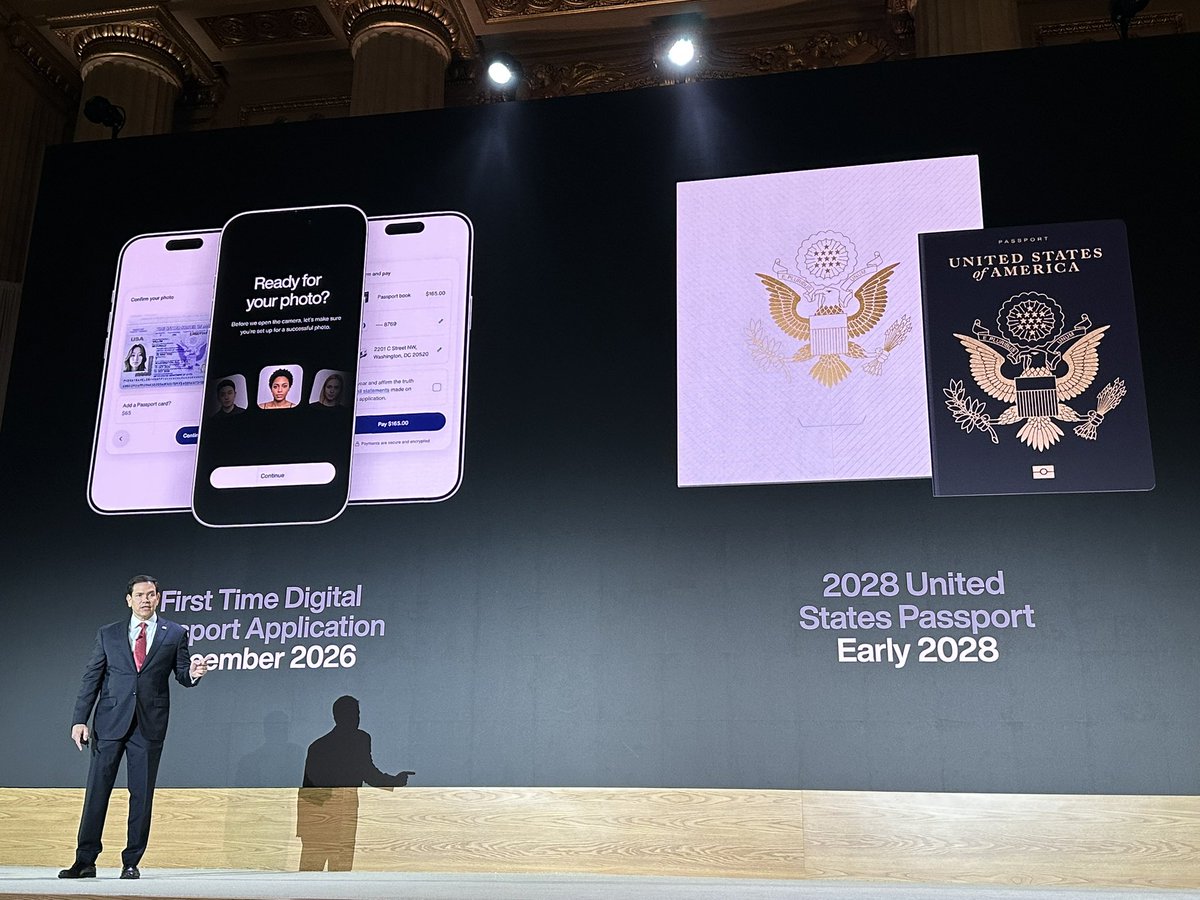
SECRETARY RUBIO on https://t.co/pt9rQXC44r PASSPORTS: No printing forms, no drugstore hostage photo, no appointment, no line, no middleman that you're paying to do something that should be available to you.
Opening access for developers to build Muse connectors. You bring the API -- Muse brings the agent, the browser, and the context of what the person actually wants. People reach your service just by asking for it, and their agent takes it from there.
New connectors are live today. Come build with us. https://t.co/o6oTf1Sj9y
agents dramatically alter even the conceptual notion of moats.
i.e. ui, workflow design, habit, & even brand all drastically lose leverage. the durable layer in the optimistic case becomes data, permissions, proprietary capabilities, distribution, & whatever api surface the agent can’t cheaply repro (which is not a lot).
almost all of software can now be recomposed with or without the permission of the actual software owners. that was never ever the case before.
These memes about the Dangote refinery and fuel trucks being the properties of those that bought shares in the IPO are great for the business!
This sense of collective ownership is what drives patronage, responsibility and accountability of everyone towards the business and ita operations.
This should become the attitude we embrace for the common wealth and the public sector - collective responsibility and demand for accountability.
The international market is loving Nigeria. Macroeconomic stability is the key driver. All we are asking for now is the micro to also align. For the prosperity to be shared.
in the first chapter of healthcare AI, the battleground was access to longitudinal clinical data.
in this next phase, it will be access to biological specimens: tissue, blood, synovial fluid, and other samples containing 1,000× more information, linked to clinical context and longitudinal outcomes.
the winners will be those who can access, assay, and interpret these specimens at the lowest cost and highest resolution.
The first complete, end-to-end fault-tolerant resource estimate for running Shor’s algorithm—the team used IonQ’s Walking Cat architecture to demonstrate how a specific application can be optimized for a trapped-ion quantum computer.
This work concludes that a 20,000-physical-qubit IonQ quantum computer, once developed, is expected to be able to break secp256k1, the 256-bit elliptic curve used by blockchain technology such as Bitcoin, in just under 26 days.
This architectural and resource-estimation study is consistent with IonQ's publicly stated roadmap, which targets systems with the relevant capabilities in the 2028 timeframe.
Watch Chris Ballance share the full view in our livestream today, September 8, at 12:30 PM ET → https://t.co/r5gIYlq5Hj
Read the announcement → https://t.co/d2iEqLV9Pd
Read the full paper → https://t.co/LRf10x3dvd
#IonQ #QuantumIsNow #QuantumComputing #WalkingCat
Medicine is losing its monopoly.
The next 12-24 months could change what American healthcare looks like for decades to come.
This is what's actually going on.
Healthcare had the freedom to behave in a way that'd be impossible for any other business. Prices would increase every year, but the experience got worse.
For comparison, if a restaurant did this, they'd be out of business in a month.
Healthcare could only do it because:
1) There aren't enough doctors and their time is finite
2) The person receiving the care isn't the person directly paying for it
3) You can't opt out of healthcare so you trust it by default
4) Regulations make it extremely hard for new alternatives to compete
With these four together, a customer can't leave and can't look for other options, therefore, they can't lose them so nothing has to improve.
Every one of these four is falling apart:
1) Supply is expanding through AI. Doctors are still scarce, but as AI improves, their scarcity will matter less. Everyone will have a doctor in their pocket that knows everything about them and is available 24/7.
2) People are leaving the payment model because of perverse incentives. They are leaving for telemedicine, peptides, cheaper diagnostics, and they're paying with cash without waiting for approval.
3) The trust is at an all-time low.
4) Regulators can't handle hundreds of thousands of people who have decided their health is their to manage. The rules are chasing people, not vice versa.
The explanation for why the current system isn't adapting could be in Shirky principle: institutions will try to preserve the problem to which they are the solution.
Current healthcare system exists because you can't understand or manage your health independently.
Everything inside the system depends on that staying true.
So when a solution emerges that could make the problem disappear, the system wants to self-preserve so it doesn't adopt it and slows everything down.
Except this time, this isn't working anymore.
The most important skills for using AI coding agents effectively. Presenting the AI Engineering Skills Map for using coding agents. https://t.co/GrEw7wG5Wz
Today, we’re bringing ChatGPT closer to the systems, information, and workflows healthcare teams already rely on. ♥️
We’re introducing a new EHR integration to connect supported Epic environments to ChatGPT and a plugin connecting to nine additional industry data sources.