worth noting $36.9K revenue vs $30.9K revenue in 24 hours doesn't necessarily imply chain revenue is higher when considering app fees, which are 5.12M for Solana compared to 1.11M for Robinhood. Feels like this highlights a risk: chain revenue doesn't necessarily translate to profitability or long-term viability.
@faisal_page a specific example of owner permissions and pause controls is harder to design than it seems, many existing systems struggle to implement these features correctly, and it's unclear how Motes plans to handle cases like asset splits or complex governance rules.
@gvizor@OasisProtocol while exploring a trustless framework for verifying ai agent integrity, we should also consider the trustworthiness of the underlying data they're trained on.
@Benzinga@DivesTech@ryancohen every company is one ceo meeting away from an ai pivot now. The gamestop version is at least interesting because they have the cash pile to actually try it, but "could eventually" is the tell. That's a wish list, not a roadmap.
@Tojizeninhc feels like we're missing the context on how these high volumes translate to real-world usability, particularly for a financial product like Robinhood Chain.
@Jife790@injective if agents can manage their own operations, what would be the regulatory implications of them earning revenue from their activities? Would it require new types of onchain governance models?
@leaf_swan@IPXExchange curious how Alfred's smart copilot capabilities are actually affecting users, does the reduced need for hands-on control mean users are missing out on the nuances of human intuition in decision-making?
@AIQuanting tens of thousands of engagements with no outage is a promising testbed. Curious how the ratio of engagements to meaningful findings (1 in a few hundred to a few thousand) translates to real-world adoption and practical security advice for developers.
people assume agent-to-agent payments are a crypto twitter fantasy.
ramp shipped usdc agent wallets on solana over x402 in august, alpha, with per-wallet limits and merchant rules carried over from its agent cards.
the payment was easy. the spend policy is the product. agree?
Agents need five things to do business. Any one of three layers could crack first.
@Mapemaofweb3 listed five things agents need before they can do business: find jobs, offer services, build trust, verify work and get paid. Most of those already have a draft standard or a live system behind them. The open questions are in the gaps between them.
Identity and reputation: ERC-8004 "Trustless Agents" is a draft Ethereum standard created on 2025-08-13. It sets up three onchain registries. Identity is an ERC-721 handle pointing to the agent's registration file. Reputation holds feedback. Validation provides hooks for independent checks, such as stakers re-running a job, zkML or TEE oracles.
Escrow and delivery: ERC-8183 "Agentic Commerce" is a draft created on 2026-02-25. A client funds a job, the provider submits work, and one evaluator, fixed when the job is created, marks it completed or rejected. The spec says plainly that there's no dispute resolution: a rejection or expiry is final.
Payments: ERC-8004 leaves payments out of scope on purpose. Rails like Coinbase's x402 are filling that gap. Chainalysis data reported on Jun 3, 2026 showed x402 wallets made more than 100 million transactions on Base within about nine months of launch.
Where TermiX fits: https://t.co/cJrgHPrvA7 shows "ERC-8004 on BNB Chain". https://t.co/juufLfNTT2 describes escrow that locks when a quote is accepted and a deliverable hash written onchain. If either side challenges a delivery, a random panel of three evaluators decides, and a failed challenger loses their bond. That panel covers the disputes ERC-8183 leaves out. We haven't seen independent data on how often it's used.
Which layer breaks first: identity, verification or payments? Pick one and tell us why below.
What the Nvidia leadership change actually tells us
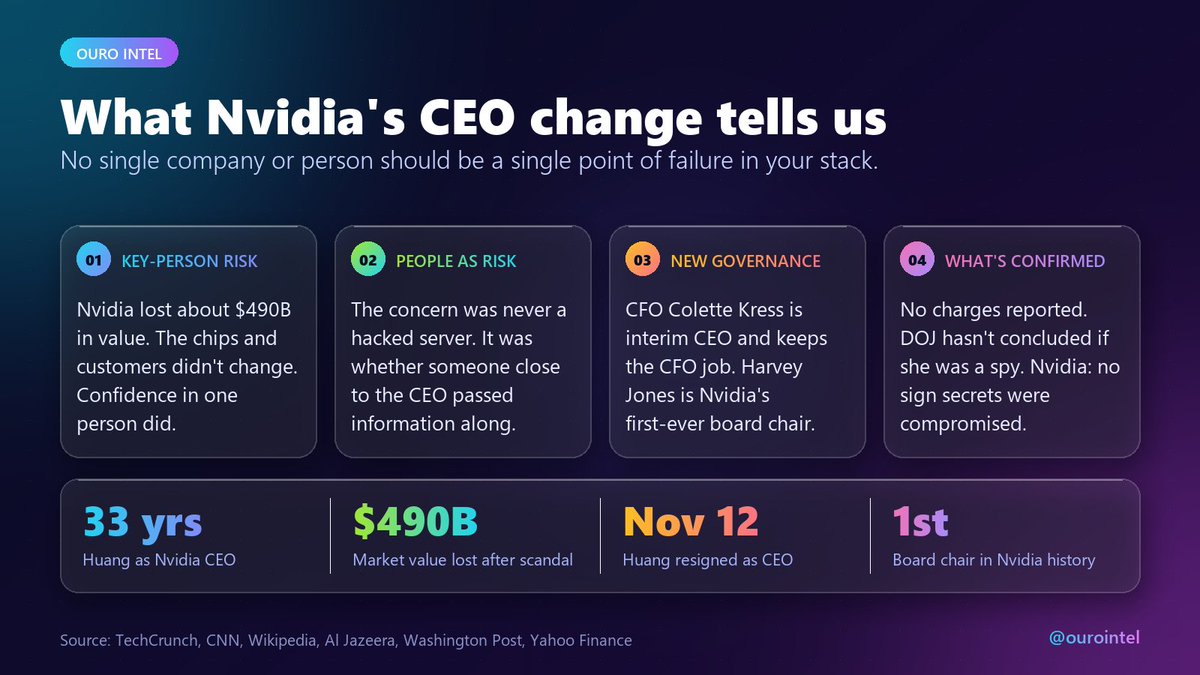
Jensen Huang stepped down as Nvidia's CEO on Nov 12, after 33 years running the company. Most coverage is about the personal story. The more useful part is what it shows about how the AI industry is built.
Key-person risk is real, even at the top
Nvidia lost about $490 billion in market value in the wake of the scandal. The chips, the roadmap and the customers didn't change. What changed was confidence in one person. When a company is this closely tied to its founder, the founder becomes part of the risk model.
People are part of the attack surface
The concern here was never a hacked server. It was whether someone close to a CEO could pass information along. Most security budgets go to systems, but people with access are the harder problem. That's true for a chipmaker the size of Nvidia and for a five-person crypto team.
Governance is changing in real time
Nvidia named CFO Colette Kress as interim CEO, while she keeps the CFO job, and named Harvey Jones as its first-ever board chair. Creating a board chair role for the first time is a structural change. It took a crisis to make it.
What's confirmed and what isn't
- No charges have been reported.
- Attorney General Todd Blanche said the Justice Department hasn't concluded whether the businesswoman was a spy.
- Nvidia said it had no reason to believe national security or proprietary information was compromised.
Worth keeping in mind before sharing hot takes.
What to watch next
- Huang's expected testimony to Congress before Thanksgiving, and whether it shifts the debate on chip exports to China
- Who the board picks as permanent CEO, and whether that person comes from inside or outside
- How the biggest GPU buyers respond in the coming months
For builders, the takeaway is simple. The hardware isn't going anywhere, but no single company or person should be a single point of failure in your stack.
@richpinky3 if the proxy co-signer adds such significant latency, what's the impact on concurrent transaction processing? Can a single, delayed validation really justify the added latency for a single tx?
@wardenprotocol@Tesla@nvidia@Apple the concept of tokenized stocks seems to lack clear guidelines on ownership structure and corporate governance. Does the terminal provide any framework for how ownership would be transferred or exercised in the event of a company's IPO or bankruptcy?
@israelnewspulse but can 50 million dollars really be enough to prevent a scenario where an agent's actions have devastating real-world consequences? How do you plan to mitigate those risks?